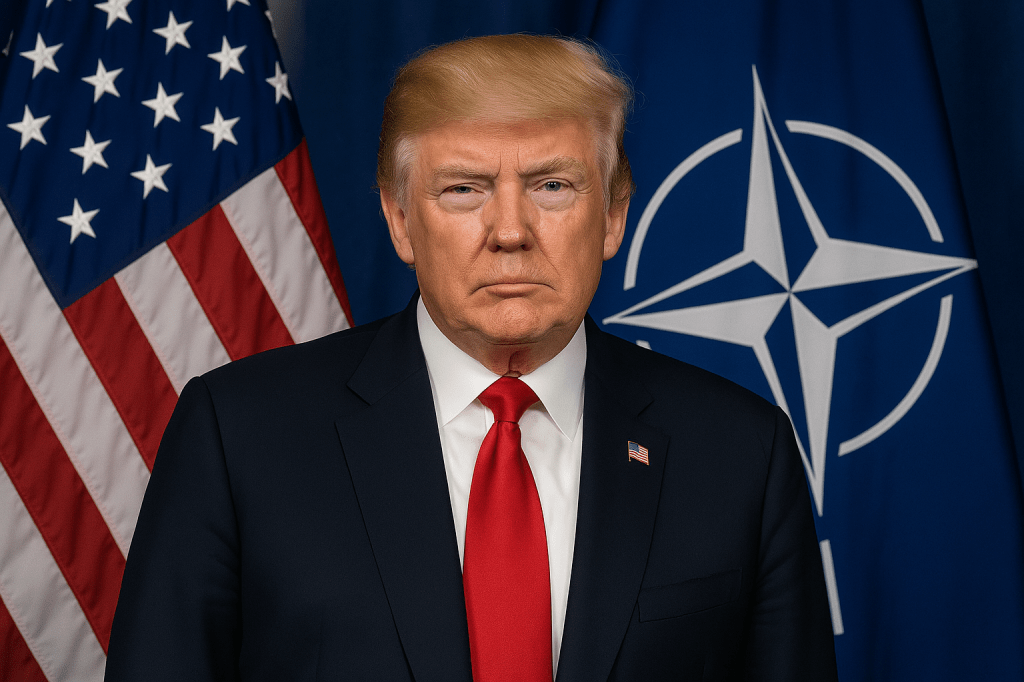
For decades, the United States has been the linchpin of global security, the backbone of NATO, the chief protector of the Pacific, and the ultimate deterrent against authoritarian expansionism. However, recent developments suggest that America’s role as the world’s guardian is eroding—an erosion driven not just by political decisions, but perhaps by a deeper spiritual message that the nation must heed.
A Pattern of Unreliability in U.S. Commitments
The Trump administration’s handling of intelligence sharing with Ukraine has sent shockwaves through allied nations. The sudden suspension of intelligence support to Ukraine, followed by its conditional resumption, has raised concerns about America’s commitment to its allies. While Ukraine’s struggle against Russian aggression continues, the erratic nature of U.S. policy has left NATO nations questioning whether they could face a similar fate.
European nations, sensing the volatility of U.S. policy, are now exploring alternative security arrangements. The European Union is considering expanding its military intelligence capabilities and reducing its reliance on U.S. intelligence. Countries such as France and Germany are leading discussions on an independent European military force—an idea that was once dismissed as politically infeasible but is now gaining momentum.
In the Pacific, America’s key allies—South Korea, Taiwan, and the Philippines—are also recalibrating their defense strategies. South Korea is bolstering regional partnerships, particularly with Japan, in anticipation of a less reliable American presence. Taiwan is actively seeking multilateral security cooperation beyond the U.S., participating in joint military exercises with the Philippines and Japan. Meanwhile, the Philippines is modernizing its military and diversifying its defense partnerships, engaging countries like Australia and Canada in military agreements.
The Breakdown of America’s Global Leadership
This growing shift away from American reliance signals the waning of U.S. global leadership. Allies who once placed unwavering trust in Washington now see the need to hedge their bets. For decades, the U.S. thrived on the strength of its alliances, but as these alliances weaken, so too does America’s influence in global affairs.
Historically, great empires did not fall solely due to external threats but because of internal decay. America’s reluctance or inability to maintain stable commitments to its allies mirrors the decline of past world powers. The erosion of trust in U.S. leadership is not just a political problem—it is symptomatic of deeper issues plaguing the nation.
A Spiritual Message to America
From a biblical perspective, national greatness is not simply a product of military strength or economic prowess—it is tied to moral and spiritual standing. The United States has long claimed to be a nation under God, but its increasing political instability, social divisions, and unreliable leadership may be signs that it is drifting further from divine favor.
The Bible warns that nations that forget God will face decline. The book of Proverbs states,
“Righteousness exalts a nation, but sin is a reproach to any people” (Proverbs 14:34).
When a nation abandons righteousness, its foundations begin to crumble, and its power wanes.
Could it be that God is allowing America’s global dominance to wane as a wake-up call? The moral compass of the nation has shifted dramatically, embracing ideologies and practices that directly contradict biblical values. At the same time, political turmoil and international distrust are rising. The weakening of U.S. leadership should not just be seen as a strategic challenge but also as a spiritual warning.
The Path to Restoration
If America wishes to maintain its standing as a world power, it must look beyond military alliances and strategic policies. The key to lasting strength is not just in political or economic reforms but in a national return to godly principles.
Leaders must recognize that power without righteousness is fleeting. The nation must prioritize integrity, justice, and moral leadership if it hopes to remain a stabilizing force in the world. This requires not only changes in governance but also a revival of spiritual commitment among its people.
America’s allies are preparing for a world where the U.S. is no longer the primary protector. If this trend continues, the United States will find itself increasingly isolated, no longer at the helm of world affairs. This should be a sobering reality for American leaders, but also an opportunity—a moment to turn back to God, to seek His guidance, and to reestablish itself as a force for good in the world.

Leave a comment