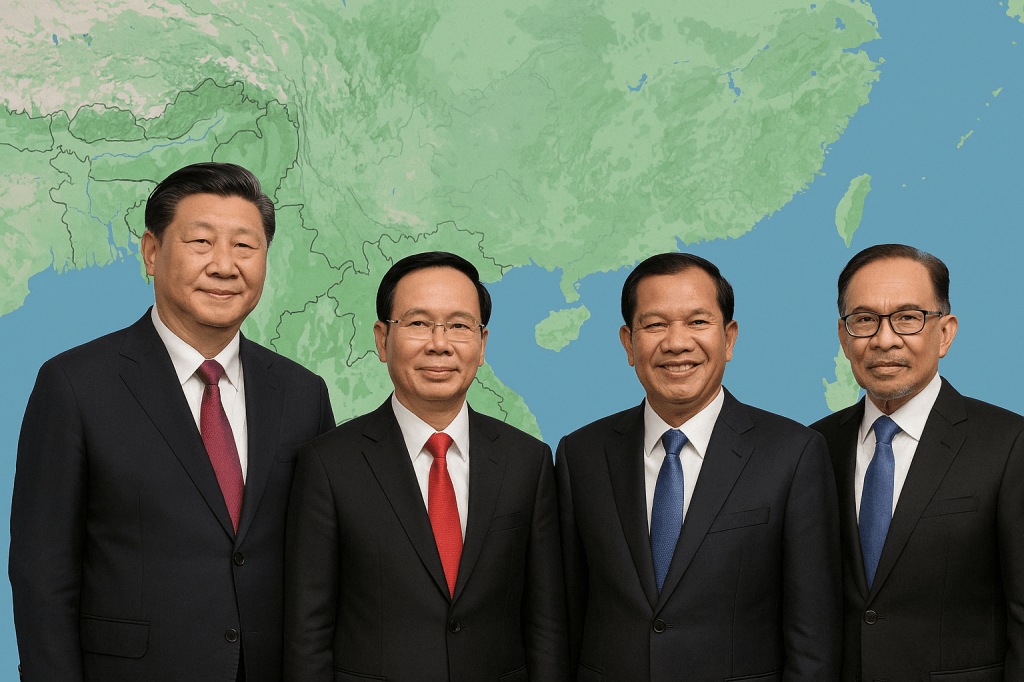
As tensions between the United States and China continue to escalate—particularly in the realm of trade and technology—Beijing is quietly laying the groundwork for a long-term economic strategy that could reshape the power dynamics of Asia. At the center of this push is President Xi Jinping’s ongoing tour of Southeast Asia, visiting Vietnam, Malaysia, and Cambodia—a move that signals China’s growing focus on emerging Asian markets and a future less dependent on the U.S.-led global economy.
Xi Jinping’s Southeast Asia Tour: A Strategic Reconnection
This week, Xi Jinping undertakes his first overseas diplomatic trip of 2025, traveling to:
- Vietnam (April 14–15)
- Malaysia (April 15–17)
- Cambodia (April 17–18)
These visits are not merely ceremonial. They are a calculated move to strengthen China’s economic and political influence in its immediate neighborhood, particularly at a time when the United States is entangled in its own domestic political volatility and global alliances are being tested by tariff wars and foreign policy shifts.
In Vietnam, Xi is engaging in high-level talks to promote infrastructure development and defense cooperation—areas that are traditionally seen as sensitive due to Vietnam’s balancing act between China and the West. In Malaysia, discussions center on bolstering trade and increasing Chinese investment in manufacturing and digital technology sectors. And in Cambodia, where China already enjoys significant influence, the visit is expected to deepen long-standing ties and further integrate the two economies.
The Next Stops: Indonesia and Central Asia?
Beyond this week’s tour, there are strong indicators that Indonesia may soon be on Xi’s diplomatic radar. A recent phone call between Xi and Indonesian President Prabowo Subianto reaffirmed both nations’ commitment to expanding their strategic partnership, particularly in light of the 75th anniversary of diplomatic ties.
Likewise, Central Asia—including Kazakhstan, Kyrgyzstan, Tajikistan, Turkmenistan, and Uzbekistan—remains a critical focus area. China is set to host the next China–Central Asia Summit, following a successful inaugural meeting in Xi’an in 2023. These engagements are part of a broader effort to secure alternative supply chains, new energy corridors, and infrastructure links under the Belt and Road Initiative (BRI).
The Bigger Picture: Preparing for a Post-American Trade Order
While the immediate economic benefits of these engagements may not yet be dramatic, their geopolitical implications are far-reaching. China is methodically building a regional trade network that is resilient and increasingly self-sufficient. This will become critically important as the American economic system continues to display signs of instability, especially as economic policy in the US increasingly sways with every change in presidential administration.
As the US imposes erratic tariffs, wavers on global commitments, and faces rising internal polarization, China is presenting itself to its neighbors as a stable, long-term economic partner—offering infrastructure, financing, and market access.
A Prophetic Pattern: Toward a Unified Eastern Bloc
What we are witnessing could be the early stages of economic and political unification across Asia, aligning China, Russia, and eventually other major Asian economies such as Japan and South Korea. Although Japan and South Korea remain closely aligned with the United States for now, the erosion of American credibility and consistency may eventually drive them to seek more reliable trade partnerships within the region.
This shift is not only geopolitical—it also fits a prophetic pattern long observed in Bible prophecy. Scripture describes the rise of Eastern powers—”kings from the east” (Revelation 16:12)—who will play a pivotal role in end-time events. The Bible also indicates that the dominant economic force of the end times will not be the Anglo-American system but a revived European power bloc. As the United States and its allies fade in influence—whether by internal collapse or external exclusion—the stage is being set for an economically unified Asia, possibly in loose collaboration with or in tension against a dominant European superstructure.
The World Is Rebalancing
Xi Jinping’s current diplomatic maneuvers are not isolated events—they are the latest in a strategic chess game, one that aims to secure China’s leadership role in a post-American, multi-polar global economy. These new alliances and trade relations, especially with Asia’s emerging markets, serve as a foundation for resilience and independence in a world where U.S. leadership is no longer guaranteed.
The world is rebalancing. For those watching closely—and for students of both geopolitics and prophecy—these developments underscore a profound truth: nations rise and fall according to a divine timetable, and the shifts we are seeing today may well be part of a larger unfolding narrative foretold long ago.

Leave a comment