
The war in Ukraine is reshaping global alliances, military capabilities, and geopolitical expectations—but perhaps nowhere more profoundly than in Europe. While the United States continues to play an important role in Ukraine’s defense, its support under the Trump administration has become more measured, transactional, and at times uncertain. Into this vacuum has stepped a more assertive, rapidly maturing European military framework—one that is not just reacting to Russia, but preparing to stand on its own.
From Steadfast Ally to Strategic Partner: The U.S. Shifts Gear
Since 2022, the United States has supplied Ukraine with a formidable array of weapons, intelligence, and training. Systems like the HIMARS rocket launchers—short for High Mobility Artillery Rocket System, a highly mobile and precise long-range rocket artillery platform—Patriot missile defense batteries, Javelin anti-tank missiles, and real-time satellite surveillance have been game-changers on the battlefield. But since 2024, U.S. support has become increasingly conditional and strategically leveraged, with aid packages paused or tied to diplomatic objectives—such as ceasefire compliance or debt repayment proposals.
This has caused anxiety in Kyiv and among NATO allies, highlighting the risks of over-reliance on a single, politically dynamic superpower. In response, Europe has not just filled the gap—it has transformed the challenge into an opportunity.
Europe’s Arsenal Awakens: Compatible Yet Competitive
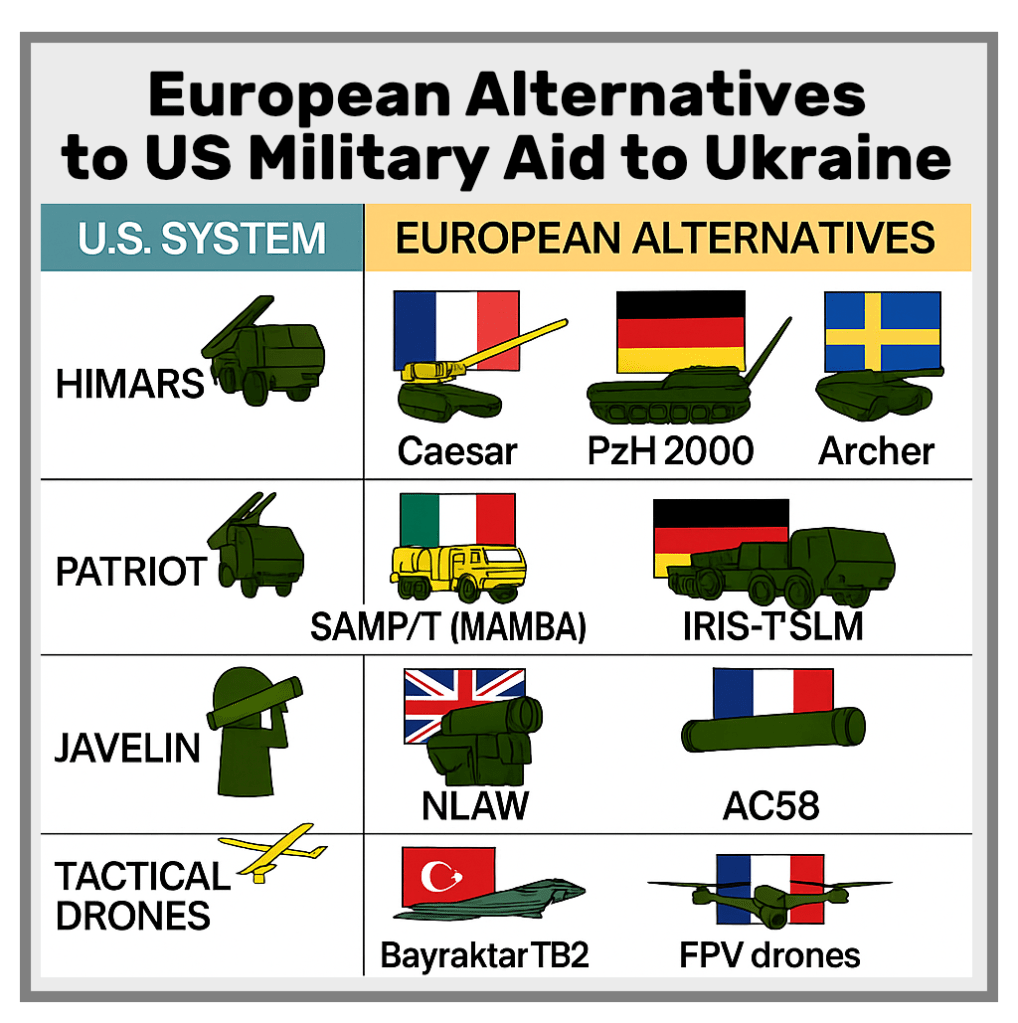
European nations are rolling out a new generation of weapons systems—interoperable with NATO standards, but increasingly independent of U.S. designs.
In the field of long-range precision artillery and rockets, Europe is deploying systems like the German PzH 2000, the French Caesar, the Swedish Archer, and a European variant of the Multiple Launch Rocket System (MLRS). These alternatives offer firepower and accuracy that rival the U.S. HIMARS, with rapid deployment capabilities and growing battlefield efficiency.
In air defense, the European SAMP/T (Mamba)—short for Sol-Air Moyenne Portée/Terrestre, a medium-range surface-to-air missile system developed by France and Italy—Germany’s IRIS-T SLM—InfraRed Imaging System Tail/Surface Launched Medium-range, a cutting-edge ground-based air defense system—and the UK’s Sky Sabre are all emerging as powerful complements—and in some cases, future replacements—for the U.S. Patriot systems. These European systems are improving in range, reliability, and interoperability, proving effective in live combat scenarios.
Anti-tank warfare is another area of parity. The British NLAW—short for Next generation Light Anti-tank Weapon, a shoulder-fired, disposable missile system designed for use by infantry against armored vehicles—and French Eryx are proving to be cost-effective, easily deployed, and tactically agile alternatives to the U.S. Javelin. Though Javelin still leads in range and target-lock capabilities, European systems are preferred in close-quarter operations.
On the drone front, while the U.S. dominates with Switchblade and Phoenix Ghost drones, Europe—along with Türkiye—is catching up. The Bayraktar TB2—a medium-altitude, long-endurance unmanned combat aerial vehicle (UCAV) developed by Türkiye for reconnaissance and precision strikes—supplemented by rapid innovation in FPV (first-person view) drones—small, manually piloted drones equipped with cameras and often used as loitering munitions—along with loitering drone tech from Poland and Ukraine, shows Europe’s ability to adapt and mass-produce effective UAV solutions.
Europe is also developing its own surveillance and battlefield coordination systems. France’s CERES—short for Capacité de Renseignement Électromagnétique Spatiale, a constellation of French military satellites for electronic intelligence—and the EU Satellite Centre are improving regional intelligence capabilities, although still not at par with U.S. global intelligence networks. Meanwhile, European C4I (Command, Control, Communications, Computers, and Intelligence) systems are being refined for NATO compatibility and AI-assisted command structures.
These tools are not just theoretical—they are being live-tested on Ukrainian soil, under the harshest real-world conditions. Field results are feeding directly into Europe’s growing defense research, industrial production, and doctrine refinement.
Learning the Russian Way of War: A Crash Course in Deterrence
Beyond hardware, European forces are gaining unprecedented insight into Russian military doctrine and operational behavior:
- Strengths: Effective use of artillery saturation, trench warfare, and electronic warfare (EW); increasing drone adaptability.
- Weaknesses: Rigid command structure, poor logistics, morale problems, and ineffective air-ground coordination.
European observers and trainers embedded with Ukrainian units have seen these dynamics up close, allowing them to adapt faster than in any traditional training scenario. In effect, the war has become a real-time strategic classroom.
And this learning is being added on top of decades of exposure to U.S. military technology, tactics, and interoperability standards. The result is a fusion: a uniquely European doctrine that integrates NATO compatibility with localized resilience, battlefield adaptability, and self-reliance.
A New European Military Order Emerges
Europe is no longer merely a supporting actor in NATO—it is becoming a strategic force in its own right. This is evident in:
- The €800 billion “ReArm Europe” initiative, pooling defense investment across the continent.
- The Coalition of the Willing, a group of 30+ nations ready to back Ukraine with military and peacekeeping forces, regardless of Washington’s direction.
- The EU Strategic Compass and PESCO (Permanent Structured Cooperation, a framework for EU member states to collaborate more closely on defense projects and initiatives) provide the backbone for long-term continental defense planning., providing the backbone for long-term continental defense planning.
More significantly, these steps represent a strategic pivot: from transatlantic dependence to continental autonomy, with the potential to stand alone—not just against Russia, but any global threat.
Europe as a Global Power
From a biblical and prophetic standpoint, this development is particularly striking. The Bible speaks of a final world power rising out of Europe, described in the book of Daniel and the Revelation as a “beast” system of immense influence—politically, economically, and militarily.
In that light, the consolidation of Europe’s military might—sparked by Russia’s war, accelerated by U.S. disengagement, and refined by real-world learning—takes on profound significance. What we are witnessing may well be the emergence of the military dimension of that prophesied power.
A military that was once fractured, slow, and dependent is now becoming agile, well-informed, technically sophisticated, and integrated—not only in doctrine and equipment but in strategic vision.
The Furnace That Forges
As U.S. assistance to Ukraine becomes more measured and transactional, Europe has not only risen to meet the challenge—it is turning the war in Ukraine into the forge of a new military identity. What began as a stopgap has become a transformation.
Europe is no longer just learning from the U.S.—it is learning from the enemy, innovating from within, and evolving into a deterrent force that could, one day, rival any military on Earth.
The fire of war is forging Europe’s future—and with it, the world’s direction.

Leave a comment