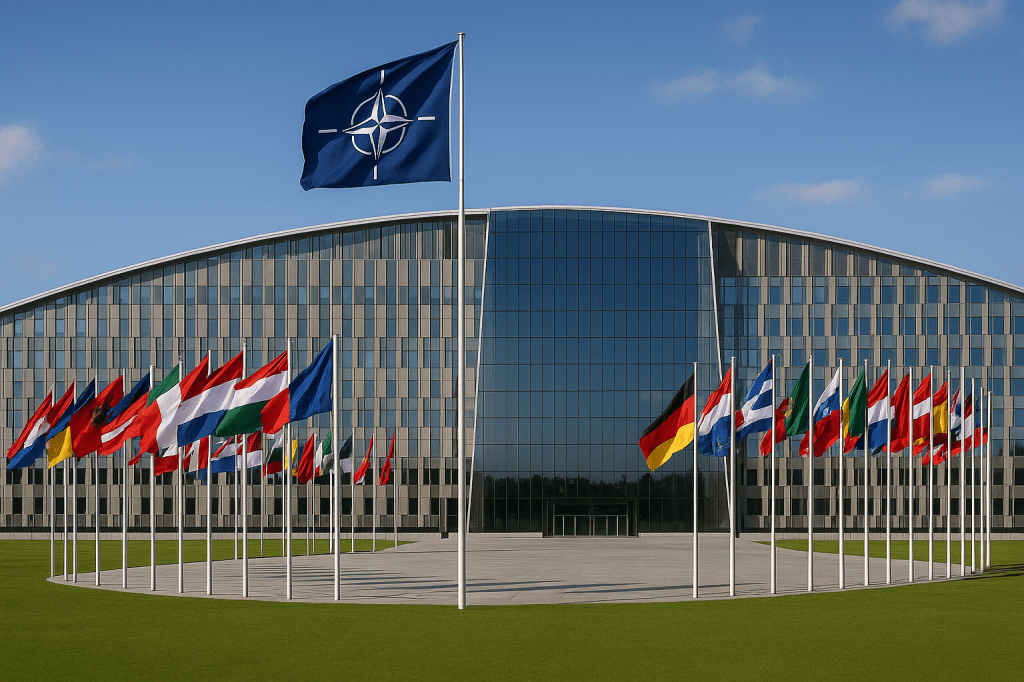
The recently concluded 2025 NATO Summit in The Hague delivered a bold slate of commitments and strategic recalibrations. Dominated by landmark decisions and cautiously visionary declarations, the alliance appeared to chart a confident path forward. But beneath the surface, the tectonic plates of transatlantic security are beginning to shift—with Europe increasingly preparing for a future where the United States may no longer stand as the guarantor of its defense.
A Bolder NATO: Spending and Strategy
Among the most significant developments was the collective agreement to raise defense spending to 5% of GDP by 2035. Of this, 3.5% will go toward core military capabilities, while 1.5% is earmarked for broader security priorities such as infrastructure protection, cybersecurity, and supply chain resilience. This dramatic increase is not just symbolic. It reflects a long-standing frustration within NATO—particularly from Washington—that European members have lagged in their defense obligations. Now, with geopolitical tensions escalating and American leadership less predictable, Europe is stepping up.
NATO also unveiled its first-ever Commercial Space Strategy, signaling a new frontier in collective defense. This move formalizes plans to integrate private-sector space capabilities—such as satellite surveillance and communication systems—into military operations. An implementation roadmap is set to be approved by NATO defense ministers later this year.
Meanwhile, the alliance pledged renewed emphasis on cyber defenses, hybrid warfare preparedness, and the protection of critical infrastructure, areas of vulnerability increasingly targeted by state and non-state actors alike. These measures aim to increase the resilience of NATO members not only in wartime scenarios but also in persistent gray-zone conflicts where ambiguity and digital disruption reign.
Another noteworthy agenda item was NATO’s intent to deepen partnerships with Indo-Pacific allies, particularly Japan, South Korea, and Australia. As China grows bolder and more assertive, NATO is reimagining its role beyond the Euro-Atlantic region. Strategic dialogues, joint exercises, and cooperative defense initiatives are expected to strengthen the global architecture of democratic security.
In addition to its Indo-Pacific focus, NATO also reaffirmed Ukraine’s right to defend itself against Russian aggression. However, the alliance stopped short of making a formal, organization-wide commitment to provide military aid. Instead, several major NATO members—such as the United Kingdom, Germany, and France—pledged individually to support Ukraine materially. This fragmented approach highlights the alliance’s internal divisions and the geopolitical complexities of coordinating unified action in a time of shifting power dynamics.
The Elephant in the Room: America’s Unsteady Hand
But for all the summit’s optimism and resolve, a quiet anxiety lingered: What if the United States steps back?
President Donald Trump, back in office for a second non-consecutive term, has repeatedly linked American military support to transactional calculations. He has questioned whether U.S. involvement in NATO should persist if other members don’t “pay their fair share.” More alarmingly for Europe, his administration has refused to frame Russian aggression as a fundamental threat unless it directly endangers U.S. security.
This sentiment is not mere rhetoric. At the summit, Trump reiterated that America’s strategic choices will be tied to whether European crises touch American soil or interests. Such framing has left many European leaders uncertain about Washington’s reliability in a scenario where, say, Russia invades another European country not named Ukraine. The United States offered no significant new commitments to Ukraine at the summit, choosing instead to emphasize that existing aid would continue for the time being. The message was clear: while support is not being withdrawn, future assistance will depend heavily on whether Ukraine’s struggle is perceived to affect core American security interests.
Europe’s Quiet Fallback Strategy
In response, Europe is slowly but deliberately laying the groundwork for strategic autonomy. Initiatives such as the European Sky Shield Initiative, Permanent Structured Cooperation (PESCO), and the EU’s Strategic Compass are not duplicating NATO but rather hedging against its potential dysfunction.
These projects are gradually increasing the EU’s independent capabilities in missile defense, cyber operations, logistics coordination, and rapid deployment. Bilateral agreements are proliferating among European states. Defense industries are being consolidated. Command and control structures are being adapted for interoperability across both NATO and EU frameworks.
In effect, Europe is designing a plug-and-play security architecture: integrated with NATO when the U.S. remains committed, and seamlessly adaptable to EU leadership should American engagement falter. While legal, logistical, and political hurdles remain, the trajectory is clear.
The Coming European Power Bloc
From a biblical prophetic perspective, these developments echo a long-foretold transition. The Bible describes a time when a powerful European entity—”the beast” of Revelation 17 and Daniel 7—will rise as a dominant geopolitical and military force, independent of American support. This power, led by a coalition of ten kings or leaders, will wield economic, military, and moral influence on a global scale.
The current cracks in NATO and Europe’s accelerating drive toward defense autonomy may well be early signs of this shift. America’s declining reliability is not simply a political story; it is part of a divine pattern that Scripture warns about. The weakening of transatlantic bonds is setting the stage for a new global order, one in which Europe stands alone, assertive, and significant.
A New Order Taking Shape
The 2025 NATO Summit may be remembered not only for its bold declarations on spending, space, and cyber readiness, but also for what it quietly signaled: that the ground under NATO is shifting. Europe is awakening to the reality that its long post-war dependence on American might is unsustainable.
While Europe cannot yet defend itself alone, the groundwork is being laid. And according to biblical prophecy, the time is coming when it will not only be capable but destined to do so. In this light, today’s NATO is not a final structure but a transitional one—a fading vestige of an old world order giving way to a very different and more prophetic future.

Leave a comment