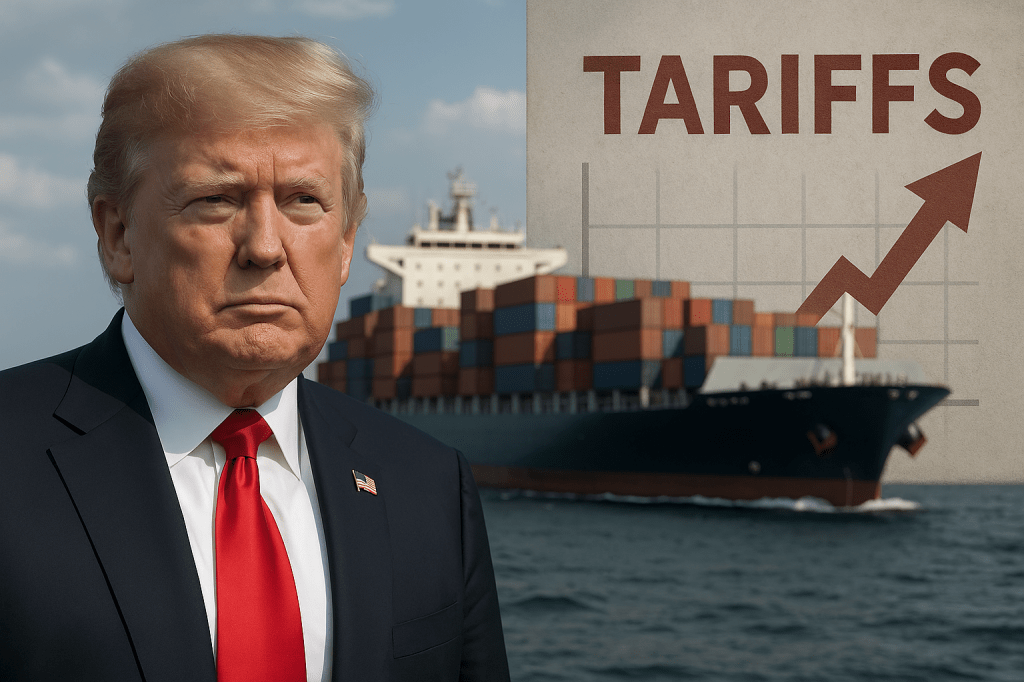
This week, President Donald Trump announced a sweeping new wave of tariffs targeting BRICS nations—Brazil, Russia, India, China, and South Africa. In a move reminiscent of his first-term trade policies, but now more aggressive and broadly applied, Trump proposed tariffs of up to 50% on imports from nations that do not have free trade agreements with the United States. Since none of the BRICS countries fall under such agreements, the move is widely interpreted as a direct economic strike on the bloc.
The rationale? According to administration officials, the policy is meant to “protect American industries from unfair foreign competition” and “punish nations that exploit the U.S. market while refusing to reciprocate.” However, behind the veneer of economic nationalism lies a far more dangerous outcome: a widening geopolitical chasm that could transform economic rivals into strategic enemies.
Tariffs That Unite the Disparate
The BRICS alliance, though often riddled with internal differences, has always shared one common trait: dissatisfaction with the post-WWII U.S.-led world order. But internal contradictions—between India and China, or Brazil and Russia’s conflicting economic models—have often limited deeper integration. That may now be changing.
By targeting all BRICS nations simultaneously, the U.S. has given them something they previously lacked: a unifying adversary. These tariffs are not just duties on goods—they are perceived as blows against sovereignty, development, and fair participation in the global system.
Rather than bringing these nations to heel, the new policy will likely yield the opposite result:
- China will retaliate economically while accelerating its efforts to establish yuan-based trade systems with BRICS and Global South nations.
- Russia, already isolated by the West, will use this as further justification to deepen ties with Beijing, New Delhi, and even Brasília.
- India, long cautious about getting too close to China, may still choose to increase intra-BRICS trade and reassert its role in leading a “non-aligned but assertive” bloc.
- Brazil, responding to Trump’s tariffs, has announced it will impose reciprocal tariffs beginning August 1, framing them as political retaliation tied to domestic tensions surrounding former President Bolsonaro.
- South Africa and other African nations will rally around the BRICS cause, framing the U.S. as a self-interested hegemon unwilling to make space for emerging powers.
A Warning Ignored
There is a vivid parallel in the Bible that offers a lesson to today’s world leaders. When Rehoboam, son of King Solomon, ascended the throne, he was faced with a divided kingdom. The northern tribes of Israel were already weary of heavy taxation and burdens imposed under Solomon’s rule. The elders wisely counseled him to speak kindly to the people and lighten their load:
“If you will be a servant to these people today… and speak good words to them, then they will be your servants forever.” (1 Kings 12:7, NKJV)
But Rehoboam arrogantly rejected their advice. Instead of gentleness, he chose threats:
“My father made your yoke heavy, but I will add to your yoke; my father chastised you with whips, but I will chastise you with scourges!” (1 Kings 12:14, NKJV)
The result? The ten northern tribes rebelled and formed their own kingdom, permanently dividing Israel.
President Trump, like Rehoboam, had a unique opportunity to drive wedges between BRICS nations by offering friendlier trade terms to democratic and more market-oriented members like India, Brazil, and South Africa. That would have deepened the existing ideological and economic divides within the bloc. Instead, his administration has chosen a path of blanket hostility, treating all BRICS members as equally hostile, and thereby giving them reason to unite.
The Proverbs of Diplomacy
This is no isolated lesson. The Bible offers enduring insight into the nature of conflict and influence:
“A soft answer turns away wrath, but a harsh word stirs up anger.” (Proverbs 15:1, NKJV)
“By long forbearance a ruler is persuaded, and a gentle tongue breaks a bone.” (Proverbs 25:15, NKJV)
“A man who is kind benefits himself, but a cruel man hurts himself.” (Proverbs 11:17, ESV)
Aggression rarely wins allies. The harsh and punitive path may feel strong, but it often produces resistance, not respect. In today’s case, it may result in a stronger, more focused BRICS alliance motivated not by shared ideology—but by shared opposition.
Coercion Over Persuasion
The United States, by its sheer size and influence, still has the ability to build coalitions or break them apart. But diplomacy—like leadership—requires wisdom. Trump’s tariff policy has chosen coercion over persuasion, and bluntness over nuance. Rather than weakening BRICS, it could very well solidify it.
Rehoboam’s mistake split a kingdom. If today’s leaders are not careful, similar arrogance could divide the world—and leave America with more rivals, fewer allies, and a weakened voice in shaping the future global order.

Leave a comment