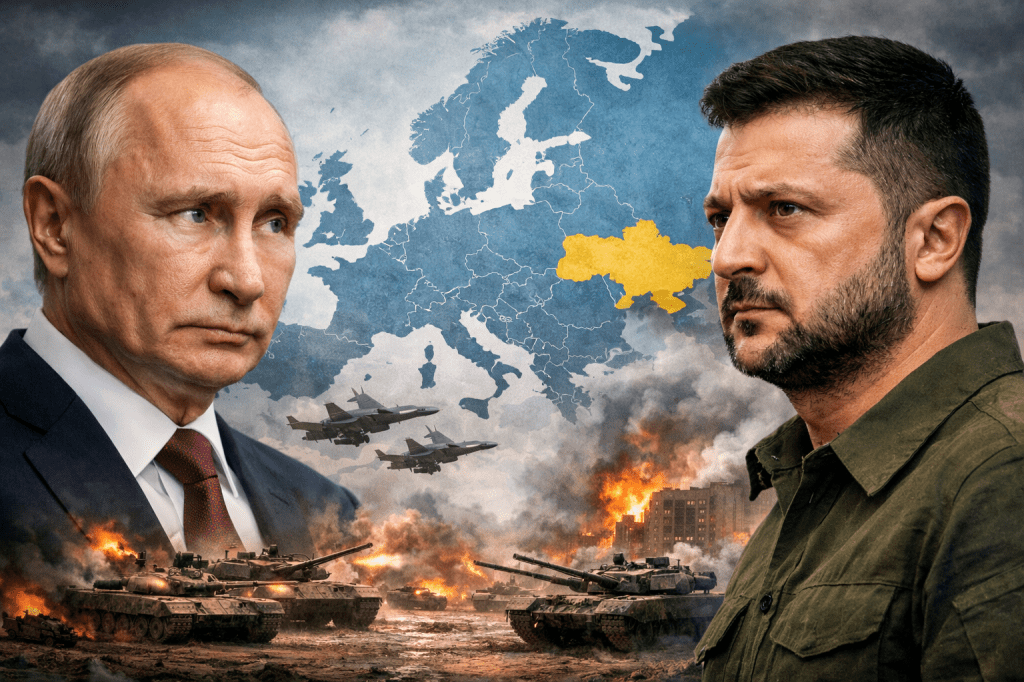
History rarely turns on a single battle. More often, it turns on leadership—how power is exercised, how truth is handled, and how people are motivated when the cost becomes unbearable. The ongoing war between Russia and Ukraine is a vivid example. While weapons, manpower, and alliances matter greatly, the leadership styles of the two presidents involved are shaping the direction of this conflict in ways that may reach far beyond Eastern Europe.
This is not merely a geopolitical struggle. It is a reminder that God rules in the affairs of men (Daniel 4:17), raising up leaders—wise or foolish, strong or weak—to accomplish His purposes.
Two leaders, two radically different approaches
On one side stands Vladimir Putin, a leader who governs through centralization, control, and fear. Power flows upward. Information flows downward—filtered, curated, and often softened to avoid displeasing the top. Loyalty is prized more than candor. This style has served Putin well in consolidating political power over decades.
On the other side is Volodymyr Zelensky, whose leadership has evolved dramatically under fire. His approach is more distributed. He relies heavily on professional military advice, encourages honest feedback, and communicates openly with both his people and Ukraine’s allies. His authority rests less on fear and more on legitimacy and shared purpose.
These differences do not determine who will “win” the war—but they strongly influence how the war unfolds.
Leadership shapes direction, not destiny
Wars are not decided by leadership style alone. Geography, industrial capacity, alliances, and sheer numbers still matter. Russia has greater manpower and resources, and it remains possible—even likely—that it will emerge from this war with some territorial gains.
Yet leadership influences critical factors that accumulate over time:
- Learning speed: Systems that punish bad news adapt slowly. Systems that tolerate honesty adjust faster.
- Morale and endurance: Fear can compel obedience, but meaning sustains sacrifice.
- Alliance management: Transparency builds trust; opacity erodes it.
Ukraine’s resilience—its refusal to collapse under pressure—has surprised much of the world. That resilience is not accidental. It flows from a leadership style that rewards initiative, accepts responsibility, and shares risk with the population.
Russia, by contrast, has relied on coercion and narrative control. That approach can sustain effort—but it struggles to correct mistakes quickly. Over long wars, such rigidity becomes costly.
God’s hand over national leadership
Scripture reminds us that God both appoints and removes leaders:
“He changes times and seasons; He removes kings and raises up kings” (Daniel 2:21).
This applies not only to righteous rulers, but also to flawed and even oppressive ones. God used Pharaoh, Nebuchadnezzar, Cyrus, and others—each very different in character—to accomplish His will.
The contrast between Putin and Zelensky should not be viewed merely as democracy versus authoritarianism, or good versus evil in simplistic terms. Rather, it is another reminder that God allows leadership styles to expose national strengths and weaknesses, often preparing the stage for larger events yet to come.
Ukraine’s influence on Europe’s future
Regardless of how the war ends territorially, Ukraine has already changed Europe.
Its steadfastness has:
- Ended decades of European complacency
- Reawakened military preparedness
- Hardened attitudes toward coercion and appeasement
Europe is moving—slowly but unmistakably—toward a more unified and force-ready posture. This matters prophetically.
Bible prophecy indicates that a powerful leader will arise in Europe, one who will dominate the world scene for a short but intense period (Daniel 11; Revelation 13). This leader will not be timid. He will act decisively, militarily, and without the restraint that has characterized post–World War II Europe.
Ukraine’s resistance may well shape the environment that produces such a leader—one forged in a Europe that has learned, painfully, that peace cannot rest on wishful thinking alone.
A sobering prophetic possibility
It is striking that biblical prophecy suggests a future European power that will not fear confrontation with Russia, even to the point of invasion when it serves his purposes (Daniel 11:44). While Scripture does not give all details, it does show that geopolitical power shifts dramatically at the end of this age.
The current war does not fulfill these prophecies outright—but it conditions minds and institutions. It teaches Europe to think in terms of force, resolve, and preemptive action. Leadership styles matter here. Ukraine’s example reinforces the idea that survival favors decisiveness, unity, and readiness to act.
Trajectory
Leadership does not decide wars by itself—but it sets their trajectory. Putin’s style has produced endurance through control. Zelensky’s has produced resilience through shared purpose. Both are being used—knowingly or unknowingly—within God’s greater plan.
For students of prophecy, this war is not just about borders. It is about preparation—of nations, leaders, and peoples—for events that Scripture tells us are coming.
As Christ Himself warned, “See that you are not troubled; for all these things must come to pass” (Matthew 24:6).
The task of God’s people is not fear, but understanding—and faith in the One who truly governs the nations.

Leave a comment