
The recent U.S. invasion of Venezuela and the capture of its sitting president, Nicolás Maduro, marks a watershed moment in international affairs. Regardless of one’s view of Maduro’s character or governance, the action itself forces an uncomfortable question: What happens when the world’s most powerful nation abandons moral ascendancy in favor of brute force?
President Donald Trump justified the operation primarily on the grounds that Maduro and elements of the Venezuelan state were allegedly complicit in drug trafficking that fuels America’s addiction crisis. On the surface, this sounds decisive. Yet even U.S. data and decades of experience show that America’s drug problem is overwhelmingly demand-driven, not supply-driven. Remove one conduit, and another quickly takes its place.
This suggests that drugs were less the true cause than the public rationale—a moral narrative used to legitimize a far more consequential act.
The Net Effect: A World More Dangerous, Not More Orderly
The most serious consequences of the invasion are not confined to Venezuela. They ripple outward, weakening already-strained international norms and emboldening other powers to act with fewer restraints.
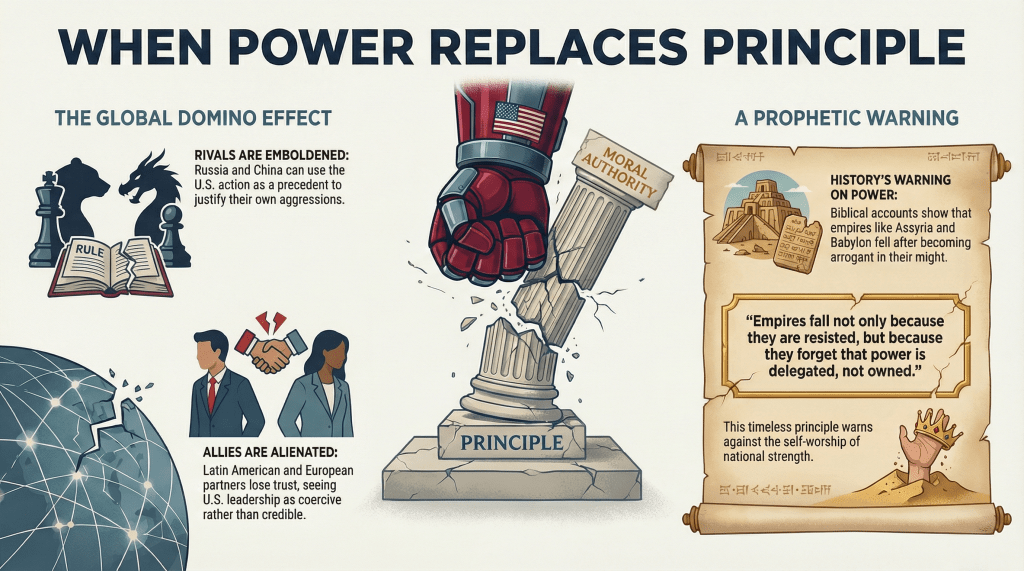
Russia and the “Precedent Problem”
Russia has long sought rhetorical cover for its invasion of Ukraine. The U.S. action in Venezuela now supplies it. If Washington can unilaterally invade a sovereign state, capture its leader, and claim criminality as justification, Moscow can argue that its actions against Ukraine—or even a future attempt to “arrest” or assassinate Volodymyr Zelenskyy—are merely variations of the same principle.
Legally and morally, this argument is weak. But geopolitics is rarely governed by fine legal distinctions. What matters is precedent, and precedents lower the cost of future aggression.
China and Taiwan
China has been more restrained in tone, but the lesson it draws is clear. If sovereignty can be overridden by unilateral claims of security or criminality, then the barrier protecting Taiwan grows thinner. The Venezuela invasion reinforces Beijing’s long-standing claim that global rules are selectively applied and therefore disposable.
When moral consistency disappears, restraint soon follows.
Fractures Closer to Home
The effects are not limited to rival powers.
Across Latin America, resentment is growing. Governments find themselves pressured—implicitly or explicitly—to align with Washington regardless of domestic opinion or national interest. The old fear of being treated as a sphere of influence rather than a community of sovereign states is being revived.
Meanwhile, America’s European allies are uneasy. Europe has historically been more willing to follow U.S. leadership when that leadership rested on moral credibility and respect for international norms. Power exercised through threat and force may compel short-term compliance, but it corrodes long-term trust. Allies who follow out of fear tend to drift away when alternatives appear.
A Biblical Pattern Too Often Forgotten
Scripture does not deny that God uses nations to judge other nations. In fact, it states this plainly.
God used Assyria to punish the northern tribes of Israel for idolatry and injustice. Yet Assyria’s error was to believe its military success proved its own righteousness. God’s response was severe:
“Shall the axe boast itself against him that heweth therewith?” (Isaiah 10:15)
Likewise, God used Babylon, under King Nebuchadnezzar, to correct Judah. But Babylon too crossed the line—from instrument to idolater of power—and was judged for its arrogance, cruelty, and self-worship.
In both cases, God made the same point: He may use power, but He does not endorse pride.
The Warning for Our Time
America’s action against Venezuela may yet serve a purpose in God’s sovereign plan. Scripture shows that God can and does judge nations through other nations. But Scripture also warns that nations which worship their own strength, trust in military might, and refuse to acknowledge God’s supremacy do not escape judgment themselves.
Empires fall not only because they are resisted, but because they forget that power is delegated, not owned.
The lesson of Assyria and Babylon is not ancient history—it is living prophecy. When moral authority is abandoned and force becomes the primary language of leadership, the world does not become safer. It becomes more lawless.
And lawlessness, Scripture tells us, always carries a cost.

Leave a comment