
Over the past several years, a noticeable shift has taken place in the foreign policy of the United States under the Trump administration. This shift marks a departure from the post–World War II framework that guided American engagement with the world for decades—a framework often described as “liberal internationalism”.
Understanding this change is important not only geopolitically, but also morally and biblically.
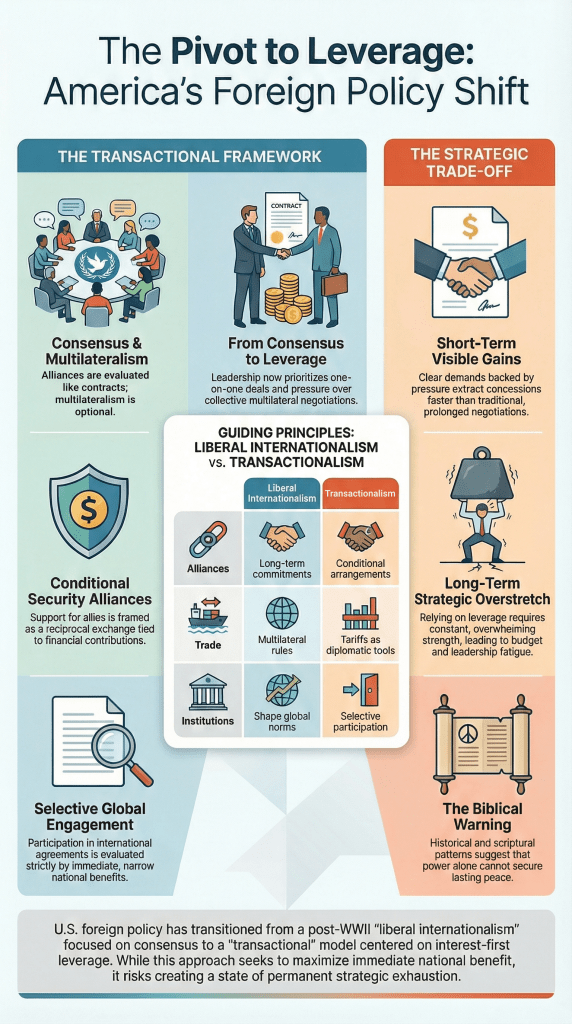
From Consensus to Transaction
For much of the postwar era, American foreign policy emphasized consensus-building. Alliances were treated as long-term commitments, multilateral institutions were used to shape global norms, and leadership was exercised by persuading others that American interests broadly aligned with international stability.
The Trump administration has taken a different approach—one that is more transactional, unilateral, and interest-first. Several concrete examples illustrate this shift:
Alliances as conditional arrangements
Security commitments, particularly within long-standing alliances, are increasingly tied to burden-sharing and financial contribution. Support is framed less as a shared obligation and more as a reciprocal exchange.
Tariffs and trade as diplomatic tools
Economic pressure—especially tariffs—is used directly to compel behavior, sometimes even against allies, rather than relying primarily on multilateral trade rules or coordinated economic frameworks.
Selective engagement with international institutions
Participation in global agreements and organizations is evaluated narrowly through immediate national benefit. When institutions are seen as constraining U.S. freedom of action, withdrawal or disengagement is treated as a legitimate option.
Bilateral pressure over multilateral coordination
Diplomacy increasingly favors one-on-one deals where American leverage is maximized, rather than collective negotiation where compromise and shared restraint are required.
Taken together, these actions represent a move away from leadership through consensus and toward leadership through leverage.
Short-Term Advantages
In the short term, this approach can produce visible gains.
Clear demands backed by pressure can extract concessions more quickly than prolonged negotiation. Allies and adversaries alike face fewer ambiguities about U.S. expectations. At the same time, the approach appears to promise fewer foreign entanglements, freeing resources for domestic priorities such as economic stability, infrastructure, and internal security.
To many observers, this looks like a restoration of national strength and focus.
The Long-Term Risks
Yet this posture carries serious long-term risks.
A transactional foreign policy only works if strength is constant—politically, economically, and militarily. When cooperation depends less on shared norms and more on pressure, any sign of weakness invites challenge. Rivals probe, allies hedge, and crises multiply.
Ironically, rather than reducing commitments, this approach often forces the United States into a permanent state of strategic alert. Multiple regions require attention at once. Military readiness must be maintained everywhere. Diplomatic energy becomes reactive rather than preventative.
What appears to save resources in the short term can, over time, sap national power. Constant war-footing strains budgets, exhausts leadership, and fuels domestic fatigue. History suggests that great powers are not undone by a single defeat, but by prolonged overstretch and internal division.
A Biblical Warning Worth Remembering
Scripture shows that this pattern is not new.
God warned ancient Israel that continued rebellion would not result in isolated problems, but in pressure from many directions at once:
“They shall besiege you at all your gates until your high and fortified walls… come down.” (Deuteronomy 28:52, NKJV)
Later, the result was summarized simply:
“The LORD sold them into the hand of their enemies all around.” (Judges 2:14, NKJV)
When Israel turned away from God, He did not need to create new enemies. He withdrew protection—and pressures converged naturally. There was no single front to manage, no isolated crisis to contain.
The Enduring Lesson
The lesson for modern nations is not that military strength is unimportant, but that power alone cannot secure lasting peace. A nation that relies primarily on leverage must always maintain overwhelming strength—and history shows that such a condition cannot be sustained indefinitely.
Foreign policy reflects deeper moral and spiritual realities. When a nation seeks security without righteousness and order without obedience, it often finds itself surrounded by problems rather than relieved of them.
The warning God gave to ancient Israel still applies today: Strength may delay consequences but only repentance and wisdom can prevent them.

Leave a comment