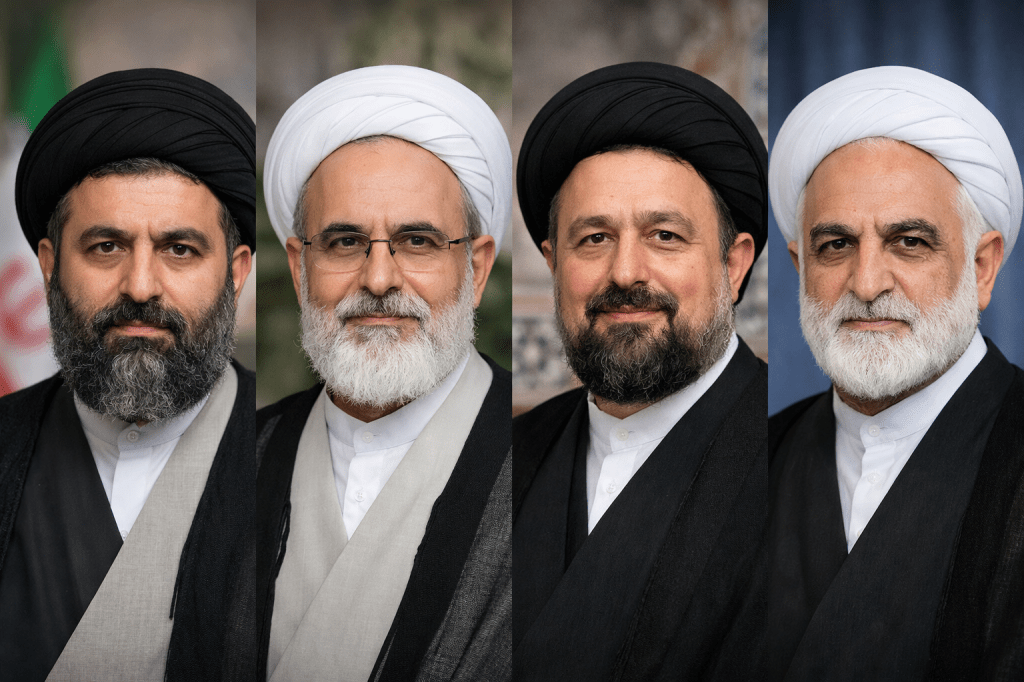
The passing of Iran’s Supreme Leader, Ayatollah Ali Khamenei, will mark one of the most important turning points in the Middle East in decades. For more than thirty years, Khamenei has been the central figure guiding the Islamic Republic’s ideology, security policy, and regional strategy. Whoever succeeds him will inherit a system that is far more pressured—economically, politically, and strategically—than it was during the early years of his rule.
Under Iran’s constitution, the next Supreme Leader will be chosen by the Assembly of Experts, a body of clerics responsible for selecting the country’s highest authority. In reality, however, the decision will likely reflect the balance of power among several key institutions—particularly the clerical establishment and the Islamic Revolutionary Guard Corps (IRGC), which has become one of the most powerful forces in Iran’s political and economic life.
Several figures are commonly mentioned as possible successors.
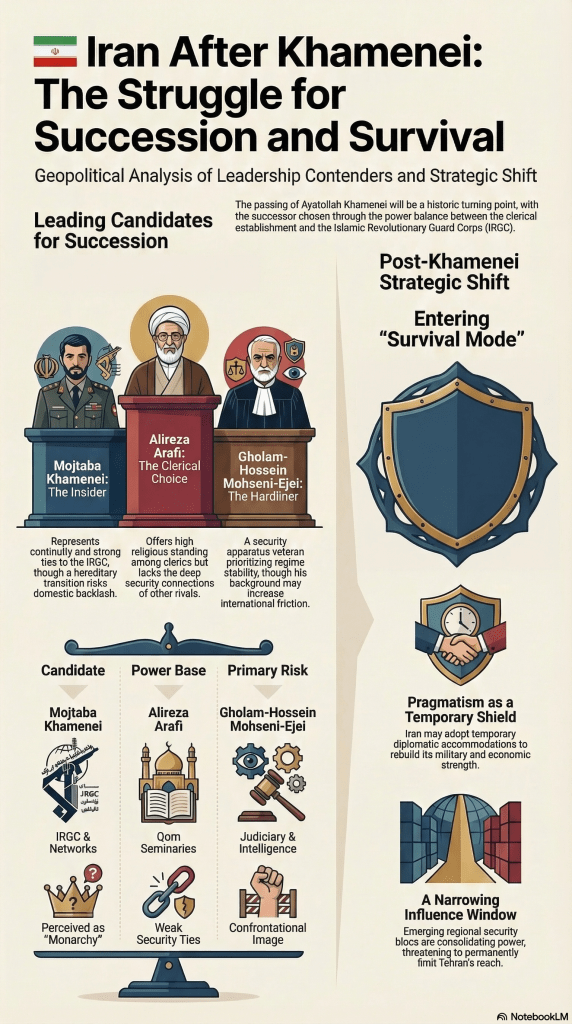
Mojtaba Khamenei: The Insider
One of the most discussed candidates is Mojtaba Khamenei, the son of the current Supreme Leader. Although he has never held major public office, he is believed to have cultivated strong ties with the Revolutionary Guards and conservative political networks.
His main advantage would be continuity. Many within the regime might view his leadership as a way to preserve the existing power structure and ensure a stable transition. However, a father-to-son succession would raise uncomfortable comparisons with the monarchy that Iran’s 1979 revolution overthrew. Some clerics also question whether Mojtaba possesses the religious stature expected of a Supreme Leader.
Alireza Arafi: The Clerical Establishment
Another possible candidate is Ayatollah Alireza Arafi, a senior cleric associated with Iran’s seminaries in Qom. Arafi represents the traditional religious institutions that form the ideological foundation of the Islamic Republic.
His strength lies in his religious credentials and standing among clerics. Choosing him could reaffirm the Islamic character of the regime. Yet he lacks the deep political and security connections that other contenders may have, which could make it harder for him to secure broad support within the power structure.
Hassan Khomeini: The Revolutionary Legacy
Hassan Khomeini, the grandson of Ayatollah Ruhollah Khomeini—the founder of the Islamic Republic—also appears periodically in succession discussions. His family name carries enormous symbolic weight within Iran.
Some see him as a figure who could reconnect the regime with the original spirit of the revolution while moderating some of its harsher policies. However, his perceived openness to reform makes hardline factions wary of his leadership.
Gholam-Hossein Mohseni-Ejei: The Security Establishment
Another possible successor is Gholam-Hossein Mohseni-Ejei, Iran’s current chief justice and a long-time figure in the country’s security apparatus. His background in intelligence and internal security gives him credibility with hardline factions that prioritize regime stability above all else.
But his association with the security establishment may reinforce Iran’s confrontational image abroad and could complicate any attempt to ease tensions with other states.
A Leadership in Survival Mode
Whoever becomes Iran’s next Supreme Leader will face a far more constrained environment than his predecessors. Iran’s economy remains under heavy sanctions, domestic dissatisfaction periodically surfaces, and several regional powers have strengthened cooperation to counter Tehran’s influence.
For these reasons, Iran may find itself entering a period of strategic retrenchment. The next leader may focus less on expanding regional influence and more on preserving the stability of the regime at home.
In effect, Iran could operate in survival mode—prioritizing economic stabilization, avoiding major wars, and maintaining internal control.
Pragmatism as a Temporary Strategy
Even leaders associated with ideological hardline positions may find themselves adopting pragmatic policies. Temporary accommodations with regional rivals or global powers could become necessary if they help stabilize Iran’s economy and reduce external pressure.
Such pragmatism would not necessarily signal a permanent change in Iran’s long-term ambitions. Instead, it could serve as a strategic pause—allowing the country to rebuild its economic and military strength before attempting once again to expand its influence in the Middle East.
A Narrow Window
If Iran hopes to regain that influence, it may have only a limited window of opportunity. Several regional states are increasingly cooperating in security, technology, and economic initiatives. If this emerging bloc consolidates its power, it could make it far more difficult for Iran to project influence beyond its borders.
The next Supreme Leader may therefore feel pressure to act quickly to preserve what remains of Iran’s strategic position before the regional balance of power shifts even further.
A Changing Middle Eastern Order
These developments suggest that the Middle East may be moving toward a new geopolitical order. The rivalries and ideological conflicts that have dominated the region for decades may gradually give way to new alignments based on economic power, security cooperation, and technological competition.
From a biblical perspective, these trends are especially intriguing. The gradual consolidation of power among certain Middle Eastern states could be laying the groundwork for what the Bible describes in Daniel 11 as the rise of the “king of the south.”
While the precise form of that power remains to be seen, the shifting alliances and emerging blocs now taking shape across the region may represent early steps toward the geopolitical configuration that biblical prophecy anticipates.

Leave a comment