Category: Asia

  • Europe’s Anxiety Over the East—and What Prophecy Says

    Europe’s Anxiety Over the East—and What Prophecy Says

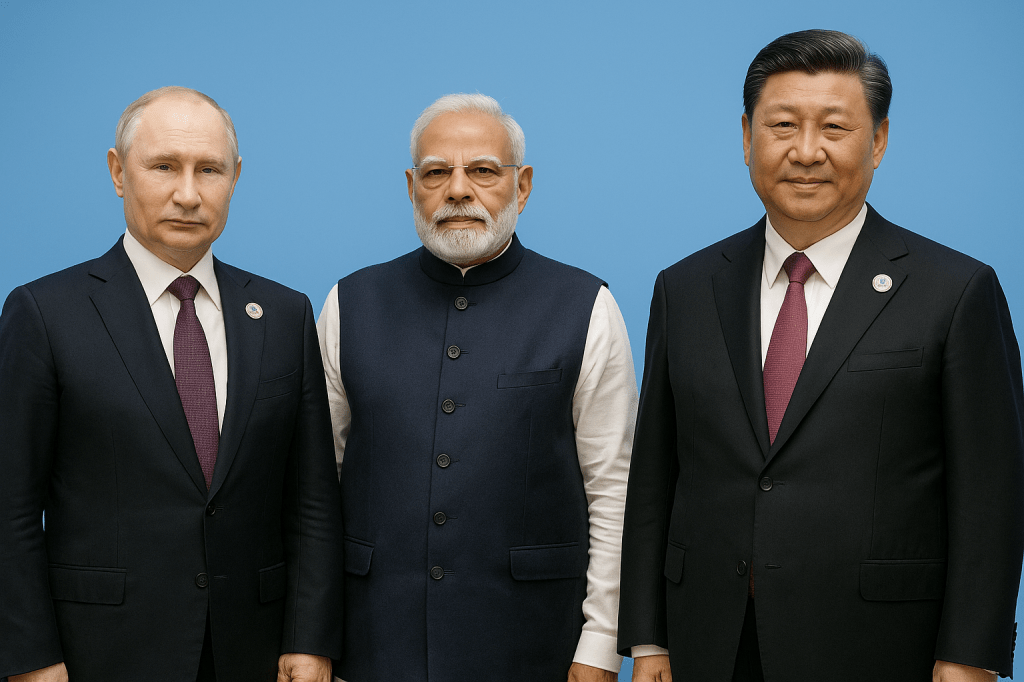
    The European Union is sounding alarms over an alignment taking shape in the East. At recent summits—such as the Shanghai Cooperation Organisation (SCO) meeting in Tianjin and the Beijing summit hosted by President Xi—China, Russia, and India signaled a willingness to deepen cooperation—militarily, economically, and diplomatically. For Brussels, this looks like a rival pole to the West’s influence.

    Brussels Speaks Out

    Commission President Ursula von der Leyen has warned at a summit in Beijing that EU–China ties have reached an “inflection point” because of the growing cooperation between China, India, and Russia (Financial Times, July 2025). High Representative Kaja Kallas has accused Beijing of enabling Russia’s war machine (MERICS report, 2025). Reports highlight India’s purchases of Russian oil and abstentions on UN votes as proof that New Delhi is hedging its bets.

    In short, Europe sees a triangle of Moscow, Beijing, and Delhi chipping away at Western unity—especially as sanctions on Russia leak eastward.

    What the EU Is Doing

    Brussels isn’t sitting idle. It has:

    • De-risked supply chains—passing laws to reduce dependency on Chinese critical materials.
    • Launched trade defenses—raising tariffs on Chinese electric vehicles, probing subsidies in wind turbines, and barring Chinese medical-device suppliers.
    • Strengthened sanctions enforcement—targeting shadow fleets and middlemen moving Russian energy.
    • Rearmed its defense base—through the €800-billion “ReArm Europe” program.
    • Courted India—via trade talks, tech councils, and alternative trade corridors.

    The strategy: blunt the impact of a tightening Moscow–Beijing–Delhi alignment while rebuilding Europe’s own economic and military muscle.

    Prophetic Perspective

    Students of Bible prophecy see in these moves echoes of an ancient forecast. Scripture foretells a revived Roman system in Europe—many see its early form in today’s EU—and an eastern coalition that will one day rise to confront it.

    Revelation 9:13-19 speaks of a war killing a third of humankind through an army “two hundred million” strong. While the Bible does not name today’s nations, the picture of eastern powers uniting and clashing with a European bloc foreshadows the very trends now unfolding.

    God will allow this to happen to call mankind to repentance, as He makes us realize that human governments apart from Him and His way of life cannot bring peace.  Shortly after this, after more severe events occur, Jesus Christ will return to establish God’s kingdom, ruling all nations under righteous rule. (Isaiah 2:1-4)

  • Why Europe—not America—is Poised to Become the West’s Hub for Advanced AI Chips

    Why Europe—not America—is Poised to Become the West’s Hub for Advanced AI Chips

    Despite the U.S.–China tech rivalry, the center of gravity for the West’s most advanced compute is drifting toward Europe in the long term. The reasons are practical—policy, supply-chain physics, and industrial base—and, for those of us who read the Bible’s prophecies, they also fit the end-time alignment in which a revived European power rivals a vast Asian coalition while America declines.

    The inflection now: “Sovereign AI” lands in Europe

    In mid-2025, Nvidia’s push for “sovereign AI”—each nation owning its models and compute—found especially fertile ground in Europe. EU leaders publicly embraced the idea and began backing massive, local AI capacity, including a plan for four “AI gigafactories” and a large 18,000-GPU build with French champion Mistral.

    At the same time, Europe is already hosting some of the world’s most capable AI-ready supercomputers under the EuroHPC program:

    • JUPITER (Germany) — built on ~24,000 Nvidia GH200 Grace Hopper superchips; Europe’s fastest system and its first exascale-class machine.
    • MareNostrum 5 (Spain) — Europe’s newest pre-exascale facility, with accelerated partitions used for AI work.
    • Leonardo (Italy) — ~13,824 Nvidia A100 GPUs on a BullSequana platform at CINECA.

    Alongside these deployments, the EU Chips Act commits €43 billion in public investment (with matching private capital) to strengthen Europe’s semiconductor ecosystem and reduce external dependencies.

    Bottom line: Europe is not just buying chips; it is deliberately localizing compute, policy, and industry to anchor AI at home.

    Why the hub is unlikely to remain in America in the long-run

    1. Export controls that fragment allied access – Recent U.S. rules on advanced AI chips and even model weights introduced tiered access inside the EU, granting some member states frictionless imports while forcing others into licensing regimes. That touched a nerve in Brussels and in national capitals because it splits the single market and turns compute into a diplomatic lever. This has already triggered European calls for more autonomous, EU-based capacity.
    2. Europe is the world’s chokepoint for the tools that make cutting-edge chips – ASML (Netherlands) is the sole supplier of EUV lithography, the tool family required to print the most advanced chips. That unique leverage—and the next High-NA EUV generation now shipping—gives Europe structural power in any Western supply-chain redesign.
    3. Manufacturing & packaging are moving onto European soil – While Nvidia remains fabless, its critical suppliers are expanding in Europe:
    • TSMC broke ground on ESMC—a Dresden fab with Bosch, Infineon, and NXP—and is opening a design center in Munich to support European customers.
    • Intel is advancing an assembly & test site in Wrocław, Poland, a key step in building an EU packaging base for advanced devices.
    • Amkor (a major OSAT partner to many chip designers) runs a packaging/test campus in Portugal, part of a broader European push into advanced packaging.

    4. The regulatory superpower effect – From the AI Act to the DMA/DSA, the EU consistently sets rules that global firms end up following. “Sovereign AI” plus European standards naturally pulls high-end compute into Europe so governments and companies can comply, train local-language models, and keep sensitive datasets under EU jurisdiction. (Nvidia is already tailoring offerings to this need.)

    Taken together: the politics (export uncertainty), the tools (ASML), the money (EU Chips Act), and the physical footprint (fabs + packaging + supercomputers) all point to Europe consolidating as the West’s home base for advanced AI infrastructure.

    “What could push this over the line?” — plausible chain of events

    • A supply-shock scare in East Asia (even weeks): Any Taiwan-Strait disruption would amplify the logic of placing more advanced packaging and system-integration in Europe—closer to sovereign AI customers and the EU’s legal/regulatory center. (Europe is already scaling exascale systems and courting multiple suppliers.)
    • Another round of U.S. export policy whiplash: If allied access again becomes conditional or transactional, EU policymakers will double-down on local capacity and procurement rules that require EU-built stacks for state and critical-infrastructure AI.
    • Ecosystem gravity: With JUPITER, MareNostrum 5, and Leonardo already training European models, follow-on clusters, specialist ASIC deployments (e.g., Groq for inference), and EU-only datasets will pull developers, service firms, and venture capital toward Europe’s compute hubs.

    Through the prophetic lens

    Scripture shows that just before Christ’s return, a revived Roman system rises as a dominant power while “kings of the East” form a counter-bloc (Dan. 2; Rev. 13; 17; 16:12). America, the British Commonwealth, and the modern descendants of Judah decline under God’s corrective hand—not annihilation, but discipline leading to repentance (Lev. 26; Hos. 5:5; 11:7; Amos 3:1–2). In that end-time landscape, it is coherent that the world’s decisive technologies—and the economic/administrative muscle that goes with them—shift to Europe (with Asia rivaling it), while the U.S. loses primacy.

    Technology doesn’t save or condemn; it reveals where power concentrates. Today’s movements in compute sovereignty, chip tools, and supply chains match the geopolitical map the Bible sketches for the end of the age.

    What to watch next (practical signposts)

    1. European capacity mandates in public procurement (e.g., “EU-built hardware for sovereign AI contracts”).
    2. HBM & advanced-packaging ramps in the EU (announcements, hiring, MW-scale campuses).
    3. ASML High-NA EUV rollout cadence and who gets priority tools.
    4. EuroHPC upgrades and national AI “gigafactory” awards (Germany/France/Italy/Spain consortia).
    5. U.S. export-control tweaks that re-tier EU access (or replace tiers with bilateral deals).

    Force of Gravity

    Even as U.S.–China rivalry dominates headlines, the Western hub for frontier AI hardware is gravitating toward Europe—by design and by necessity. For policy and industry, this is about sovereignty and resilience. For those of us who study prophecy, it is one more stepping-stone toward the world the Bible describes: a powerful European bloc facing a consolidated Asian power, while America is humbled to repentance—just before Christ returns.

  • The Battle for the West Philippine Sea: Why the EU is Stepping Forward

    The Battle for the West Philippine Sea: Why the EU is Stepping Forward

    On July 22, 2025, Philippine President Ferdinand Marcos Jr. met with U.S. President Donald Trump at the White House to reinforce economic and military ties between their two countries. The visit culminated in a high-profile agreement that introduced a 19% U.S. tariff on Philippine exports in exchange for zero tariffs on American vehicles and parts, certain agricultural products and pharmaceuticals entering the Philippines. While some critics argue that the Philippines is getting the shorter end of the stick in this trade arrangement, the reality is more nuanced: the Philippines managed to secure concessions similar to or slightly better than those granted to other Southeast Asian nations such as Vietnam and Indonesia, though it still fell short of the far more favorable terms negotiated by Japan. But beyond the trade negotiations, the more pressing development was the renewed emphasis on joint security. The two leaders committed to expanding the Enhanced Defense Cooperation Agreement (EDCA), establishing new naval repair facilities in Palawan, and reaffirming that any attack on Philippine assets in the West Philippine Sea (WPS) would trigger American support under the Mutual Defense Treaty.

    While these moves project strength, they also expose an emerging geopolitical gap: the long-term sustainability of U.S. leadership in Asia. As Washington becomes increasingly preoccupied with domestic challenges and global overstretch, Europe—especially the European Union—will have to prepare to take a more proactive stance in securing vital global commons, including the WPS.

    Why the West Philippine Sea Matters Globally

    The WPS, part of the broader South China Sea, is not merely a regional concern. It is a critical artery for international trade:

    • Over 30% of the world’s shipping, valued at more than $3 trillion annually, passes through these waters.
    • Key goods—from energy supplies to high-tech components—transit routes that connect East Asia with Europe, the Middle East, and Africa.
    • The seabed is believed to contain vast reserves of oil and natural gas, making it a major energy frontier.

    For the EU, whose economic engine thrives on global commerce, any disruption in the WPS would create devastating ripple effects across its member states. France, Germany, the Netherlands, and Italy all rely on uninterrupted access through these lanes to sustain their export-heavy economies.

    The U.S. as Present Guarantor—But for How Long?

    For now, the U.S. remains the strongest military power in the Indo-Pacific and the principal guarantor of free access to the WPS. American naval operations, such as Freedom of Navigation Operations (FONOPs), continue to challenge China’s expansive claims.

    However, the sustainability of this leadership is in question. Economic strains, political polarization, and the growing appeal of isolationist policies suggest that America’s global commitments may continue to shrink. In a future where Washington withdraws, who ensures that vital sea lanes remain open?

    Why the EU is Preparing to Secure the WPS

    1. Trade Dependence: Nearly 40% of the EU’s external trade moves through the South China Sea. Control or disruption of this route by China would allow it to economically coerce Europe.
    2. Strategic Credibility: If the EU seeks to become a global superpower, it must demonstrate the ability to project power and protect its interests far beyond its borders. Inaction in the WPS would reveal a lack of strategic autonomy.
    3. Legal and Moral Leadership: The EU champions the rules-based international order, especially UNCLOS. Yielding to Chinese hegemony in the WPS would undermine its commitment to international law.
    4. Asian Partnerships: Europe is deepening ties with Indo-Pacific countries, including Japan, India, and ASEAN states. Active involvement in ensuring freedom of navigation in the WPS will solidify its standing in the region.

    Steps the EU Is Taking

    At the recent 2025 EU Summit in Brussels, leaders agreed on a number of critical initiatives:

    • Creation of a Permanent Indo-Pacific Naval Task Group, spearheaded by France, Germany, and Italy, with rotational patrols planned for 2026.
    • Enhanced Military Cooperation with ASEAN nations, including maritime surveillance and joint training exercises.
    • Strategic Investments in Defense Production and Blue-Water Naval Capabilities, to ensure operational reach in the Indo-Pacific.
    • Intelligence-Sharing Agreements with Japan and the Philippines aimed at countering disinformation and tracking Chinese maritime movements.

    These developments represent a significant shift in the EU’s global posture. While not yet capable of replacing the U.S., the EU is beginning to prepare for a world in which it may have to act independently.

    East vs. West and the Philippines in the Middle

    From a biblical standpoint, the rise of a European-centered global power is not unexpected. The Bible foresees a final world superpower described as a “beast” rising out of the sea (Revelation 13:1), a union of nations centered in Europe. As it rises, it will eventually clash with a coalition of eastern powers, including nations historically associated with “the kings of the east” (Revelation 16:12).

    In such a scenario, the Philippines—geographically and strategically situated between China and the Western Pacific—would find itself at the intersection of a great geopolitical conflict. Its alliance with the U.S., and potentially with the EU in the future, makes it a key outpost in a looming confrontation between East and West.

    A Call to Strategic Vigilance

    The recent Marcos-Trump meeting underscores that the Philippines is not blind to the growing tensions in the West Philippine Sea. Yet the sustainability of American guarantees is not forever assured. The EU, slowly but surely, recognizes that its preparations for global leadership hinge on its willingness to secure the global commons.

    The West Philippine Sea is a fulcrum of future power dynamics. The EU will have to ensure it plays a defining role in keeping it free—not only for the sake of trade and legal norms but to attain its goal of becoming a central actor on the world stage. The Philippines, meanwhile, will have to brace for the storms ahead.

  • Between Giants: Australia’s Delicate Balancing Act in a Fracturing World

    Between Giants: Australia’s Delicate Balancing Act in a Fracturing World

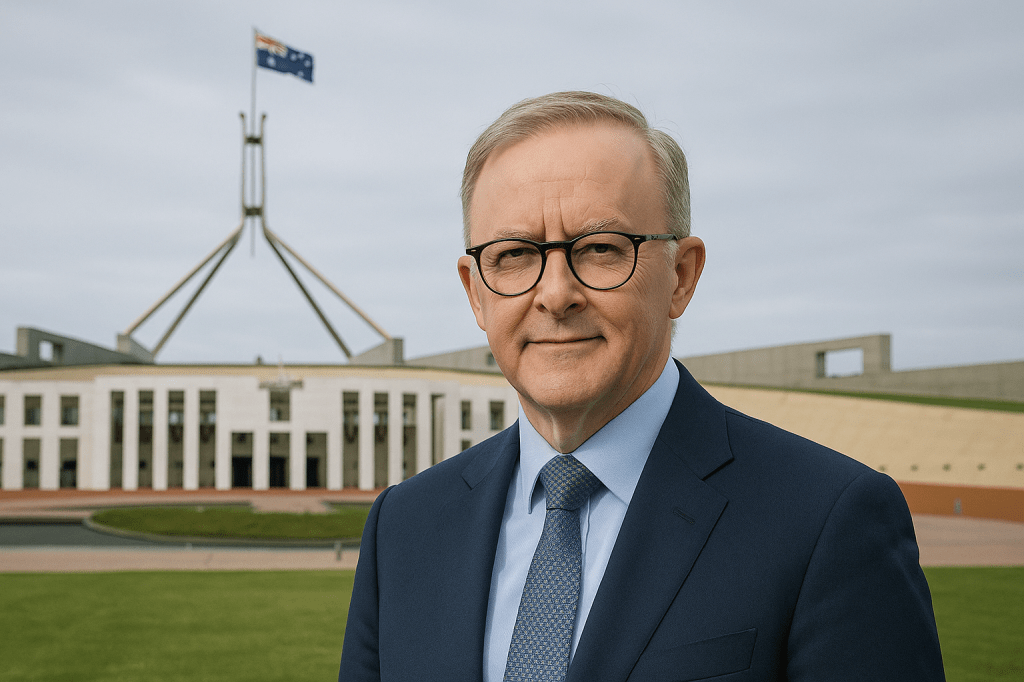
    The 2025 Australian federal elections have delivered a resounding mandate to Prime Minister Anthony Albanese and the Labor Party, marking a significant moment in the country’s political and strategic journey. With an expanded majority in the House of Representatives and the unprecedented defeat of Opposition Leader Peter Dutton, Albanese has not only secured domestic authority but also acquired a stronger hand in steering Australia’s foreign and trade policy at a time of rising global tensions.

    As the world splinters into competing blocs—one centered around China, another adrift under an increasingly inward-looking United States, and a third slowly forming in a reassertive Europe—Australia must now walk a diplomatic tightrope. Its future security and prosperity will depend on how well it navigates this dangerous geopolitical terrain.

    A Mandate for Continuity and Change

    The Labor Party’s election platform emphasized continuity in trade diversification, investment in domestic manufacturing under the “Future Made in Australia” strategy, and a pragmatic approach to foreign affairs. While the domestic issues of cost of living and healthcare drove voter attention, international realities are now dictating Canberra’s broader path.

    Australia’s foreign policy trajectory under the renewed Albanese government will likely focus on:

    • Strengthening trade relations with Southeast Asia, India, and the EU;
    • Preserving (but not blindly following) its defense alliance with the United States;
    • Managing a complex and often fraught relationship with China.

    This approach reflects a delicate dance—an effort to safeguard both Australia’s security and its economic lifeblood.

    Trade: Diversify or Die

    China remains Australia’s largest trading partner, absorbing over 30% of its exports. But recent tensions—from Chinese tariffs on Australian goods to PLA naval drills within Australia’s EEZ—have underscored the perils of overdependence.

    Labor’s strategy is clear: reduce economic vulnerability. The Australia-EU free trade agreement signed in late 2024 opens new doors, while increasing outreach to India, Japan, and ASEAN nations is high on the government’s agenda.

    Still, trade diversification will not happen overnight. Australian iron ore, coal, and LNG are still central to China’s industrial economy, making complete detachment unlikely. At the same time, the U.S.’s renewed protectionism—marked by fresh Trump-era tariffs—makes relying on American markets increasingly uncertain.

    Thus, Australia’s trade policy must not only be bold but also nuanced. Diversification is a goal, but interdependence with China remains a geopolitical fact.

    National Security: Submarines, Missiles, and Cyber Walls

    The Albanese government’s defense policy reflects growing anxiety about the Indo-Pacific. With the AUKUS agreement in full swing, Canberra will continue acquiring nuclear-powered submarines and investing billions in advanced missile systems.

    Meanwhile, cyber threats from state actors—especially China—have spurred a renewed push for digital infrastructure protection. APT31-linked cyberattacks on Australian MPs in 2024 and Chinese military provocations in the Tasman Sea and South China Sea have reinforced a reality that Canberra can no longer ignore: Australia is no longer in a quiet neighborhood.

    Yet, increasing defense spending does not equate to abandoning diplomacy. The Albanese administration seeks to balance hard security with stable regional relationships—a recognition that Australia’s fate is tied to the stability of Asia.

    Australia and China: Uneasy Symbiosis

    Beijing is watching closely. Despite high-level diplomatic resets since 2023, including Premier Li Qiang’s visit and lifted sanctions on wine and barley, strategic distrust persists. Chinese military actions in Australia’s EEZ and aggressive aerial maneuvers near Australian aircraft show that goodwill has limits.

    Australia must now manage this “uneasy symbiosis”—keeping trade open while resisting strategic coercion. Beijing’s vision of a Sinocentric Asia challenges Canberra’s alignment with the West, especially in the South Pacific where Chinese influence is expanding.

    America First, Again

    The return of Donald Trump to the White House in 2025 has brought renewed U.S. isolationism. New tariffs on allies, lukewarm engagement in multilateral forums, and transactional diplomacy have unsettled traditional partners.

    For Australia, this complicates its long-standing reliance on the U.S. alliance. While the security guarantees of ANZUS remain, Canberra must increasingly weigh American unpredictability against its own national interests.

    Rather than follow Washington blindly, Australia is likely to engage with the U.S. on a case-by-case basis—committed to defense ties, cautious on economic entanglements.

    Europe Rising

    At the other end of the globe, Europe is slowly awakening as a strategic actor. The EU’s recent assertiveness in trade, defense integration, and global diplomacy—especially in the Pacific and Indo-Pacific—offers Australia an alternative pole of partnership.

    The Australia-EU FTA marks a pivotal opportunity, not just for economic gain but for geopolitical alignment with a bloc that shares values around democracy, climate responsibility, and multilateralism. However, Europe’s strategic pace remains slower and more fragmented than Asia’s urgency or America’s might.

    A Nation Between Blocs

    Australia today finds itself between three powerful and diverging blocs:

    • An Asian economic behemoth, dominated by China;
    • An unpredictable America, protective of its own interests;
    • An emerging European power, still finding its strategic rhythm.

    Navigating among them will be increasingly difficult. Trade policy will require surgical precision. Security choices may demand hard compromises. The old rules of alliance and economy no longer apply neatly in this age of fragmentation.

    But this also presents an opportunity—for Australia to lead as a middle power, a bridge, and a voice for balance in a divided world. To do that, it must remain anchored in principle, agile in policy, and clear-eyed about where the world is heading.

    In a time when larger powers flex their muscles and redraw the rules, the path for smaller nations like Australia is narrow—but not impossible. It must now learn to walk it with steadiness, resolve, and above all, wisdom (Proverbs 4:7).
  • Early Signs of Authoritarianism: What the Government and Its Citizens Reveal

    Early Signs of Authoritarianism: What the Government and Its Citizens Reveal

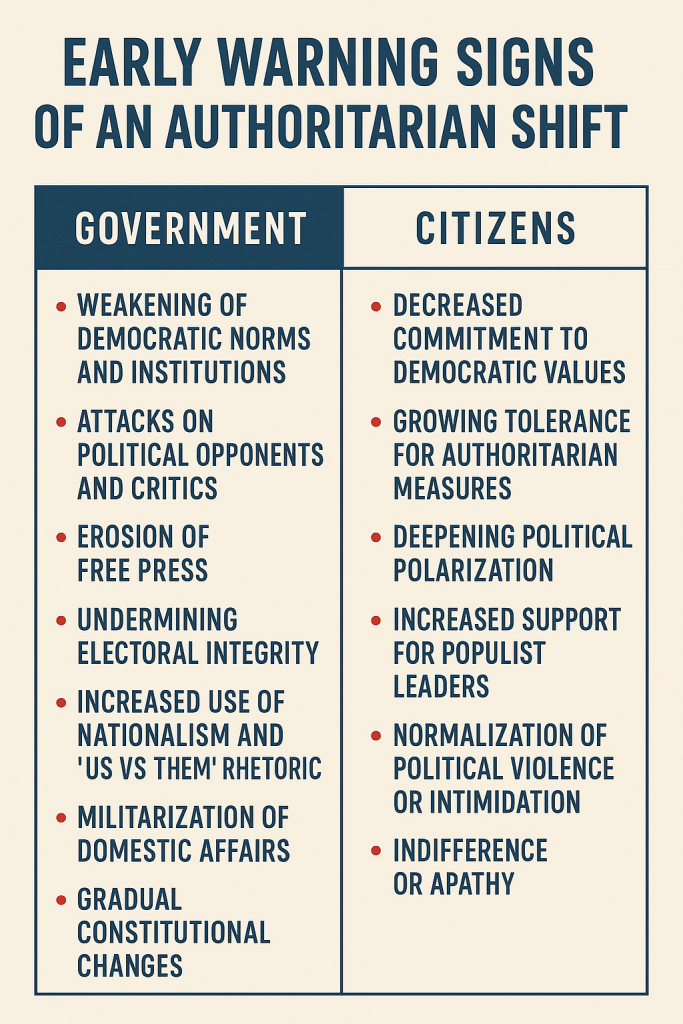
    Across the world, democratic institutions are showing signs of wear. Many nations—both young democracies and long-established ones—are slowly drifting toward authoritarianism or are becoming more tolerant of leaders with apparently authoritarian approaches to governance. What’s more troubling is that this drift doesn’t always start with violent coups or military takeovers. Often, it begins with subtle shifts—first in government behavior, then in the attitudes of its citizens.

    From Democracy to Autocracy: Government-Level Warning Signs

    According to studies from Freedom House, Varieties of Democracy (V-Dem), and political scientists like Steven Levitsky and Daniel Ziblatt (How Democracies Die), the early symptoms of democratic decline include:

    • Weakening of institutions: Leaders bypass courts, weaken legislatures, and centralize power.
    • Attacks on the press and opposition: Independent journalism is labeled “fake news”; critics are treated as enemies.
    • Undermining electoral integrity: Rules are bent, votes suppressed, or results questioned.
    • Inflammatory nationalism: Leaders stir up “us versus them” rhetoric to divide society.
    • Militarization of politics: Police and military are used to suppress protests or intimidate dissent.
    • Incremental constitutional changes: Term limits are eliminated, and checks and balances eroded.

    These patterns have played out in countries like Hungary, Turkey, and Russia, where democratic structures were gradually hollowed out from within—often with the legal system as a tool of control.

    The Other Side of the Coin: What Citizens Reveal

    Yet governments don’t act in a vacuum. Citizens themselves show signs of enabling authoritarianism. Research by Yascha Mounk, Pippa Norris, and surveys like the World Values Survey reveal the following trends:

    • Declining commitment to democratic norms: Fewer people, especially the youth, view democracy as essential.
    • Support for strongman rule: Citizens begin to favor “strong leaders” who can “get things done,” even at the cost of democracy.
    • Deep polarization: Society divides into tribes where compromise is seen as betrayal.
    • Indifference and apathy: Many withdraw from civic duties, feeling their voices no longer matter.
    • Tolerating violence and censorship: Some justify political violence or suppression of dissent if it favors their side.

    In short: when enough people care more about power, comfort, or ideology than fairness, truth, or accountability, democracy withers.

    A Spiritual Dimension

    God intended for humanity to live free, joyful, and safe—not under the thumb of cruel or corrupt rulers. Scripture shows that He warned nations and removed kings when they became oppressive. But He also allowed tyrants to rise when His people disobeyed.

    “I gave you a king in My anger, and took him away in My wrath.” — Hosea 13:11

    When people turn from justice, ignore the cries of the poor, and tolerate corruption or abuse, God may allow unjust rulers as a form of correction. Authoritarianism, in that sense, is not just a political shift—it can be a spiritual consequence.

    But that’s not the end of the story.

    Beyond Corrupt Human Rule

    The Bible points us to a future beyond corrupt human rule. When Christ returns, He will establish a perfect government where justice, love, and truth prevail:

     “For the Lord is our Judge, the Lord is our Lawgiver, the Lord is our King; He will save us.” — Isaiah 33:22

    Under Christ’s rule:

    • All leaders will be spiritually and morally perfected (Revelation 5:10).
    • Laws will be just and applied with gentle strength (Isaiah 11:4).
    • Every citizen—rich or poor—will be cared for (Psalm 72:4).
    • There will be no need for propaganda, police states, or manipulation (Micah 4:3-4).

    This is the kind of leadership God intended from the beginning.

    Final Word

    If mankind continues to fail to change its ways—if ordinary citizens and national leaders don’t reject selfishness, if they refuse to care for the marginalized, if they ignore the signs—we may soon find much of the world (including the most powerful nations) ruled not by servants of the people, but by strongmen who rule only for themselves. And not just in countries with authoritarian legacies, but even in places we now regard as bastions of democracy. This includes the United States and the democracies of Asia and Europe.