Category: China

  • Tariffs Rolled Back: China Sees an Opening, America Risks More Than It Thinks

    Tariffs Rolled Back: China Sees an Opening, America Risks More Than It Thinks

    After months of aggressive tariffs targeting Chinese goods, the U.S. has reversed course—partially rolling back some of the very tariffs it once defended as “necessary pain.” The reason? Mounting economic pressure, international backlash, and rising consumer costs at home.

    Yet this isn’t just about tariffs. It’s about how nations perceive strength, foresight, and credibility.

    China’s Calculated Calm

    Beijing, unsurprisingly, has not celebrated loudly. Instead, it’s using this rollback to present itself—especially to Asia-Pacific nations—as a reliable, stable, and forward-looking economic partner.

    China’s quiet confidence suggests it’s playing a long game: 

    • Let America appear reactive and short-sighted 
    • Fill the vacuum left by U.S. instability 
    • Build loyalty among countries hurt by U.S. tariffs 

    Allies Are Watching—and Worrying

    To many U.S. allies, this isn’t just a course correction—it’s another example of incoherent policy-making. First came the shock tariffs. Now comes the quiet reversal. The message? 

    “America acts first, thinks later.”

    As alliances strain, countries like Japan, South Korea, Vietnam, and even the EU are increasingly looking to China—not the U.S.—for consistency.

    What the Bible Says About Leadership and Judgment

    Isaiah 3:4 is strikingly relevant here:  “I will make mere youths their officials; children will rule over them.”

    God sometimes allows national leaders to act impulsively and without wisdom as a wake-up call for His people. It’s a warning to turn back to God’s principles of justice, truth, and humility.

    Where This Is Headed

    If America continues down this path of erratic policymaking, it risks more than economic losses. It risks becoming a symbol of declining global leadership, fractured alliances, and moral confusion. Meanwhile, China continues to craft its narrative as the stabilizer in a chaotic world order.

  • A Scientific Exodus: A Nation at Risk of Losing Its Edge

    A Scientific Exodus: A Nation at Risk of Losing Its Edge

    In a quiet but consequential shift, some of America’s best and brightest scientists are packing their bags—not because they’ve lost faith in science, but because they’ve lost faith in the system supporting it.

    From physicists and biomedical researchers to climate scientists and engineers, highly trained professionals are now being drawn away from the United States to countries that offer a more stable, respectful, and well-funded environment for their work. The exodus isn’t dramatic, but it is undeniable—and its effects could ripple across generations.

    Why Are Scientists Leaving?

    The ongoing movement of scientists away from the United States has accelerated under policies perceived as hostile to scientific inquiry. Among the key reasons:

    • Funding Cuts: Major research institutions like the National Institutes of Health (NIH), the National Science Foundation (NSF), and the Centers for Disease Control and Prevention (CDC) have seen budgets slashed or frozen. Research grants are becoming harder to secure, especially for long-term or basic research.
    • Political Interference: Decisions that used to be grounded in peer-reviewed science are now being overridden by political agendas. Several high-profile projects were stalled or canceled due to ideological disagreements, eroding the trust scientists place in public institutions.
    • Immigration Restrictions: Many international researchers—who make up a significant portion of the U.S. scientific community—are finding it harder to enter or remain in the country due to tightened visa policies and anti-immigrant rhetoric.
    • Lack of Academic Freedom: There is growing concern over efforts to suppress or discredit science that contradicts prevailing political narratives, especially in areas like climate change, reproductive health, and pandemic preparedness.

    Where Are They Going?

    Countries such as France, Germany, Canada, Australia, and even China have recognized the opportunity. These nations are actively recruiting disillusioned American scientists through dedicated talent-attraction programs:

    • France launched its “Choose France for Science” initiative, which recently received hundreds of applications for just a few dozen positions.
    • Australia’s Global Talent Visa Program has drawn in academics from U.S. institutions who now feel more respected and supported abroad.
    • Germany continues to be a haven for physicists and chemists, especially through institutions like the Max Planck Society.
    • China, despite geopolitical tensions, has successfully attracted ethnic Chinese scientists from U.S. universities to return and lead cutting-edge research in AI, quantum computing, and biotech.

    Areas of Expertise Being Lost

    The scientists leaving are not average academics—they represent the elite of the global research community. Many are:

    • Biomedical researchers in cancer therapy and immunology
    • Artificial intelligence and machine learning experts
    • Environmental and climate scientists
    • Physicists involved in particle research and quantum technologies
    • Engineers specializing in aerospace, robotics, and advanced manufacturing

    These aren’t just brain drains—they are bleeding-edge minds whose work directly affects national security, public health, and global competitiveness.

    Lessons from History: The WWII Parallel

    Ironically, a major reason the United States won World War II was because of the exact opposite trend: brilliant scientists migrated to America, fleeing persecution and ideological tyranny in their own countries.

    Jewish and anti-Nazi scientists from Germany and Austria—including Albert Einstein, Enrico Fermi, and Leo Szilard—brought with them unparalleled expertise. Their contributions were vital to America’s scientific rise, including the success of the Manhattan Project, which led to the development of the atomic bomb.

    America’s post-war technological dominance wasn’t just built on factories—it was built on brains that had found refuge in a country that respected their minds and valued their freedom.

    Now, the tables are turning.

    When God Withholds the Wise

    The Bible presents a sobering parallel. In Isaiah 3:1,3 (NIV), God warned Jerusalem and Judah of judgment:

     “See now, the Lord, the Lord Almighty, is about to take from Jerusalem and Judah both supply and support: all supplies of food and all supplies of water… the judge and the prophet, the diviner and the elder, the captain of fifty and the man of rank, the counselor, skilled craftsman and clever enchanter.”

    When a nation turns its back on God and His laws, He does not merely withhold rain or prosperity—He also removes its human capital: the wise, the skilled, the visionary. Without such leaders and thinkers, a society collapses from within, even if its military and economy still appear strong on the outside.

    What This Means for America

    The loss of scientific talent is not just a brain drain—it’s a judgment of capability. It hinders America’s ability to innovate, compete, and protect its own people. Technologies that could have cured diseases, predicted natural disasters, or strengthened national defense may now be developed under different flags.

    It is a warning, but also a wake-up call.

    Restoring scientific integrity is not just about increasing funding or adjusting immigration quotas. It’s about restoring the moral and spiritual foundation upon which wisdom and truth are welcomed. It’s about America humbling itself as a nation and recognizing that knowledge is a gift from God, not something to be manipulated for political convenience.

    As we watch the pillars of America’s global leadership quietly erode, one is reminded of Proverbs 29:18:

     “Where there is no revelation, the people cast off restraint; but blessed is the one who heeds wisdom’s instruction.”

    Will America once again become a refuge for wisdom and innovation—or will it become the very place from which wisdom flees?

  • A World Unraveling – The High Price of Tariffs and a Coming Global Reckoning

    A World Unraveling – The High Price of Tariffs and a Coming Global Reckoning

    When President Donald Trump announced sweeping tariffs against nearly all countries in April 2025—infamously dubbed “Liberation Day”—the move was framed as an act of economic sovereignty. Aimed at defending American workers, correcting trade imbalances, and punishing foreign nations accused of unfair practices, the 10% baseline tariff (and far higher rates for select nations) was meant to be a declaration of independence from a trade system that many believed disadvantaged the United States.

    But what began as an assertion of American self-interest is now reverberating across the globe, triggering economic tremors that few anticipated and many fear may permanently reshape the global order.

    The Intentions: Economic Nationalism Reborn

    Trump’s rationale was not new. Tariffs have historically been used to protect domestic industries, reduce reliance on foreign imports, and pressure trade partners to change their behavior. This round of tariffs was more sweeping than any the U.S. had imposed in over a century. The administration targeted over 180 countries, including allies, emerging economies, and even remote territories that barely trade with the U.S.—a precaution against tariff evasion through transshipment.

    The administration’s messaging was simple but aggressive: it’s time for America to stop being the world’s economic doormat and to rebuild its industrial might from within.

    The Reality: Economic Strain and Fragmentation

    However, history and current evidence tell a more sobering story. Tariffs are blunt instruments. While they may temporarily protect local industries, they often result in higher consumer prices, supply chain disruptions, and retaliatory measures. We’ve seen this before—during the Great Depression with the Smoot-Hawley Tariff Act and more recently during Trump’s first term trade war with China. In both cases, the long-term consequences were damaging.

    In 2025, it’s happening again—on a broader scale:

    • Stock markets have plunged, wiping out trillions in value.
    • Consumer prices are rising as import costs spike.
    • Supply chains are unraveling as companies scramble to redirect sourcing.
    • Global trade flows are shifting away from the U.S., as countries retaliate and seek new partners.

    The U.S. hoped to isolate abusive trading behaviors, but it is increasingly isolating itself.

    The Rise of Economic Blocs

    In response, the world is reorganizing into regional economic blocs. What America has stepped away from, others are now rushing to claim:

    • The European Union, increasingly united in trade and security, is moving to fill the void in global leadership.
    • China, through its Belt and Road Initiative and new trade alliances across Asia, is tightening its grip on emerging markets.
    • India, ASEAN nations, and Latin America are pursuing regional deals to shield themselves from U.S. unpredictability.
    • Africa, through the African Continental Free Trade Area (AfCFTA), is charting a course toward intra-regional trade independence.

    These blocs are forming not just out of economic logic—but out of necessity. The post–World War II era of U.S.-led globalization is ending. In its place, a fragmented, competitive, and increasingly adversarial global economy is emerging.

    The Geopolitical Risks: From Trade War to Real War

    This economic realignment carries with it grave geopolitical risks.

    As trade blocs become more inward-looking and rivalrous, the possibility of military conflict among major powers increases—especially as nuclear-armed states compete for influence, resources, and strategic positioning. The risk of conflict between the U.S. and China, or even among European powers and their neighbors, is no longer hypothetical—it is becoming increasingly likely in a world no longer bound by mutual economic interest.

    Furthermore, the economic instability triggered by tariff wars could prompt a dangerous political shift. History has shown us that during extremely difficult times, people can trade personal freedom for security. With inflation, job losses, and uncertainty mounting, charismatic strongmen often step into the void—offering order, prosperity, and national pride in exchange for civil liberties and democratic safeguards.

    A World on the Edge

    This is precisely the world that the Bible describes will exist just before the return of Jesus Christ.

    The book of Revelation speaks of a final global system—a powerful economic and military confederation—that dominates the world for a short time. This “beast” power promises security and prosperity, and the world, desperate for stability, embraces it. But this system, empowered by human pride and corrupted leadership, ultimately brings humanity to the brink of annihilation (Matthew 24:22).

    We are not there yet—but the signs are unmistakable.

    • The weakening of American influence, once a stabilizing force in the world, is accelerating.
    • The rise of rival blocs, each with its own rules and ambitions, is fracturing the global system.
    • The erosion of freedoms in favor of authoritarian efficiency is gaining traction.

    A Time to Watch and Prepare

    President Trump’s tariffs were intended to make America strong. But by pursuing economic disengagement in a globalized world, the U.S. may have instead triggered the unraveling of the very system that kept major conflicts in check.

    We do not place our hope in presidents, trade policies, or economic systems. We watch these events with a discerning eye—not in panic, but in understanding. The unraveling world system is not the end of the story. It is a prelude to Christ’s return, when the kingdoms of this world will become the kingdoms of our Lord and of His Christ (Revelation 11:15).

    While men pursue security through strength and prosperity through force, true peace will only come through the righteous rule of God’s coming Kingdom.

  • The Asian Pivot: China’s Long-Term Strategy to Thrive Beyond the American System

    The Asian Pivot: China’s Long-Term Strategy to Thrive Beyond the American System

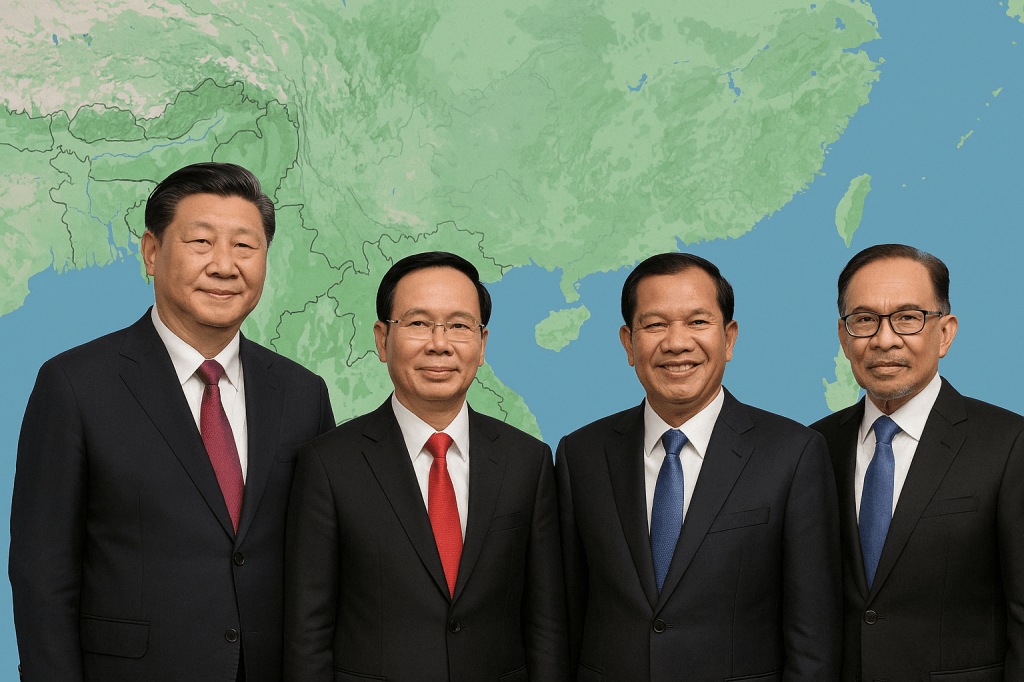
    As tensions between the United States and China continue to escalate—particularly in the realm of trade and technology—Beijing is quietly laying the groundwork for a long-term economic strategy that could reshape the power dynamics of Asia. At the center of this push is President Xi Jinping’s ongoing tour of Southeast Asia, visiting Vietnam, Malaysia, and Cambodia—a move that signals China’s growing focus on emerging Asian markets and a future less dependent on the U.S.-led global economy.

    Xi Jinping’s Southeast Asia Tour: A Strategic Reconnection

    This week, Xi Jinping undertakes his first overseas diplomatic trip of 2025, traveling to:

    • Vietnam (April 14–15) 
    • Malaysia (April 15–17) 
    • Cambodia (April 17–18)

    These visits are not merely ceremonial. They are a calculated move to strengthen China’s economic and political influence in its immediate neighborhood, particularly at a time when the United States is entangled in its own domestic political volatility and global alliances are being tested by tariff wars and foreign policy shifts.

    In Vietnam, Xi is engaging in high-level talks to promote infrastructure development and defense cooperation—areas that are traditionally seen as sensitive due to Vietnam’s balancing act between China and the West. In Malaysia, discussions center on bolstering trade and increasing Chinese investment in manufacturing and digital technology sectors. And in Cambodia, where China already enjoys significant influence, the visit is expected to deepen long-standing ties and further integrate the two economies.

    The Next Stops: Indonesia and Central Asia?

    Beyond this week’s tour, there are strong indicators that Indonesia may soon be on Xi’s diplomatic radar. A recent phone call between Xi and Indonesian President Prabowo Subianto reaffirmed both nations’ commitment to expanding their strategic partnership, particularly in light of the 75th anniversary of diplomatic ties.

    Likewise, Central Asia—including Kazakhstan, Kyrgyzstan, Tajikistan, Turkmenistan, and Uzbekistan—remains a critical focus area. China is set to host the next China–Central Asia Summit, following a successful inaugural meeting in Xi’an in 2023. These engagements are part of a broader effort to secure alternative supply chains, new energy corridors, and infrastructure links under the Belt and Road Initiative (BRI).

    The Bigger Picture: Preparing for a Post-American Trade Order

    While the immediate economic benefits of these engagements may not yet be dramatic, their geopolitical implications are far-reaching. China is methodically building a regional trade network that is resilient and increasingly self-sufficient. This will become critically important as the American economic system continues to display signs of instability, especially as economic policy in the US increasingly sways with every change in presidential administration.

    As the US imposes erratic tariffs, wavers on global commitments, and faces rising internal polarization, China is presenting itself to its neighbors as a stable, long-term economic partner—offering infrastructure, financing, and market access.

    A Prophetic Pattern: Toward a Unified Eastern Bloc

    What we are witnessing could be the early stages of economic and political unification across Asia, aligning China, Russia, and eventually other major Asian economies such as Japan and South Korea. Although Japan and South Korea remain closely aligned with the United States for now, the erosion of American credibility and consistency may eventually drive them to seek more reliable trade partnerships within the region.

    This shift is not only geopolitical—it also fits a prophetic pattern long observed in Bible prophecy. Scripture describes the rise of Eastern powers—”kings from the east” (Revelation 16:12)—who will play a pivotal role in end-time events. The Bible also indicates that the dominant economic force of the end times will not be the Anglo-American system but a revived European power bloc. As the United States and its allies fade in influence—whether by internal collapse or external exclusion—the stage is being set for an economically unified Asia, possibly in loose collaboration with or in tension against a dominant European superstructure.

    The World Is Rebalancing

    Xi Jinping’s current diplomatic maneuvers are not isolated events—they are the latest in a strategic chess game, one that aims to secure China’s leadership role in a post-American, multi-polar global economy. These new alliances and trade relations, especially with Asia’s emerging markets, serve as a foundation for resilience and independence in a world where U.S. leadership is no longer guaranteed.

    The world is rebalancing. For those watching closely—and for students of both geopolitics and prophecy—these developments underscore a profound truth: nations rise and fall according to a divine timetable, and the shifts we are seeing today may well be part of a larger unfolding narrative foretold long ago.

  • Asia’s New Trade Bloc: A Quiet Divorce from U.S. Economic Leadership

    Asia’s New Trade Bloc: A Quiet Divorce from U.S. Economic Leadership

    The resumption of Free Trade Agreement (FTA) negotiations among Japan, South Korea, and China is more than just another trade pact in the making—it marks a seismic shift in global economic alignment. This initiative—long delayed by political differences and historical wounds—is now being revived, and this time with a clearer, bolder purpose: to insulate Asia’s three largest economies from the mood swings of Washington and to lay the groundwork for a trading bloc that functions independently of the United States.

    The implications are profound. The world’s economic tectonic plates are moving, and America’s position as the central hub of global trade may soon be a relic of the past.

    Why Now? Timing Is Everything

    Although discussions on the Japan–South Korea–China FTA began more than a decade ago, the effort is being urgently revived amid the reimposition of U.S. tariffs, a resurgence of “America First” protectionism, and the growing perception that the U.S. is no longer a reliable partner in global economic stability.

    All three countries—despite competing interests and past grievances—now share a strategic concern: dependence on the U.S. economic system is risky. Their response? Build their own system.

    This new round of negotiations is not just about lowering tariffs. It is a deliberate, preemptive move to:

    • Diversify supply chains,
    • Reduce economic exposure to U.S. policies,
    • And prepare for a world where Asia leads its own economic future.

    What Will the FTA Look Like?

    The Japan–South Korea–China FTA, while not as politically integrated as the European Union, will likely cover:

    • Trade liberalization in goods and services,
    • Regulatory harmonization in digital trade, green tech, and finance,
    • Joint industrial strategies, especially in semiconductors and electric vehicles.

    If completed, this agreement would create the largest trilateral trade zone in Asia, covering over 20% of global GDP and home to some of the most advanced manufacturing ecosystems in the world.

    How Does It Compare to the European Union?

    Unlike the EU, which operates with a single market, shared currency (for many), and supranational governance, the trilateral FTA will be more flexible and state-centered. However, its logic is the same: to create a unified economic space, reduce dependency on external powers, and enhance regional self-reliance.

    Both the EU and the Asia FTA are examples of regional consolidation—the world is moving from globalism to bloc-ism, where major regions trade and grow within insulated economic frameworks.

    But there’s one big loser in this trend: the United States.

    The Isolation of the American Economy

    In the 1990s and early 2000s, the U.S. was the uncontested center of the global trading system. Today, with the rise of:

    • RCEP (led by China),
    • A reinvigorated EU internal market,
    • And now a potential Japan–Korea–China bloc,

    America is slowly but surely being economically encircled—not by enemies, but by former friends who are hedging their bets.

    The irony is striking: these are U.S. allies. Yet they are preparing quietly for a world where the U.S. is no longer the anchor—and perhaps even the adversary, should political winds turn.

    When a Nation Forgets Its God

    The Bible reminds us in Proverbs 16:7: 

    “When a man’s ways please the Lord, He makes even his enemies to be at peace with him.”

    But the opposite is also true: when a nation forgets its Creator, even its friends begin to drift away.

    The U.S. once stood as a beacon of moral leadership, prosperity, and justice—attributes that, whether acknowledged or not, were the fruit of a people who broadly honored biblical values. But as the moral compass of the nation shifts further from God, we are now witnessing a slow unraveling—not by sudden collapse, but by isolation.

    Trade is not just about economics; it reflects trust, alignment, and shared destiny. When even close allies like Japan, South Korea, and the EU begin forming trade structures without America, they are signaling a future where the U.S. is optional—perhaps even expendable.

    A Wake-Up Call for America

    The question is not whether the FTA among Japan, South Korea, and China will succeed. Even in limited form, it is already succeeding—simply by existing. The real question is whether America will heed the warning that these developments present.

    This is not just about trade. It is a spiritual signal.

    God is allowing America to experience the slow, strategic withdrawal of international favor—not out of vengeance, but out of love. Just as He warned ancient Israel, so He now warns modern nations: return to Me, and live.

    As economic alliances form, as former allies build insurance policies against U.S. unpredictability, and as new blocs rise with quiet determination, we must ask:

    • Will America recognize the signs? 
    • Will it return to the values that once made it a stabilizing force in the world?

    Or will it continue down the road of isolation—militarily powerful, economically large, but increasingly alone?