Category: Europe

  • 2025: A World in Motion—and a World on Edge

    2025: A World in Motion—and a World on Edge

    As 2025 draws to a close, it is increasingly clear that the international order is not merely changing—it is unraveling. Long-standing assumptions about security, leadership, and stability are being tested simultaneously on multiple fronts. Scripture warns that the closing years before Christ’s return would be marked by accelerating turmoil, confusion among nations, and a longing for peace that human systems cannot deliver (Matthew 24:6–8; Luke 21:25–26).

    This year’s geopolitical developments fit that biblical framework with sobering clarity.

    Ukraine, Russia, and the Fracturing of Europe

    The war between Russia and Ukraine continued through 2025 with no decisive resolution. Instead, the conflict hardened into a prolonged confrontation that reshaped Europe’s political and economic landscape.

    European nations faced sustained energy insecurity, rising defense expenditures, and increasing political fragmentation. Public fatigue over the war—combined with inflation, migration pressures, and social polarization—has weakened internal cohesion across the continent. Rather than producing unity, the crisis has exposed the limits of Europe’s ability to guarantee peace through economic integration and military alliances alone (Psalm 146:3).

    Biblically, this aligns with prophecies describing a world in which nations are “in distress” and unsure how to respond to cascading crises (Luke 21:25).

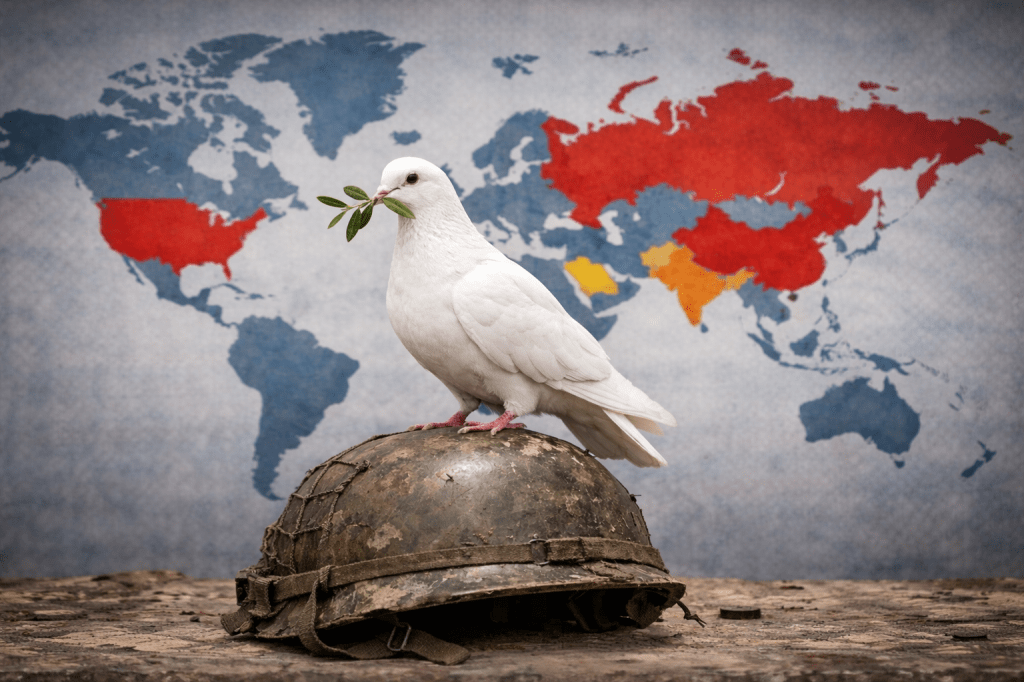
    A Strengthening Russia–India–China Axis

    While Europe struggled, 2025 saw deeper strategic coordination among Russia, China, and India. Though not a formal alliance, their growing cooperation in energy, trade, military exercises, and diplomatic positioning signals an accelerating shift away from a Western-dominated global order.

    This emerging bloc increasingly emphasizes sovereignty over values, stability over liberty, and power over principle. The Bible foretells a time when large coalitions of nations pursue their own strategic interests, often in opposition to one another, contributing to global instability rather than peace (Daniel 11; Revelation 16:12).

    America’s Transactional Turn

    Another notable development in 2025 was the continued evolution of American global leadership. The United States increasingly framed its foreign policy in transactional terms—security guarantees, trade access, and diplomatic support tied more directly to economic or strategic return.

    While this approach may appear pragmatic, it marks a departure from earlier eras when American influence was at least rhetorically linked to democratic ideals, moral leadership, and—however imperfectly—Christian ethical foundations. Scripture warns that when nations abandon righteousness as a guiding principle, their stability erodes from within (Proverbs 14:34).

    This shift also contributed to uncertainty among allies and emboldened rivals, further destabilizing the international system.

    Rising Unrest Within Nations

    Beyond wars and alliances, 2025 was marked by growing internal unrest across many countries. Economic inequality, mistrust of institutions, identity conflicts, and political polarization fueled protests, strikes, and sporadic violence. Governments increasingly struggled to maintain order without resorting to heavier surveillance or coercive measures.

    The Bible foretells such conditions: societies strained by fear, anger, and disillusionment, where people are “lovers of themselves” and distrustful of authority (2 Timothy 3:1–5). These pressures weaken nations from the inside, making them more vulnerable to external shocks and internal collapse.

    The Only Lasting Solution

    Taken together, the events of 2025 reinforce a vital biblical truth: humanity cannot secure lasting peace on its own. Military power, economic integration, and diplomatic maneuvering may delay conflict—but they cannot eliminate it. The worsening of world conditions should not surprise Christians; Christ Himself said these trends would intensify as the end of the age approaches (Matthew 24:8).

    Rather than yielding to fear or political despair, God’s people are called to a different response—to watch, to pray, and to look forward with hope. We are exhorted to pray earnestly for the coming of God’s Kingdom, the only government capable of bringing true justice, peace, and security to all nations (Matthew 6:10; Isaiah 9:6–7).

    As 2025 reminds us yet again, the solution to the world’s problems will not arise from shifting alliances or stronger armies—but from the return of Jesus Christ and the establishment of God’s righteous rule over the whole earth.
  • Greenland, Power Politics, and the Illusion of Security

    Greenland, Power Politics, and the Illusion of Security

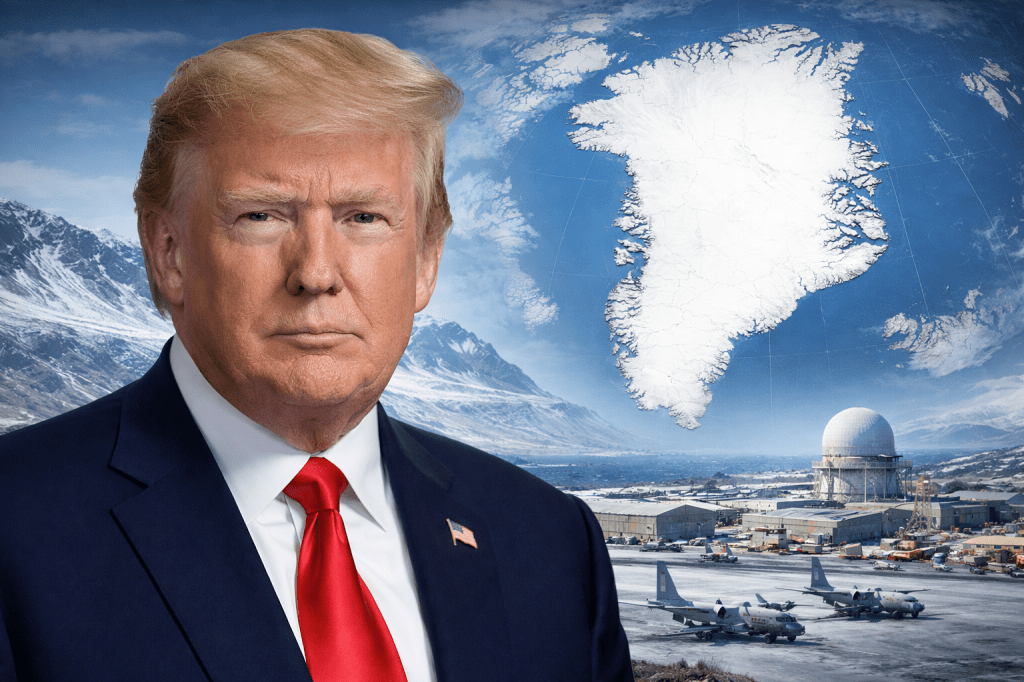
    In recent months, President Donald Trump has revived an idea that initially sounds like a relic from the 19th century: the possibility of Greenland becoming part of the United States. To modern ears—especially those shaped by post–World War II norms—this proposal sounds strange, even reckless. Yet from a purely strategic perspective, the idea is not as irrational as it first appears.

    Greenland sits astride the Arctic gateway between North America and Eurasia. As polar ice melts and great-power competition intensifies, the Arctic is no longer a frozen backwater but a developing strategic theater. Control of airspace, sea lanes, missile-warning systems, undersea cables, and critical minerals increasingly matters. From Washington’s viewpoint, Greenland is not about prestige or novelty; it is about geography.

    Why Greenland Appeals to U.S. Strategists

    If Greenland were to become a U.S. territory, America would gain several tangible advantages.

    First, it would remove political constraints on U.S. military operations there. Today, American forces operate in Greenland by agreement with Denmark and the Greenlandic government. That arrangement works—but it depends on continued consent. Sovereignty would allow the United States to expand radar systems, ports, airfields, and space-tracking infrastructure without diplomatic friction or delay.

    Second, it would permanently deny China and Russia strategic entry. China’s Arctic strategy relies not on overt military bases but on long-term economic footholds—research stations, mining investments, and infrastructure projects that later become leverage. U.S. sovereignty would close that door entirely. Russia, meanwhile, already treats the Arctic as a military frontier. Greenland would give the United States an unmatched vantage point over Russian submarine and missile activity.

    Third, it would future-proof American Arctic power. Military sufficiency today does not guarantee security tomorrow. Technology, climate, and warfare evolve, and human planners instinctively seek permanence through geography and assets.

    From a strategic planning standpoint, the logic is clear. Bases can be revoked. Treaties can be rewritten. Geography cannot be moved.

    The Difficulties and Risks

    Yet the obstacles to such a plan are immense.

    Greenland is not an empty possession waiting to be acquired. It is home to a distinct people with their own language, culture, and parliament. Most Greenlanders do not aspire to trade Danish oversight for American oversight. Their dominant political aspiration is independence—standing as Greenland, not as someone else’s territory—reflecting the biblical reality that peoples seek to dwell according to their own identity and inheritance (Acts 17:26).

    Denmark, for its part, has no appetite to sell territory in the modern era. While it once sold the Virgin Islands to the United States in 1917, today’s political environment is vastly different. Any transfer of sovereignty would require not only Danish agreement but clear Greenlandic consent, reminding us that rulers act within limits they do not always control (Daniel 2:21).

    There are also risks for the United States itself. Acquiring Greenland would strain relations with allies, complicate NATO unity, and saddle Washington with enormous long-term costs—governance, infrastructure, social services, and environmental stewardship in one of the world’s harshest climates. Strategic gain does not come free, a truth Scripture repeatedly affirms regarding the true cost of ambition (see Luke 14:28).

    But beyond these practical difficulties lies a deeper risk: the belief that security ultimately comes from geography and power.

    A Biblical Warning from the Transjordan

    Scripture offers a sobering parallel.

    When Israel conquered the lands east of the Jordan River, the tribes of Reuben, Gad, and half of Manasseh chose to settle there. The arrangement was lawful, negotiated, and strategically sensible, unwittingly serving as a buffer zone protecting the heartland west of the Jordan (Numbers 32:1–5; Deuteronomy 3:12–13).

    Yet history records a tragic outcome. Those Transjordan tribes were the first to fall when foreign empires swept through the land (2 Kings 15:29). Their frontier position—once a strength—became a vulnerability.

    That lesson should not be missed.

    If Greenland were to become a U.S. territory, it would almost certainly serve as America’s Arctic frontier—its buffer and early-warning shield. And if the United States were to grow spiritually weak, morally corrupt, and ripe for judgment, Greenland would likely be among the first places to fall, just as exposed territories often are in biblical history (Isaiah 10:5–12).

    Where Security Truly Comes From

    The Bible is unambiguous on one point: nations do not secure themselves by land acquisition alone.

    Scripture teaches that God determines the boundaries of nations, raises up kingdoms, and brings them down according to His purpose (Deuteronomy 32:8; Acts 17:26). He grants territory—and He removes it—sometimes as blessing, sometimes as judgment (Daniel 4:17).

    This does not mean strategy is meaningless. Governments are responsible to act wisely within their calling. But it does mean that territorial expansion, military presence, and geopolitical maneuvering are at best secondary causes. Ultimate security belongs to God alone (Psalm 127:1).

    A nation is secure not because it controls more land, but because it stands under God’s favor (Proverbs 14:34).

    Strategic Instinct

    President Trump’s Greenland proposal reflects an old, recognizably American strategic instinct: secure the frontier before it becomes contested. In historical terms, the idea is not radical. In modern political terms, it is extraordinarily difficult. And in biblical terms, it is insufficient.

    Even if Greenland were someday to fly the American flag, it would not save a nation under judgment. Like the Transjordan territories of ancient Israel, it could become the first warning sign—not the last line of defense.

    History, Scripture, and experience all point to the same conclusion:

    national security does not ultimately come from acquiring territory, but from the God who grants and withdraws it according to His will (Psalm 33:16–19).

  • Leadership, War, and the Hand of God: What Ukraine and Russia Are Teaching Europe

    Leadership, War, and the Hand of God: What Ukraine and Russia Are Teaching Europe

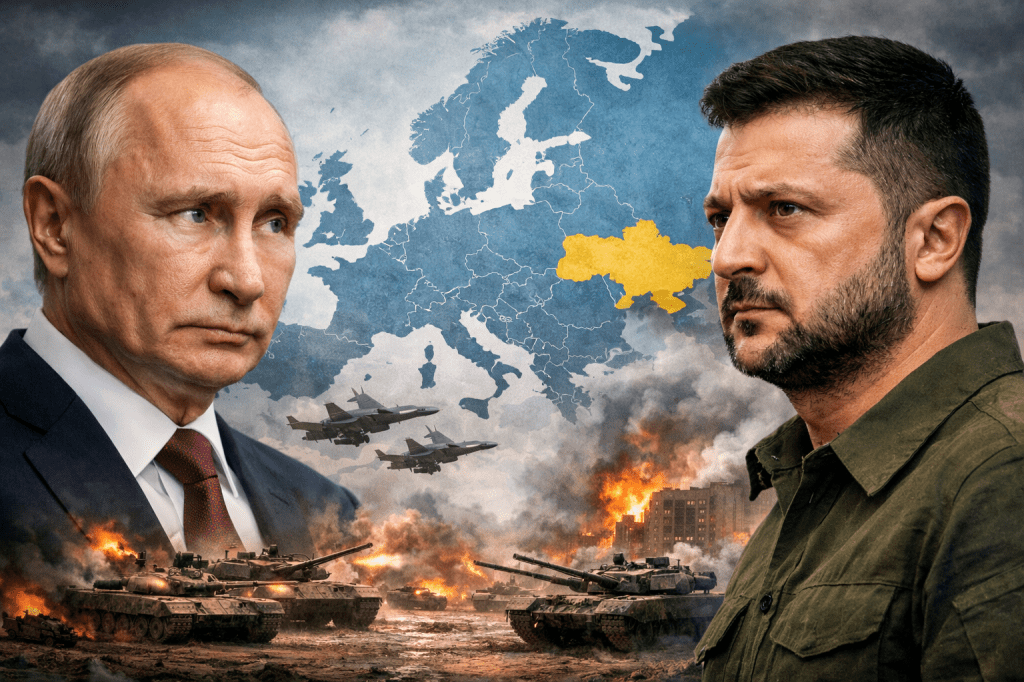
    History rarely turns on a single battle. More often, it turns on leadership—how power is exercised, how truth is handled, and how people are motivated when the cost becomes unbearable. The ongoing war between Russia and Ukraine is a vivid example. While weapons, manpower, and alliances matter greatly, the leadership styles of the two presidents involved are shaping the direction of this conflict in ways that may reach far beyond Eastern Europe.

    This is not merely a geopolitical struggle. It is a reminder that God rules in the affairs of men (Daniel 4:17), raising up leaders—wise or foolish, strong or weak—to accomplish His purposes.

    Two leaders, two radically different approaches

    On one side stands Vladimir Putin, a leader who governs through centralization, control, and fear. Power flows upward. Information flows downward—filtered, curated, and often softened to avoid displeasing the top. Loyalty is prized more than candor. This style has served Putin well in consolidating political power over decades.

    On the other side is Volodymyr Zelensky, whose leadership has evolved dramatically under fire. His approach is more distributed. He relies heavily on professional military advice, encourages honest feedback, and communicates openly with both his people and Ukraine’s allies. His authority rests less on fear and more on legitimacy and shared purpose.

    These differences do not determine who will “win” the war—but they strongly influence how the war unfolds.

    Leadership shapes direction, not destiny

    Wars are not decided by leadership style alone. Geography, industrial capacity, alliances, and sheer numbers still matter. Russia has greater manpower and resources, and it remains possible—even likely—that it will emerge from this war with some territorial gains.

    Yet leadership influences critical factors that accumulate over time:

    • Learning speed: Systems that punish bad news adapt slowly. Systems that tolerate honesty adjust faster.
    • Morale and endurance: Fear can compel obedience, but meaning sustains sacrifice.
    • Alliance management: Transparency builds trust; opacity erodes it.

    Ukraine’s resilience—its refusal to collapse under pressure—has surprised much of the world. That resilience is not accidental. It flows from a leadership style that rewards initiative, accepts responsibility, and shares risk with the population.

    Russia, by contrast, has relied on coercion and narrative control. That approach can sustain effort—but it struggles to correct mistakes quickly. Over long wars, such rigidity becomes costly.

    God’s hand over national leadership

    Scripture reminds us that God both appoints and removes leaders:

    “He changes times and seasons; He removes kings and raises up kings” (Daniel 2:21).

    This applies not only to righteous rulers, but also to flawed and even oppressive ones. God used Pharaoh, Nebuchadnezzar, Cyrus, and others—each very different in character—to accomplish His will.

    The contrast between Putin and Zelensky should not be viewed merely as democracy versus authoritarianism, or good versus evil in simplistic terms. Rather, it is another reminder that God allows leadership styles to expose national strengths and weaknesses, often preparing the stage for larger events yet to come.

    Ukraine’s influence on Europe’s future

    Regardless of how the war ends territorially, Ukraine has already changed Europe.

    Its steadfastness has:

    • Ended decades of European complacency
    • Reawakened military preparedness
    • Hardened attitudes toward coercion and appeasement

    Europe is moving—slowly but unmistakably—toward a more unified and force-ready posture. This matters prophetically.

    Bible prophecy indicates that a powerful leader will arise in Europe, one who will dominate the world scene for a short but intense period (Daniel 11; Revelation 13). This leader will not be timid. He will act decisively, militarily, and without the restraint that has characterized post–World War II Europe.

    Ukraine’s resistance may well shape the environment that produces such a leader—one forged in a Europe that has learned, painfully, that peace cannot rest on wishful thinking alone.

    A sobering prophetic possibility

    It is striking that biblical prophecy suggests a future European power that will not fear confrontation with Russia, even to the point of invasion when it serves his purposes (Daniel 11:44). While Scripture does not give all details, it does show that geopolitical power shifts dramatically at the end of this age.

    The current war does not fulfill these prophecies outright—but it conditions minds and institutions. It teaches Europe to think in terms of force, resolve, and preemptive action. Leadership styles matter here. Ukraine’s example reinforces the idea that survival favors decisiveness, unity, and readiness to act.

    Trajectory

    Leadership does not decide wars by itself—but it sets their trajectory. Putin’s style has produced endurance through control. Zelensky’s has produced resilience through shared purpose. Both are being used—knowingly or unknowingly—within God’s greater plan.

    For students of prophecy, this war is not just about borders. It is about preparation—of nations, leaders, and peoples—for events that Scripture tells us are coming.

    As Christ Himself warned, “See that you are not troubled; for all these things must come to pass” (Matthew 24:6).

    The task of God’s people is not fear, but understanding—and faith in the One who truly governs the nations.

  • The Trump-Zelensky Meeting: A Pause or a Prolongation?

    The Trump-Zelensky Meeting: A Pause or a Prolongation?

    On October 17, 2025, U.S. President Donald J. Trump hosted Ukrainian President Volodymyr Zelenskyy in Florida, following a phone call between Zelenskyy and Russian President Vladimir Putin. The meeting drew wide attention—especially Trump’s call for both Russia and Ukraine to “stop where they are” and his caution about supplying Tomahawk missiles to Ukraine. (“Face to Face With Zelensky, Trump Waffles on Providing Tomahawk Missiles”, http://www.time.com, October 18, 2025)

    That phrase—“stop where you are”—sounds like a ceasefire appeal. Trump wants a negotiated peace, not a sweeping Ukrainian military advance. He signaled reluctance to commit to delivering Tomahawk cruise missiles to Ukraine, warning that doing so could be a “dangerous escalation” and might deplete U.S. stockpiles. (ibid.)

    From a strategic standpoint, these positions carry profound implications for Ukraine’s ability to reclaim territory and check Russia’s offensive capability.

    The Military Dilemma: Risks, Opportunity, or Deadlock?

    1. Ukrainian counteroffensive depends on advanced capability

    Ukraine’s recovery of territory occupied by Russia relies not only on courage and manpower, but on force projection, intelligence, airpower, and deep-strike capability. Tomahawk missiles (with ranges up to ~2,500 km) would allow Ukraine to target Russian logistic hubs, ammunition depots, and command nodes far behind the front lines—imposing cost and pressure. (“Trump may approve Tomahawks for Ukraine if Russia continues war”, http://www.reuters.com, October 13, 2025)

    Without such long-range tools, Ukraine is often limited to tactical counterattacks, artillery duels, drones, or missile strikes of more limited reach. The risk: Russian forces retain sanctuary, rear logistics, and the ability to mobilize for future offensives.

    2. “Stop where you are” risks freezing Russian gains

    A cease-at-current-front-lines deals with “who holds what now” as a status quo. That potentially cements Russian control over occupied areas and undermines momentum for further Ukrainian advances. It may even embolden Russian forces to fortify, entrench and prepare further campaigns, knowing that any future shift in the balance would require much greater effort by Ukraine (and its backers).

    3. Escalation fears versus strategic deterrence

    Trump’s argument is risk-averse: supplying Tomahawks to Ukraine might trigger escalation, risk U.S. involvement, or cross red lines. Critics counter: inaction or under-arming Ukraine may ultimately prolong the war more than escalation would. Deterrence is stronger when backed by credible threat, not passive restraint.

    Thus, the meeting’s tone—calling for a halt and hesitating on high-end systems—implicitly leans toward a diplomatic pause rather than decisive battlefield advantage.

    Prolongation, Paradox, and European Responsibility

    While diplomacy is always a desirable goal, when military advantage is declining, peace talks at the wrong moment tend to prolong wars rather than conclude them. A war without clarity of leverage becomes a war of attrition. Ukraine, under less-than-optimal capabilities, risks being squeezed over time.

    This dynamic suggests a strategic inflection for Europe. If the United States—with Trump as president—hesitates to provide the most potent tools, Europe must not remain a passive bystander. Instead, the European Union and individual European nations should accelerate development of independent defense capability, reducing overreliance on U.S. arms and policy swings. If Europe can field credible deterrent power—air, long-range strike, resilient logistics, intelligence networks—it can shape the strategic balance, protect its eastern flank, and avoid being dragged into conflicts by external alliances.

    In short: Ukraine’s fate, and Europe’s independence, may hinge not on American generosity but on European resolve.

    Biblical Insight: False Prophets, Stale Remedies, and the Beast of Europe

    Throughout Scripture, God denounces spiritual mediocrity and false peace. In Jeremiah 6:14 we read:

    “They have healed the wound of my people lightly, saying, ‘Peace, peace,’ when there is no peace.” (NKJV)

    That is a prophetic warning against superficial, half-hearted solutions—peace declared before the root problem is addressed. When world leaders demand “peace now” without removing the forces of evil or ensuring justice, they risk masking deeper wounds rather than healing them.

    From a prophetic lens, the New Testament presents a future global power often called “the beast” (Revelation 13). Students of Bible prophecy understand this beast as a military-political force emerging in Europe—a revived “king of the North” power, leading a confederation of nations that exerts influence across the earth.

    If Europe were rising into military unity and dominance, that could align with the prophetic pattern. The reluctance of the U.S. (and perhaps the echoing call for restraint in Ukraine) may indirectly clear space for a European superpower to emerge. That is not speculation but caution: when world powers waver, the stage shifts—and biblical prophecy warns that a European beast with military might will arise before Christ’s return.

    Thus, trusting only in ceasefires or superpower mediation invites that prophetic shift. God calls His people to watch, to discern, and to remain rooted in His Kingdom—not in the vain illusions of human “peace” schemes.

    Call to Discernment

    The Trump–Zelensky meeting marks a critical crossroads. It could serve as a step toward peace—but more likely, given its posture, it may lock in a long stalemate that gradually advantages the aggressor. Unless Ukraine (and Europe) can muster sufficient clout, “stop where you are” becomes a perpetual cage.

    From God’s perspective, a peace that ignores justice is a faux peace. Jeremiah’s indictment of “peace, peace when there is none” reminds us that real healing demands confronting evil, not succumbing to superficial ceasefires. And Christian prophecy urges vigilance: as one power (the U.S.) hesitates, another (Europe) may arise—and that very beast may seek global dominance.

    Watch world events with biblical eyes, recognize that human schemes often fall short, and root your hope not in any earthly power, but in the return of Christ and the establishment of God’s Kingdom. In the meantime, let Europe—and the free world—awake: if we delay building real strength for justice, the prophetic pieces may fall faster than we expect.

  • Probing the Shield: Russia’s Airspace Tests and Europe’s Future Army

    Probing the Shield: Russia’s Airspace Tests and Europe’s Future Army

    Every few weeks, headlines surface of Russian fighter jets or drones slipping—sometimes boldly, sometimes stealthily—into NATO airspace. Recently, Estonia, Poland, and other allies have sounded the alarm as Russian aircraft flew without transponders, ignored intercept signals, or even sent swarms of drones across borders.

    To the casual observer, these events seem reckless. Why would Russia risk provoking NATO, the most powerful military alliance in the world? But there is strategy here. Moscow is probing. Each incursion is a test—an attempt to measure NATO’s reflexes, to spot weaknesses, and to learn how far it can go without triggering a serious response.

    And yet, in a twist of irony, these provocations may be preparing NATO for the very conflict Russia hopes to avoid. Every incursion forces allied radars to track, interceptors to scramble, and commanders to review their rules of engagement. Every incident adds data, sharpens coordination, and strengthens air defenses along NATO’s eastern flank. Russia may think it is playing offense, but in reality it is helping its adversaries rehearse for war.

    NATO Today, Europe Tomorrow

    But what of NATO’s future? The alliance has held since 1949, yet cracks are visible. American leadership has become uncertain, swaying between strong commitments and hints of withdrawal. If the United States wavers long enough, NATO as we know it may one day fade.

    That does not mean Europe will remain undefended. On the contrary, the pressures of Russian aggression and American inconsistency may drive European states to consolidate their own defense into a new structure—a European army. Such a force would not begin from scratch. It would inherit the muscle memory that NATO’s training and Russia’s provocations are providing right now.

    A Power Foretold

    The Bible itself points to the rise of such a force. In the book of Revelation, the Apostle John describes a European-centered power that will astonish the world with its military might: “Who is like the beast? Who is able to make war with him?” (Revelation 13:4).

    That prophecy speaks of a union, political and military, arising in Europe in the end times—an army that no earthly coalition could match. It is sobering to realize that today’s “tests” by Russia may be laying the groundwork for that very power. The lessons Europe learns under NATO’s umbrella will be reapplied in a future alliance, one described in Scripture as both formidable and unmatched.

    Rehearsals

    So the next time Russian jets slip into Baltic skies or drones drift over Poland, remember: these are not isolated provocations. They are rehearsals. Moscow is probing for weakness, but in doing so it is forcing Europe to harden its shield. And in the long arc of history, that shield may outlast NATO itself—emerging as something far stronger, and prophetically destined, on the world stage.