Category: Europe

  • Storm Over the Shoal: The Philippines, China, and the Future of the West Philippine Sea

    Storm Over the Shoal: The Philippines, China, and the Future of the West Philippine Sea

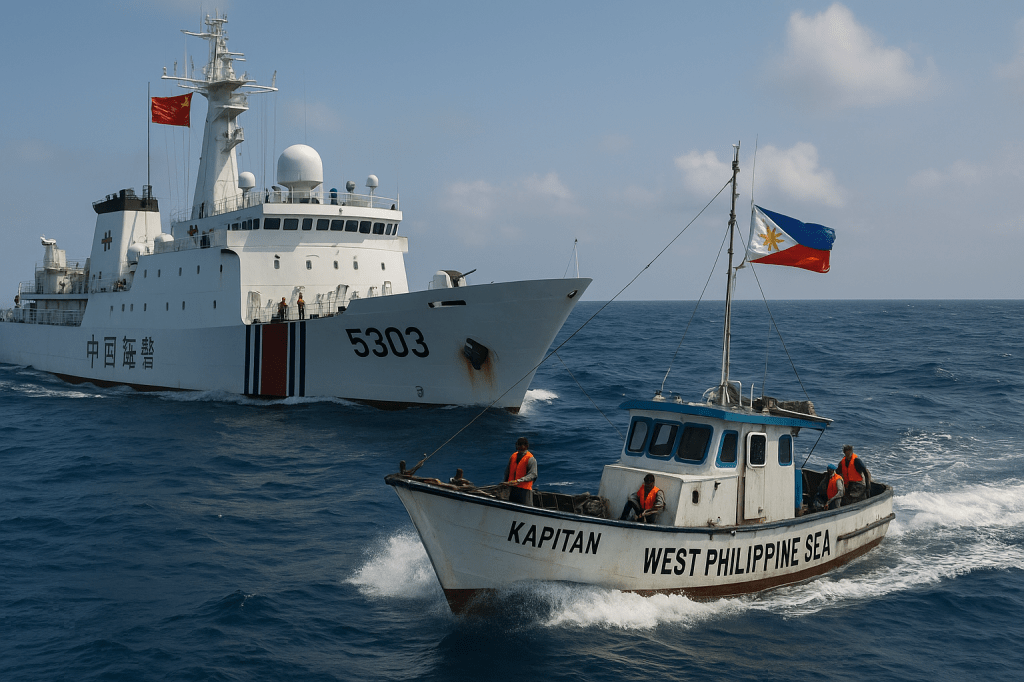
    Tensions flared again in the West Philippine Sea when Philippine and Chinese vessels collided near Scarborough Shoal on September 16, 2025. According to Manila, Chinese coast guard ships used high-powered water cannons against a Philippine resupply vessel, shattering glass on the bridge, damaging critical equipment, and injuring at least one crew member. China, for its part, accused the Philippines of “illegally” entering its waters and even claimed Manila rammed one of its ships—an allegation firmly denied by Philippine officials.

    This confrontation followed China’s unilateral declaration of a “national nature reserve” at Scarborough Shoal just days earlier. Filipino fishermen and government leaders saw this as an attempt to further tighten Beijing’s grip on a vital fishing ground that lies well within the Philippines’ Exclusive Economic Zone under international law and the 2016 Hague tribunal ruling.

    How Nations Responded

    Philippines: Manila lodged a strong diplomatic protest and ramped up patrols in contested waters. At home, protests over corruption added to the sense of urgency in defending national interests.

    China: Beijing justified its moves as “environmental” but in practice deployed coast guard and maritime militia vessels to enforce its claims, warning the Philippines against “provocations.”

    Allies & Partners:

    • The United States reiterated its defense commitments, condemning China’s actions.
    • Australia, Canada, Japan, and the UK voiced concern and pledged continued support for international law.
    • Germany and France are deepening defense ties with Manila. The UK is even exploring a Visiting Forces Agreement to allow closer military cooperation.

    What to Expect in the Next 3–5 Years

    The Philippines is investing heavily in its navy and coast guard, acquiring new frigates, offshore patrol vessels, and long-range missile systems like the BrahMos. It is also strengthening defense partnerships with allies from Asia, North America, and Europe. These steps will improve deterrence, but they cannot fully offset China’s overwhelming naval power.

    The likely trajectory is continued gray-zone conflict: water cannons, rammings, blockades, and the creation of more “facts on the ground” by China. At the same time, broader coalitions—Philippines with the U.S., Japan, Australia, the UK, and even select EU states—will increase naval patrols and exercises. Expect more incidents, more diplomatic protests, and a slow but steady militarization of the West Philippine Sea.

    The Long-Term Outlook: Prophecy and the Coming Clash

    While today the flashpoint is between the Philippines and China, the Bible shows that the stage is being set for something far greater. Prophecy in the book of Revelation describes a time when two great power blocs will dominate the world scene:

    • On one side, a resurrected Roman Empire, a powerful federation that will evolve out of today’s European Union.
    • On the other side, a vast eastern alliance led by powers like China and its allies.

    The South China Sea, a vital artery of global trade and security, could very well be one of the hot spots where these rival blocs collide. Scripture warns that this confrontation will erupt into a catastrophic war threatening the very survival of humanity (Matthew 24:21–22).

    But God has not left humanity without hope. Jesus Christ will intervene to stop world war from annihilating mankind. He will establish the Kingdom of God on earth, bringing true justice, security, and lasting peace—a peace no human power can achieve on its own.

    A Call to Repentance and Preparation

    In the meantime, God is calling individuals to repent, turn from sin, and live in obedience to His laws. The worsening conflicts, corruption, and rivalries we see today are signs of a world cut off from God. Yet for those who listen and respond, these events can serve as a wake-up call—a reminder to prepare for the soon-coming government of God, which will finally bring peace to all nations.

  • Europe’s Shift in Arms Procurement: A Subtle Sign of Change

    Europe’s Shift in Arms Procurement: A Subtle Sign of Change

    For decades, the defense relationship between the United States and Europe has been clear-cut: Europe bought American weapons, and Washington remained the uncontested leader of the Western alliance. That picture, however, is beginning to change.

    The recent decision by Denmark to bypass the American Patriot missile system in favor of the European-made SAMP/T (New Generation) air defense system is the most visible example of this shift. Denmark also intends to rely on European suppliers for its medium-range air defense, considering systems like Germany’s IRIS-T, Norway’s NASAMS, and France’s VL MICA. Officials in Copenhagen cited delivery speed, affordability, and industrial benefits as reasons—but the symbolism is clear: Europe is increasingly willing to equip itself without defaulting to U.S. systems.

    And Denmark is not alone.

    • Germany is leading the European Sky Shield Initiative, which is pooling resources to expand the IRIS-T system across Europe.
    • The Baltic States—Latvia, Lithuania, and Estonia—are purchasing IRIS-T units in joint arrangements with Germany.
    • Slovenia has also joined the Sky Shield program, relying on European suppliers rather than U.S. ones.
    • Poland, while still buying U.S. Patriots, is investing heavily in the British-designed CAMM missile family, weaving European systems into its layered defense structure.
    • On the ground, Czechia and Slovakia have turned to Swedish CV90 infantry fighting vehicles, and EU funds are pushing production of European artillery ammunition.
    • Ukraine, while still dependent on U.S. armaments, is now producing a significant portion of the weapons it uses in its war against Russia. These include locally manufactured drones, artillery shells, and even missile systems. At the same time, Ukraine has received European-made weapons such as German Leopard tanks, French Caesar howitzers, and British Storm Shadow missiles, showing both its own production and Europe’s growing role in its defense.

    None of this means Europe has abandoned the U.S. As of now, the United States still supplies the majority of Europe’s imported arms—especially in critical areas like fighter jets (the F-35 dominates sales) and strategic enablers. Yet, alongside those U.S. weapons, European nations are increasingly equipping themselves with homegrown systems that are largely interoperable with American platforms. It is not a clean break, but a diversification—a subtle hedge.

    Why This Shift?

    Several factors explain the trend:

    1. Delivery and cost pressures: U.S. systems are often more expensive and slower to deliver than European alternatives.
    2. Strategic autonomy: Europe wants the ability to defend itself without total reliance on American decision-making.
    3. Industrial policy: Supporting European defense industries preserves jobs, technology, and sovereignty.
    4. Political uncertainty: U.S. policy swings—especially under different administrations—make allies wary of putting all their eggs in one basket.

    A Spiritual Dimension

    Behind the headlines, however, lies a deeper story. The Bible tells us that God raises up nations and brings them down (Daniel 2:21). America long stood as the leader of the free world, providing the shield under which much of Europe prospered. But that leadership is eroding.

    The quiet but real shift in Europe’s arms procurement is a symptom of this change. By relying more on each other, Europeans are learning to do without America. This is not merely economics or politics—it is part of God’s judgment on the United States. Scripture warns that when a nation turns away from Him, He will “break the pride of your power” (Leviticus 26:19). America’s military dominance has been a key expression of that power. Now we see signs of it slipping away.

    A Marker of Something Larger

    The choice of Denmark may seem like a technical procurement matter, but it is a marker of something larger. Europe is slowly but steadily becoming more self-reliant in arms production. The United States still supplies much—but the monopoly is gone, and the trend is growing.

    In the months and years ahead, watch Europe’s defense market closely. What appears as procurement diversification is also a signal of shifting leadership in the Western world. As America declines, God is setting the stage for other powers to rise—just as the Bible foretells.

  • Europe’s Anxiety Over the East—and What Prophecy Says

    Europe’s Anxiety Over the East—and What Prophecy Says

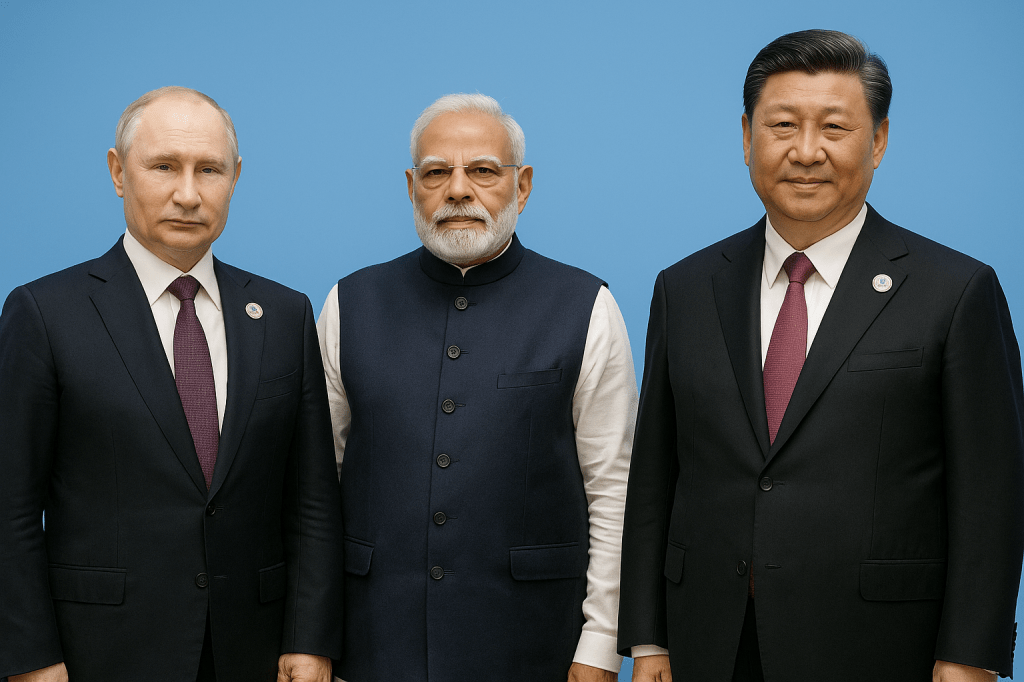
    The European Union is sounding alarms over an alignment taking shape in the East. At recent summits—such as the Shanghai Cooperation Organisation (SCO) meeting in Tianjin and the Beijing summit hosted by President Xi—China, Russia, and India signaled a willingness to deepen cooperation—militarily, economically, and diplomatically. For Brussels, this looks like a rival pole to the West’s influence.

    Brussels Speaks Out

    Commission President Ursula von der Leyen has warned at a summit in Beijing that EU–China ties have reached an “inflection point” because of the growing cooperation between China, India, and Russia (Financial Times, July 2025). High Representative Kaja Kallas has accused Beijing of enabling Russia’s war machine (MERICS report, 2025). Reports highlight India’s purchases of Russian oil and abstentions on UN votes as proof that New Delhi is hedging its bets.

    In short, Europe sees a triangle of Moscow, Beijing, and Delhi chipping away at Western unity—especially as sanctions on Russia leak eastward.

    What the EU Is Doing

    Brussels isn’t sitting idle. It has:

    • De-risked supply chains—passing laws to reduce dependency on Chinese critical materials.
    • Launched trade defenses—raising tariffs on Chinese electric vehicles, probing subsidies in wind turbines, and barring Chinese medical-device suppliers.
    • Strengthened sanctions enforcement—targeting shadow fleets and middlemen moving Russian energy.
    • Rearmed its defense base—through the €800-billion “ReArm Europe” program.
    • Courted India—via trade talks, tech councils, and alternative trade corridors.

    The strategy: blunt the impact of a tightening Moscow–Beijing–Delhi alignment while rebuilding Europe’s own economic and military muscle.

    Prophetic Perspective

    Students of Bible prophecy see in these moves echoes of an ancient forecast. Scripture foretells a revived Roman system in Europe—many see its early form in today’s EU—and an eastern coalition that will one day rise to confront it.

    Revelation 9:13-19 speaks of a war killing a third of humankind through an army “two hundred million” strong. While the Bible does not name today’s nations, the picture of eastern powers uniting and clashing with a European bloc foreshadows the very trends now unfolding.

    God will allow this to happen to call mankind to repentance, as He makes us realize that human governments apart from Him and His way of life cannot bring peace.  Shortly after this, after more severe events occur, Jesus Christ will return to establish God’s kingdom, ruling all nations under righteous rule. (Isaiah 2:1-4)

  • Why Europe—not America—is Poised to Become the West’s Hub for Advanced AI Chips

    Why Europe—not America—is Poised to Become the West’s Hub for Advanced AI Chips

    Despite the U.S.–China tech rivalry, the center of gravity for the West’s most advanced compute is drifting toward Europe in the long term. The reasons are practical—policy, supply-chain physics, and industrial base—and, for those of us who read the Bible’s prophecies, they also fit the end-time alignment in which a revived European power rivals a vast Asian coalition while America declines.

    The inflection now: “Sovereign AI” lands in Europe

    In mid-2025, Nvidia’s push for “sovereign AI”—each nation owning its models and compute—found especially fertile ground in Europe. EU leaders publicly embraced the idea and began backing massive, local AI capacity, including a plan for four “AI gigafactories” and a large 18,000-GPU build with French champion Mistral.

    At the same time, Europe is already hosting some of the world’s most capable AI-ready supercomputers under the EuroHPC program:

    • JUPITER (Germany) — built on ~24,000 Nvidia GH200 Grace Hopper superchips; Europe’s fastest system and its first exascale-class machine.
    • MareNostrum 5 (Spain) — Europe’s newest pre-exascale facility, with accelerated partitions used for AI work.
    • Leonardo (Italy) — ~13,824 Nvidia A100 GPUs on a BullSequana platform at CINECA.

    Alongside these deployments, the EU Chips Act commits €43 billion in public investment (with matching private capital) to strengthen Europe’s semiconductor ecosystem and reduce external dependencies.

    Bottom line: Europe is not just buying chips; it is deliberately localizing compute, policy, and industry to anchor AI at home.

    Why the hub is unlikely to remain in America in the long-run

    1. Export controls that fragment allied access – Recent U.S. rules on advanced AI chips and even model weights introduced tiered access inside the EU, granting some member states frictionless imports while forcing others into licensing regimes. That touched a nerve in Brussels and in national capitals because it splits the single market and turns compute into a diplomatic lever. This has already triggered European calls for more autonomous, EU-based capacity.
    2. Europe is the world’s chokepoint for the tools that make cutting-edge chips – ASML (Netherlands) is the sole supplier of EUV lithography, the tool family required to print the most advanced chips. That unique leverage—and the next High-NA EUV generation now shipping—gives Europe structural power in any Western supply-chain redesign.
    3. Manufacturing & packaging are moving onto European soil – While Nvidia remains fabless, its critical suppliers are expanding in Europe:
    • TSMC broke ground on ESMC—a Dresden fab with Bosch, Infineon, and NXP—and is opening a design center in Munich to support European customers.
    • Intel is advancing an assembly & test site in Wrocław, Poland, a key step in building an EU packaging base for advanced devices.
    • Amkor (a major OSAT partner to many chip designers) runs a packaging/test campus in Portugal, part of a broader European push into advanced packaging.

    4. The regulatory superpower effect – From the AI Act to the DMA/DSA, the EU consistently sets rules that global firms end up following. “Sovereign AI” plus European standards naturally pulls high-end compute into Europe so governments and companies can comply, train local-language models, and keep sensitive datasets under EU jurisdiction. (Nvidia is already tailoring offerings to this need.)

    Taken together: the politics (export uncertainty), the tools (ASML), the money (EU Chips Act), and the physical footprint (fabs + packaging + supercomputers) all point to Europe consolidating as the West’s home base for advanced AI infrastructure.

    “What could push this over the line?” — plausible chain of events

    • A supply-shock scare in East Asia (even weeks): Any Taiwan-Strait disruption would amplify the logic of placing more advanced packaging and system-integration in Europe—closer to sovereign AI customers and the EU’s legal/regulatory center. (Europe is already scaling exascale systems and courting multiple suppliers.)
    • Another round of U.S. export policy whiplash: If allied access again becomes conditional or transactional, EU policymakers will double-down on local capacity and procurement rules that require EU-built stacks for state and critical-infrastructure AI.
    • Ecosystem gravity: With JUPITER, MareNostrum 5, and Leonardo already training European models, follow-on clusters, specialist ASIC deployments (e.g., Groq for inference), and EU-only datasets will pull developers, service firms, and venture capital toward Europe’s compute hubs.

    Through the prophetic lens

    Scripture shows that just before Christ’s return, a revived Roman system rises as a dominant power while “kings of the East” form a counter-bloc (Dan. 2; Rev. 13; 17; 16:12). America, the British Commonwealth, and the modern descendants of Judah decline under God’s corrective hand—not annihilation, but discipline leading to repentance (Lev. 26; Hos. 5:5; 11:7; Amos 3:1–2). In that end-time landscape, it is coherent that the world’s decisive technologies—and the economic/administrative muscle that goes with them—shift to Europe (with Asia rivaling it), while the U.S. loses primacy.

    Technology doesn’t save or condemn; it reveals where power concentrates. Today’s movements in compute sovereignty, chip tools, and supply chains match the geopolitical map the Bible sketches for the end of the age.

    What to watch next (practical signposts)

    1. European capacity mandates in public procurement (e.g., “EU-built hardware for sovereign AI contracts”).
    2. HBM & advanced-packaging ramps in the EU (announcements, hiring, MW-scale campuses).
    3. ASML High-NA EUV rollout cadence and who gets priority tools.
    4. EuroHPC upgrades and national AI “gigafactory” awards (Germany/France/Italy/Spain consortia).
    5. U.S. export-control tweaks that re-tier EU access (or replace tiers with bilateral deals).

    Force of Gravity

    Even as U.S.–China rivalry dominates headlines, the Western hub for frontier AI hardware is gravitating toward Europe—by design and by necessity. For policy and industry, this is about sovereignty and resilience. For those of us who study prophecy, it is one more stepping-stone toward the world the Bible describes: a powerful European bloc facing a consolidated Asian power, while America is humbled to repentance—just before Christ returns.

  • Trump and Putin in Alaska: A Peace Summit Full of Pitfalls

    Trump and Putin in Alaska: A Peace Summit Full of Pitfalls

    Later this week, in Alaska, U.S. President Donald Trump will meet face-to-face with Russian President Vladimir Putin to discuss one of the most intractable crises of our time — Russia’s ongoing invasion of Ukraine. The announced agenda is ambitious: negotiate a framework for ending the war, possibly as the first step toward a ceasefire.

    The timing and optics are deliberate. Trump wants to present himself as the dealmaker who can succeed where others have failed — the leader who brings “peace through strength” and does it fast. But the devil, as always, is in the details. And those details make this meeting a minefield.

    Trump’s Goal: A Quick Win Through “Realism”

    From Trump’s perspective, the fastest way to stop the bloodshed is to recognize “facts on the ground” — in other words, to accept that Russia retains control of the territory it has already seized, including Crimea and much of eastern Ukraine. In exchange, Putin would agree to halt further offensives, and the West might offer security guarantees and economic relief to Ukraine.

    It’s a high-pressure, “take-it-or-leave-it” model: create a deal between Washington and Moscow first, then present it to Kyiv and Europe as the only viable path forward. The thinking is that Putin would pocket his territorial gains while the West declares a victory for peace.

    The Built-In Problems

    The plan has serious, perhaps fatal, flaws:

    1. Ukraine Isn’t at the Table – By structuring the Alaska talks as a bilateral U.S.–Russia summit, Trump risks sidelining the very country whose sovereignty is at stake. Ukrainian President Volodymyr Zelenskyy has made it clear: *nothing about Ukraine without Ukraine*.
    • Russia’s Track Record – In Georgia (2008), eastern Ukraine (2014–2015), and Syria (2016–2018), Moscow agreed to ceasefires mainly to regroup, rearm, and solidify its gains — not to make lasting peace.
    • Weak Enforcement – If the deal lacks robust monitoring and automatic penalties for violations, Russia can probe and push the limits without meaningful consequences.
    • Western Disunity – Forcing Ukraine to concede territory risks fracturing Western unity. Many European leaders reject any settlement that legitimizes territorial conquest, and public opinion in Ukraine is overwhelmingly against ceding land.

    The Likely Outcome: A Pause, Not a Peace

    Even if an agreement is signed, it’s far more likely to be an armistice in name only than a true resolution. Our analysis suggests that:

    • The most probable outcome is a “frozen conflict” — small-scale fighting, periodic ceasefire breaches, and Russia consolidating its hold on occupied areas.
    • The war’s core dispute — Ukraine’s sovereignty and borders — will remain unresolved.
    • Russia will use any pause to reinforce defenses, rebuild stockpiles, and prepare for future moves.
    • Ukraine, feeling pressured and sidelined, will quietly rearm and strengthen its alliances, waiting for a more favorable moment to push back.

    If Trump’s plan demands territorial concessions, the result will likely be a breathing space for Russia and a bitterly resentful Ukraine — with much of Europe also frustrated at the precedent it sets.

    The Peace the World Really Needs

    The Bible shows us that true peace will not come through deals built on compromise with aggression. Compromises may silence guns for a time, but they do not remove the seeds of future war. Real, lasting peace will only come when a world leader emerges who is stronger than any human power — one who will rule not with political expediency, but with perfect justice.

    That leader will be Jesus Christ at His return. Isaiah prophesied of Him:

    “Of the increase of His government and peace there will be no end… to order it and establish it with judgment and justice from that time forward, even forever” (Isaiah 9:7, NKJV).

    When Christ establishes His Kingdom, peace will not be negotiated on the basis of who holds what territory or who can extract the better deal. It will be enforced worldwide on the basis of God’s law, which ensures fairness, righteousness, and the protection of all peoples.

    Realities on the Ground

    The Trump–Putin meeting in Alaska may produce headlines about “ending the war,” but the realities on the ground — and the terms being floated — make a genuine resolution improbable. At best, the world may see a temporary reduction in hostilities. At worst, it will simply buy time for Russia to regroup and return to the fight.

    Until the day Christ returns to impose peace with justice, the world will keep watching leaders attempt to negotiate their way out of wars — and keep learning, painfully, that human solutions can never match God’s plan for lasting peace.