As the war in Ukraine grinds on, U.S. President Donald Trump has unveiled a controversial peace proposal aimed at ending the conflict. His plan includes recognition of Russia’s annexation of Crimea, acceptance of Russian control over other occupied Ukrainian territories, a permanent block on Ukraine joining NATO, and the lifting of Western sanctions on Russia. The goal, Trump argues, is to “stop the killing” and restore stability.
But peace at this price is proving unacceptable—not just to Ukraine, but to much of Europe.
Why Ukraine Won’t Accept It
Ukrainian President Volodymyr Zelensky has remained firm: Crimea and the occupied territories are sovereign Ukrainian land. To accept this deal would violate Ukraine’s constitution, dishonor the memory of its fallen defenders, and reward aggression. As Zelensky bluntly put it, “This is our territory, the territory of the people of Ukraine.” No peace can be built on a foundation of surrender and injustice.
Why Europe Is Alarmed
European leaders are also rejecting the Trump plan. To them, it’s not peace—it’s appeasement. Recognizing territorial conquest sets a dangerous precedent in a continent scarred by war. EU officials warn that such a deal could “kill EU unity,” weaken NATO, and embolden future acts of aggression. By sidelining European voices and values, the proposal risks fracturing the Western alliance.
A World Without Shared Values
Trump’s plan, if implemented, will not produce peace. It will shift global dynamics. Europe is already moving toward greater strategic autonomy—asserting itself more forcefully in defense and diplomacy. The U.S., meanwhile, is at risk of forfeiting its global leadership—not due to a lack of military power, but from a growing disconnect with the moral compass of its democratic allies.
The Bible reminds us, “Can two walk together unless they are agreed?” (Amos 3:3). True peace, like true partnership, requires shared values—not just shared interests. Trump’s peace deal fails that test. And the world is watching.
The war in Ukraine is reshaping global alliances, military capabilities, and geopolitical expectations—but perhaps nowhere more profoundly than in Europe. While the United States continues to play an important role in Ukraine’s defense, its support under the Trump administration has become more measured, transactional, and at times uncertain. Into this vacuum has stepped a more assertive, rapidly maturing European military framework—one that is not just reacting to Russia, but preparing to stand on its own.
From Steadfast Ally to Strategic Partner: The U.S. Shifts Gear
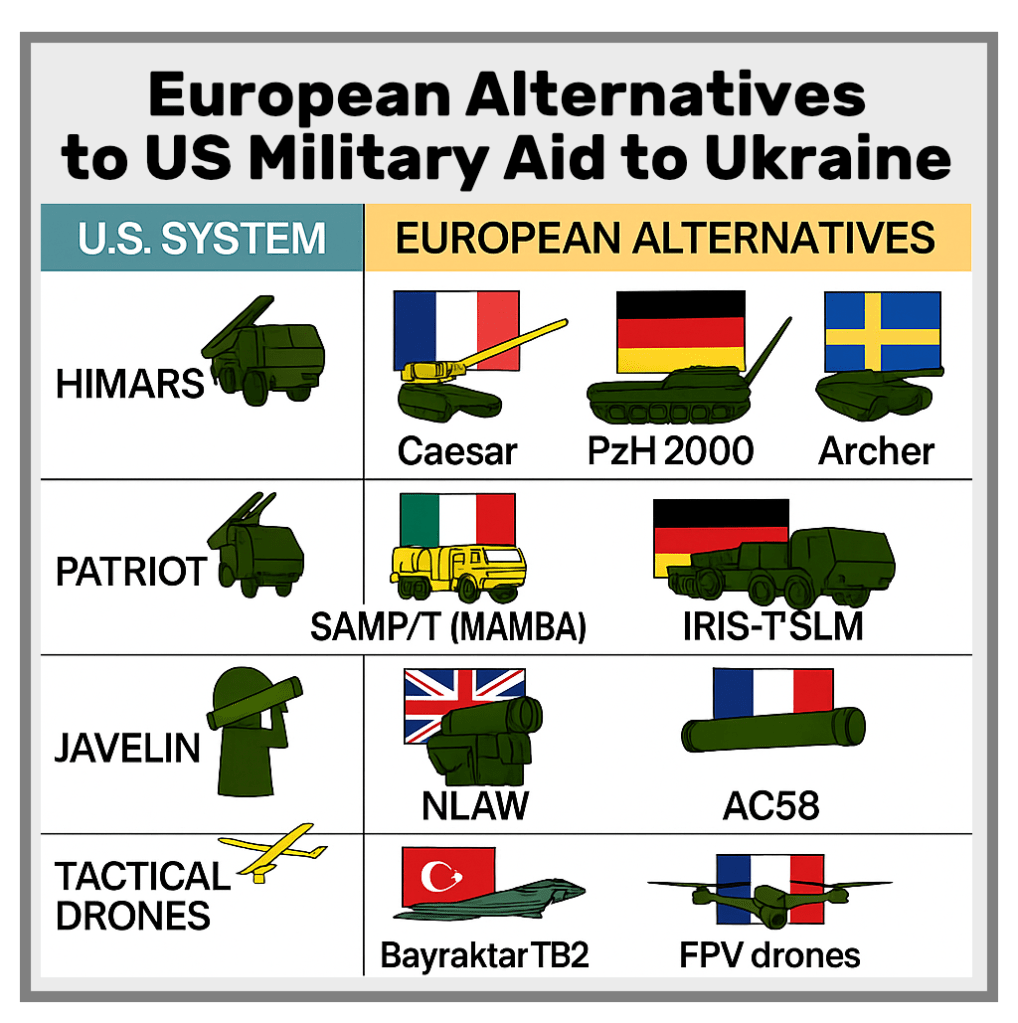
Since 2022, the United States has supplied Ukraine with a formidable array of weapons, intelligence, and training. Systems like the HIMARS rocket launchers—short for High Mobility Artillery Rocket System, a highly mobile and precise long-range rocket artillery platform—Patriot missile defense batteries, Javelin anti-tank missiles, and real-time satellite surveillance have been game-changers on the battlefield. But since 2024, U.S. support has become increasingly conditional and strategically leveraged, with aid packages paused or tied to diplomatic objectives—such as ceasefire compliance or debt repayment proposals.
This has caused anxiety in Kyiv and among NATO allies, highlighting the risks of over-reliance on a single, politically dynamic superpower. In response, Europe has not just filled the gap—it has transformed the challenge into an opportunity.
Europe’s Arsenal Awakens: Compatible Yet Competitive
European nations are rolling out a new generation of weapons systems—interoperable with NATO standards, but increasingly independent of U.S. designs.
In the field of long-range precision artillery and rockets, Europe is deploying systems like the German PzH 2000, the French Caesar, the Swedish Archer, and a European variant of the Multiple Launch Rocket System (MLRS). These alternatives offer firepower and accuracy that rival the U.S. HIMARS, with rapid deployment capabilities and growing battlefield efficiency.
In air defense, the European SAMP/T (Mamba)—short for Sol-Air Moyenne Portée/Terrestre, a medium-range surface-to-air missile system developed by France and Italy—Germany’s IRIS-T SLM—InfraRed Imaging System Tail/Surface Launched Medium-range, a cutting-edge ground-based air defense system—and the UK’s Sky Sabre are all emerging as powerful complements—and in some cases, future replacements—for the U.S. Patriot systems. These European systems are improving in range, reliability, and interoperability, proving effective in live combat scenarios.
Anti-tank warfare is another area of parity. The British NLAW—short for Next generation Light Anti-tank Weapon, a shoulder-fired, disposable missile system designed for use by infantry against armored vehicles—and French Eryx are proving to be cost-effective, easily deployed, and tactically agile alternatives to the U.S. Javelin. Though Javelin still leads in range and target-lock capabilities, European systems are preferred in close-quarter operations.
On the drone front, while the U.S. dominates with Switchblade and Phoenix Ghost drones, Europe—along with Türkiye—is catching up. The Bayraktar TB2—a medium-altitude, long-endurance unmanned combat aerial vehicle (UCAV) developed by Türkiye for reconnaissance and precision strikes—supplemented by rapid innovation in FPV (first-person view) drones—small, manually piloted drones equipped with cameras and often used as loitering munitions—along with loitering drone tech from Poland and Ukraine, shows Europe’s ability to adapt and mass-produce effective UAV solutions.
Europe is also developing its own surveillance and battlefield coordination systems. France’s CERES—short for Capacité de Renseignement Électromagnétique Spatiale, a constellation of French military satellites for electronic intelligence—and the EU Satellite Centre are improving regional intelligence capabilities, although still not at par with U.S. global intelligence networks. Meanwhile, European C4I (Command, Control, Communications, Computers, and Intelligence) systems are being refined for NATO compatibility and AI-assisted command structures.
These tools are not just theoretical—they are being live-tested on Ukrainian soil, under the harshest real-world conditions. Field results are feeding directly into Europe’s growing defense research, industrial production, and doctrine refinement.
Learning the Russian Way of War: A Crash Course in Deterrence
Beyond hardware, European forces are gaining unprecedented insight into Russian military doctrine and operational behavior:
Strengths: Effective use of artillery saturation, trench warfare, and electronic warfare (EW); increasing drone adaptability.
European observers and trainers embedded with Ukrainian units have seen these dynamics up close, allowing them to adapt faster than in any traditional training scenario. In effect, the war has become a real-time strategic classroom.
And this learning is being added on top of decades of exposure to U.S. military technology, tactics, and interoperability standards. The result is a fusion: a uniquely European doctrine that integrates NATO compatibility with localized resilience, battlefield adaptability, and self-reliance.
A New European Military Order Emerges
Europe is no longer merely a supporting actor in NATO—it is becoming a strategic force in its own right. This is evident in:
The €800 billion “ReArm Europe” initiative, pooling defense investment across the continent.
The Coalition of the Willing, a group of 30+ nations ready to back Ukraine with military and peacekeeping forces, regardless of Washington’s direction.
The EU Strategic Compass and PESCO (Permanent Structured Cooperation, a framework for EU member states to collaborate more closely on defense projects and initiatives) provide the backbone for long-term continental defense planning., providing the backbone for long-term continental defense planning.
More significantly, these steps represent a strategic pivot: from transatlantic dependence to continental autonomy, with the potential to stand alone—not just against Russia, but any global threat.
Europe as a Global Power
From a biblical and prophetic standpoint, this development is particularly striking. The Bible speaks of a final world power rising out of Europe, described in the book of Daniel and the Revelation as a “beast” system of immense influence—politically, economically, and militarily.
In that light, the consolidation of Europe’s military might—sparked by Russia’s war, accelerated by U.S. disengagement, and refined by real-world learning—takes on profound significance. What we are witnessing may well be the emergence of the military dimension of that prophesied power.
A military that was once fractured, slow, and dependent is now becoming agile, well-informed, technically sophisticated, and integrated—not only in doctrine and equipment but in strategic vision.
The Furnace That Forges
As U.S. assistance to Ukraine becomes more measured and transactional, Europe has not only risen to meet the challenge—it is turning the war in Ukraine into the forge of a new military identity. What began as a stopgap has become a transformation.
Europe is no longer just learning from the U.S.—it is learning from the enemy, innovating from within, and evolving into a deterrent force that could, one day, rival any military on Earth.
The fire of war is forging Europe’s future—and with it, the world’s direction.
On April 21, 2025, the world awoke to the news that Pope Francis, born Jorge Mario Bergoglio, had passed away at the age of 88. His death, though expected due to his recent health struggles, marks the end of a papacy that was as transformative as it was challenging.
The Legacy of Pope Francis
Pope Francis was the first Jesuit pope, the first from the Global South, and the first non-European to hold the papacy in over a millennium. Elected in 2013 following the resignation of Pope Benedict XVI, Francis quickly set a tone of humility and simplicity. He rejected the papal palace for modest quarters, emphasized service over status, and frequently reminded the Church to be “a field hospital for the wounded.”
His Key Legacies:
A Church of the Poor: Francis sought to shift the Church’s focus toward social justice, economic inequality, and care for the marginalized.
Environmental Advocacy: His encyclical Laudato Si’ was a global call to action on climate change, rooted in both science and theology.
Synodality and Inclusion: He opened up global synods to deeper listening and greater participation, especially from laypeople and women.
Bridging East and West: Francis made significant efforts to reach out to the Orthodox churches, Islamic leaders, and even the atheist world, portraying the papacy as a platform for dialogue, not division.
Yet, his papacy was not without controversy.
The Challenges He Faced
Pope Francis inherited a Church rocked by scandal, polarization, and a shrinking influence in secularized societies.
Sexual Abuse Crisis: While he took steps to address abuse and enforce accountability, critics felt he moved too slowly and hesitated in confronting entrenched institutional culture.
Doctrinal Tensions: His pastoral leniency—especially on issues like communion for the divorced and remarried—sparked pushback from conservative cardinals.
Internal Resistance: Within the Curia, efforts to reform finances and structures were met with inertia or subtle sabotage. Yet he pressed on, famously warning Vatican insiders against “spiritual Alzheimer’s” and careerism.
Global Fragmentation: As global Catholicism grew more diverse—demographically and theologically—Francis emphasized unity without uniformity, a challenging task in an increasingly polarized world.
Despite this, he remained a steady voice for over a decade.
Who Will Follow? The Frontrunners—and the Unknowns
With Pope Francis now laid to rest, the College of Cardinals will convene in the coming days to elect the next pope. While the process is steeped in prayer, tradition, and secrecy, analysts have identified several frontrunners.
Cardinal Pietro Parolin of Italy is widely respected for his diplomatic acumen as the Vatican’s Secretary of State. He brings deep institutional experience and a calm, steady hand in global affairs. However, he is sometimes seen as too reserved or bureaucratic, lacking the charismatic presence many seek in a modern pope.
Cardinal Luis Antonio Tagle from the Philippines is known for his warmth, eloquence, and global popularity. Often described as “the Asian Francis,” his pastoral approach and media-friendly presence make him a compelling figure. Still, his perceived closeness to Pope Francis and prior management challenges in Caritas Internationalis may lead some cardinals to hesitate.
Cardinal Matteo Zuppi of Italy is a bridge-builder and advocate for peace, respected for his leadership in both ecclesial and political circles. His involvement in international peace efforts and emphasis on compassion position him as a continuity candidate. Yet, his progressive image might not sit well with more conservative electors.
Cardinal Jean-Claude Hollerich of Luxembourg is a Jesuit with sharp intellect and a deep understanding of European affairs. As president of COMECE, he brings a sophisticated grasp of EU dynamics. However, his openness to revisiting Church teachings may alienate more traditional factions.
Cardinal Peter Turkson of Ghana has long been a prophetic voice on social justice, environment, and global inequities. He commands global respect, particularly in the Global South. Nonetheless, his advanced age and some internal controversies during his Vatican tenure may dim his prospects.
Cardinal Robert Sarah of Guinea is revered by traditionalists for his doctrinal clarity and liturgical conservatism. A fierce defender of persecuted Christians, he could anchor the Church in orthodoxy. Yet, his strong conservative stance may polarize the conclave.
But history reminds us: the next pope is not always the frontrunner. In 2013, very few observers predicted the election of Jorge Bergoglio. And yet, it was he who emerged from the Sistine Chapel balcony as Pope Francis.
Geopolitical Crossroads: The Next Pope’s New World
The pope is not just the Bishop of Rome; he is a global religious statesman. The next pontiff will inherit a world in flux—and a Church that must navigate through rapidly shifting tides.
1. Europe’s Fragile Unity
With the U.S. becoming increasingly isolationist, Europe is left to face rising Russian aggression on its own. The next pope will need to be a voice for moral clarity and continental unity, encouraging Europe to reclaim not just political cooperation but a shared spiritual heritage.
2. Sharia Law and Cultural Tensions
Across parts of Europe, the growing Muslim population has led to calls for recognition of Sharia-based parallel legal systems. The new pope will have to navigate interreligious relations with both diplomatic grace and doctrinal firmness, defending the religious freedom of all while protecting Christian identity.
3. Global Persecution of Christians
From the Middle East to Africa and even parts of Asia, Christians are increasingly persecuted, discriminated against, and even martyred. The next pope will need to be an unflinching advocate for the persecuted Christians (Catholics, in particular), pressing global leaders to act while strengthening the Church’s support systems on the ground.
4. The Rise of New Empires
China’s economic dominance, Russia’s militarism, and a fragmented West point to the emergence of competing “blocs” of influence. The Catholic Church, uniquely global and transnational, will need to be a bridge-builder and a moral compass in a divided age.
God Is Sovereign
While cardinals may deliberate, campaign informally, and weigh personalities and programs, the ultimate decision lies beyond their human plans.
“For there is no authority except from God, and those that exist have been instituted by God.” — Romans 13:1 (ESV)
Throughout history, God has raised up kings, emperors, and yes—even popes—to accomplish His divine purpose. The next pope, whoever he is, will be stepping into a role far greater than himself.
When President Donald Trump announced sweeping tariffs against nearly all countries in April 2025—infamously dubbed “Liberation Day”—the move was framed as an act of economic sovereignty. Aimed at defending American workers, correcting trade imbalances, and punishing foreign nations accused of unfair practices, the 10% baseline tariff (and far higher rates for select nations) was meant to be a declaration of independence from a trade system that many believed disadvantaged the United States.
But what began as an assertion of American self-interest is now reverberating across the globe, triggering economic tremors that few anticipated and many fear may permanently reshape the global order.
The Intentions: Economic Nationalism Reborn
Trump’s rationale was not new. Tariffs have historically been used to protect domestic industries, reduce reliance on foreign imports, and pressure trade partners to change their behavior. This round of tariffs was more sweeping than any the U.S. had imposed in over a century. The administration targeted over 180 countries, including allies, emerging economies, and even remote territories that barely trade with the U.S.—a precaution against tariff evasion through transshipment.
The administration’s messaging was simple but aggressive: it’s time for America to stop being the world’s economic doormat and to rebuild its industrial might from within.
The Reality: Economic Strain and Fragmentation
However, history and current evidence tell a more sobering story. Tariffs are blunt instruments. While they may temporarily protect local industries, they often result in higher consumer prices, supply chain disruptions, and retaliatory measures. We’ve seen this before—during the Great Depression with the Smoot-Hawley Tariff Act and more recently during Trump’s first term trade war with China. In both cases, the long-term consequences were damaging.
In 2025, it’s happening again—on a broader scale:
Stock markets have plunged, wiping out trillions in value.
Consumer prices are rising as import costs spike.
Supply chains are unraveling as companies scramble to redirect sourcing.
Global trade flows are shifting away from the U.S., as countries retaliate and seek new partners.
The U.S. hoped to isolate abusive trading behaviors, but it is increasingly isolating itself.
The Rise of Economic Blocs
In response, the world is reorganizing into regional economic blocs. What America has stepped away from, others are now rushing to claim:
The European Union, increasingly united in trade and security, is moving to fill the void in global leadership.
China, through its Belt and Road Initiative and new trade alliances across Asia, is tightening its grip on emerging markets.
India, ASEAN nations, and Latin America are pursuing regional deals to shield themselves from U.S. unpredictability.
Africa, through the African Continental Free Trade Area (AfCFTA), is charting a course toward intra-regional trade independence.
These blocs are forming not just out of economic logic—but out of necessity. The post–World War II era of U.S.-led globalization is ending. In its place, a fragmented, competitive, and increasingly adversarial global economy is emerging.
The Geopolitical Risks: From Trade War to Real War
This economic realignment carries with it grave geopolitical risks.
As trade blocs become more inward-looking and rivalrous, the possibility of military conflict among major powers increases—especially as nuclear-armed states compete for influence, resources, and strategic positioning. The risk of conflict between the U.S. and China, or even among European powers and their neighbors, is no longer hypothetical—it is becoming increasingly likely in a world no longer bound by mutual economic interest.
Furthermore, the economic instability triggered by tariff wars could prompt a dangerous political shift. History has shown us that during extremely difficult times, people can trade personal freedom for security. With inflation, job losses, and uncertainty mounting, charismatic strongmen often step into the void—offering order, prosperity, and national pride in exchange for civil liberties and democratic safeguards.
A World on the Edge
This is precisely the world that the Bible describes will exist just before the return of Jesus Christ.
The book of Revelation speaks of a final global system—a powerful economic and military confederation—that dominates the world for a short time. This “beast” power promises security and prosperity, and the world, desperate for stability, embraces it. But this system, empowered by human pride and corrupted leadership, ultimately brings humanity to the brink of annihilation (Matthew 24:22).
We are not there yet—but the signs are unmistakable.
The weakening of American influence, once a stabilizing force in the world, is accelerating.
The rise of rival blocs, each with its own rules and ambitions, is fracturing the global system.
The erosion of freedoms in favor of authoritarian efficiency is gaining traction.
A Time to Watch and Prepare
President Trump’s tariffs were intended to make America strong. But by pursuing economic disengagement in a globalized world, the U.S. may have instead triggered the unraveling of the very system that kept major conflicts in check.
We do not place our hope in presidents, trade policies, or economic systems. We watch these events with a discerning eye—not in panic, but in understanding. The unraveling world system is not the end of the story. It is a prelude to Christ’s return, when the kingdoms of this world will become the kingdoms of our Lord and of His Christ (Revelation 11:15).
While men pursue security through strength and prosperity through force, true peace will only come through the righteous rule of God’s coming Kingdom.
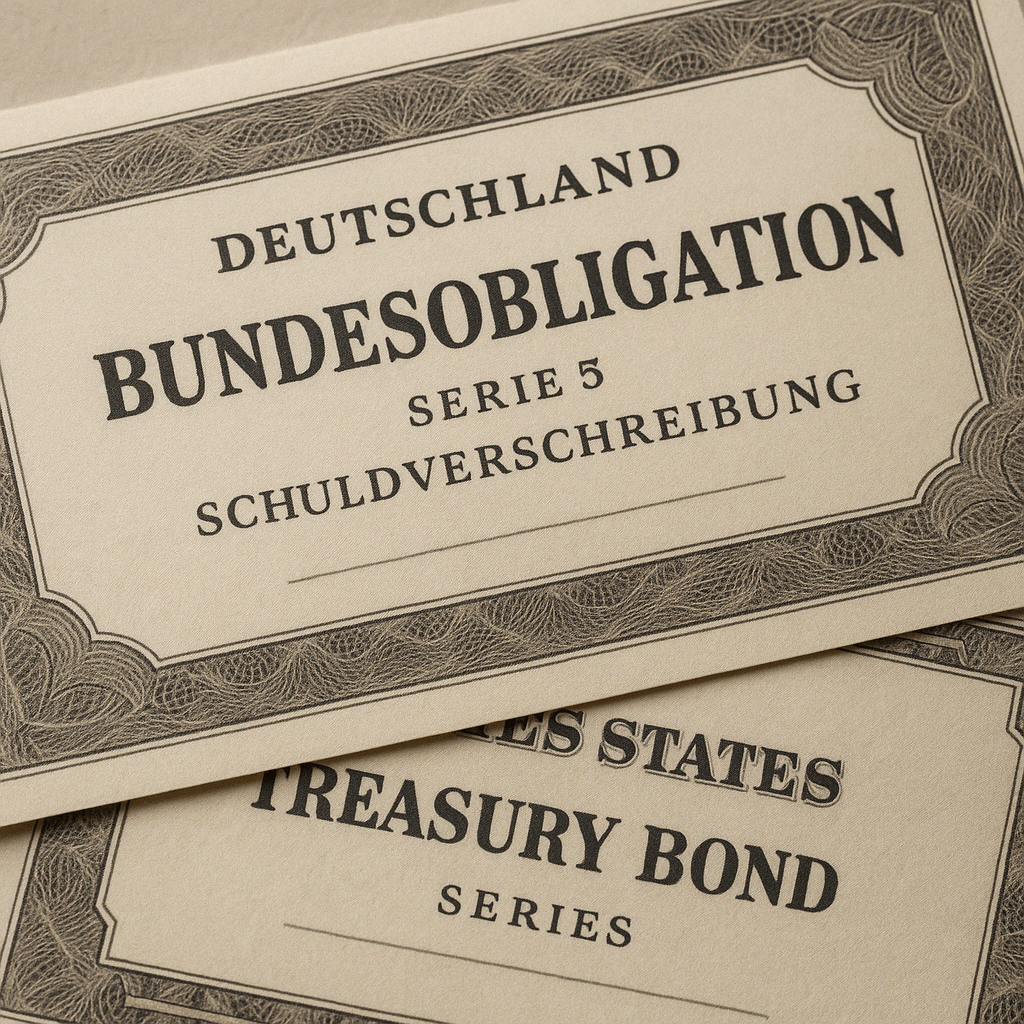
In a stunning turn of events that highlights the growing volatility of the global economic order, massive investment capital recently flowed into German government bonds (Bunds)—not during a surge in optimism, but ironically while the markets were collapsing. As investors fled from the perceived safety of U.S. Treasury bonds, they sought refuge in what many now regard as a more reliable store of value: German Bunds.
This development is not merely a market footnote. It is a signal—a telling indicator of where the global economy may be headed and how the world is gradually repositioning itself away from U.S. dominance.
Where Did the Money Go When the U.S. Markets Fell?
When the U.S. stock market tumbled and Treasury bonds were unexpectedly sold off—a rare sign of lost confidence—investors redirected their money into various safe-haven assets, including:
Gold – A time-tested hedge against inflation and currency instability. While it has universal value, it yields no income and lacks an economic engine like a government bond.
Swiss Franc and Swiss Bonds – Switzerland’s neutrality and stable banking sector make it attractive in crises. But the market is small and lacks the influence of a continental economy like the EU.
Japanese Government Bonds – Japan’s political stability and economic power still attract investors, though its massive debt levels and shrinking population limit long-term confidence.
High-Rated Corporate Bonds – Blue-chip corporate debt offers a balance of risk and return, but it still depends on company-specific performance and is no substitute for sovereign backing.
Despite these options, the German Bund stood out. Investors were not just seeking safety—they were seeking credibility, discipline, and leadership in a changing financial landscape.
The Rise of the German Bond
Why did the German Bund rise above the rest?
Stability and Discipline: Germany maintains a low debt-to-GDP ratio and upholds strict fiscal policy.
Economic Strength: It leads Europe in exports, productivity, and industrial capacity.
Institutional Trust: German governance is measured, transparent, and central to the EU framework.
German bonds provide both safety and structure, tied to real economic output and geopolitical influence.
A Future European “Super Bond”?
As the EU continues integrating politically and economically, a unified Eurobond seems inevitable. That bond may simply be modeled after the German Bund or even adopt its structure entirely.
Such a development would:
Strengthen the euro as a global reserve currency
Centralize the EU’s financial system
Challenge, or even replace, the dominance of the U.S. dollar in world trade
The Fall of the Anglo-Saxon Economies
America and Britain have long been pillars of the global economic system. But the Bible warns that the modern descendants of Ephraim (Britain) and Manasseh (U.S.) would be brought low as they forsake God.
Their decline is now underway:
The dollar is declining in global preference
U.S. bonds are losing their safe-haven status
Internal chaos and international isolation are rising
As the dollar fades, Europe is rising—and with it, a system that will soon dominate the world.
The End-Time Economic Empire
The surge in demand for German bonds—and the push toward a centralized European financial tool—are early signs of what the Bible foretells: a final superpower in Europe that will control global commerce.
At its heart may be a financial instrument—perhaps resembling the German Bund—that becomes the foundation of world trade. At that time, the dollar will be irrelevant, and U.S. Treasury bonds will no longer matter.
God gave this warning to Israel through Hosea:
“When they had pasture, they were filled; they were filled and their heart was exalted; therefore they forgot Me.” — Hosea 13:6
And Moses had earlier said:
“Beware that you do not forget the Lord your God… when your herds and flocks multiply, and your silver and your gold are multiplied… and your heart is lifted up, and you forget the Lord your God.” — Deuteronomy 8:11–14
This is the story of modern Israel: economic pride followed by spiritual amnesia. And as always, pride comes before a fall.
But God’s goal is not destruction—it is repentance. The coming collapse of the Western financial system will prepare the hearts and minds of peoples descended from ancient Israel and the rest of the world for the return of Jesus Christ, who will establish a righteous economy and government rooted in truth, equity, and lasting peace.