Category: Europe

  • A Pause in the Storm: President Trump’s Tariff Reversal and the Wisdom of Many Counselors

    A Pause in the Storm: President Trump’s Tariff Reversal and the Wisdom of Many Counselors

    The global markets held their breath—and then exhaled—when President Donald Trump announced a sudden 90-day pause on the sweeping tariffs he had imposed on virtually all U.S. trading partners. Except for China, whose tariffs were raised sharply to 125%, most nations received a temporary reprieve from what many feared would become a full-scale global trade war.

    But this “pause” has analysts and world leaders wondering: is this merely a temporary detour, or the beginning of a quiet retreat?

    Why the Sudden Shift?

    The official narrative from the Trump administration is that this is a “strategic pause”—a window of time to negotiate bespoke trade arrangements with allies and economic partners. Treasury Secretary Scott Bessent noted that the 90-day halt gives space for talks with countries like Japan, Vietnam, and the European Union.

    Yet beneath this diplomatic language lies a more complex—and revealing—story.

    Internal Dissent

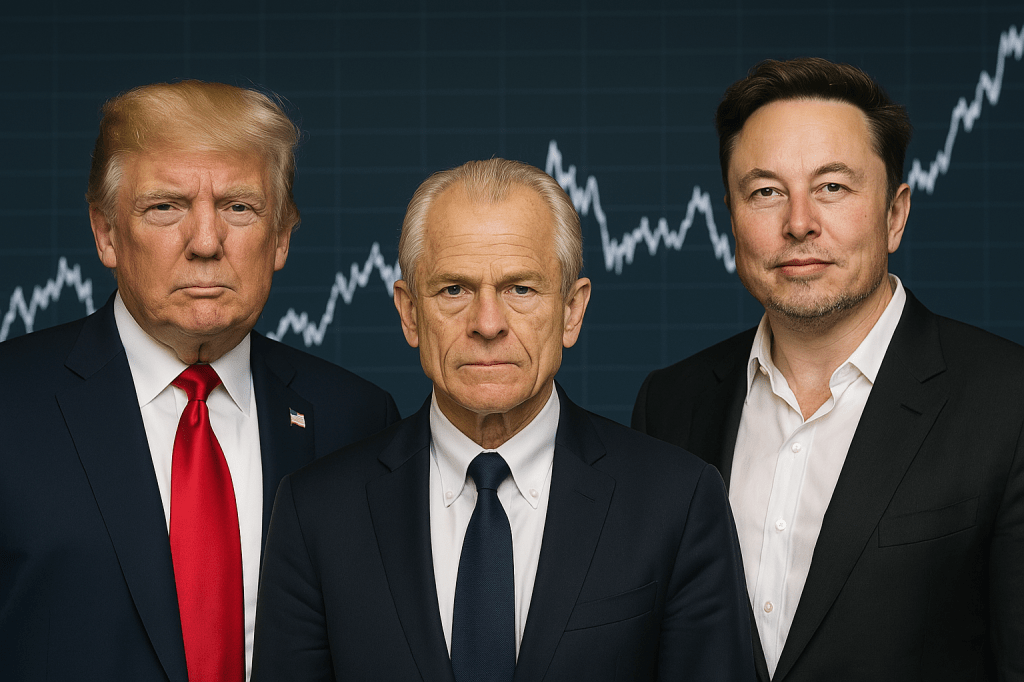
    While some cabinet members like Commerce Secretary Howard Lutnick and trade advisor Peter Navarro pushed aggressively for the tariffs, others sounded the alarm. Treasury Secretary Bessent and National Economic Council Director Kevin Hassett reportedly warned of the dangers of a unilateral tariff policy, urging a more measured and consultative approach.

    Their concerns proved prescient.

    Elon Musk’s Warning

    One of the loudest voices from the private sector was Elon Musk, who called for a zero-tariff environment between Europe and North America and warned that blanket tariffs would disrupt Tesla’s global supply chain. Musk’s businesses depend on internationally sourced components, and the tariffs would significantly raise production costs.

    Predictably, Navarro dismissed Musk’s position as self-serving. But the economic fallout soon made it clear that Musk and others raising red flags were not speaking out of self-interest alone—they were highlighting systemic risks to American consumers, workers, and the broader economy.

    Economic Turbulence and Market Recoil

    The markets responded with a wild swing of emotion.

    At first, optimism over the tariff pause sent the S&P 500 up 9.5% in a single day—one of the largest one-day rallies in its history. But the euphoria didn’t last. Investors quickly realized that no one knows what happens on Day 91. Will the tariffs resume in full force? Will exceptions be granted selectively? The lack of clarity caused a sharp sell-off the next day, with the Dow losing over 2,000 points.

    Businesses across the country remain in limbo. Some are delaying hiring and investments. Others are considering shifting supply chains abroad—ironically, the opposite of the tariffs’ intended effect.

    Why Call It a “Pause” Instead of a Reversal?

    Calling it a “pause” allows the President to preserve political face. It offers flexibility: he can later say he gave America’s partners a chance to negotiate—and if they didn’t, he had no choice but to proceed.

    This language also keeps pressure on foreign governments while maintaining domestic leverage. But make no mistake: if the tariffs are reinstated, the economic whiplash could be far worse the second time around. The credibility of U.S. trade policy is already in question. A re-escalation could deepen inflation, strain key industries, and damage America’s standing in global markets.

    A Lesson in Leadership: The Value of Many Counselors

    Could this turmoil have been avoided? Almost certainly yes.

    Had the administration listened early on—not only to internal critics but also to voices like Elon Musk’s—much of this volatility might have been spared. The issue wasn’t merely policy—it was isolation in decision-making, surrounded by yes-men and ideological hardliners.

    The Bible has long taught the wisdom of diverse counsel:

    “Where there is no counsel, the people fall;
    But in the multitude of counselors there is safety.”
    (Proverbs 11:14)

    “Without counsel, plans go awry,
    But in the multitude of counselors they are established.”
    (Proverbs 15:22)

    Scripture reveals that even great leaders falter when they ignore wise advice. King Rehoboam rejected the seasoned advice of elders in favor of arrogant young men, splitting the kingdom of Israel (1 Kings 12). Moses thrived by heeding Jethro’s advice to delegate (Exodus 18).

    The principle is clear: humility and wise counsel go hand in hand. National leaders who isolate themselves in echo chambers risk decisions harmful to their reputation and their people.

    Adjusting the Course

    President Trump’s tariff pause may signal rethinking—or merely a tactical maneuver. Its lessons should not be missed. Listening only to affirming voices leads to blind spots. Strong leadership isn’t about always being right, but about being wise enough to adjust course when consequences become clear.

    The Bible’s wisdom remains timeless. If only more leaders today took it to heart.
  • Trump’s Tariff on the EU: A Trigger for Economic Realignment with Prophetic Implications

    Trump’s Tariff on the EU: A Trigger for Economic Realignment with Prophetic Implications

    In a bold move that is already rippling through the global economy, U.S. President Donald Trump announced the imposition of a 25% tariff on certain products imported from European Union member nations, particularly targeting automobiles and auto parts. Framing the policy as a necessary act of economic defense, Trump cited several reasons: the protection of the U.S. auto industry, the need to correct trade imbalances, and to promote domestic manufacturing.

    The Reasons Behind the Tariffs

    According to the Trump administration, the United States has for too long tolerated unfair trade practices from the EU. European auto manufacturers, buoyed by state subsidies and benefiting from high U.S. market access, have allegedly disadvantaged American producers. Trump also pointed to the persistent trade deficit with Europe as proof that the playing field needs to be leveled. Lastly, in line with his “America First” agenda, Trump aims to bring jobs and factories back to the U.S. heartland.

     “For decades, we allowed foreign nations to take advantage of our workers, our industries, and our markets. Those days are over.” — President Donald Trump

    While these goals may sound patriotic, the method—tariffs—has proven to be a deeply flawed tool for addressing such systemic issues.

    The EU’s Strong but Strategic Response

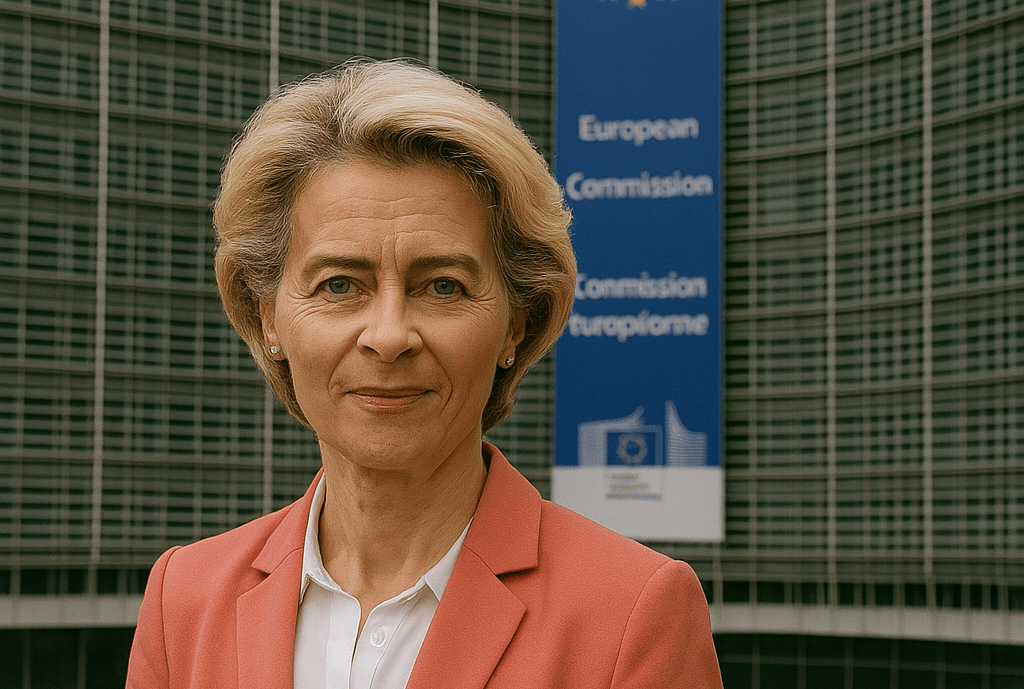
    European Commission President Ursula von der Leyen responded swiftly and assertively. She called the tariffs unjustified and warned that the European Union would not submit passively.

     “Let me be clear: We did not start this. But we will respond with strength and unity. The European Union will always defend its people and its interests.” — Ursula von der Leyen

    Instead of backing down, the EU announced it would reinstate previously suspended retaliatory tariffs and introduce new duties targeting over €18 billion worth of American goods.

    But von der Leyen didn’t stop there. In a move with far-reaching implications, she declared that the EU would intensify efforts to remove internal trade barriers among member states, strengthening Europe’s economic unity and competitiveness. This is not just a tactical response—it is a strategic redirection that could reshape global economic power dynamics.

    The Problem with Tariffs: A Historical and Economic Perspective

    Historically, tariffs have not proven effective in resolving the very problems the Trump administration seeks to address. Here’s why:

    • Trade Deficits Persist: Tariffs do little to reduce overall trade deficits, which are more influenced by consumption patterns, currency values, and national savings rates than by trade policies alone.
    • Domestic Costs Rise: Tariffs often raise the price of goods for domestic consumers and businesses, resulting in job losses in downstream industries, as happened with steel tariffs in the early 2000s.

    “In an effort to help one industry, tariffs often hurt many others. For every job saved, others are lost in the supply chain.” — Peterson Institute for International Economics

    • Global Supply Chains Are Disrupted: Especially in industries like automobiles, where parts come from multiple countries, tariffs complicate logistics and increase production costs.
    • Retaliation Undermines Gains: Rather than bringing trade partners to heel, tariffs often provoke retaliation—escalating into trade wars that benefit no one.

    In short, the strategy of imposing tariffs often fails to achieve its intended outcomes. Worse, it can spark deeper divisions and strengthen the resolve of other nations to build alternative economic alliances.

    Unintended Consequences: Strengthening an Emerging Economic Giant

    By pushing the EU to become more internally unified and economically autonomous, these tariffs may ultimately accelerate the rise of a formidable economic force centered in Europe. A more integrated and efficient European single market—less dependent on the U.S.—could emerge as a dominant global player.

    In economic terms, this is more than just a response; it’s the birth of a new power structure. And in prophetic terms, it aligns with a picture the Bible has long painted.

    A Prophetic Fulfillment Unfolding

    The Book of Revelation warns of the rise of a powerful system called Babylon the Great, described as a dominant force influencing “all the nations” with its wealth, commerce, and political might:

    “For all the nations have drunk of the wine of the wrath of her fornication, and the kings of the earth have committed fornication with her, and the merchants of the earth have become rich through the abundance of her luxury.” — Revelation 18:3

    Many biblical scholars understand this as a future revival of the Roman Empire, centered in Europe—a union of nations wielding enormous economic and religious influence.

    This entity is prophesied to become the epicenter of global trade and power, even as the United States recedes into economic and geopolitical insignificance. The very actions that Trump hopes will “Make America Great Again” may instead be accelerating the transfer of influence to a new superpower arising out of Europe.

    Provoking Conflict

    The Bible gives practical wisdom on the folly of provocation:

     “As charcoal is to burning coals, and wood to fire, so is a contentious man to kindle strife.”

     — Proverbs 26:21

    Instead of resolving disputes, provoking a quarrel usually escalates the conflict, rarely resulting in the other party’s servile submission. This principle applies powerfully to international relations. Trump’s aggressive trade posture has not cowed the EU—it has galvanized it.

    An Economically Fortified Europe

    In the short term, the 25% tariff may appear to be a strong move to protect American jobs and industries. But in the long run, it may provoke the rise of a unified, economically fortified European power that is not just a rival but, prophetically, a system poised to dominate the world scene before the return of Jesus Christ.

    For those who understand the deeper forces at work—both geopolitical and spiritual—these developments are not random. They are part of a larger plan that is unfolding, exactly as foretold.

  • The “Freeloader” Fallacy and the Unraveling of the World America Built

    The “Freeloader” Fallacy and the Unraveling of the World America Built

    In recent years, voices from within the United States—most prominently in the current administration of President Donald Trump—have labeled America’s European allies as “freeloaders.” This sentiment, recently reinforced by leaked chats from senior U.S. defense officials, suggests that the U.S. is unfairly burdened by its role as the world’s security guarantor, while allies reap the benefits without paying their fair share.

    But this view, while emotionally resonant in a time of rising nationalism and budget pressures, fails to recognize a deeper historical truth: the so-called “freeloading” arrangement was designed by the United States itself after World War II.

    America’s Strategic Design After World War II

    When the dust of WWII settled, the United States stood as the dominant power in a shattered world. Europe lay in ruins. Germany, the nation that had ignited two world wars, was disarmed and divided. The Soviet Union, though an ally during the war, quickly emerged as a global ideological and military threat, expanding its grip over Eastern Europe and seeking to export communism globally.

    To prevent a third world war—and to contain the spread of Soviet communism—the U.S. devised a grand strategy. It would serve as a global security umbrella, deploying its vast military and nuclear power to deter aggression in both Europe and Asia.

    But this security guarantee came with conditions.

    Why the U.S. Took on the Burden

    In Europe, the U.S. created NATO in 1949, a collective defense alliance that essentially declared: “If the Soviets invade, America will respond.” This meant stationing tens of thousands of troops in Germany and elsewhere—not to dominate Europe, but to protect it, while also ensuring that Germany would never again re-arm on its own and potentially start another global war.

    The U.S. didn’t stop in Europe. In Asia, the United States went even further: it wrote Japan’s post-war constitution, explicitly forbidding it from maintaining offensive military forces. In exchange, the U.S. promised to defend Japan from any external threats. This kept the peace in the Pacific and ensured that Japan, once an imperial power, would remain a pacifist state under American protection.

    Aside from maintaining military presence in various points around the globe, this also meant that the U.S. Navy would patrol the world’s oceans and major trade routes, ensuring they remained open and secure for international commerce. This naval presence guaranteed that goods, products, energy supplies, and even people could travel safely across seas and continents, under the protection of a rules-based order that the U.S. enforced. In effect, the United States became the maritime guardian of global trade, allowing the modern economy to flourish.

    The Global Bargain

    What did America get in return?

    Quite a lot.

    These countries, under the U.S. defense umbrella, pledged to:

    • Side with the United States in the ideological and military contest of the Cold War. 
    • Maintain for the most part (or at least at the surface) democratic forms of governance, compatible with American values and institutions. 
    • Participate in a global economic system centered on free trade, the U.S. dollar, and open access to American markets, capital, and technology. 

    This arrangement created decades of global stability, fueled unprecedented economic growth, and cemented America’s leadership role in the world. Allies didn’t have to spend massive portions of their GDP on defense, because America did it for them—intentionally, and as a strategic choice.

    But this system also worked immensely in America’s favor:

    • It helped defeat the former Soviet Union.
    • It generated vast wealth for the United States.
    • It gave America access to the natural resources, talent, savings, and investments of allied nations.
    • It kept the U.S. economy resilient, allowing it to absorb shocks during oil crises, recessions, and financial collapses because the global economy was effectively built around it.

    This wasn’t just charity. It was a mutually beneficial arrangement that secured the U.S. economy and reinforced its global dominance across finance, technology, and military affairs.

    The Trump Doctrine and the Unraveling Order

    Enter the 21st century, and with it, growing discontent. Successive U.S. administrations urged allies to increase defense spending, but President Trump went further—publicly ridiculing NATO partners, questioning America’s commitment to mutual defense, and suggesting that the U.S. might not come to their aid.

    The recent leaks of U.S. defense officials calling allies “freeloaders” is not new rhetoric—it is the continuation of a growing American retrenchment from the very system it built. This shift is not just about burden-sharing; it’s about dismantling a world order that was held together by American security guarantees and economic leadership.

    And the consequences are enormous.

    As America pulls back:

    • Germany is rearming—a move unthinkable just a decade ago.
    • Japan is building new missile capabilities, breaking with its pacifist tradition.
    • France and others are openly discussing European “strategic autonomy,” no longer counting on U.S. support.

    The global system is fragmenting. Old alliances are fraying, and new coalitions may rise—not because of shared values, but based on shared interests, geography, or ethnicity. The future could very well be a world of competing blocs, exclusive clubs, and permanent insecurity.

    A Nation in Decline—By God’s Hand

    It is tempting to see all this purely through the lens of geopolitics. But for those who understand biblical prophecy, something deeper is taking place.

    America’s decline is not merely the result of policy decisions or shifting public opinion—it is a judgment from God.

    “My people are destroyed for lack of knowledge. Because you have rejected knowledge, I also will reject you… I will change their glory into shame.”  (Hosea 4:6–7)

    God blessed America with power, influence, and prosperity—but as the nation increasingly turns from Him, He is taking away its leadership role, allowing other powers to rise in its place. Whether those nations will be friendly or adversarial remains to be seen—but they will not uphold the same values or provide the same guarantees.

    What we are witnessing is not just the collapse of a U.S.-led global system. We are witnessing a divine reshaping of the world order, as foretold in Scripture.

  • When a Signal Becomes a Siren: How a Digital Blunder Revealed a Geopolitical Rift

    When a Signal Becomes a Siren: How a Digital Blunder Revealed a Geopolitical Rift

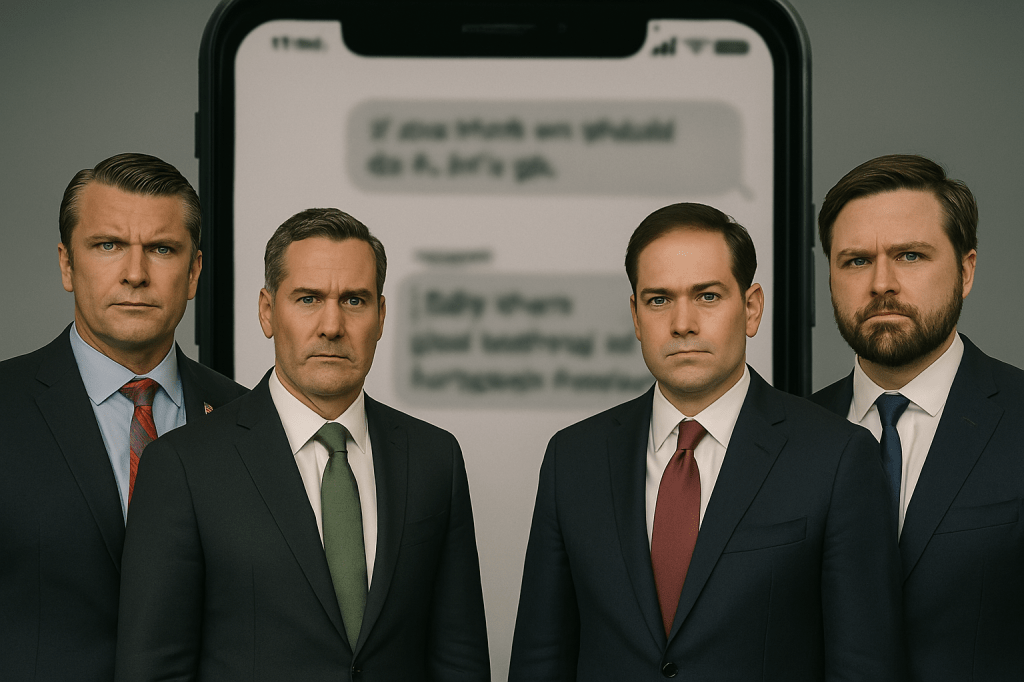
    In a moment that would be almost comedic if it weren’t so alarming, a senior U.S. official recently added The Atlantic editor-in-chief Jeffrey Goldberg to a Signal group chat intended only for top-level military and government leaders. Inside this chat, senior members of the Trump administration—including Defense Secretary Pete Hegseth, National Security Adviser Mike Waltz, Secretary of State Marco Rubio, and Vice President JD Vance—were discussing a potential military strike against Houthi rebels in Yemen. The conversation contained what most observers would consider sensitive, if not outright classified, operational information: target locations, aircraft to be deployed, weapons systems, and timelines.

    Goldberg, stunned to find himself in the virtual war room, watched silently. The officials, apparently oblivious to his presence, continued discussing military actions with astonishing candor. Later, Goldberg went public with screenshots and a narrative of the incident, sparking outrage—not just in Washington, but across Europe and the broader international community.

    This was not just a breach of digital security. It was a breach of trust. And its fallout may mark yet another turning point in the slow erosion of America’s leadership among its democratic allies.

    Europe’s Growing Frustration

    Perhaps more damaging than the operational details were the opinions shared within the chat. Vice President JD Vance was quoted saying: “If you think we should do it, let’s go. I just hate bailing Europe out again.” To which Defense Secretary Hegseth replied: “I fully share your loathing of European freeloading. It’s PATHETIC.”

    European diplomats were stunned. While allied nations often have disagreements behind closed doors, these words—blunt, dismissive, and now public—cut deep. One EU diplomat told Politico that this leak confirmed their worst fears: that these officials were not merely posturing in public, but genuinely disdainful of their European counterparts. The comment reinforced the view that the U.S., under current leadership, no longer sees NATO and other alliances as relationships of mutual respect, but as burdens it reluctantly carries.

    Former British Defense Secretary Grant Shapps and other European leaders were quick to point out that UK aircraft were directly involved in supporting U.S. operations in the region. The characterization of Europe as passive and parasitic was not only wrong—it was insulting.

    The Cracks in the Alliance Are Widening

    This diplomatic fiasco didn’t happen in a vacuum. It comes on the heels of years of shifting American foreign policy—retreats from multilateralism, trade skirmishes, and a growing isolationist sentiment among U.S. voters and officials. Allies have already begun to question whether the U.S. can still be counted on in a crisis. Now, they are wondering whether they should even try.

    The European Union has long debated the need for “strategic autonomy”—building its own defense capacities independent of the U.S. This event may give that idea a new urgency.

    The Tail and Not the Head

    From a biblical standpoint, what we are witnessing is not just a political realignment. It is a spiritual reckoning.

    In Deuteronomy 28, God outlines the blessings for obedience and the curses for disobedience directed to the descendants of Israel. Among the warnings, He said:

    “The LORD will make you the head and not the tail… if you heed the commandments of the LORD your God” (Deuteronomy 28:13).

    But if Israel disobeyed, the reverse would happen:

    “The alien who is among you shall rise higher and higher above you, and you shall come down lower and lower. He shall be the head, and you shall be the tail” (Deuteronomy 28:43–44).

    America, modern descendant of the biblical tribe of Manasseh (a son of Joseph and a branch of the house of Israel), was once clearly the “head” of the nations—a global leader, a force for order, a beacon of democratic values. But it has increasingly turned its back on God’s commandments. It celebrates what God calls sin, exalts pride over repentance, and puts national interest before divine instruction.

    This latest diplomatic debacle is a reflection of that spiritual decline. A nation that cannot keep its communications secure, that mocks its allies behind their backs, and that fails to act with humility and integrity, is not fit to lead. It is becoming the tail.

    A Warning and a Wake-Up Call

    The Signal group chat leak is more than a tech blunder or diplomatic embarrassment. It is a sign of unraveling leadership—moral, strategic, and spiritual. America’s allies are losing faith. Its adversaries are watching closely. And its citizens are left wondering how the world’s most powerful nation could stumble so carelessly.

    But Scripture shows us the way back:

    “Return to Me, and I will return to you,” says the LORD of hosts (Malachi 3:7).

    America—and indeed all modern descendants of Israel—need to humble itself, and to restore the values that once made it great.

    Until then, the head will continue to become the tail.

  • Europe’s Economic Momentum: The European Council’s Latest Agreements and the Rise of a Powerhouse

    Europe’s Economic Momentum: The European Council’s Latest Agreements and the Rise of a Powerhouse

    In a rapidly shifting geopolitical landscape, the European Union (EU) is making bold moves to cement its place as an economic superpower. The recent European Council Summit in Brussels may not have made global headlines, but its economic agreements could very well mark a turning point—not just for Europe, but for the entire world order. These decisions, once fully realized, will enhance internal trade, fortify the EU against unpredictable external shocks like U.S. tariffs, and align with a prophetic trajectory long described in the Bible.

    A Strategic Shift Toward Internal Strength

    At the heart of the summit’s economic agenda was competitiveness—not merely as a buzzword, but as a detailed and actionable commitment. EU leaders emphasized the urgent need to reduce regulatory burdens, fast-track investments in innovation, and ensure that European businesses can scale and trade more freely across the Union.

    • Simplifying regulations to make compliance easier and faster
    • Cutting red tape to reduce barriers to entrepreneurship
    • Boosting strategic sectors like clean tech, digital infrastructure, and defense manufacturing
    • Mobilizing private and public investment toward a greener, more resilient economy
    • Accelerating the Capital Markets Union to unlock pan-European financing and reduce dependence on U.S. capital

    In other words, the EU is building an internal economic engine capable of powering itself—with or without favorable external trade relations.

    Shielding Europe from Unpredictable U.S. Trade Policies

    This effort to “strengthen the inside” comes at a critical time. The return of a Trump administration has revived protectionist trade policies, including new tariffs on EU steel, aluminum, and potentially automobiles and alcohol. These moves, often executed with little warning or negotiation, have left European exporters scrambling and trade diplomats frustrated.

    In contrast, the EU’s approach appears more rules-based, predictable, and business-friendly. Decision-making processes may be slow and consensus-driven, but once adopted, EU economic policies tend to provide long-term stability.

    This contrast is growing starker, especially as the United States seems to oscillate between multilateralism and nationalism with each new administration.

    By fortifying its internal market and expanding trade partnerships beyond the U.S.—toward Asia, Africa, and Latin America—the EU is buffering itself from the turbulence of American politics and global market shocks. It’s an economic strategy rooted in resilience, self-reliance, and forward-looking collaboration.

    A Biblical Powerhouse in the Making

    Revelation 17 speaks of a “beast power” rising out of the sea, forged by a union of nations and guided by a dominant political and religious force. Daniel 2 and 7 describe a succession of world empires, culminating in a final kingdom characterized by ten kings (or nations) giving their power to one system. This points to a unified European power—not necessarily the EU in its current form, but something that could easily emerge from it.

    When we see the EU laying the economic foundation for such unity—standardizing rules, integrating capital markets, and collectively responding to global threats—we are witnessing a transitional phase in prophetic fulfillment. An economic powerhouse is taking shape, not by accident, but by design—and it aligns strikingly with what the Bible foretells.

    More Than Just Economics

    The European Council’s latest agreements are not merely about economic growth—they are about sovereignty, identity, and preparation. By streamlining its internal market and lessening dependence on unpredictable allies, the EU is setting the stage for deeper integration—economically, politically, and possibly even militarily.

    Compared to the increasingly erratic trade policies of the United States, Europe’s methodical and cooperative approach looks not just appealing—but strategically superior. What we’re seeing is not just the evolution of a trading bloc. We may be witnessing the formation of a prophetic empire whose economic foundation is already being laid.