Category: India

  • 2025: A World in Motion—and a World on Edge

    2025: A World in Motion—and a World on Edge

    As 2025 draws to a close, it is increasingly clear that the international order is not merely changing—it is unraveling. Long-standing assumptions about security, leadership, and stability are being tested simultaneously on multiple fronts. Scripture warns that the closing years before Christ’s return would be marked by accelerating turmoil, confusion among nations, and a longing for peace that human systems cannot deliver (Matthew 24:6–8; Luke 21:25–26).

    This year’s geopolitical developments fit that biblical framework with sobering clarity.

    Ukraine, Russia, and the Fracturing of Europe

    The war between Russia and Ukraine continued through 2025 with no decisive resolution. Instead, the conflict hardened into a prolonged confrontation that reshaped Europe’s political and economic landscape.

    European nations faced sustained energy insecurity, rising defense expenditures, and increasing political fragmentation. Public fatigue over the war—combined with inflation, migration pressures, and social polarization—has weakened internal cohesion across the continent. Rather than producing unity, the crisis has exposed the limits of Europe’s ability to guarantee peace through economic integration and military alliances alone (Psalm 146:3).

    Biblically, this aligns with prophecies describing a world in which nations are “in distress” and unsure how to respond to cascading crises (Luke 21:25).

    A Strengthening Russia–India–China Axis

    While Europe struggled, 2025 saw deeper strategic coordination among Russia, China, and India. Though not a formal alliance, their growing cooperation in energy, trade, military exercises, and diplomatic positioning signals an accelerating shift away from a Western-dominated global order.

    This emerging bloc increasingly emphasizes sovereignty over values, stability over liberty, and power over principle. The Bible foretells a time when large coalitions of nations pursue their own strategic interests, often in opposition to one another, contributing to global instability rather than peace (Daniel 11; Revelation 16:12).

    America’s Transactional Turn

    Another notable development in 2025 was the continued evolution of American global leadership. The United States increasingly framed its foreign policy in transactional terms—security guarantees, trade access, and diplomatic support tied more directly to economic or strategic return.

    While this approach may appear pragmatic, it marks a departure from earlier eras when American influence was at least rhetorically linked to democratic ideals, moral leadership, and—however imperfectly—Christian ethical foundations. Scripture warns that when nations abandon righteousness as a guiding principle, their stability erodes from within (Proverbs 14:34).

    This shift also contributed to uncertainty among allies and emboldened rivals, further destabilizing the international system.

    Rising Unrest Within Nations

    Beyond wars and alliances, 2025 was marked by growing internal unrest across many countries. Economic inequality, mistrust of institutions, identity conflicts, and political polarization fueled protests, strikes, and sporadic violence. Governments increasingly struggled to maintain order without resorting to heavier surveillance or coercive measures.

    The Bible foretells such conditions: societies strained by fear, anger, and disillusionment, where people are “lovers of themselves” and distrustful of authority (2 Timothy 3:1–5). These pressures weaken nations from the inside, making them more vulnerable to external shocks and internal collapse.

    The Only Lasting Solution

    Taken together, the events of 2025 reinforce a vital biblical truth: humanity cannot secure lasting peace on its own. Military power, economic integration, and diplomatic maneuvering may delay conflict—but they cannot eliminate it. The worsening of world conditions should not surprise Christians; Christ Himself said these trends would intensify as the end of the age approaches (Matthew 24:8).

    Rather than yielding to fear or political despair, God’s people are called to a different response—to watch, to pray, and to look forward with hope. We are exhorted to pray earnestly for the coming of God’s Kingdom, the only government capable of bringing true justice, peace, and security to all nations (Matthew 6:10; Isaiah 9:6–7).

    As 2025 reminds us yet again, the solution to the world’s problems will not arise from shifting alliances or stronger armies—but from the return of Jesus Christ and the establishment of God’s righteous rule over the whole earth.

  • The Rise of an Eastern Bloc: Russia, China, India—and a Biblical Warning to the World

    The Rise of an Eastern Bloc: Russia, China, India—and a Biblical Warning to the World

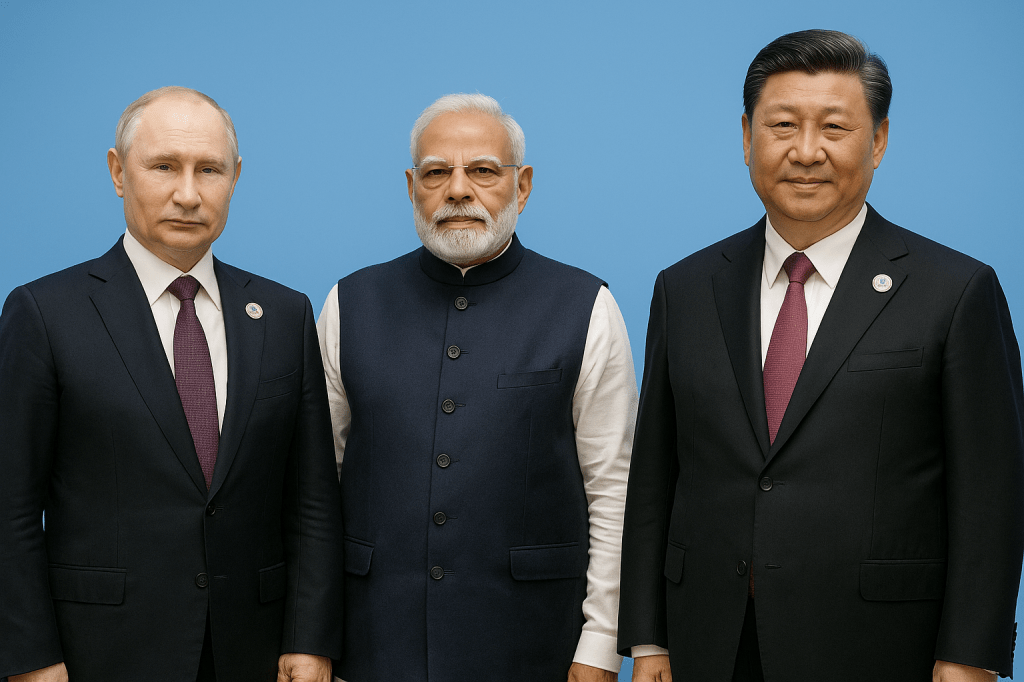
    In recent years, the world has watched a quiet but profound shift taking place across Eurasia. Once separated by ideology, suspicion, and historic rivalries, Russia, China, and India are now moving into deeper military, economic, and strategic alignment. What once appeared as limited cooperation is rapidly taking the shape of something far more consequential—the early framework of a powerful Eastern military and economic bloc that is reshaping global security.

    Just this week, China and Russia conducted joint anti-missile defense drills on Russian territory—a highly sensitive area of military cooperation. Anti-missile systems are not ordinary battlefield tools; they are designed for strategic nuclear survival. These exercises reveal that Moscow and Beijing are not merely partners of convenience—they are preparing together for high-end warfare against advanced military powers.

    At the same time, Russian President Vladimir Putin made a major state visit to India, where he and Prime Minister Narendra Modi agreed to expand cooperation in defense, energy, trade, and high technology. Russia reaffirmed its commitment to supply India with uninterrupted oil and gas, deepen military equipment transfers, and accelerate joint weapons development. These agreements further solidify Russia as India’s primary long-term strategic partner, even as pressure mounts from Western nations.

    Together, these two developments—strategic missile defense coordination between China and Russia and Russia’s expanding economic-military commitments with India—signal the tightening of an enormous Eastern alignment. Russia now sits at the center of two massive Asian powers, binding them through energy, weapons, diplomacy, and shared opposition to Western dominance.

    This alignment is no longer theoretical. It now influences:

    • Global energy markets
    • Arms production and weapons supply
    • Trade corridors across Eurasia
    • Cyber and space warfare capabilities
    • Diplomatic voting blocs in international institutions

    And most sobering of all—it aligns precisely with a military configuration foretold in Bible prophecy thousands of years ago.

    A Prophetic Eastern Power Foretold

    The book of Revelation describes a time just before the return of Jesus Christ when an enormous military force will rise from the East:

    “Then the sixth angel sounded: And I heard a voice… saying… ‘Release the four angels who are bound at the great river Euphrates.’ … And the number of the army of the horsemen was two hundred million; I heard the number of them.” (Revelation 9:13, 16)

    This army unleashes a catastrophic war that results in the death of one-third of all humanity:

    “By these three plagues a third of mankind was killed—by the fire and the smoke and the brimstone which came out of their mouths.” (Revelation 9:18)

    For centuries, critics dismissed this as symbolic or impossible. No nation in all of history could field such numbers. But today, China alone possesses the industrial and manpower base necessary for mass-mobilization on an unprecedented scale. Add to that India’s population, Russia’s nuclear arsenal and missile systems, and the combined military technology of these powers—and suddenly a 200-million-man force is no longer unthinkable.

    What we are witnessing today is likely the early geopolitical scaffolding of that very army.

    A Western Invasion Triggers the Eastern Response

    Revelation reveals that this massive Eastern force does not strike first. It is a retaliatory power, responding to earlier devastation launched from the West:

    “They were given power… to torment men five months… The shapes of the locusts were like horses prepared for battle… and their sound was like chariots with many horses running into battle.” (Revelation 9:5–9)

    This describes a technologically overwhelming assault—symbolized by aircraft-like weapons—coming from a revived imperial power historically associated with Rome. This suggests that a future Western-centered empire will unleash devastating attacks that destabilize the world, triggering the colossal Eastern retaliation described later in Revelation 9.

    Thus, the coming world war is not random. It unfolds in distinct prophetic phases—first Western domination, then Eastern vengeance.

    Not Just Geopolitics—But Divine Judgment

    These wars are not merely the product of nationalism, economics, or ideology. They are allowed by God as a final intervention in human self-destruction.

    After the devastation of Revelation 9, Scripture declares:

    “But the rest of mankind, who were not killed by these plagues, did not repent of the works of their hands…” (Revelation 9:20)

    God permits these horrors for one overriding reason: to shock humanity out of its rebellion and back toward Him. The world has rejected God’s law, exalted violence, celebrated immorality, and mocked repentance. In mercy, God allows the consequences of human defiance to play out—so that at last, people may see that human rule without God leads only to death.

    Yet even then, His goal is still salvation, not annihilation.

    Why God Delays—Even Now

    Long before these judgments arrive, God extends mercy:

    “Or do you despise the riches of His goodness, forbearance, and longsuffering, not knowing that the goodness of God leads you to repentance?”  (Romans 2:4)

    God’s patience is not permission to continue in sin—it is an open door to repentance. Every year that passes without World War III is not a sign that prophecy is false. It is proof that God is still giving humanity time to change.

    But the deepening military drills, missile defenses, energy alliances, and war-ready economic blocs forming today show that the world is racing toward the very conditions the Bible warned would come.

    What This Means for Us Now

    The alignment of Russia, China, and India delivers a personal message to every thinking observer:

    • The world is not drifting aimlessly
    • Global power is shifting exactly as prophecy declared
    • Military alliances will not bring peace
    • Economic blocs will not stop global catastrophe
    • Only the return of Jesus Christ and the establishment of God’s Kingdom will finally end war

    The coming wars will be terrible beyond modern imagination. Yet they will also clear the way for the only true solution to human conflict—God’s righteous rule over all nations.

  • Europe’s Anxiety Over the East—and What Prophecy Says

    Europe’s Anxiety Over the East—and What Prophecy Says

    The European Union is sounding alarms over an alignment taking shape in the East. At recent summits—such as the Shanghai Cooperation Organisation (SCO) meeting in Tianjin and the Beijing summit hosted by President Xi—China, Russia, and India signaled a willingness to deepen cooperation—militarily, economically, and diplomatically. For Brussels, this looks like a rival pole to the West’s influence.

    Brussels Speaks Out

    Commission President Ursula von der Leyen has warned at a summit in Beijing that EU–China ties have reached an “inflection point” because of the growing cooperation between China, India, and Russia (Financial Times, July 2025). High Representative Kaja Kallas has accused Beijing of enabling Russia’s war machine (MERICS report, 2025). Reports highlight India’s purchases of Russian oil and abstentions on UN votes as proof that New Delhi is hedging its bets.

    In short, Europe sees a triangle of Moscow, Beijing, and Delhi chipping away at Western unity—especially as sanctions on Russia leak eastward.

    What the EU Is Doing

    Brussels isn’t sitting idle. It has:

    • De-risked supply chains—passing laws to reduce dependency on Chinese critical materials.
    • Launched trade defenses—raising tariffs on Chinese electric vehicles, probing subsidies in wind turbines, and barring Chinese medical-device suppliers.
    • Strengthened sanctions enforcement—targeting shadow fleets and middlemen moving Russian energy.
    • Rearmed its defense base—through the €800-billion “ReArm Europe” program.
    • Courted India—via trade talks, tech councils, and alternative trade corridors.

    The strategy: blunt the impact of a tightening Moscow–Beijing–Delhi alignment while rebuilding Europe’s own economic and military muscle.

    Prophetic Perspective

    Students of Bible prophecy see in these moves echoes of an ancient forecast. Scripture foretells a revived Roman system in Europe—many see its early form in today’s EU—and an eastern coalition that will one day rise to confront it.

    Revelation 9:13-19 speaks of a war killing a third of humankind through an army “two hundred million” strong. While the Bible does not name today’s nations, the picture of eastern powers uniting and clashing with a European bloc foreshadows the very trends now unfolding.

    God will allow this to happen to call mankind to repentance, as He makes us realize that human governments apart from Him and His way of life cannot bring peace.  Shortly after this, after more severe events occur, Jesus Christ will return to establish God’s kingdom, ruling all nations under righteous rule. (Isaiah 2:1-4)

  • Trump’s Tariff Blitz on BRICS: Forging Unity Among America’s Adversaries

    Trump’s Tariff Blitz on BRICS: Forging Unity Among America’s Adversaries

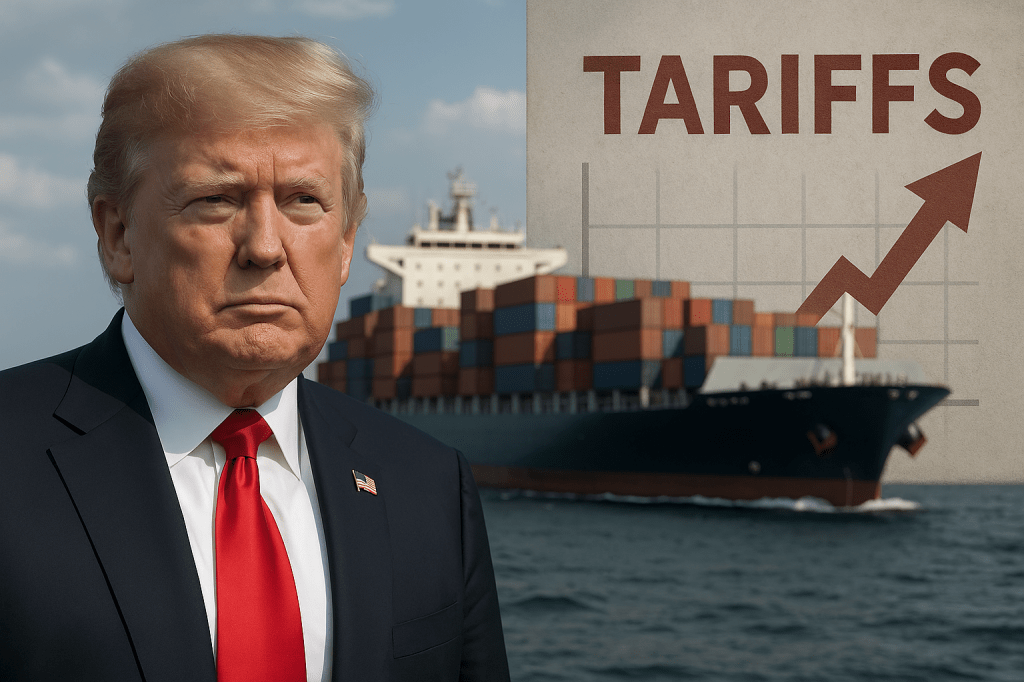
    This week, President Donald Trump announced a sweeping new wave of tariffs targeting BRICS nations—Brazil, Russia, India, China, and South Africa. In a move reminiscent of his first-term trade policies, but now more aggressive and broadly applied, Trump proposed tariffs of up to 50% on imports from nations that do not have free trade agreements with the United States. Since none of the BRICS countries fall under such agreements, the move is widely interpreted as a direct economic strike on the bloc.

    The rationale? According to administration officials, the policy is meant to “protect American industries from unfair foreign competition” and “punish nations that exploit the U.S. market while refusing to reciprocate.” However, behind the veneer of economic nationalism lies a far more dangerous outcome: a widening geopolitical chasm that could transform economic rivals into strategic enemies.

    Tariffs That Unite the Disparate

    The BRICS alliance, though often riddled with internal differences, has always shared one common trait: dissatisfaction with the post-WWII U.S.-led world order. But internal contradictions—between India and China, or Brazil and Russia’s conflicting economic models—have often limited deeper integration. That may now be changing.

    By targeting all BRICS nations simultaneously, the U.S. has given them something they previously lacked: a unifying adversary. These tariffs are not just duties on goods—they are perceived as blows against sovereignty, development, and fair participation in the global system.

    Rather than bringing these nations to heel, the new policy will likely yield the opposite result:

    • China will retaliate economically while accelerating its efforts to establish yuan-based trade systems with BRICS and Global South nations.
    • Russia, already isolated by the West, will use this as further justification to deepen ties with Beijing, New Delhi, and even Brasília.
    • India, long cautious about getting too close to China, may still choose to increase intra-BRICS trade and reassert its role in leading a “non-aligned but assertive” bloc.
    • Brazil, responding to Trump’s tariffs, has announced it will impose reciprocal tariffs beginning August 1, framing them as political retaliation tied to domestic tensions surrounding former President Bolsonaro.
    • South Africa and other African nations will rally around the BRICS cause, framing the U.S. as a self-interested hegemon unwilling to make space for emerging powers.

    A Warning Ignored

    There is a vivid parallel in the Bible that offers a lesson to today’s world leaders. When Rehoboam, son of King Solomon, ascended the throne, he was faced with a divided kingdom. The northern tribes of Israel were already weary of heavy taxation and burdens imposed under Solomon’s rule. The elders wisely counseled him to speak kindly to the people and lighten their load:

    “If you will be a servant to these people today… and speak good words to them, then they will be your servants forever.” (1 Kings 12:7, NKJV)

    But Rehoboam arrogantly rejected their advice. Instead of gentleness, he chose threats:

    “My father made your yoke heavy, but I will add to your yoke; my father chastised you with whips, but I will chastise you with scourges!” (1 Kings 12:14, NKJV)

    The result? The ten northern tribes rebelled and formed their own kingdom, permanently dividing Israel.

    President Trump, like Rehoboam, had a unique opportunity to drive wedges between BRICS nations by offering friendlier trade terms to democratic and more market-oriented members like India, Brazil, and South Africa. That would have deepened the existing ideological and economic divides within the bloc. Instead, his administration has chosen a path of blanket hostility, treating all BRICS members as equally hostile, and thereby giving them reason to unite.

    The Proverbs of Diplomacy

    This is no isolated lesson. The Bible offers enduring insight into the nature of conflict and influence:

    “A soft answer turns away wrath, but a harsh word stirs up anger.” (Proverbs 15:1, NKJV)

    “By long forbearance a ruler is persuaded, and a gentle tongue breaks a bone.” (Proverbs 25:15, NKJV)

    “A man who is kind benefits himself, but a cruel man hurts himself.” (Proverbs 11:17, ESV)

    Aggression rarely wins allies. The harsh and punitive path may feel strong, but it often produces resistance, not respect. In today’s case, it may result in a stronger, more focused BRICS alliance motivated not by shared ideology—but by shared opposition.

    Coercion Over Persuasion

    The United States, by its sheer size and influence, still has the ability to build coalitions or break them apart. But diplomacy—like leadership—requires wisdom. Trump’s tariff policy has chosen coercion over persuasion, and bluntness over nuance. Rather than weakening BRICS, it could very well solidify it.

    Rehoboam’s mistake split a kingdom. If today’s leaders are not careful, similar arrogance could divide the world—and leave America with more rivals, fewer allies, and a weakened voice in shaping the future global order.

  • BRICS in Rio: A Rising Bloc’s Bid to Reshape the World Order

    BRICS in Rio: A Rising Bloc’s Bid to Reshape the World Order

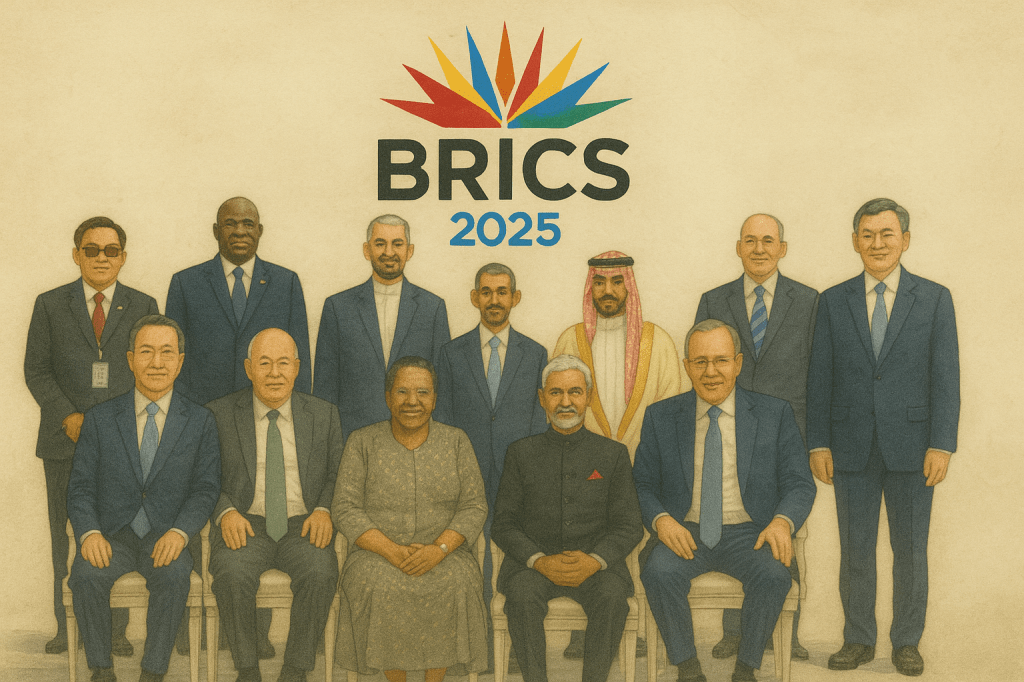
    As the leaders of an expanded BRICS convene in Rio de Janeiro this July 6-7 for the 17th BRICS Summit, the world watches closely. What began in 2009 as an informal coalition of emerging economies is now growing into a geopolitical force, aiming to challenge the dominance of Western institutions like the G7, the IMF, and SWIFT.

    With major issues on the table—including currency de-dollarization, cross-border payment systems, and development finance—the BRICS bloc appears more ambitious than ever.

    The BRICS—originally Brazil, Russia, India, and China—held their first summit in 2009. South Africa joined the following year, completing the initial five-member alliance. Over time, BRICS built real institutional capacity, establishing the New Development Bank (NDB) and Contingent Reserve Arrangement (CRA) to promote development and economic resilience among its members.

    A major expansion took place in 2023, when Egypt, Ethiopia, Iran, and the United Arab Emirates were granted full membership. Indonesia joined in early 2025, bringing the group to eleven. With ongoing interest from countries like Vietnam, Bangladesh, and Argentina, BRICS is quickly turning from a bloc into a movement.

    BRICS’ accomplishments over the last 16 years include:

    • Financial Infrastructure: The NDB has funded more than $30 billion in development projects, while the CRA provides a $100 billion reserve pool to guard against financial crises.
    • Alternative Payment Systems: With growing distrust of Western-dominated platforms like SWIFT, BRICS members have begun developing BRICS Pay, a decentralized payment messaging system allowing trade in local currencies.
    • Strategic Partnerships: Dozens of working groups and institutions now foster cooperation on energy, health, digital governance, and more—advancing what some have called a new “Global South consensus.”

    Despite progress, the Rio 2025 summit reveals fault lines:

    • Leadership Absences: Neither Xi Jinping nor Vladimir Putin is attending in person. Putin faces travel limitations due to international sanctions, and Xi reportedly cited scheduling conflicts. Their absence reflects the bloc’s internal tensions.
    • Ideological Divide: While nations like Iran and Russia advocate a confrontational stance toward the West, others like India, Brazil, and Indonesia prefer a more balanced approach. This divergence hampers consensus on issues like UN reform, Ukraine, and Gaza.
    • Competing Interests: India’s growing ties with Western powers contrast with China’s ambitions, and Brazil, the host nation, has tried to focus this year’s agenda on neutral topics like climate finance, AI governance, and healthcare.

    With 11 member nations representing over 40% of global GDP (PPP) and more than half the world’s population, BRICS is no longer a marginal force. It’s now a serious contender in shaping global governance.

    Key differences with the G7 include:

    • Development Focus: While G7 prioritizes legacy institutions like the IMF and World Bank, BRICS centers its efforts on flexible South-South cooperation.
    • Financial Sovereignty: Tools like BRICS Pay and the NDB enable countries to bypass traditional Western financial systems.
    • Multipolar Vision: BRICS advocates for a more equitable world order, with power shared among emerging and developing nations—not monopolized by the West.

    After Russia’s invasion of Ukraine in 2022, Western sanctions cut off many Russian banks from the SWIFT network. In response, Russia turned to:

    • SPFS: Its own financial messaging system.
    • Bilateral Trade Deals: Using rubles, yuan, and other local currencies with BRICS members.
    • BRICS Pay: A system still in early rollout but with growing support. China, Brazil, and Iran have all agreed to increase usage in 2025.

    Though not yet a global replacement for SWIFT, BRICS Pay offers a real alternative for countries under sanctions—laying the groundwork for a parallel financial system.

    If BRICS can overcome its divisions, the economic integration of Russia, India, and China could mark the emergence of a powerful Eastern economic bloc. With joint development banks, currency swaps, and shared digital platforms, this bloc would rival any Western alliance economically and geopolitically.

    Such a scenario aligns with what many Bible students interpret as an end-time prophecy: an Eastern power—“kings from the East”—rising to challenge a revived Roman Empire (see Revelation 16:12).

    The BRICS summit in Rio showcases both promise and peril. Its expansion, financial innovation, and strategic agenda give it the tools to build a new world order. But internal rivalries, absent leaders, and divergent visions threaten to stall momentum.

    Still, if BRICS succeeds, it won’t just change economics. It could reshape the balance of global power—perhaps even fulfilling ancient biblical prophecies about a world divided between East and West in the final days before Christ’s return.