Category: Iran

  • Iran’s Unrest and the Quiet Shifting of Power in the Middle East

    Iran’s Unrest and the Quiet Shifting of Power in the Middle East

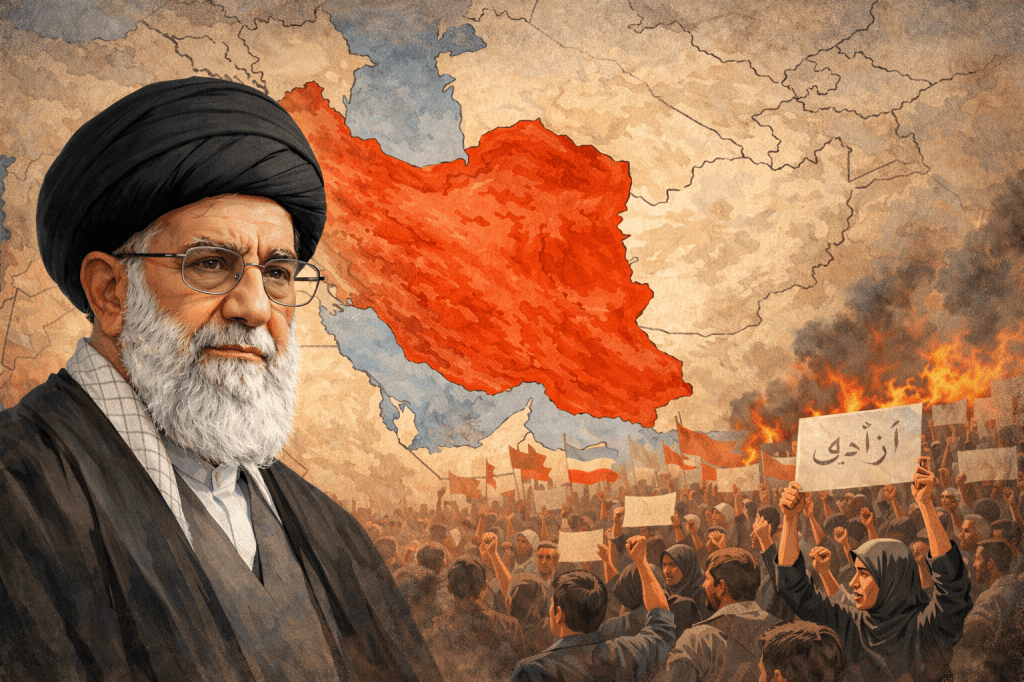
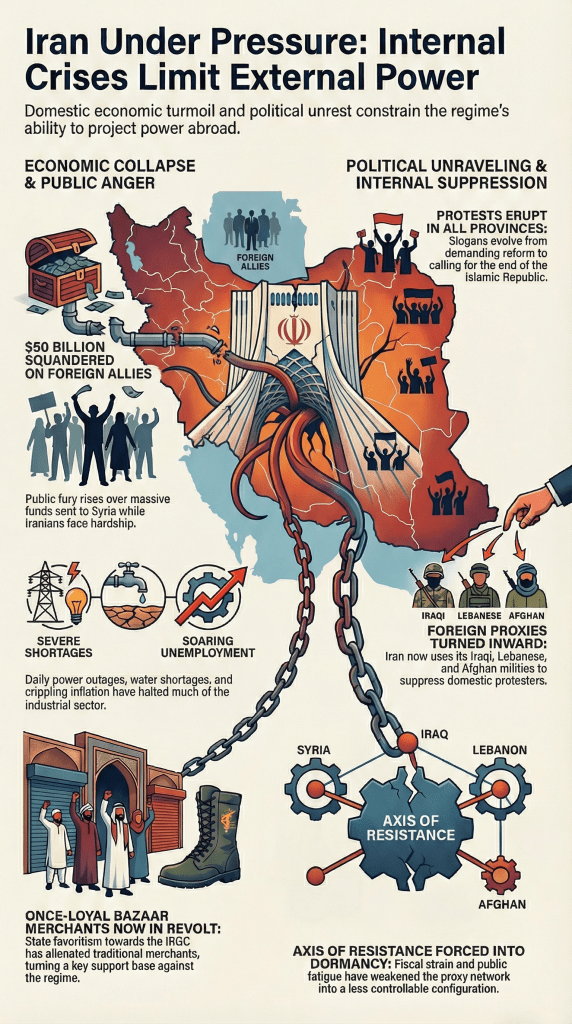
    Iran is experiencing a period of sustained internal strain. Economic hardship, currency weakness, political dissatisfaction, and recurring unrest have placed growing pressure on the country’s leadership. While these challenges have not yet produced a change of government, they are steadily corroding Iran’s ability to project power effectively beyond its borders.

    This erosion matters not because it fulfills a specific biblical prophecy, but because it contributes to changing conditions in the Middle East.

    A Nation Increasingly Turned Inward

    Iran’s leadership today is increasingly preoccupied with domestic stability. Persistent economic problems and social unrest demand attention, resources, and security forces that might otherwise be directed outward.

    History shows that when a nation’s focus turns inward, its ability to act decisively abroad weakens. Internal pressure does not eliminate national power overnight, but it limits how consistently and effectively that power can be exercised.

    External Influence Under Strain

    For many years, Iran has relied on indirect methods to influence the Middle East. Through aligned groups and political partners in Iraq, Syria, Lebanon, and Yemen, Iran has sought to shape regional events while avoiding direct confrontation.

    That strategy, however, requires sustained coordination, funding, and centralized leadership.

    In Syria, Iranian positions remain vulnerable and costly to maintain. In Iraq, Iran-aligned militias continue to operate, but their priorities increasingly reflect local political realities rather than unified direction. In Lebanon, Hezbollah remains influential, yet Iran’s financial and strategic constraints limit how forcefully that influence can be applied. In Yemen, Iranian involvement persists, but with diminishing control over outcomes.

    Iran has not withdrawn from the region, but its influence is becoming less cohesive and less reliable. Scripture warns that division weakens authority: “Every kingdom divided against itself is brought to desolation” (Matthew 12:25).

    A Region Shaped by Fragmentation

    These developments are significant in light of the broader biblical pattern for the Middle East. Prophecy does not portray the region as dominated indefinitely by a single local power. Instead, it describes repeated cycles of instability, rivalry, and realignment.

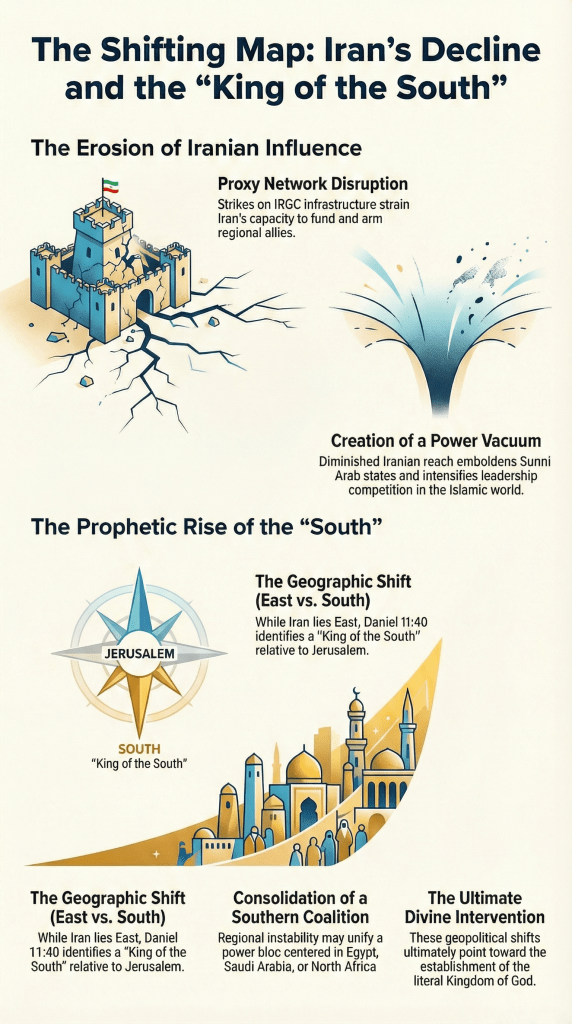
    Daniel 11 shows that, at “the time of the end,” a powerful southern entity will emerge—strong enough to act assertively in regional affairs (Daniel 11:40). That power is described geographically as being south of Israel, and it involves Egypt and surrounding areas (Daniel 11:42–43).

    Such a development does not arise suddenly. It requires time, opportunity, and changing regional conditions.

    Erosion Creates Opportunity

    Iran’s current difficulties are contributing to a broader erosion of centralized influence in the Middle East. As Iran’s ability to coordinate and sustain regional pressure diminishes, space opens for other actors to organize, cooperate, and assert leadership.

    Bible prophecy often shows that new powers emerge not in moments of stability, but during prolonged periods of disorder. Isaiah described a time when regional confusion weakened the existing structures of Egypt, at that time, a powerful entity in the region: “I will set Egyptians against Egyptians… and the spirit of Egypt will fail in its midst” (Isaiah 19:2–3). The passage illustrates a recurring biblical principle—internal instability precedes external change.

    If Iran’s internal corrosion continues long enough, it may provide the time and conditions necessary for a rival entity south of Israel to develop the unity, resources, and leadership required to play a decisive role in the region.

    Watching the Trend, Not the Moment

    Iran’s unrest does not signal the immediate appearance of “the king of the south”. But it does fit a consistent biblical pattern: internal weakening leading to geopolitical realignment.

    For students of prophecy, the task is not to draw premature conclusions, but to observe how conditions develop in light of Scripture’s long-term framework.

    Iran’s turmoil may not define the future—but it may be quietly helping to shape it.

  • The Bombs That Echoed Beyond the Bunker: How the U.S. Struck Iran and Redefined the Conflict

    The Bombs That Echoed Beyond the Bunker: How the U.S. Struck Iran and Redefined the Conflict

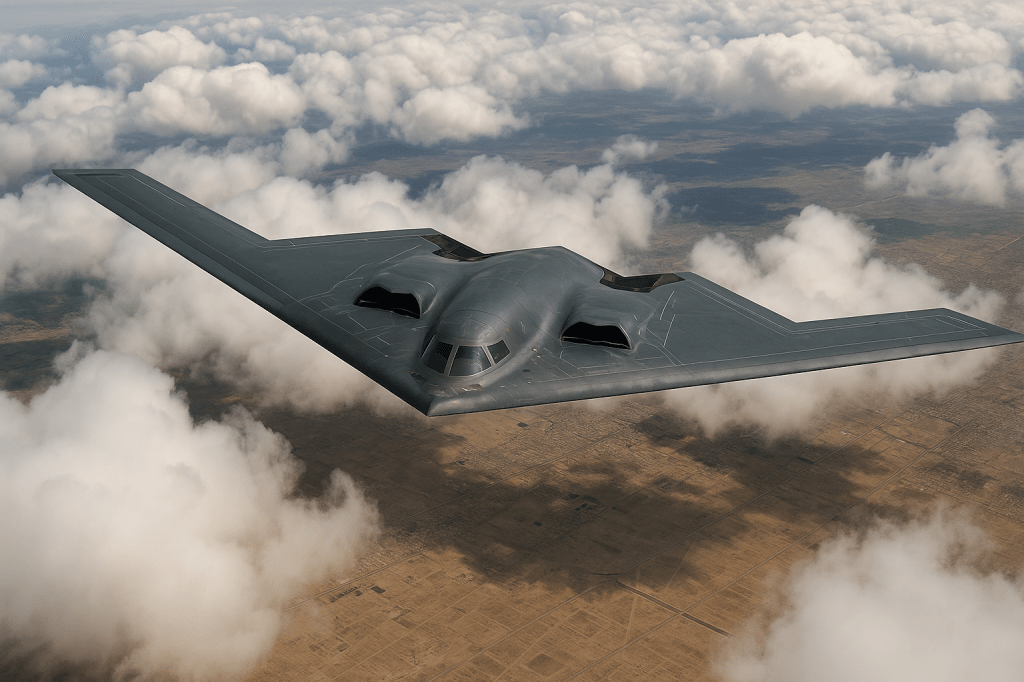
    The world watched with bated breath as U.S. stealth bombers pierced Iranian skies this week, dropping bunker-busting munitions over nuclear sites long suspected of harboring secret ambitions. The airstrikes, aimed primarily at Fordow and Natanz, were President Donald Trump’s dramatic move to insert the United States into the Israel–Iran conflict — a conflict that has steadily escalated over months of covert attacks, proxy skirmishes, and fiery rhetoric.

    This was no random act of war. The chain of events leading to the strikes was long in the making.

    Israel had already launched targeted bombings on Iran’s nuclear infrastructure after a series of provocations and growing concern that Iran was on the verge of achieving “breakout capability” — the technical means to rapidly assemble a nuclear weapon. Iran had enriched uranium beyond 60%, far exceeding the JCPOA limit of 3.67%, and had blocked international inspectors from verifying its claims of peaceful use. Following Iranian retaliatory missile strikes that hit civilian infrastructure in Israel — including a hospital — President Trump acted, stating that the U.S. “could not afford to remain on the sidelines any longer.”

    The U.S. strikes were powerful and symbolically significant. Reports suggest they inflicted damage on key components of Iran’s nuclear program, especially at deeply buried sites like Fordow. However, experts remain cautious: while the attacks likely delayed Iran’s nuclear timeline, they did not obliterate its capacity. Iran’s nuclear infrastructure, built for redundancy and deeply embedded in mountainous terrain, appears bruised but not broken.

    The Islamic Republic’s response has been telling. Rather than capitulate, Iran has shifted into a hardened posture. Supreme Leader Ayatollah Ali Khamenei has reportedly delegated broader military authority to the IRGC’s Supreme Council, signaling a move toward full war footing. At the same time, he has retreated from public view and fortified leadership succession mechanisms — a sign that the regime is preparing for further destabilization.

    And destabilization may well be inevitable. Iran’s economy, already reeling under decades of sanctions and recent damage to oil and gas platforms, faces a dangerous tipping point. Inflation is soaring, blackouts are widespread, and foreign reserves are shrinking. New sanctions by the U.S. Treasury—targeting oil networks and defense contractors—tighten the noose.

    Still, even in this moment of heightened tension, there are subtle signals of diplomatic possibilities. Behind closed doors, indirect talks between the U.S. and Iran, brokered by Oman and European intermediaries, have resumed. Iran has made clear that any negotiation will only proceed if Israel halts its military campaign. The U.S., for its part, has given the diplomacy track a two-week window before resuming further military action.

    What would a negotiated agreement mean for the Islamic regime?

    If Tehran is forced to accept limits on enrichment, allow full inspections, and scale back its regional proxy activities, the regime may secure short-term relief — such as eased sanctions, access to frozen assets, and a reopening of international trade. But this comes at a long-term cost: Iran’s ambition to become the uncontested leader of the Islamic world would be severely blunted.

    Interestingly, many Muslim-majority nations have responded to these developments with a tone of caution and neutrality. Egypt, Saudi Arabia, the UAE, and others have called for restraint and diplomacy rather than rallying to Iran’s defense. The Arab world, once deeply fractured along Sunni–Shia lines, seems unwilling to unite under Iran’s banner in a broader Islamic showdown. Their priority remains regional stability and economic continuity, not ideological warfare.

    This failure to galvanize Islamic solidarity is one of the more consequential outcomes of the conflict. Iran’s once-lofty goal of positioning itself as Islam’s vanguard power — and possibly even the long-awaited Mahdi state in some extremist views — now seems distant. Instead of leading, Iran now finds itself isolated, internally strained, and increasingly cornered.

    The Bible speaks prophetically of a time near the end when a power from the south — a “king of the South” — will rise to challenge a dominant power in the north (Daniel 11:40). Many biblical scholars believe this southern power will emerge from Arab nations south of the Promised Land such as Egypt or a coalition that includes Libya, not from Iran. What’s unfolding now may well be a realignment toward that eventual scenario. Iran’s decline makes room for another Islamic bloc to fill that prophetic role.

    The bombs dropped by the United States did more than strike concrete and steel — they shattered illusions. Iran’s nuclear program may recover in part, and its leadership may cling to power a while longer. But the regional and prophetic trajectory is shifting. If Iran does come to the negotiating table — as economic desperation and diplomatic isolation suggest it might — it will do so not as a rising empire but as a state trying to salvage its footing. And with that, the dream of Iran leading the Islamic world grows dimmer, clearing the stage for other prophetic actors to emerge.

  • The Lion Strikes: How Israel’s Offensive Against Iran Could Pave the Way for Another Power in the Middle East

    The Lion Strikes: How Israel’s Offensive Against Iran Could Pave the Way for Another Power in the Middle East

    In a dramatic development, Israel has launched a targeted and far-reaching strike on Iranian nuclear and military infrastructure. The operation—striking key facilities such as Natanz and Fordow, and eliminating several of Iran’s top nuclear scientists—delivers a significant blow to Tehran’s ambition to become a nuclear power.

    These attacks are not only crippling Iran’s scientific and military capabilities but are also signaling a shift in the Middle East’s balance of power. Israel, perceiving a nuclear-armed Iran as an existential threat, has acted decisively to delay or dismantle what it views as an imminent danger. In doing so, Israel has likely bought itself time—perhaps even years—of relative security from a nuclear threat originating from Iran.

    However, these events may have a broader prophetic consequence. As Iran’s ability to wield the ultimate weapon of mass destruction gets postponed, and its ability to project power wanes as Israel brings the war into its doorstep, it could open the door for a new Islamic power to rise—not rooted in Elam (ancient Iran), but in the Arab world. Iran, whose ancient name in the Bible is Elam (Genesis 10:22; Jeremiah 49:34–39), may find its dominance eclipsed by a coalition of Arab nations, leading to the emergence of a different kind of power bloc in the Middle East.

    According to Daniel 11, a “king of the South” will arise south of Israel in the end time—a national or regional power bloc that will challenge the “king of the North”, a revived Roman Empire based in Europe. When this king of the South attacks, the king of the North will launch a swift and devastating counterattack (Daniel 11:40).

    The biblical details in Daniel 11:42–43 tell us more:

    “He shall stretch out his hand against the countries, and the land of Egypt shall not escape. He shall have power over the treasures of gold and silver, and over all the precious things of Egypt; also the Libyans and Ethiopians shall follow at his heels.”

    This strongly indicates that Egypt, Libya, and possibly other Arab nations will comprise or support the king of the South. These are not Persian or Elamite nations, but nations from the Arab world—suggesting that by the time this prophecy is fulfilled, Iran will no longer be a dominant player in Middle Eastern affairs.

    This fits perfectly with Jeremiah 49, which foretells judgment upon Elam, stating that God would “break the bow of Elam” and scatter its people. Yet the prophecy does not end there. In verse 39, God declares:

    “But it shall come to pass in the latter days: I will bring back the captives of Elam,” says the Lord.

    Though Iran may be humbled in coming years, God will not forget its people. In the Millennial reign of Jesus Christ, the people of Elam—Iran—will be restored to their land and brought under God’s righteous government. They will no longer be instruments of aggression, but citizens of a world at peace.

    The current Israeli-Iranian conflict, therefore, may be far more than a military standoff—it may be a prophetic transition, marking the decline of Elam’s influence and preparing the stage for the final alignment of nations described in the Bible. As one Islamic power fades, another rises. But above all, the ultimate resolution lies not in human alliances or military might, but in the coming Kingdom of God, where all nations—including Iran—will be restored under the leadership of Jesus Christ.