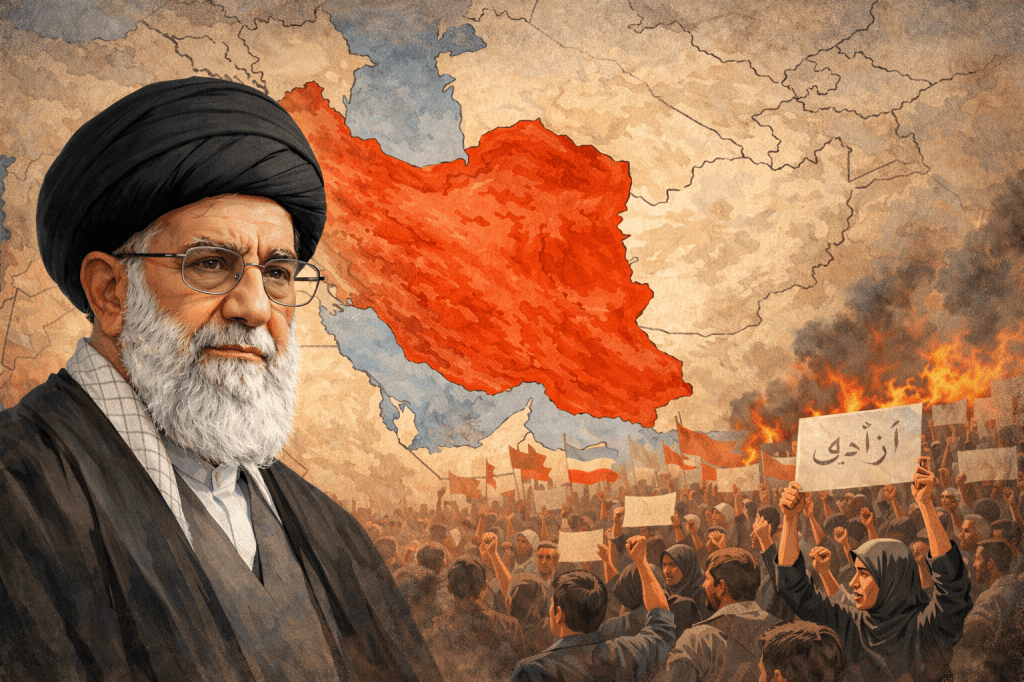
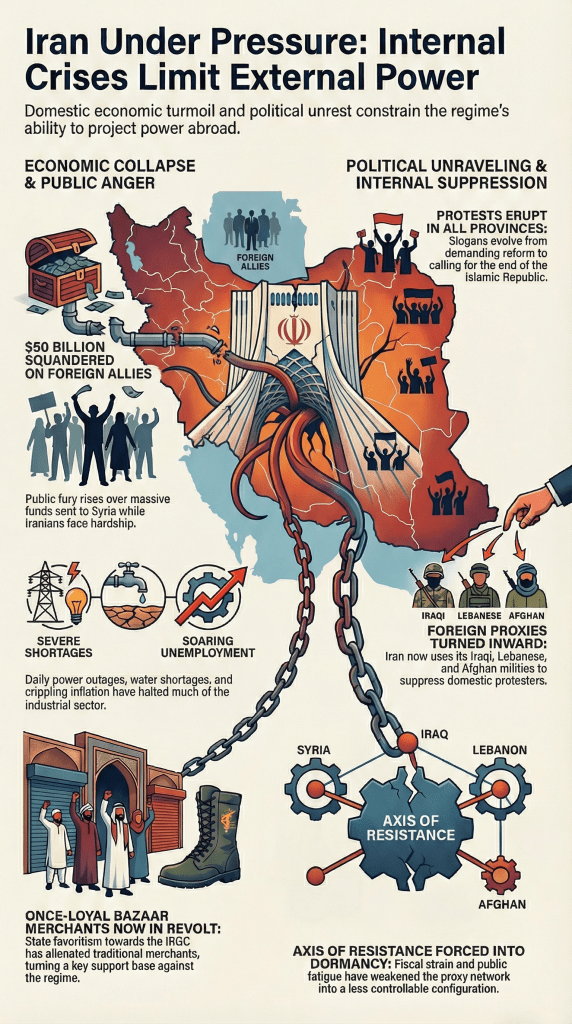
Iran is experiencing a period of sustained internal strain. Economic hardship, currency weakness, political dissatisfaction, and recurring unrest have placed growing pressure on the country’s leadership. While these challenges have not yet produced a change of government, they are steadily corroding Iran’s ability to project power effectively beyond its borders.
This erosion matters not because it fulfills a specific biblical prophecy, but because it contributes to changing conditions in the Middle East.
A Nation Increasingly Turned Inward
Iran’s leadership today is increasingly preoccupied with domestic stability. Persistent economic problems and social unrest demand attention, resources, and security forces that might otherwise be directed outward.
History shows that when a nation’s focus turns inward, its ability to act decisively abroad weakens. Internal pressure does not eliminate national power overnight, but it limits how consistently and effectively that power can be exercised.
External Influence Under Strain
For many years, Iran has relied on indirect methods to influence the Middle East. Through aligned groups and political partners in Iraq, Syria, Lebanon, and Yemen, Iran has sought to shape regional events while avoiding direct confrontation.
That strategy, however, requires sustained coordination, funding, and centralized leadership.
In Syria, Iranian positions remain vulnerable and costly to maintain. In Iraq, Iran-aligned militias continue to operate, but their priorities increasingly reflect local political realities rather than unified direction. In Lebanon, Hezbollah remains influential, yet Iran’s financial and strategic constraints limit how forcefully that influence can be applied. In Yemen, Iranian involvement persists, but with diminishing control over outcomes.
Iran has not withdrawn from the region, but its influence is becoming less cohesive and less reliable. Scripture warns that division weakens authority: “Every kingdom divided against itself is brought to desolation” (Matthew 12:25).
A Region Shaped by Fragmentation
These developments are significant in light of the broader biblical pattern for the Middle East. Prophecy does not portray the region as dominated indefinitely by a single local power. Instead, it describes repeated cycles of instability, rivalry, and realignment.
Daniel 11 shows that, at “the time of the end,” a powerful southern entity will emerge—strong enough to act assertively in regional affairs (Daniel 11:40). That power is described geographically as being south of Israel, and it involves Egypt and surrounding areas (Daniel 11:42–43).
Such a development does not arise suddenly. It requires time, opportunity, and changing regional conditions.
Erosion Creates Opportunity
Iran’s current difficulties are contributing to a broader erosion of centralized influence in the Middle East. As Iran’s ability to coordinate and sustain regional pressure diminishes, space opens for other actors to organize, cooperate, and assert leadership.
Bible prophecy often shows that new powers emerge not in moments of stability, but during prolonged periods of disorder. Isaiah described a time when regional confusion weakened the existing structures of Egypt, at that time, a powerful entity in the region: “I will set Egyptians against Egyptians… and the spirit of Egypt will fail in its midst” (Isaiah 19:2–3). The passage illustrates a recurring biblical principle—internal instability precedes external change.
If Iran’s internal corrosion continues long enough, it may provide the time and conditions necessary for a rival entity south of Israel to develop the unity, resources, and leadership required to play a decisive role in the region.
Watching the Trend, Not the Moment
Iran’s unrest does not signal the immediate appearance of “the king of the south”. But it does fit a consistent biblical pattern: internal weakening leading to geopolitical realignment.
For students of prophecy, the task is not to draw premature conclusions, but to observe how conditions develop in light of Scripture’s long-term framework.
Iran’s turmoil may not define the future—but it may be quietly helping to shape it.

