The upcoming NATO summit in The Hague this June 24 and 25—meant to showcase unity and resolve—may end up doing the opposite: exposing divisions, achieving little, and revealing a troubling shift. The alliance that once served as the anchor of Western defense now faces an identity crisis, largely influenced by the changing role of the United States under President Donald Trump.
A President at Odds with the Alliance
President Trump comes to the NATO summit not as a stabilizing leader but as a disruptor. His position on the Russian invasion of Ukraine sharply differs from that of most European leaders. While many in Europe see Russia’s 2022 attack on Ukraine as unprovoked aggression, Trump has suggested that Ukraine “provoked” Russia—downplaying Moscow’s responsibility and treating both sides as equally culpable.
This stance is deeply unsettling to countries like Poland, the Baltic states, and Romania. For them, NATO is more than diplomacy—it’s a protective shield. But under Trump’s view, that shield seems uncertain.
Trump’s view of Vladimir Putin also contrasts sharply with NATO consensus. While European leaders regard Putin as a serious, long-term threat to European stability, Trump has described him in favorable terms—even amid allegations of war crimes. This isn’t just a difference in tone—it reflects a fundamentally different understanding of global threats.
From Shared Values to Shared Costs
At its core, Trump treats NATO less like a community of shared democratic values and more like a financial arrangement. His message has been blunt: pay more or risk losing protection. Although calls for higher European defense spending aren’t new, Trump frames the issue as a fee-for-service model—diminishing the alliance’s foundational spirit of mutual defense.
This year’s summit is expected to focus heavily on Trump’s demand that allies commit 5% of GDP to defense. Some countries like Poland and the UK may support the idea, but many others find it politically and economically unfeasible, even coercive.
Even more concerning is what won’t be addressed: there will likely be no new pledges to Ukraine or a clear plan to deal with Russia’s ongoing threats. That silence speaks volumes.
A Shifting Balance of Power
The summit may produce few policy breakthroughs, but it will make one reality painfully clear: the United States no longer leads NATO as it once did. Without U.S. leadership grounded in shared values, the alliance becomes more fragmented—less a united front, and more a group of nations with diverging priorities.
Faced with this void, Europe is beginning to respond.
Europe Steps Forward
As the summit unfolds, European leaders are moving to create a more independent defense structure. France is taking the lead, with Germany showing increased support. Their goal: prepare for a future where Europe must defend itself—even without, or against, U.S. approval.
Key elements of this shift include France’s nuclear arsenal, the EU’s Common Security and Defence Policy (CSDP), and joint defense projects through initiatives like PESCO. Once seen as symbolic, these are now gaining strategic importance.
Eastern Europe is also adapting. Countries like Poland are ramping up defense spending and modernizing their forces. Nordic nations are working more closely together through regional groups like NORDEFCO and the Joint Expeditionary Force.
A Prophetic Parallel
This changing defense landscape may have more than political implications—it could carry prophetic weight. The Bible foretells a final resurrection of the Roman Empire, emerging from Europe shortly before the return of Jesus Christ. Scripture describes this end-time empire as a powerful beast—ruthless, dominant, and seemingly unstoppable: “Who is like the beast? Who is able to make war with him?” (Revelation 13:4).
The weakening of NATO and the decline of U.S. leadership are not just political shifts—they are part of a larger prophetic pattern. A new European-centered power is rising, one that may dominate the global stage with strength and unity, even without—or in defiance of—American leadership.
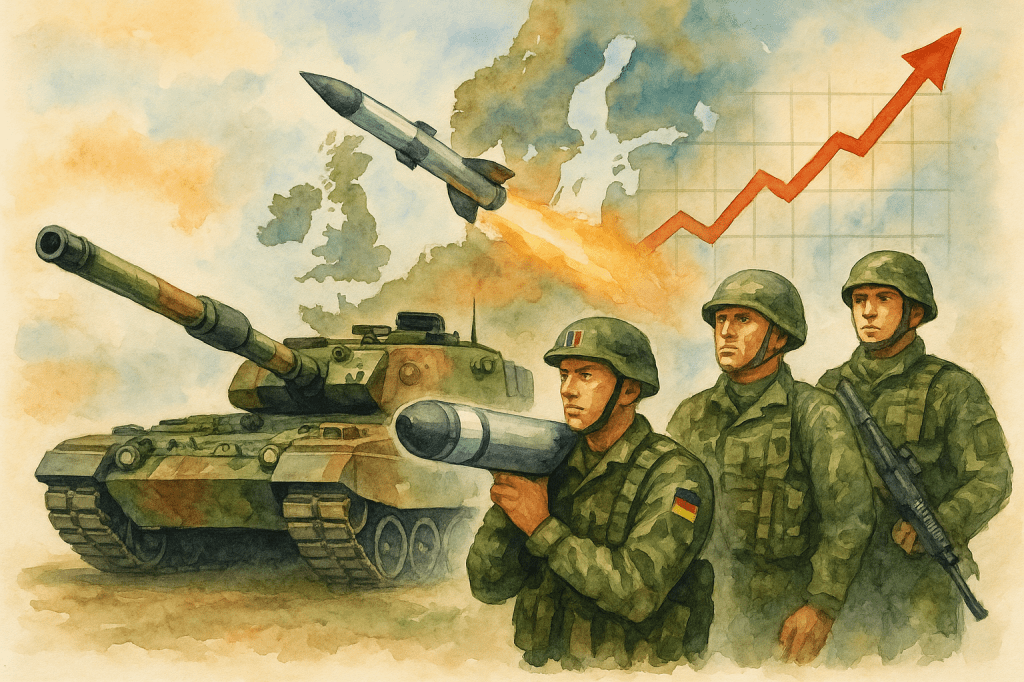
In recent years, a quiet revolution has been unfolding across the European continent. Long known for its reliance on diplomacy, economic influence, and NATO protection, Europe is now undergoing one of the most dramatic rearmament campaigns in its modern history. From Germany and Poland to Sweden and Denmark, defense budgets are surging, production lines are being reactivated, and leaders are speaking with new urgency about “war readiness.”
Germany has pledged to raise defense spending to 3.5% of GDP, launching a massive modernization campaign including expanded tank and artillery production, as well as investments in cyber and missile defense.
Poland is going further, earmarking 4.7% of GDP—now the highest in NATO—for new weapon systems, base upgrades, and troop increases. Meanwhile, Sweden is expanding its armed forces, reintroducing conscription, and ramping up spending to reach 2.6% of GDP by 2028.
Denmark plans to hit 3% of GDP by 2026, citing Russian aggression and emerging threats as key motivations. The Baltic states—Estonia, Latvia, and Lithuania—are each committing over 3% of GDP and building territorial defense units with citizen-soldier models.
France is investing in new-generation aircraft and drones, while Italy is streamlining its military-industrial base to boost efficiency.
Although theUK is not part of the EU, it is also undertaking significant measures to enhance its military readiness. The UK’s Strategic Defence Review outlines plans to increase defense spending to 2.5% of GDP by 2027, with a longer-term goal of reaching 3%. Key initiatives include the construction of up to 12 SSN-AUKUS nuclear-powered submarines, a £15 billion investment in the Astraea nuclear warhead program, and the procurement of 7,000 long-range missiles.
Additionally, the UK is establishing six new munitions factories to ensure an “always-on” weapons pipeline. On the technological front, the UK is investing in the Global Combat Air Programme (GCAP) to develop a sixth-generation stealth fighter in collaboration with Japan and Italy.
Efforts are also underway to expand the British Army to 76,000 personnel, create a new home guard, and enhance cyber and electromagnetic capabilities through the establishment of a CyberEM Command.
Europe as a whole is also pushing technological advancement. The EU’s European Defence Fund is channeling billions into joint R&D for AI, autonomous systems, and space-based surveillance. NATO-aligned nations are jointly developing standardized platforms for faster, interoperable deployment. Recruitment campaigns have been reinvigorated, with new enlistment incentives, reserve force expansions, and revitalized officer academies across the continent.
All these efforts point toward a continent no longer satisfied with symbolic defense gestures, but one preparing, materially and mentally, for the very real possibility of conventional and hybrid war.
A Changing World Order
Several major forces are converging to drive this military resurgence:
Russian Aggression: The ongoing conflict in Ukraine has shattered decades-old illusions of peace on the continent. With Russia investing heavily in its military-industrial complex, European nations now see the need to prepare for high-intensity warfare.
Uncertainty Over U.S. Support: The return of Donald Trump to the White House and his continuing “America First” posture have deepened concerns about long-term American commitment to Europe’s defense. This is prompting nations to take ownership of their own security.
Emerging Global Threats: Rising instability in parts of the Middle East, terrorism, cyberattacks, and the proliferation of drones and artificial intelligence in warfare have added new layers of complexity to Europe’s security landscape.
Internal Political Shifts: Public sentiment is shifting, especially in frontline states like Poland and the Baltic nations. Defense is no longer seen as a luxury but a necessity. Even traditionally pacifist countries like Germany and Sweden are rewriting their security doctrines.
Challenges Along the Way
Despite this new momentum, Europe’s defense transformation faces serious limitations:
Fragmented Military Systems: Europe maintains over a dozen different tank models, more than 30 types of naval vessels, and dozens of aircraft types, each with its own logistics chain, spare parts system, and training regimen. This lack of standardization results in operational inefficiencies, higher maintenance costs, and serious interoperability challenges in joint missions. Similarly, air forces operate multiple jet fighters that are incompatible in terms of armament and electronic systems. During exercises, these disparities often complicate coordination, from communications to battlefield support. The absence of a central procurement body further aggravates the issue, leading to overlapping orders and missed opportunities for bulk purchasing. Unless these fractured systems are consolidated, Europe’s ability to act quickly and cohesively in a large-scale conflict remains compromised.
Slow Production Capacity: Unlike Russia, which has moved to a war economy footing, Europe’s peacetime industries are not yet able to produce ammunition, vehicles, and systems at the speed and scale needed for major conflict.
Diverging National Priorities: What threatens Estonia may not concern Italy. Differing threat perceptions and strategic cultures across Europe hinder the formation of a unified response strategy. This divergence has also resulted in varying levels of support for Ukraine’s defense against Russia’s invasion. While frontline states like Poland, the Baltic nations, and the Nordic countries have provided robust military aid and training, others such as Hungary have been more reserved, citing internal political considerations or skepticism about provoking further escalation. These inconsistencies underscore the lack of a cohesive continental approach to security threats—even when a major war is unfolding at Europe’s doorstep.
Budgetary Constraints: While some nations, like Poland and Germany, are pouring billions into defense, others still struggle with fiscal limits or public resistance to increased military spending.
A Vision for Unity: The Case for a Common European Government
To truly overcome these limitations, a more radical solution is being quietly considered in think tanks and political circles: a common European government with a unified defense authority.
Such a government would:
Centralize decision-making on military strategy.
Standardize equipment, training, and procurement across nations.
Operate a single European military force under one command.
Speak with one voice in global affairs, strengthening Europe’s role on the world stage.
This is not mere idealism. The seeds have already been planted in initiatives like PESCO (Permanent Structured Cooperation), the European Defence Fund, and the “ReArm Europe” plan, which proposes up to €800 billion in defense investments through 2030.
However, real obstacles remain:
National sovereignty concerns.
Resistance from nations wary of losing control over their own armed forces.
The legal and political complexities of treaty reform.
Uncertainty about how such a force would relate to NATO.
What Could Accelerate This Path?
History shows that crises often accelerate integration. A large-scale terrorist attack on European soil, or a coordinated threat from a rogue state or coalition in the Middle East for example, could galvanize public support for stronger, centralized defense structures. In moments of deep fear or shock, nations tend to set aside long-standing differences in favor of unified action.
Should such an event occur, Europe’s path to full military unification could move from decades to just a few years, or even a few months. A single European military superpower would then emerge, capable of acting swiftly, decisively, and globally.
What Lies Ahead
Bible prophecy speaks of a coming end-time superpower—a revived Roman Empire—that will rise in Europe, just before the return of Jesus Christ. It will be politically and militarily dominant, led by strongmen and underpinned by ten nations or groups of nations acting in unity (Revelation 17:12–14).
What we are seeing today may well be the early stages of that development. The unprecedented rise in defense budgets, the move toward centralization, and the willingness to take military matters into Europe’s own hands—all suggest that the groundwork is being laid.
A Call for Vigilance
For Christians, these developments are not cause for fear, but for spiritual vigilance and heartfelt prayer.
We are reminded of Christ’s words: “Blessed are the peacemakers, for they shall be called sons of God” (Matthew 5:9, NKJV). As nations prepare for war, the Bible encourages us to pray all the more fervently for peace—peace in Europe, peace in the Middle East, and peace in our own communities.
The Bible also encourages to pray for wisdom among leaders, that they may exercise restraint even as they prepare for conflict.
And above all, Christ encourages us to pray for the coming of God’s kingdom, which will break the cycle of war once and for all. God’s Kingdom will not rely on tanks or missiles, but will be ruled by justice, equity, and righteousness (Isaiah 2:4; Micah 4:3).
Europe Rising
Europe is rising—militarily, politically, and prophetically. Whether through slow integration or rapid unification triggered by crisis, the continent is laying the foundation for a future superpower that may dominate the world stage.
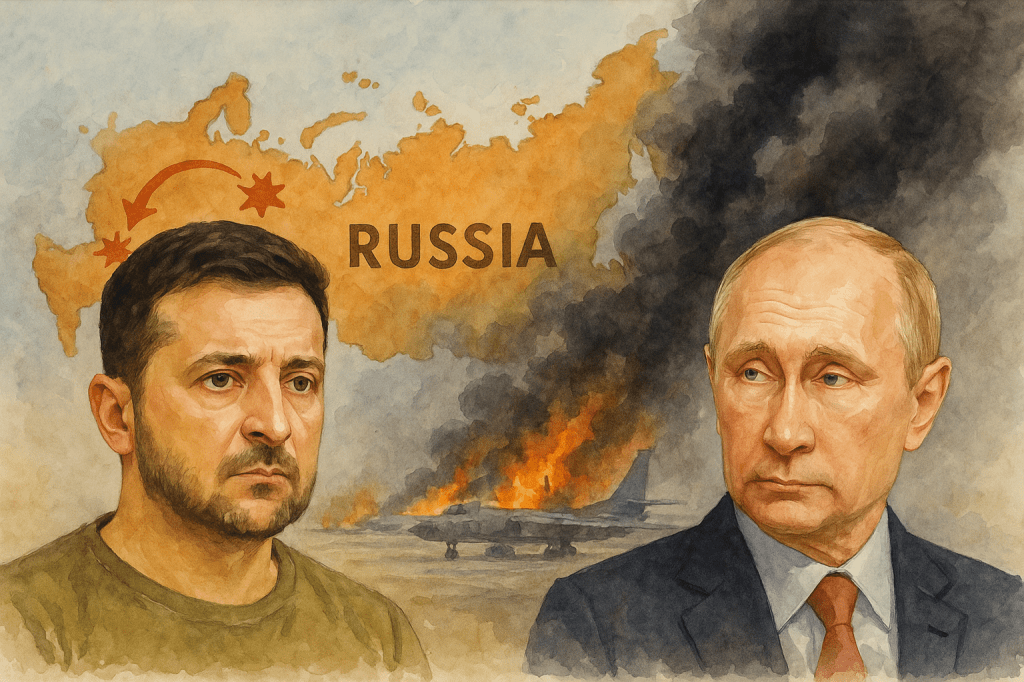
In one of the most audacious and sophisticated operations since the Ukraine-Russia war began, a fleet of Ukrainian drones recently struck deep into Russian territory, destroying over 40 military aircraft — including strategic bombers and radar surveillance planes — parked at airbases once thought untouchable. Known as Operation Spiderweb, this strike not only dealt a blow to Russia’s military capability but shattered its assumption that the heartland of its empire was beyond reach.
But what truly makes this operation historic is not just Ukraine’s execution. It is what it signals: the emergence of a European military that is able to cripple Russia’s military.
Beyond Ukraine: The Rise of European Military Power
At first glance, it appears to be a Ukrainian success story. But beneath the surface, Europe’s fingerprints are all over it.
After the Trump administration cut off intelligence-sharing and military support to pressure Ukraine into a negotiated peace, it was France and the United Kingdom that stepped in to keep Ukraine informed. (Although the US has suspended its intelligence support to Ukraine from March 3-11, its intelligence support resumed after Ukraine agreed to the Trump administration’s 30-day ceasefire proposal. By the time Ukraine executed Operation Spider’s Web on June 1, US intelligence support has resumed for over two months. Likewise, the operation has been in planning for more than a year and it has benefitted from US intelligence provided for several years prior to its execution. The fact however remains that European military intelligence support to Ukraine has remained consistent and robust whether US support was there or not.)
The Drone Coalition for Ukraine, spearheaded by the UK and Latvia and joined by Germany, Belgium, and Turkey, has funded over €1.8 billion in drone warfare innovations — the very capabilities that made Operation Spiderweb possible.
European intelligence satellites, logistical frameworks, encrypted communication systems, and battlefield coordination tools filled the vacuum left by the U.S. withdrawal.
This was not just a Ukrainian strike. It was a European-enabled blow against Russia’s strategic depth. And it was devastating.
Russia’s False Sense of Security is Gone
The targets included Tu-95 and Tu-160 bombers — Russia’s nuclear-capable aircraft — and A-50 early-warning planes, essential for commanding airspace and coordinating attacks. In one night, Ukraine managed to destroy approximately one-third of Russia’s long-range bomber fleet. These aren’t assets that can be easily or quickly replaced. Many were Soviet-era, and the factories that built them no longer exist.
With the United States uninvolved, this blow was delivered largely through European intelligence, European drone design, and European coordination. The operation shattered the illusion that Russia’s vast geography offers security — and marked the first strategic-level success of a European-backed military force since World War II.
A Glimpse into the Future: Europe Without America
Europe’s military awakening is no accident — and it’s accelerating:
The Galileo satellite network, the IRIS² secure communications constellation, and nationally operated reconnaissance satellites are enabling Europe to be independent of U.S. space assets.
Germany’s Sky Shield Initiative, Airbus’s A400M strategic airlift, and the Multinational MRTT air-refueling fleet now give Europe global logistics reach.
France, with its independent nuclear arsenal, is now leading talks on a pan-European nuclear deterrence umbrella.
What we are witnessing is the rapid formation of an autonomous European military force — one no longer under the U.S. defense umbrella, and increasingly capable of replacing it.
In the near future, Europe may very well decimate Russia in a head-to-head war. And it wouldn’t need the United States to do it.
This, Too, Was Prophesied
Long before this shift, the Bible foretold of a coming superpower in the end time — a “Beast” power rising out of Europe (Revelation 17:12–13). This power would consist of “ten kings” — a coalition of nations that give their authority to a central military leader. It would wield immense force and shake the earth with its dominion.
We are watching that prophecy unfold.
Russia, despite its nuclear bravado, is crumbling before a resurgent Europe. And America, once the dominant force for world order, is stepping back — politically, economically, and militarily.
These events point to a global realignment of power — exactly as the Scriptures predicted.
Spiritual Reality
As Europe grows in power and war looms ever larger, it is easy to marvel at the strategic brilliance or technological advances. But we must not lose sight of the spiritual reality behind these geopolitical shifts.
Christ warned in Matthew 24:22 that unless those days were shortened, no flesh would be saved — meaning that humanity, left to its own devices, would annihilate itself. The tools of our destruction — hypersonic missiles, autonomous drones, cyber warfare, biological agents — already exist.
The question is not if they will be used, but when.
And yet, there is hope. Not in politics. Not in NATO or the EU or Washington. But in God.
As the world plunges toward conflict and chaos, God is calling us to repent, to seek His truth, and to prepare spiritually for what lies ahead. Only His intervention will stop mankind from self-destruction.
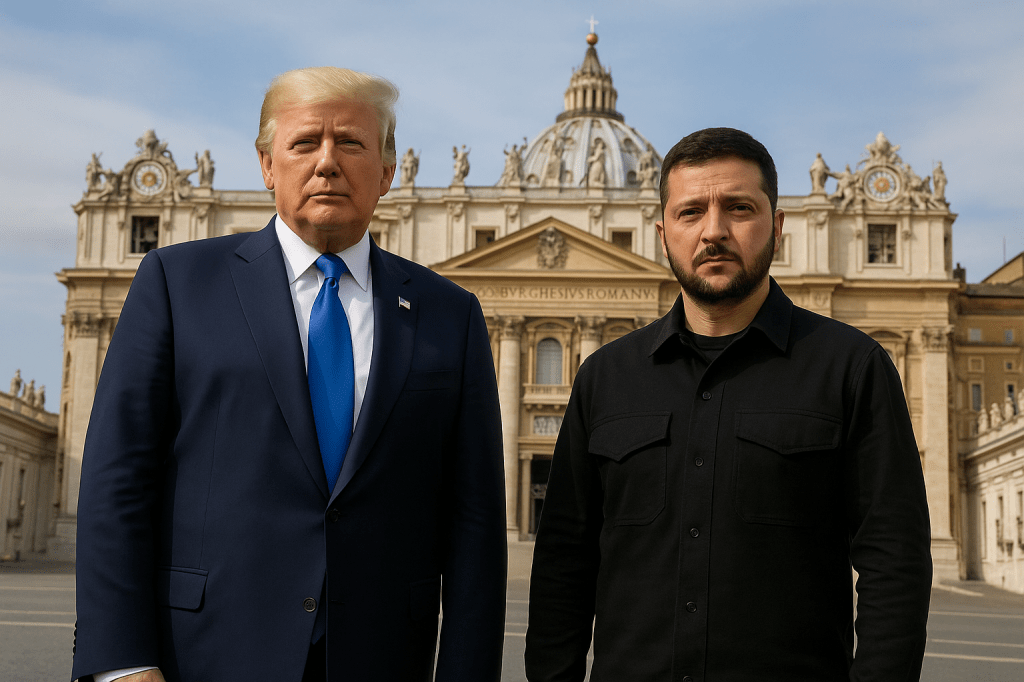
At the sidelines of the funeral of Pope Francis, held at the Vatican — a setting deeply symbolic of hope, reconciliation, and peace — a private and significant meeting took place between Ukrainian President Volodymyr Zelensky and U.S. President Donald Trump. Although their conversation lasted only around fifteen minutes, it produced key developments that, if sustained, suggest a possible shift in tone regarding the ongoing Russia-Ukraine conflict. This meeting, in its timing and tone, could have lasting implications for Ukraine, Europe, and global peace efforts.
Key Outcomes of the Meeting
The Zelensky–Trump meeting achieved several notable outcomes that signal at least a partial change from previous U.S. positions:
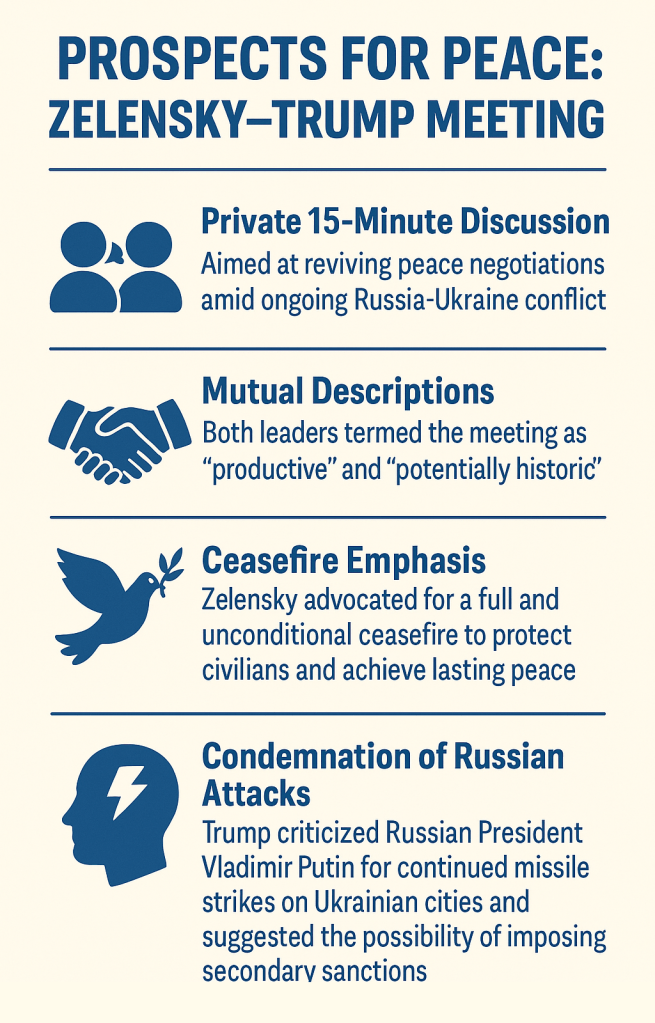
Private 15-Minute Discussion – The two leaders engaged in a brief but focused conversation aimed at reviving the stalled peace negotiations between Ukraine and Russia. Though details remain limited, both sides characterized the exchange as serious and constructive.
Mutual Praise of the Meeting – Afterward, both Trump and Zelensky described their discussion as “productive” and “potentially historic.” This mutual appreciation suggested a desire — at least rhetorically — to move beyond posturing and work toward real diplomatic progress.
Emphasis on the Need for a Ceasefire – President Zelensky strongly advocated for a full and unconditional ceasefire to protect Ukrainian civilians and prevent further devastation. Trump, echoing a similar concern, called for immediate steps to reduce violence on the ground, marking a notable rhetorical shift from earlier periods when he emphasized quick deals even at Ukraine’s potential expense.
Public Condemnation of Russia’s Attacks – For the first time in a significant international setting, Trump openly criticized Russia’s continued missile strikes on Ukrainian cities. He even hinted at the possibility of imposing secondary sanctions on Russia if hostilities escalated — a firmer line than he had taken during his previous administration.
These outcomes suggest that while Trump’s overall strategy may not have fully changed, his tone and priorities appear to have evolved — at least in how he publicly frames the conflict.
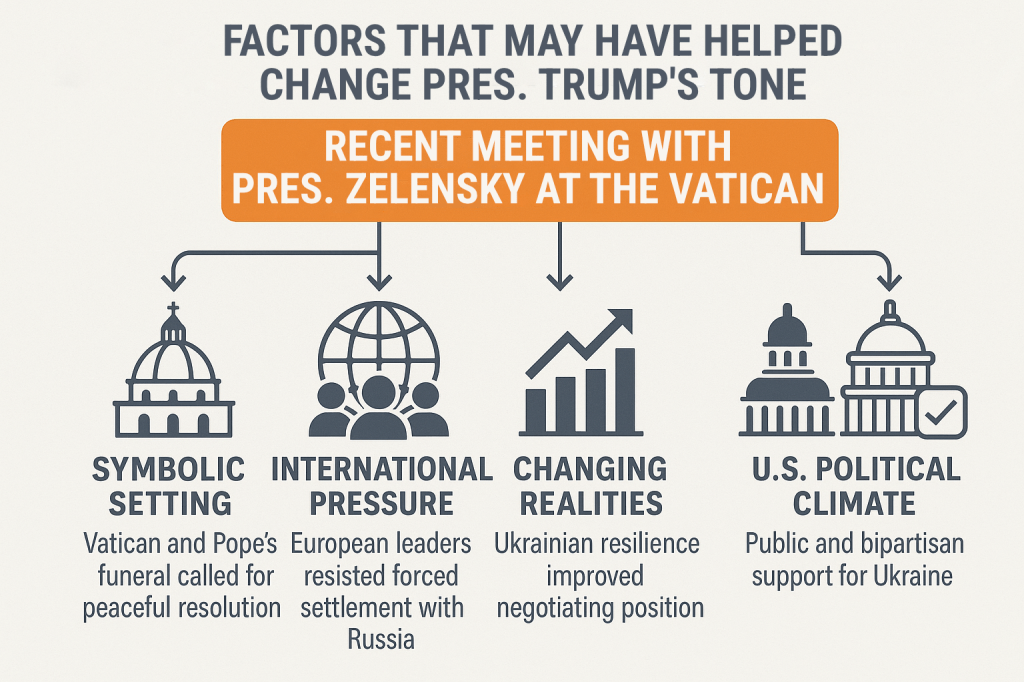
Factors That Likely Changed President Trump’s Tone
Several important forces likely contributed to this adjustment in Trump’s rhetoric and stance:
The Symbolic Setting of the Vatican – Meeting during Pope Francis’ funeral inevitably shaped the atmosphere. In a setting dedicated to peace, compassion, and global unity, it would have appeared callous and politically risky for Trump to project a transactional or overly hardline image.
International Diplomatic Pressure – Major European powers such as France, Germany, and the United Kingdom had already signaled strong opposition to any peace deal that legitimized Russia’s territorial gains. Trump’s administration would risk significant diplomatic isolation if it pushed for an unjust settlement.
Ukraine’s Battlefield Resilience – Ukraine’s ability to hold its ground against Russian aggression impressed even skeptical observers. Zelensky’s ability to represent a nation that refuses to surrender easily likely demanded a more respectful and serious response from Trump.
Growing Bipartisan U.S. Support for Ukraine – Both Democratic and Republican lawmakers have increasingly voiced support for Ukraine’s territorial integrity. With elections looming in 2026, Trump cannot afford to alienate a significant portion of the American electorate who sympathize with Ukraine’s struggle.
Trump’s Need to Reinforce a Statesmanlike Image – As he looks toward solidifying his legacy and future leadership reputation, Trump understands the value of being seen as a “peacemaker.” This meeting provided an opportunity to bolster that image on a global stage.
Taken together, these factors likely combined to encourage Trump to moderate his tone and speak more seriously about a diplomatic path forward.
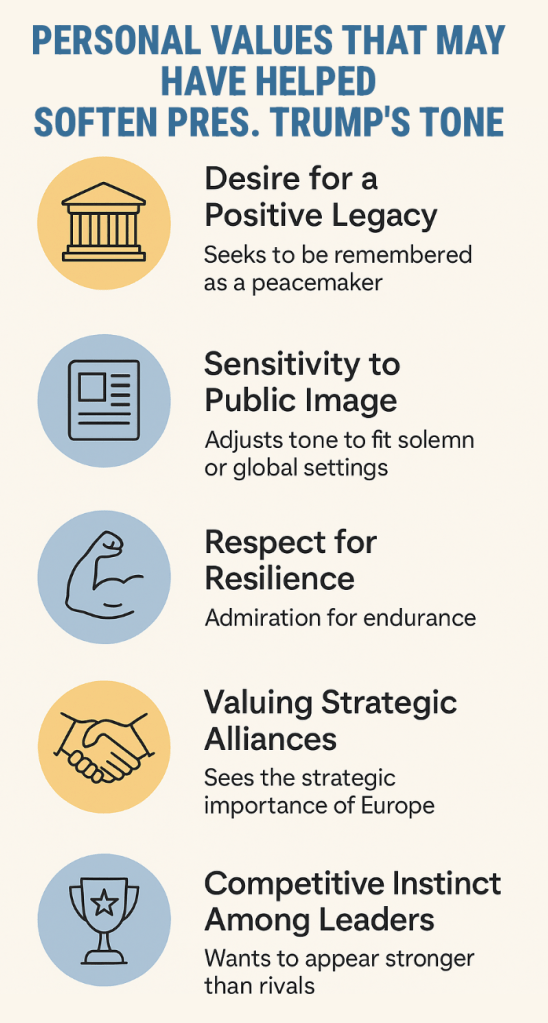
Personal Values That Helped Soften Trump’s Tone
Trump’s change in tone wasn’t merely a result of external pressures. Some of his core personal values may also have played a role:
Desire for a Legacy of Peace – Trump is deeply concerned about how history will remember him. Securing peace between Ukraine and Russia could be a monumental achievement that cements his place among world leaders who brokered significant peace deals.
Sensitivity to Public Image – Trump’s acute awareness of how he is portrayed in the media likely made him realize that appearing compassionate, especially at the Vatican, would play well both internationally and domestically.
Respect for Strength and Resilience – Trump’s admiration for strength — whether in individuals, businesses, or nations — likely drew a measure of respect for Ukraine’s unwavering resistance against a much larger military power.
Transactional View of Alliances – Trump sees international relationships through the lens of mutual benefit. He understands that maintaining strong European alliances is crucial for America’s broader strategic interests.
Competitive Instinct Against World Leaders – Trump views global politics as a contest among strong personalities. His evolving criticism of Putin may not only reflect strategic calculation but also a desire to appear tougher and more effective than the Russian leader.
These personal values — particularly the desire for a positive legacy and respect for strength — could later motivate Trump to adjust even further on the more contentious areas of the peace negotiations.
Remaining Areas of Difference
Despite the softened tone, serious divergences remain between the U.S. and Ukraine’s vision of peace:
Recognition of Crimea as Russian Territory – Reports indicate that Trump is still inclined to propose recognizing Russia’s annexation of Crimea — a move Ukraine and nearly all of Europe categorically reject. For Ukraine, such recognition would legitimize illegal aggression and set a dangerous precedent.
Permanent Exclusion of Ukraine from NATO Membership – Trump has also suggested that Ukraine should be permanently barred from NATO as part of any settlement. This would leave Ukraine vulnerable to future Russian attacks and could embolden other aggressors worldwide.
If these areas are not resolved, any peace agreement would be fragile at best — and future conflicts almost inevitable.
What Could Change Trump’s Mind
Several dynamics could influence Trump to reconsider these positions:
Continued Ukrainian Military Gains – If Ukraine demonstrates continued success on the battlefield, the political cost of asking them to surrender land will become much higher.
Strong Legislative and Public Pressure in the U.S. – If Congress ties military aid and diplomatic support to maintaining Ukraine’s sovereignty — and if public opinion stays firmly with Ukraine — Trump will find it harder to push controversial concessions.
European Unity and Toughness – A united European stance could make any plan involving territorial compromise diplomatically and economically costly for the U.S.
Legacy Motivations – Trump’s desire to be remembered as a historic peacemaker could drive him to accept more principled, lasting solutions, rather than quick political victories.
Thus, personal ambition for a noble legacy could actually help steer Trump toward better, fairer peace terms.
How Putin Might React
Russian President Vladimir Putin is unlikely to ignore these developments:
Potential Escalation – If Putin senses that the U.S. position is hardening, he may attempt to escalate militarily to force a settlement while he still holds significant ground.
Undermining Trump’s Credibility – Russia’s information networks might try to discredit Trump if they believe he is drifting too far from their strategic goals.
Increased Diplomatic Pressure on Ukraine – Expect Moscow to step up efforts to intimidate Ukraine into accepting unfavorable terms before U.S. policy hardens further.
In short, Russia is likely to respond aggressively, viewing a tougher Trump as a threat to their long-term objectives.
The Bigger Picture
Even if a ceasefire is achieved, true and lasting peace will not come merely through negotiations.
What is needed is a profound change in the hearts and values of leaders and nations:
Leaders must focus on justice and dignity over power and conquest.
Nations must seek cooperation and fairness instead of exploitation and fear.
Alliances must be built not just on interest, but on principles of mutual respect.
The Bible points us to a future beyond the broken leadership of today.
When Christ returns, He will establish a government where “nation shall not lift up sword against nation, neither shall they learn war anymore” (Micah 4:3).
Under His perfect reign, there will be no more aggressors and no more victims.
Bigger nations will no longer oppress smaller ones. Great powers will no longer fear or threaten one another. True, lasting peace will fill the earth — a peace built on justice, love, and eternal strength.
Cautious Optimism
The Vatican meeting between Trump and Zelensky offers a rare moment of cautious optimism.
But real peace will require more than changed strategies — it will require changed values.
Until the Kingdom of God is established on earth, peace among nations will remain fragile. But every step toward justice, compassion, and respect today is a small glimpse of the greater peace that is yet to come.
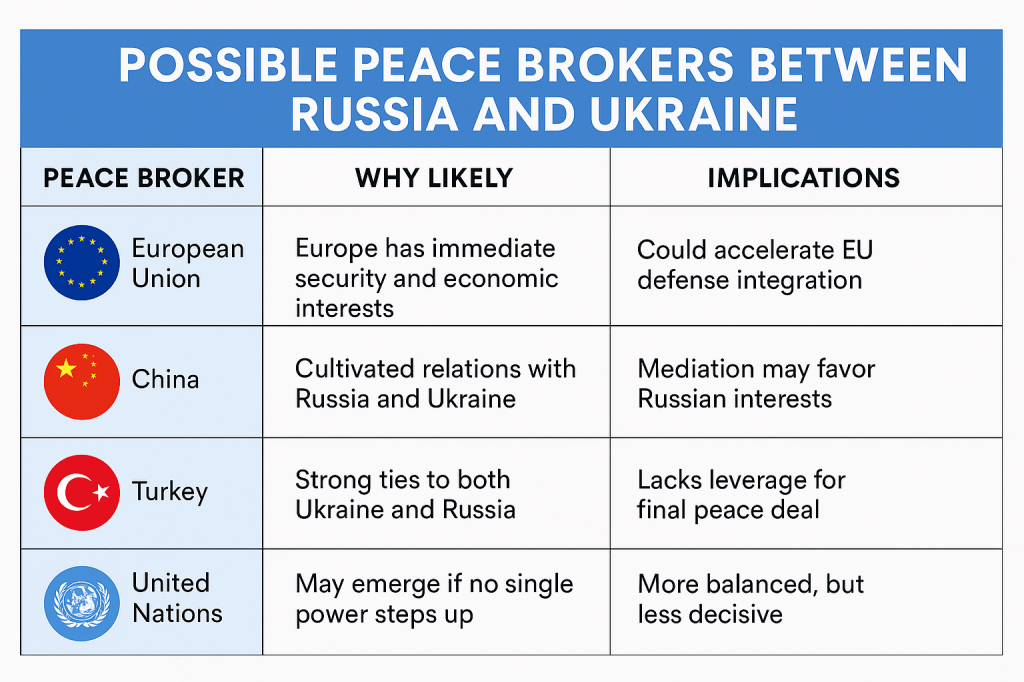
As the Trump administration threatens to withdraw from peace negotiations between Russia and Ukraine, a dangerous vacuum is forming. If the U.S. steps back, others are ready to step in—and the one best poised to fill that role is the European Union.
Europe, more than any other region, has direct security and economic stakes in the outcome of the war. Should the EU, led by nations like France and Germany, manage to broker peace where Washington falters, it would not only mark a diplomatic victory—it would solidify Europe’s emerging role as a global leader in world affairs.
This shift is not just geopolitical—it aligns with Biblical prophecy. Scripture foresees a powerful union rising from the heart of Europe, more dominant than the United States, just before the return of Christ (Daniel 7:7-8; Revelation 17:12-13). The world may soon witness the rise of a superpower that reshapes global alliances—and prophecy warns that it will wield great influence, for better or worse.
“The ten horns which you saw are ten kings… they receive authority for one hour as kings with the beast. These are of one mind, and they will give their power and authority to the beast.” – Revelation 17:12–13
As the U.S. recedes from the center of global diplomacy, Europe’s moment may be dawning.