Category: United States

  • Strikes on Iran and the Shifting Map of the Middle East

    Strikes on Iran and the Shifting Map of the Middle East

    The present military strikes by the United States and Israel against Iran mark one of the most serious escalations in the Middle East in recent years. While immediate headlines focus on missile exchanges, air defenses, and retaliatory threats, the longer-term implications may prove even more significant.

    Beyond the battlefield damage, these strikes are likely to further weaken Iran’s ability to directly project power across the region. And in doing so, they may begin to reshape the balance of influence in ways that are prophetically noteworthy.

    Iran’s Diminishing Reach

    For decades, Iran has extended its influence not primarily through conventional armies crossing borders, but through indirect power — training, funding, and arming proxy groups throughout Lebanon, Syria, Iraq, Yemen, and Gaza. This strategy allowed Tehran to exert regional leverage without inviting full-scale war.

    However, sustained military pressure changes that equation.

    Strikes that target military infrastructure, command networks, weapons production, and elements tied to the Islamic Revolutionary Guard Corps inevitably strain Iran’s logistical capacity. Even if the Iranian government remains in power, its ability to fund, arm, and coordinate its regional allies may be reduced. Economic strain from sanctions combined with military losses compounds this effect.

    In short, whether the current campaign is brief or prolonged, it is likely to further weaken Iran’s direct and indirect power projection.

    And when a dominant regional player weakens, a vacuum can form.

    A Possible Power Vacuum in the Islamic World

    Iran is a Persian, Shiite-majority nation and has never represented the entire Islamic world. In fact, much of the Sunni Arab world has historically viewed Iranian expansion with suspicion.

    If Iran’s influence diminishes significantly, several possibilities emerge:

    • Sunni Arab states may feel less constrained and more emboldened.
    • Regional alliances among Arab nations could deepen.
    • Leadership competition within the Islamic world could intensify.
    • A stronger southern regional bloc could begin to consolidate.

    Geographically speaking, Iran lies east of Israel. But the Bible speaks of a power south of Jerusalem rising at the time of the end.

    This distinction is important.
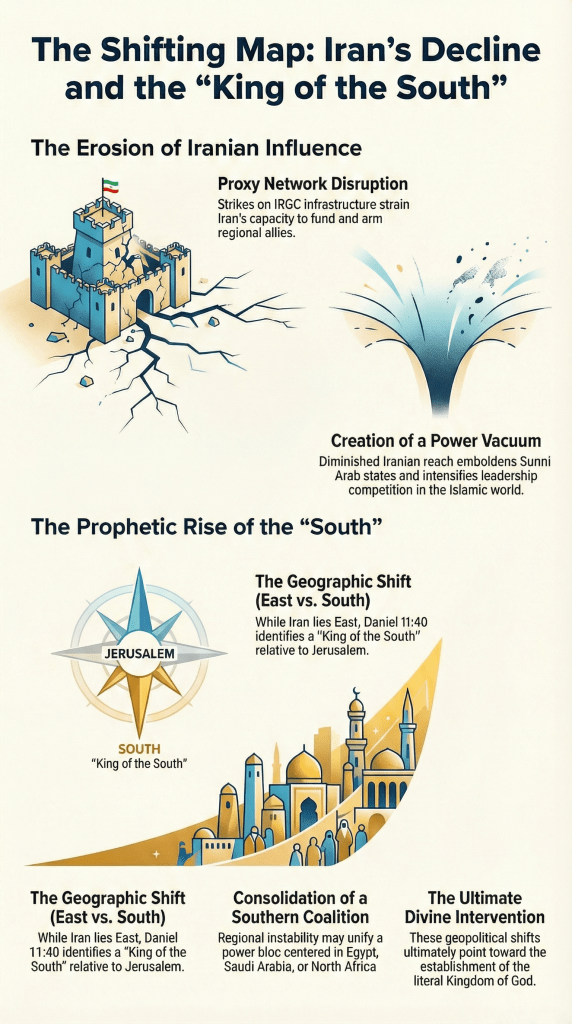
    The Prophetic Dimension: The “King of the South”

    The book of Daniel provides remarkable insight into geopolitical developments surrounding the Holy Land. Historically, Daniel 11 describes conflicts between northern and southern powers relative to Jerusalem.

    In its end-time setting, Daniel 11:40 (NKJV) states:

     “At the time of the end the king of the South shall attack him; and the king of the North shall come against him like a whirlwind…”

    The geographic reference point throughout the chapter is Jerusalem.

    In earlier historical fulfillments, the “king of the South” referred to rulers based in Egypt. Many prophetic interpretations have long understood that a future southern power — located south of Jerusalem — will again rise and play a major role shortly before the return of Jesus Christ.

    Iran does not fit that geographic description. It lies to the east.

    But if Iran’s regional weight declines, could this open the door for another southern coalition — perhaps centered in Egypt, Saudi Arabia, or a broader North African-Arab alignment — to rise in prominence?

    It is not difficult to envision such a development under conditions of crisis. History shows that instability often accelerates consolidation. War, economic distress, or perceived external threats can unify previously fragmented nations.

    Right now, the Islamic world is divided along ethnic, political, and sectarian lines. But circumstances can change rapidly.

    Watching Without Speculating

    We must be careful not to jump to premature conclusions. Prophetic fulfillment often occurs through sudden realignments rather than gradual shifts. No present nation or leader should be hastily labeled as a final fulfillment.

    Yet we also should not ignore directional trends.

    If Iran weakens significantly, and if another regional power south of Jerusalem begins to consolidate influence — especially in opposition to a northern power — that would align remarkably with the biblical pattern described in Daniel.

    The Bible does not give these prophecies to satisfy curiosity, but to provide perspective and warning.

    The Greater Lesson

    While geopolitical analysis is important, prophecy ultimately points beyond political maneuvering to something far greater: the coming literal rule of Jesus Christ over this earth.

    Daniel’s prophecies culminate not in endless war, but in divine intervention.

    The same book that describes the clash of kings also foretells the establishment of God’s Kingdom:

     “And in the days of these kings the God of heaven will set up a kingdom which shall never be destroyed…” (Daniel 2:44, NKJV)

    Events in the Middle East should not merely provoke strategic interest — they should stir spiritual reflection.

    The volatility of nations underscores the certainty of God’s word.

    Power rises. Power falls. Alliances shift. But the prophetic outline remains intact.

    A Call to Watch — and to Return

    Christ instructed His followers to “watch” world events. Not in fear, but in awareness. Not in speculation, but in faith.

    The Middle East remains the central stage of biblical prophecy. As developments unfold — including the weakening of established powers and the potential emergence of new ones — we should observe carefully.

    More importantly, we should examine ourselves.

    The approaching fulfillment of prophecy is not simply about geopolitics; it is about repentance, readiness, and renewal. God’s exhortation has not changed. He calls individuals and nations alike to return to Him.

    The rise and fall of regional powers ultimately point to the only lasting government — the Kingdom of God under the rule of Jesus Christ.

    As the world grows more unstable, that hope grows nearer.

  • America’s Foreign Policy Shift: Short-Term Gain, Long-Term Strain

    America’s Foreign Policy Shift: Short-Term Gain, Long-Term Strain

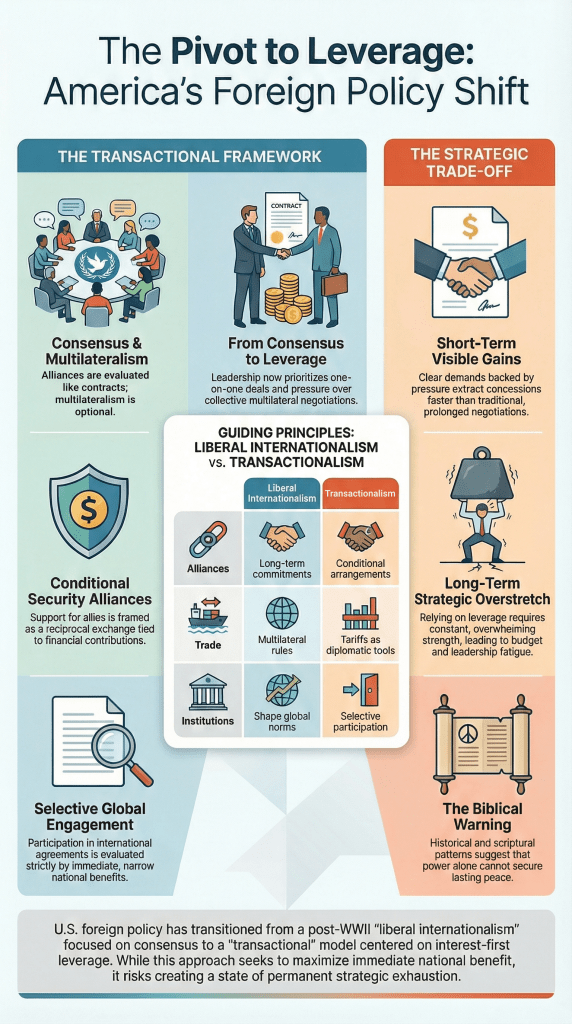
    Over the past several years, a noticeable shift has taken place in the foreign policy of the United States under the Trump administration. This shift marks a departure from the post–World War II framework that guided American engagement with the world for decades—a framework often described as “liberal internationalism”.

    Understanding this change is important not only geopolitically, but also morally and biblically.

    From Consensus to Transaction

    For much of the postwar era, American foreign policy emphasized consensus-building. Alliances were treated as long-term commitments, multilateral institutions were used to shape global norms, and leadership was exercised by persuading others that American interests broadly aligned with international stability.

    The Trump administration has taken a different approach—one that is more transactional, unilateral, and interest-first. Several concrete examples illustrate this shift:

    Alliances as conditional arrangements

    Security commitments, particularly within long-standing alliances, are increasingly tied to burden-sharing and financial contribution. Support is framed less as a shared obligation and more as a reciprocal exchange.

    Tariffs and trade as diplomatic tools

    Economic pressure—especially tariffs—is used directly to compel behavior, sometimes even against allies, rather than relying primarily on multilateral trade rules or coordinated economic frameworks.

    Selective engagement with international institutions

    Participation in global agreements and organizations is evaluated narrowly through immediate national benefit. When institutions are seen as constraining U.S. freedom of action, withdrawal or disengagement is treated as a legitimate option.

    Bilateral pressure over multilateral coordination

    Diplomacy increasingly favors one-on-one deals where American leverage is maximized, rather than collective negotiation where compromise and shared restraint are required.

    Taken together, these actions represent a move away from leadership through consensus and toward leadership through leverage.

    Short-Term Advantages

    In the short term, this approach can produce visible gains.

    Clear demands backed by pressure can extract concessions more quickly than prolonged negotiation. Allies and adversaries alike face fewer ambiguities about U.S. expectations. At the same time, the approach appears to promise fewer foreign entanglements, freeing resources for domestic priorities such as economic stability, infrastructure, and internal security.

    To many observers, this looks like a restoration of national strength and focus.

    The Long-Term Risks

    Yet this posture carries serious long-term risks.

    A transactional foreign policy only works if strength is constant—politically, economically, and militarily. When cooperation depends less on shared norms and more on pressure, any sign of weakness invites challenge. Rivals probe, allies hedge, and crises multiply.

    Ironically, rather than reducing commitments, this approach often forces the United States into a permanent state of strategic alert. Multiple regions require attention at once. Military readiness must be maintained everywhere. Diplomatic energy becomes reactive rather than preventative.

    What appears to save resources in the short term can, over time, sap national power. Constant war-footing strains budgets, exhausts leadership, and fuels domestic fatigue. History suggests that great powers are not undone by a single defeat, but by prolonged overstretch and internal division.

    A Biblical Warning Worth Remembering

    Scripture shows that this pattern is not new.

    God warned ancient Israel that continued rebellion would not result in isolated problems, but in pressure from many directions at once:

    “They shall besiege you at all your gates until your high and fortified walls… come down.” (Deuteronomy 28:52, NKJV)

    Later, the result was summarized simply:

    “The LORD sold them into the hand of their enemies all around.” (Judges 2:14, NKJV)

    When Israel turned away from God, He did not need to create new enemies. He withdrew protection—and pressures converged naturally. There was no single front to manage, no isolated crisis to contain.

    The Enduring Lesson

    The lesson for modern nations is not that military strength is unimportant, but that power alone cannot secure lasting peace. A nation that relies primarily on leverage must always maintain overwhelming strength—and history shows that such a condition cannot be sustained indefinitely.

    Foreign policy reflects deeper moral and spiritual realities. When a nation seeks security without righteousness and order without obedience, it often finds itself surrounded by problems rather than relieved of them.

    The warning God gave to ancient Israel still applies today: Strength may delay consequences but only repentance and wisdom can prevent them.

  • When Power Replaces Principle: America, Venezuela, and the Dangerous Erosion of Moral Authority

    When Power Replaces Principle: America, Venezuela, and the Dangerous Erosion of Moral Authority

    The recent U.S. invasion of Venezuela and the capture of its sitting president, Nicolás Maduro, marks a watershed moment in international affairs. Regardless of one’s view of Maduro’s character or governance, the action itself forces an uncomfortable question: What happens when the world’s most powerful nation abandons moral ascendancy in favor of brute force?

    President Donald Trump justified the operation primarily on the grounds that Maduro and elements of the Venezuelan state were allegedly complicit in drug trafficking that fuels America’s addiction crisis. On the surface, this sounds decisive. Yet even U.S. data and decades of experience show that America’s drug problem is overwhelmingly demand-driven, not supply-driven. Remove one conduit, and another quickly takes its place.

    This suggests that drugs were less the true cause than the public rationale—a moral narrative used to legitimize a far more consequential act.

    The Net Effect: A World More Dangerous, Not More Orderly

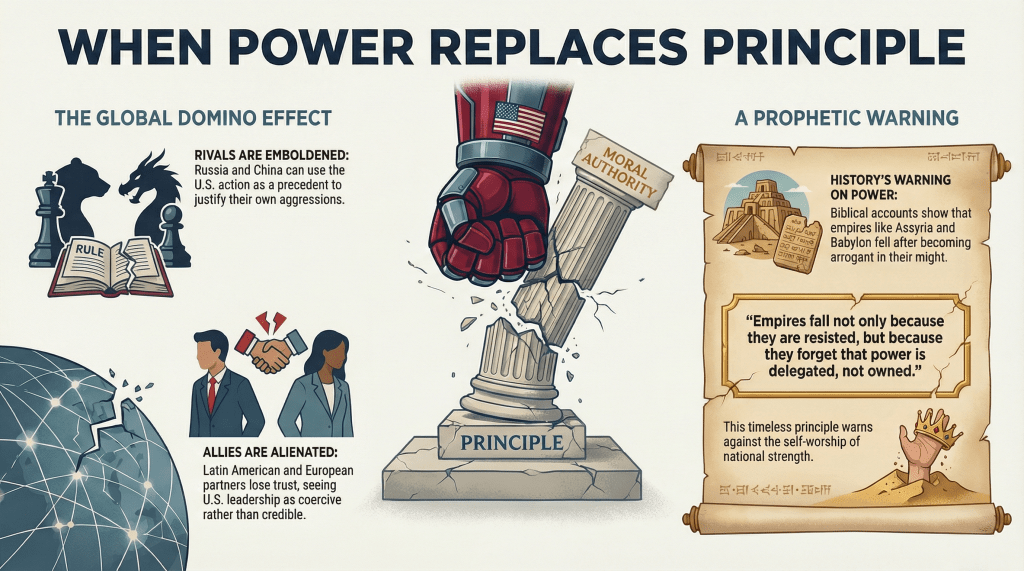
    The most serious consequences of the invasion are not confined to Venezuela. They ripple outward, weakening already-strained international norms and emboldening other powers to act with fewer restraints.

    Russia and the “Precedent Problem”

    Russia has long sought rhetorical cover for its invasion of Ukraine. The U.S. action in Venezuela now supplies it. If Washington can unilaterally invade a sovereign state, capture its leader, and claim criminality as justification, Moscow can argue that its actions against Ukraine—or even a future attempt to “arrest” or assassinate Volodymyr Zelenskyy—are merely variations of the same principle.

    Legally and morally, this argument is weak. But geopolitics is rarely governed by fine legal distinctions. What matters is precedent, and precedents lower the cost of future aggression.

    China and Taiwan

    China has been more restrained in tone, but the lesson it draws is clear. If sovereignty can be overridden by unilateral claims of security or criminality, then the barrier protecting Taiwan grows thinner. The Venezuela invasion reinforces Beijing’s long-standing claim that global rules are selectively applied and therefore disposable.

    When moral consistency disappears, restraint soon follows.

    Fractures Closer to Home

    The effects are not limited to rival powers.

    Across Latin America, resentment is growing. Governments find themselves pressured—implicitly or explicitly—to align with Washington regardless of domestic opinion or national interest. The old fear of being treated as a sphere of influence rather than a community of sovereign states is being revived.

    Meanwhile, America’s European allies are uneasy. Europe has historically been more willing to follow U.S. leadership when that leadership rested on moral credibility and respect for international norms. Power exercised through threat and force may compel short-term compliance, but it corrodes long-term trust. Allies who follow out of fear tend to drift away when alternatives appear.

    A Biblical Pattern Too Often Forgotten

    Scripture does not deny that God uses nations to judge other nations. In fact, it states this plainly.

    God used Assyria to punish the northern tribes of Israel for idolatry and injustice. Yet Assyria’s error was to believe its military success proved its own righteousness. God’s response was severe:

     “Shall the axe boast itself against him that heweth therewith?” (Isaiah 10:15)

    Likewise, God used Babylon, under King Nebuchadnezzar, to correct Judah. But Babylon too crossed the line—from instrument to idolater of power—and was judged for its arrogance, cruelty, and self-worship.

    In both cases, God made the same point: He may use power, but He does not endorse pride.

    The Warning for Our Time

    America’s action against Venezuela may yet serve a purpose in God’s sovereign plan. Scripture shows that God can and does judge nations through other nations. But Scripture also warns that nations which worship their own strength, trust in military might, and refuse to acknowledge God’s supremacy do not escape judgment themselves.

    Empires fall not only because they are resisted, but because they forget that power is delegated, not owned.

    The lesson of Assyria and Babylon is not ancient history—it is living prophecy. When moral authority is abandoned and force becomes the primary language of leadership, the world does not become safer. It becomes more lawless.

    And lawlessness, Scripture tells us, always carries a cost.

  • 2025: A World in Motion—and a World on Edge

    2025: A World in Motion—and a World on Edge

    As 2025 draws to a close, it is increasingly clear that the international order is not merely changing—it is unraveling. Long-standing assumptions about security, leadership, and stability are being tested simultaneously on multiple fronts. Scripture warns that the closing years before Christ’s return would be marked by accelerating turmoil, confusion among nations, and a longing for peace that human systems cannot deliver (Matthew 24:6–8; Luke 21:25–26).

    This year’s geopolitical developments fit that biblical framework with sobering clarity.

    Ukraine, Russia, and the Fracturing of Europe

    The war between Russia and Ukraine continued through 2025 with no decisive resolution. Instead, the conflict hardened into a prolonged confrontation that reshaped Europe’s political and economic landscape.

    European nations faced sustained energy insecurity, rising defense expenditures, and increasing political fragmentation. Public fatigue over the war—combined with inflation, migration pressures, and social polarization—has weakened internal cohesion across the continent. Rather than producing unity, the crisis has exposed the limits of Europe’s ability to guarantee peace through economic integration and military alliances alone (Psalm 146:3).

    Biblically, this aligns with prophecies describing a world in which nations are “in distress” and unsure how to respond to cascading crises (Luke 21:25).

    A Strengthening Russia–India–China Axis

    While Europe struggled, 2025 saw deeper strategic coordination among Russia, China, and India. Though not a formal alliance, their growing cooperation in energy, trade, military exercises, and diplomatic positioning signals an accelerating shift away from a Western-dominated global order.

    This emerging bloc increasingly emphasizes sovereignty over values, stability over liberty, and power over principle. The Bible foretells a time when large coalitions of nations pursue their own strategic interests, often in opposition to one another, contributing to global instability rather than peace (Daniel 11; Revelation 16:12).

    America’s Transactional Turn

    Another notable development in 2025 was the continued evolution of American global leadership. The United States increasingly framed its foreign policy in transactional terms—security guarantees, trade access, and diplomatic support tied more directly to economic or strategic return.

    While this approach may appear pragmatic, it marks a departure from earlier eras when American influence was at least rhetorically linked to democratic ideals, moral leadership, and—however imperfectly—Christian ethical foundations. Scripture warns that when nations abandon righteousness as a guiding principle, their stability erodes from within (Proverbs 14:34).

    This shift also contributed to uncertainty among allies and emboldened rivals, further destabilizing the international system.

    Rising Unrest Within Nations

    Beyond wars and alliances, 2025 was marked by growing internal unrest across many countries. Economic inequality, mistrust of institutions, identity conflicts, and political polarization fueled protests, strikes, and sporadic violence. Governments increasingly struggled to maintain order without resorting to heavier surveillance or coercive measures.

    The Bible foretells such conditions: societies strained by fear, anger, and disillusionment, where people are “lovers of themselves” and distrustful of authority (2 Timothy 3:1–5). These pressures weaken nations from the inside, making them more vulnerable to external shocks and internal collapse.

    The Only Lasting Solution

    Taken together, the events of 2025 reinforce a vital biblical truth: humanity cannot secure lasting peace on its own. Military power, economic integration, and diplomatic maneuvering may delay conflict—but they cannot eliminate it. The worsening of world conditions should not surprise Christians; Christ Himself said these trends would intensify as the end of the age approaches (Matthew 24:8).

    Rather than yielding to fear or political despair, God’s people are called to a different response—to watch, to pray, and to look forward with hope. We are exhorted to pray earnestly for the coming of God’s Kingdom, the only government capable of bringing true justice, peace, and security to all nations (Matthew 6:10; Isaiah 9:6–7).

    As 2025 reminds us yet again, the solution to the world’s problems will not arise from shifting alliances or stronger armies—but from the return of Jesus Christ and the establishment of God’s righteous rule over the whole earth.

  • Greenland, Power Politics, and the Illusion of Security

    Greenland, Power Politics, and the Illusion of Security

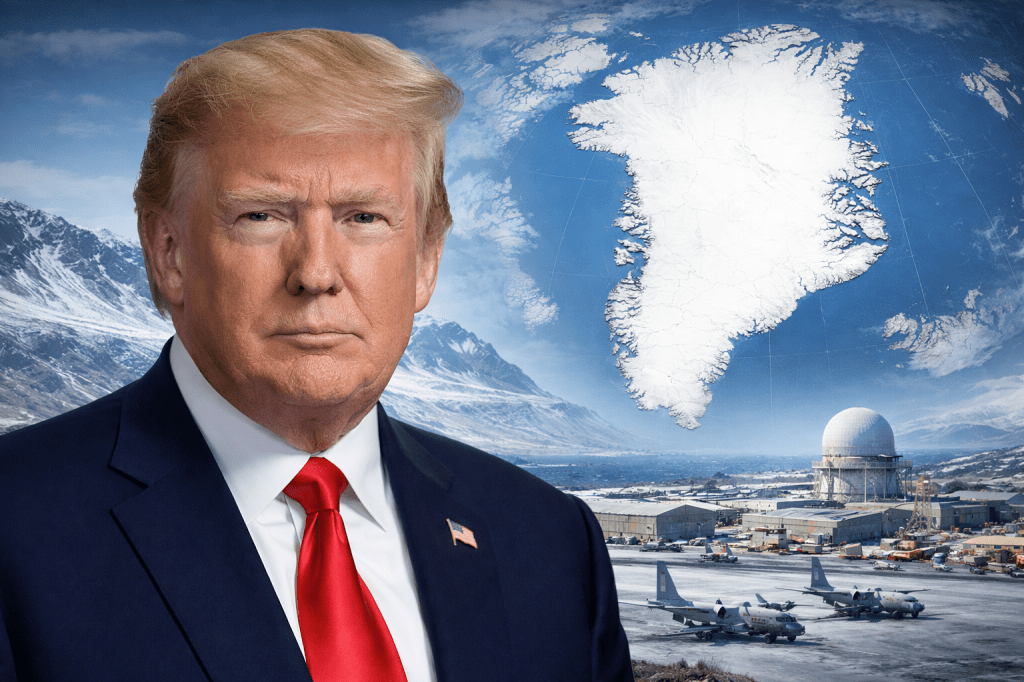
    In recent months, President Donald Trump has revived an idea that initially sounds like a relic from the 19th century: the possibility of Greenland becoming part of the United States. To modern ears—especially those shaped by post–World War II norms—this proposal sounds strange, even reckless. Yet from a purely strategic perspective, the idea is not as irrational as it first appears.

    Greenland sits astride the Arctic gateway between North America and Eurasia. As polar ice melts and great-power competition intensifies, the Arctic is no longer a frozen backwater but a developing strategic theater. Control of airspace, sea lanes, missile-warning systems, undersea cables, and critical minerals increasingly matters. From Washington’s viewpoint, Greenland is not about prestige or novelty; it is about geography.

    Why Greenland Appeals to U.S. Strategists

    If Greenland were to become a U.S. territory, America would gain several tangible advantages.

    First, it would remove political constraints on U.S. military operations there. Today, American forces operate in Greenland by agreement with Denmark and the Greenlandic government. That arrangement works—but it depends on continued consent. Sovereignty would allow the United States to expand radar systems, ports, airfields, and space-tracking infrastructure without diplomatic friction or delay.

    Second, it would permanently deny China and Russia strategic entry. China’s Arctic strategy relies not on overt military bases but on long-term economic footholds—research stations, mining investments, and infrastructure projects that later become leverage. U.S. sovereignty would close that door entirely. Russia, meanwhile, already treats the Arctic as a military frontier. Greenland would give the United States an unmatched vantage point over Russian submarine and missile activity.

    Third, it would future-proof American Arctic power. Military sufficiency today does not guarantee security tomorrow. Technology, climate, and warfare evolve, and human planners instinctively seek permanence through geography and assets.

    From a strategic planning standpoint, the logic is clear. Bases can be revoked. Treaties can be rewritten. Geography cannot be moved.

    The Difficulties and Risks

    Yet the obstacles to such a plan are immense.

    Greenland is not an empty possession waiting to be acquired. It is home to a distinct people with their own language, culture, and parliament. Most Greenlanders do not aspire to trade Danish oversight for American oversight. Their dominant political aspiration is independence—standing as Greenland, not as someone else’s territory—reflecting the biblical reality that peoples seek to dwell according to their own identity and inheritance (Acts 17:26).

    Denmark, for its part, has no appetite to sell territory in the modern era. While it once sold the Virgin Islands to the United States in 1917, today’s political environment is vastly different. Any transfer of sovereignty would require not only Danish agreement but clear Greenlandic consent, reminding us that rulers act within limits they do not always control (Daniel 2:21).

    There are also risks for the United States itself. Acquiring Greenland would strain relations with allies, complicate NATO unity, and saddle Washington with enormous long-term costs—governance, infrastructure, social services, and environmental stewardship in one of the world’s harshest climates. Strategic gain does not come free, a truth Scripture repeatedly affirms regarding the true cost of ambition (see Luke 14:28).

    But beyond these practical difficulties lies a deeper risk: the belief that security ultimately comes from geography and power.

    A Biblical Warning from the Transjordan

    Scripture offers a sobering parallel.

    When Israel conquered the lands east of the Jordan River, the tribes of Reuben, Gad, and half of Manasseh chose to settle there. The arrangement was lawful, negotiated, and strategically sensible, unwittingly serving as a buffer zone protecting the heartland west of the Jordan (Numbers 32:1–5; Deuteronomy 3:12–13).

    Yet history records a tragic outcome. Those Transjordan tribes were the first to fall when foreign empires swept through the land (2 Kings 15:29). Their frontier position—once a strength—became a vulnerability.

    That lesson should not be missed.

    If Greenland were to become a U.S. territory, it would almost certainly serve as America’s Arctic frontier—its buffer and early-warning shield. And if the United States were to grow spiritually weak, morally corrupt, and ripe for judgment, Greenland would likely be among the first places to fall, just as exposed territories often are in biblical history (Isaiah 10:5–12).

    Where Security Truly Comes From

    The Bible is unambiguous on one point: nations do not secure themselves by land acquisition alone.

    Scripture teaches that God determines the boundaries of nations, raises up kingdoms, and brings them down according to His purpose (Deuteronomy 32:8; Acts 17:26). He grants territory—and He removes it—sometimes as blessing, sometimes as judgment (Daniel 4:17).

    This does not mean strategy is meaningless. Governments are responsible to act wisely within their calling. But it does mean that territorial expansion, military presence, and geopolitical maneuvering are at best secondary causes. Ultimate security belongs to God alone (Psalm 127:1).

    A nation is secure not because it controls more land, but because it stands under God’s favor (Proverbs 14:34).

    Strategic Instinct

    President Trump’s Greenland proposal reflects an old, recognizably American strategic instinct: secure the frontier before it becomes contested. In historical terms, the idea is not radical. In modern political terms, it is extraordinarily difficult. And in biblical terms, it is insufficient.

    Even if Greenland were someday to fly the American flag, it would not save a nation under judgment. Like the Transjordan territories of ancient Israel, it could become the first warning sign—not the last line of defense.

    History, Scripture, and experience all point to the same conclusion:

    national security does not ultimately come from acquiring territory, but from the God who grants and withdraws it according to His will (Psalm 33:16–19).