Category: United States

  • The Trump-Zelensky Meeting: A Pause or a Prolongation?

    The Trump-Zelensky Meeting: A Pause or a Prolongation?

    On October 17, 2025, U.S. President Donald J. Trump hosted Ukrainian President Volodymyr Zelenskyy in Florida, following a phone call between Zelenskyy and Russian President Vladimir Putin. The meeting drew wide attention—especially Trump’s call for both Russia and Ukraine to “stop where they are” and his caution about supplying Tomahawk missiles to Ukraine. (“Face to Face With Zelensky, Trump Waffles on Providing Tomahawk Missiles”, http://www.time.com, October 18, 2025)

    That phrase—“stop where you are”—sounds like a ceasefire appeal. Trump wants a negotiated peace, not a sweeping Ukrainian military advance. He signaled reluctance to commit to delivering Tomahawk cruise missiles to Ukraine, warning that doing so could be a “dangerous escalation” and might deplete U.S. stockpiles. (ibid.)

    From a strategic standpoint, these positions carry profound implications for Ukraine’s ability to reclaim territory and check Russia’s offensive capability.

    The Military Dilemma: Risks, Opportunity, or Deadlock?

    1. Ukrainian counteroffensive depends on advanced capability

    Ukraine’s recovery of territory occupied by Russia relies not only on courage and manpower, but on force projection, intelligence, airpower, and deep-strike capability. Tomahawk missiles (with ranges up to ~2,500 km) would allow Ukraine to target Russian logistic hubs, ammunition depots, and command nodes far behind the front lines—imposing cost and pressure. (“Trump may approve Tomahawks for Ukraine if Russia continues war”, http://www.reuters.com, October 13, 2025)

    Without such long-range tools, Ukraine is often limited to tactical counterattacks, artillery duels, drones, or missile strikes of more limited reach. The risk: Russian forces retain sanctuary, rear logistics, and the ability to mobilize for future offensives.

    2. “Stop where you are” risks freezing Russian gains

    A cease-at-current-front-lines deals with “who holds what now” as a status quo. That potentially cements Russian control over occupied areas and undermines momentum for further Ukrainian advances. It may even embolden Russian forces to fortify, entrench and prepare further campaigns, knowing that any future shift in the balance would require much greater effort by Ukraine (and its backers).

    3. Escalation fears versus strategic deterrence

    Trump’s argument is risk-averse: supplying Tomahawks to Ukraine might trigger escalation, risk U.S. involvement, or cross red lines. Critics counter: inaction or under-arming Ukraine may ultimately prolong the war more than escalation would. Deterrence is stronger when backed by credible threat, not passive restraint.

    Thus, the meeting’s tone—calling for a halt and hesitating on high-end systems—implicitly leans toward a diplomatic pause rather than decisive battlefield advantage.

    Prolongation, Paradox, and European Responsibility

    While diplomacy is always a desirable goal, when military advantage is declining, peace talks at the wrong moment tend to prolong wars rather than conclude them. A war without clarity of leverage becomes a war of attrition. Ukraine, under less-than-optimal capabilities, risks being squeezed over time.

    This dynamic suggests a strategic inflection for Europe. If the United States—with Trump as president—hesitates to provide the most potent tools, Europe must not remain a passive bystander. Instead, the European Union and individual European nations should accelerate development of independent defense capability, reducing overreliance on U.S. arms and policy swings. If Europe can field credible deterrent power—air, long-range strike, resilient logistics, intelligence networks—it can shape the strategic balance, protect its eastern flank, and avoid being dragged into conflicts by external alliances.

    In short: Ukraine’s fate, and Europe’s independence, may hinge not on American generosity but on European resolve.

    Biblical Insight: False Prophets, Stale Remedies, and the Beast of Europe

    Throughout Scripture, God denounces spiritual mediocrity and false peace. In Jeremiah 6:14 we read:

    “They have healed the wound of my people lightly, saying, ‘Peace, peace,’ when there is no peace.” (NKJV)

    That is a prophetic warning against superficial, half-hearted solutions—peace declared before the root problem is addressed. When world leaders demand “peace now” without removing the forces of evil or ensuring justice, they risk masking deeper wounds rather than healing them.

    From a prophetic lens, the New Testament presents a future global power often called “the beast” (Revelation 13). Students of Bible prophecy understand this beast as a military-political force emerging in Europe—a revived “king of the North” power, leading a confederation of nations that exerts influence across the earth.

    If Europe were rising into military unity and dominance, that could align with the prophetic pattern. The reluctance of the U.S. (and perhaps the echoing call for restraint in Ukraine) may indirectly clear space for a European superpower to emerge. That is not speculation but caution: when world powers waver, the stage shifts—and biblical prophecy warns that a European beast with military might will arise before Christ’s return.

    Thus, trusting only in ceasefires or superpower mediation invites that prophetic shift. God calls His people to watch, to discern, and to remain rooted in His Kingdom—not in the vain illusions of human “peace” schemes.

    Call to Discernment

    The Trump–Zelensky meeting marks a critical crossroads. It could serve as a step toward peace—but more likely, given its posture, it may lock in a long stalemate that gradually advantages the aggressor. Unless Ukraine (and Europe) can muster sufficient clout, “stop where you are” becomes a perpetual cage.

    From God’s perspective, a peace that ignores justice is a faux peace. Jeremiah’s indictment of “peace, peace when there is none” reminds us that real healing demands confronting evil, not succumbing to superficial ceasefires. And Christian prophecy urges vigilance: as one power (the U.S.) hesitates, another (Europe) may arise—and that very beast may seek global dominance.

    Watch world events with biblical eyes, recognize that human schemes often fall short, and root your hope not in any earthly power, but in the return of Christ and the establishment of God’s Kingdom. In the meantime, let Europe—and the free world—awake: if we delay building real strength for justice, the prophetic pieces may fall faster than we expect.


  • A Silent Room: Trump, the Generals, and the Bible’s Warning on Leadership

    A Silent Room: Trump, the Generals, and the Bible’s Warning on Leadership

    Last week, President Donald Trump convened an extraordinary gathering of America’s top generals and admirals at Quantico, Virginia. It was billed as a moment to rally the officer corps behind his vision for a “War Department” — a return, he said, to discipline, ferocity, and warrior ethos. Yet by all credible accounts, the meeting did not go as planned.

    When Trump entered the room, he remarked that he had “never walked into a room so silent before.” His attempt at humor — warning that officers who disliked his words could “leave the room, though there goes your rank and future” — drew only nervous laughter. Applause was sparse, and the atmosphere, instead of being charged with unity and inspiration, was marked by unease.

    Trump pressed his case further, suggesting that America’s cities could be used as “training grounds” for the military to combat what he called “the enemy from within.” For many observers, this was alarming. The United States has long drawn a line between its armed forces and domestic policing — a line rooted in both law and democratic principle. To see the president urge the military toward coercive roles at home, while belittling senior officers as “fat generals” or “politically correct,” sent the opposite of an uplifting message. It showcased division rather than resolve.

    Why did the meeting fail to inspire? Because leadership rooted in pride and coercion always fails. History teaches this lesson, and so does the Bible.

    Proverbs 16:18 warns that, “Pride goes before destruction, and a haughty spirit before a fall.” Jesus Himself contrasted godly leadership with the authoritarian rulers of the world: “You know that the rulers of the Gentiles lord it over them … yet it shall not be so among you; but whoever desires to become great among you, let him be your servant” (Matthew 20:25–26). And the apostle Peter urged overseers not to rule “with force and cruelty,” but to be examples to those entrusted to them (1 Peter 5:2–3).

    Trump’s meeting is a sobering reminder: leadership built on ego, threats, and authoritarian impulses cannot unify even the most disciplined of institutions. True leadership is not about coercing applause or demanding loyalty; it is about humility, service, and inspiring trust.

    The Weekly Telescope has often warned that the Bible’s wisdom speaks just as powerfully to today’s headlines as it did to ancient kings. When leaders exalt themselves and belittle others, the result is not strength but fracture. But when leaders humble themselves before God and serve with justice and mercy, then nations — and their armies — can find true unity.

  • Storm Over the Shoal: The Philippines, China, and the Future of the West Philippine Sea

    Storm Over the Shoal: The Philippines, China, and the Future of the West Philippine Sea

    Tensions flared again in the West Philippine Sea when Philippine and Chinese vessels collided near Scarborough Shoal on September 16, 2025. According to Manila, Chinese coast guard ships used high-powered water cannons against a Philippine resupply vessel, shattering glass on the bridge, damaging critical equipment, and injuring at least one crew member. China, for its part, accused the Philippines of “illegally” entering its waters and even claimed Manila rammed one of its ships—an allegation firmly denied by Philippine officials.

    This confrontation followed China’s unilateral declaration of a “national nature reserve” at Scarborough Shoal just days earlier. Filipino fishermen and government leaders saw this as an attempt to further tighten Beijing’s grip on a vital fishing ground that lies well within the Philippines’ Exclusive Economic Zone under international law and the 2016 Hague tribunal ruling.

    How Nations Responded

    Philippines: Manila lodged a strong diplomatic protest and ramped up patrols in contested waters. At home, protests over corruption added to the sense of urgency in defending national interests.

    China: Beijing justified its moves as “environmental” but in practice deployed coast guard and maritime militia vessels to enforce its claims, warning the Philippines against “provocations.”

    Allies & Partners:

    • The United States reiterated its defense commitments, condemning China’s actions.
    • Australia, Canada, Japan, and the UK voiced concern and pledged continued support for international law.
    • Germany and France are deepening defense ties with Manila. The UK is even exploring a Visiting Forces Agreement to allow closer military cooperation.

    What to Expect in the Next 3–5 Years

    The Philippines is investing heavily in its navy and coast guard, acquiring new frigates, offshore patrol vessels, and long-range missile systems like the BrahMos. It is also strengthening defense partnerships with allies from Asia, North America, and Europe. These steps will improve deterrence, but they cannot fully offset China’s overwhelming naval power.

    The likely trajectory is continued gray-zone conflict: water cannons, rammings, blockades, and the creation of more “facts on the ground” by China. At the same time, broader coalitions—Philippines with the U.S., Japan, Australia, the UK, and even select EU states—will increase naval patrols and exercises. Expect more incidents, more diplomatic protests, and a slow but steady militarization of the West Philippine Sea.

    The Long-Term Outlook: Prophecy and the Coming Clash

    While today the flashpoint is between the Philippines and China, the Bible shows that the stage is being set for something far greater. Prophecy in the book of Revelation describes a time when two great power blocs will dominate the world scene:

    • On one side, a resurrected Roman Empire, a powerful federation that will evolve out of today’s European Union.
    • On the other side, a vast eastern alliance led by powers like China and its allies.

    The South China Sea, a vital artery of global trade and security, could very well be one of the hot spots where these rival blocs collide. Scripture warns that this confrontation will erupt into a catastrophic war threatening the very survival of humanity (Matthew 24:21–22).

    But God has not left humanity without hope. Jesus Christ will intervene to stop world war from annihilating mankind. He will establish the Kingdom of God on earth, bringing true justice, security, and lasting peace—a peace no human power can achieve on its own.

    A Call to Repentance and Preparation

    In the meantime, God is calling individuals to repent, turn from sin, and live in obedience to His laws. The worsening conflicts, corruption, and rivalries we see today are signs of a world cut off from God. Yet for those who listen and respond, these events can serve as a wake-up call—a reminder to prepare for the soon-coming government of God, which will finally bring peace to all nations.

  • Europe’s Shift in Arms Procurement: A Subtle Sign of Change

    Europe’s Shift in Arms Procurement: A Subtle Sign of Change

    For decades, the defense relationship between the United States and Europe has been clear-cut: Europe bought American weapons, and Washington remained the uncontested leader of the Western alliance. That picture, however, is beginning to change.

    The recent decision by Denmark to bypass the American Patriot missile system in favor of the European-made SAMP/T (New Generation) air defense system is the most visible example of this shift. Denmark also intends to rely on European suppliers for its medium-range air defense, considering systems like Germany’s IRIS-T, Norway’s NASAMS, and France’s VL MICA. Officials in Copenhagen cited delivery speed, affordability, and industrial benefits as reasons—but the symbolism is clear: Europe is increasingly willing to equip itself without defaulting to U.S. systems.

    And Denmark is not alone.

    • Germany is leading the European Sky Shield Initiative, which is pooling resources to expand the IRIS-T system across Europe.
    • The Baltic States—Latvia, Lithuania, and Estonia—are purchasing IRIS-T units in joint arrangements with Germany.
    • Slovenia has also joined the Sky Shield program, relying on European suppliers rather than U.S. ones.
    • Poland, while still buying U.S. Patriots, is investing heavily in the British-designed CAMM missile family, weaving European systems into its layered defense structure.
    • On the ground, Czechia and Slovakia have turned to Swedish CV90 infantry fighting vehicles, and EU funds are pushing production of European artillery ammunition.
    • Ukraine, while still dependent on U.S. armaments, is now producing a significant portion of the weapons it uses in its war against Russia. These include locally manufactured drones, artillery shells, and even missile systems. At the same time, Ukraine has received European-made weapons such as German Leopard tanks, French Caesar howitzers, and British Storm Shadow missiles, showing both its own production and Europe’s growing role in its defense.

    None of this means Europe has abandoned the U.S. As of now, the United States still supplies the majority of Europe’s imported arms—especially in critical areas like fighter jets (the F-35 dominates sales) and strategic enablers. Yet, alongside those U.S. weapons, European nations are increasingly equipping themselves with homegrown systems that are largely interoperable with American platforms. It is not a clean break, but a diversification—a subtle hedge.

    Why This Shift?

    Several factors explain the trend:

    1. Delivery and cost pressures: U.S. systems are often more expensive and slower to deliver than European alternatives.
    2. Strategic autonomy: Europe wants the ability to defend itself without total reliance on American decision-making.
    3. Industrial policy: Supporting European defense industries preserves jobs, technology, and sovereignty.
    4. Political uncertainty: U.S. policy swings—especially under different administrations—make allies wary of putting all their eggs in one basket.

    A Spiritual Dimension

    Behind the headlines, however, lies a deeper story. The Bible tells us that God raises up nations and brings them down (Daniel 2:21). America long stood as the leader of the free world, providing the shield under which much of Europe prospered. But that leadership is eroding.

    The quiet but real shift in Europe’s arms procurement is a symptom of this change. By relying more on each other, Europeans are learning to do without America. This is not merely economics or politics—it is part of God’s judgment on the United States. Scripture warns that when a nation turns away from Him, He will “break the pride of your power” (Leviticus 26:19). America’s military dominance has been a key expression of that power. Now we see signs of it slipping away.

    A Marker of Something Larger

    The choice of Denmark may seem like a technical procurement matter, but it is a marker of something larger. Europe is slowly but steadily becoming more self-reliant in arms production. The United States still supplies much—but the monopoly is gone, and the trend is growing.

    In the months and years ahead, watch Europe’s defense market closely. What appears as procurement diversification is also a signal of shifting leadership in the Western world. As America declines, God is setting the stage for other powers to rise—just as the Bible foretells.

  • The High Price of Corruption

    The High Price of Corruption

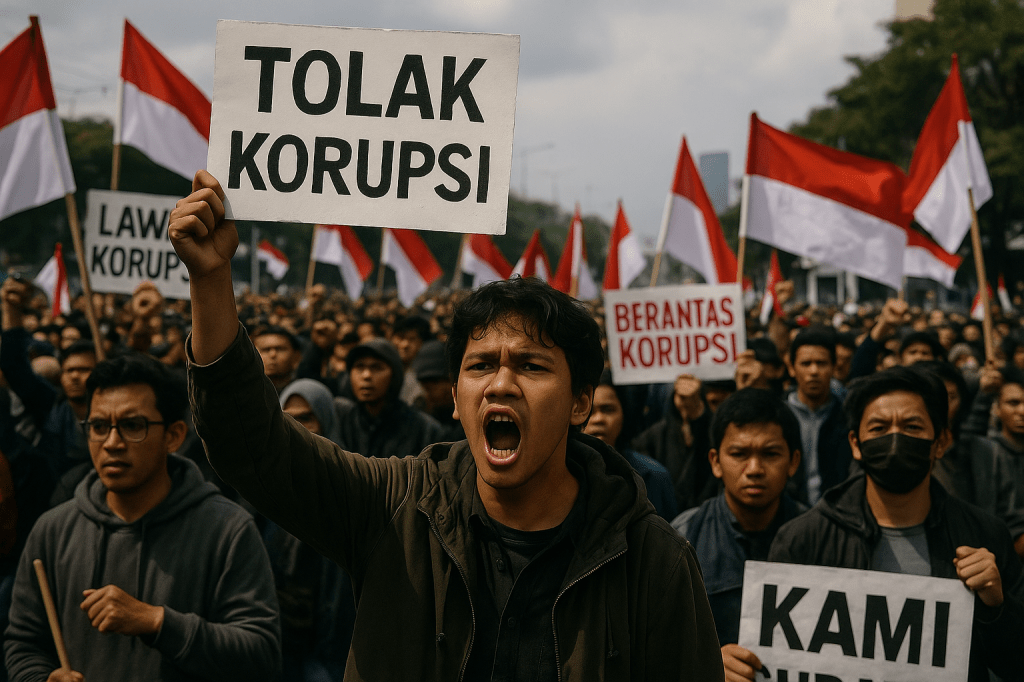
    Corruption is more than a scandal—it is a global crisis. From Asia to the West, it is draining economies, crippling politics, and fueling public anger. Citizens are demanding answers, but efforts to curb graft often fall short.

    In the Philippines, outrage over billions lost in flood-control projects has led to calls for an independent probe. President Ferdinand Marcos Jr. has promised action, yet questions linger over whether lawmakers themselves will be scrutinized.

    In Indonesia, protests have engulfed more than 30 provinces after revelations of lavish perks for lawmakers while ordinary citizens endure austerity. A young delivery driver’s death during demonstrations only deepened the fury. The government has rolled back some benefits but simultaneously unleashed mass arrests and deployed tens of thousands of troops.

    In Mongolia, youth-led rallies over a luxury scandal forced the prime minister to resign. In Thailand, Prime Minister Paetongtarn Shinawatra faces suspension amid an anti-graft probe. Even in the United States, President Donald Trump faces allegations his family enriched itself through cryptocurrency ventures and overseas real estate deals tied to his political stature.

    The toll is immense. The IMF estimates over $1 trillion in bribes are paid each year, with trillions more lost to embezzlement. Money meant for schools, hospitals, and roads vanishes into private pockets. Economies stall, investors hesitate, and inequality grows. Politically, corruption skews elections, weakens the rule of law, and entrenches ruling elites. It sparks unrest, as seen in Asia’s street protests, and opens the door for populist strongmen who often build new corruption networks of their own.

    Governments are not standing still. Independent commissions, anti-graft courts, and international watchdogs have all been established. Technology, from blockchain to open procurement systems, is increasingly used to reduce graft. But progress is slow. Transparency International’s 2024 index shows two-thirds of nations still scoring below 50/100 in integrity.

    Why? Because corruption is not only a systems problem—it is a moral problem. At its heart lies greed, pride, and disregard for God’s law. Leaders who enrich themselves break the command, “You shall not steal.” When justice is twisted, truth is trampled.

    Without spiritual renewal and adherence to God’s commandments, reforms alone will not succeed. Nations may pass laws, but unless hearts change, corruption will simply find new ways to thrive.

    The Bible points to a different future. When Jesus Christ returns, He will establish a government free of graft, ruling with perfect justice and truth. As Isaiah prophesied, Christ will “judge the poor with righteousness, and decide with equity for the meek of the earth” (Isaiah 11:4). Under His reign, nations will finally be able to prosper, free from the drain of corruption, and humanity will experience the fairness and peace it has long desired.

    That is the true solution to the world’s crisis: not just better systems, but a coming Kingdom where corruption has no place.