Category: United States

  • Why Europe—not America—is Poised to Become the West’s Hub for Advanced AI Chips

    Why Europe—not America—is Poised to Become the West’s Hub for Advanced AI Chips

    Despite the U.S.–China tech rivalry, the center of gravity for the West’s most advanced compute is drifting toward Europe in the long term. The reasons are practical—policy, supply-chain physics, and industrial base—and, for those of us who read the Bible’s prophecies, they also fit the end-time alignment in which a revived European power rivals a vast Asian coalition while America declines.

    The inflection now: “Sovereign AI” lands in Europe

    In mid-2025, Nvidia’s push for “sovereign AI”—each nation owning its models and compute—found especially fertile ground in Europe. EU leaders publicly embraced the idea and began backing massive, local AI capacity, including a plan for four “AI gigafactories” and a large 18,000-GPU build with French champion Mistral.

    At the same time, Europe is already hosting some of the world’s most capable AI-ready supercomputers under the EuroHPC program:

    • JUPITER (Germany) — built on ~24,000 Nvidia GH200 Grace Hopper superchips; Europe’s fastest system and its first exascale-class machine.
    • MareNostrum 5 (Spain) — Europe’s newest pre-exascale facility, with accelerated partitions used for AI work.
    • Leonardo (Italy) — ~13,824 Nvidia A100 GPUs on a BullSequana platform at CINECA.

    Alongside these deployments, the EU Chips Act commits €43 billion in public investment (with matching private capital) to strengthen Europe’s semiconductor ecosystem and reduce external dependencies.

    Bottom line: Europe is not just buying chips; it is deliberately localizing compute, policy, and industry to anchor AI at home.

    Why the hub is unlikely to remain in America in the long-run

    1. Export controls that fragment allied access – Recent U.S. rules on advanced AI chips and even model weights introduced tiered access inside the EU, granting some member states frictionless imports while forcing others into licensing regimes. That touched a nerve in Brussels and in national capitals because it splits the single market and turns compute into a diplomatic lever. This has already triggered European calls for more autonomous, EU-based capacity.
    2. Europe is the world’s chokepoint for the tools that make cutting-edge chips – ASML (Netherlands) is the sole supplier of EUV lithography, the tool family required to print the most advanced chips. That unique leverage—and the next High-NA EUV generation now shipping—gives Europe structural power in any Western supply-chain redesign.
    3. Manufacturing & packaging are moving onto European soil – While Nvidia remains fabless, its critical suppliers are expanding in Europe:
    • TSMC broke ground on ESMC—a Dresden fab with Bosch, Infineon, and NXP—and is opening a design center in Munich to support European customers.
    • Intel is advancing an assembly & test site in Wrocław, Poland, a key step in building an EU packaging base for advanced devices.
    • Amkor (a major OSAT partner to many chip designers) runs a packaging/test campus in Portugal, part of a broader European push into advanced packaging.

    4. The regulatory superpower effect – From the AI Act to the DMA/DSA, the EU consistently sets rules that global firms end up following. “Sovereign AI” plus European standards naturally pulls high-end compute into Europe so governments and companies can comply, train local-language models, and keep sensitive datasets under EU jurisdiction. (Nvidia is already tailoring offerings to this need.)

    Taken together: the politics (export uncertainty), the tools (ASML), the money (EU Chips Act), and the physical footprint (fabs + packaging + supercomputers) all point to Europe consolidating as the West’s home base for advanced AI infrastructure.

    “What could push this over the line?” — plausible chain of events

    • A supply-shock scare in East Asia (even weeks): Any Taiwan-Strait disruption would amplify the logic of placing more advanced packaging and system-integration in Europe—closer to sovereign AI customers and the EU’s legal/regulatory center. (Europe is already scaling exascale systems and courting multiple suppliers.)
    • Another round of U.S. export policy whiplash: If allied access again becomes conditional or transactional, EU policymakers will double-down on local capacity and procurement rules that require EU-built stacks for state and critical-infrastructure AI.
    • Ecosystem gravity: With JUPITER, MareNostrum 5, and Leonardo already training European models, follow-on clusters, specialist ASIC deployments (e.g., Groq for inference), and EU-only datasets will pull developers, service firms, and venture capital toward Europe’s compute hubs.

    Through the prophetic lens

    Scripture shows that just before Christ’s return, a revived Roman system rises as a dominant power while “kings of the East” form a counter-bloc (Dan. 2; Rev. 13; 17; 16:12). America, the British Commonwealth, and the modern descendants of Judah decline under God’s corrective hand—not annihilation, but discipline leading to repentance (Lev. 26; Hos. 5:5; 11:7; Amos 3:1–2). In that end-time landscape, it is coherent that the world’s decisive technologies—and the economic/administrative muscle that goes with them—shift to Europe (with Asia rivaling it), while the U.S. loses primacy.

    Technology doesn’t save or condemn; it reveals where power concentrates. Today’s movements in compute sovereignty, chip tools, and supply chains match the geopolitical map the Bible sketches for the end of the age.

    What to watch next (practical signposts)

    1. European capacity mandates in public procurement (e.g., “EU-built hardware for sovereign AI contracts”).
    2. HBM & advanced-packaging ramps in the EU (announcements, hiring, MW-scale campuses).
    3. ASML High-NA EUV rollout cadence and who gets priority tools.
    4. EuroHPC upgrades and national AI “gigafactory” awards (Germany/France/Italy/Spain consortia).
    5. U.S. export-control tweaks that re-tier EU access (or replace tiers with bilateral deals).

    Force of Gravity

    Even as U.S.–China rivalry dominates headlines, the Western hub for frontier AI hardware is gravitating toward Europe—by design and by necessity. For policy and industry, this is about sovereignty and resilience. For those of us who study prophecy, it is one more stepping-stone toward the world the Bible describes: a powerful European bloc facing a consolidated Asian power, while America is humbled to repentance—just before Christ returns.
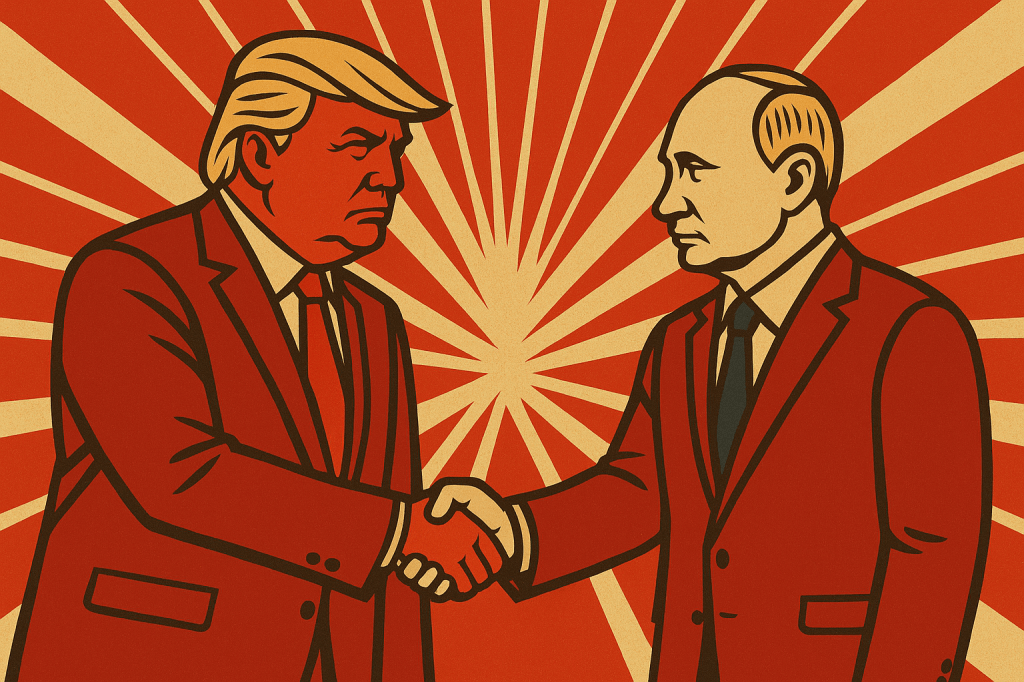
  • The Alaska Summit: Is a ‘Reverse Nixon’ Strategy Realistic?

    The Alaska Summit: Is a ‘Reverse Nixon’ Strategy Realistic?

    The highly anticipated Trump–Putin summit in Alaska has now concluded, and its outcome was largely as expected. There was no breakthrough peace deal, no dramatic ceasefire in Ukraine, and certainly no resolution of the war that has scarred Europe for over three years. Instead, as we anticipated, what emerged was a meeting heavy on appearances but light on substance—one that gave Russia space to make demands and allowed President Trump to present the encounter as a step toward peace.

    Yet one surprising narrative surfaced in post-summit commentary: that Russia could somehow be drawn into serving as a counterweight to China. At first glance, this might sound like a clever geopolitical gambit. In reality, if it is really part of Trump’s planned outcome, it is little more than wishful thinking.

    The “Reverse Nixon” Strategy—Revisited

    Some analysts have framed the Trump administration’s approach as a kind of “reverse Nixon.” Just as President Richard Nixon reached out to China in the 1970s to isolate the Soviet Union, so too might Trump try to cultivate Russia to isolate China. Post-summit analysis suggested that Alaska revealed “Washington’s intent to weaken the Sino-Russian partnership, positioning Russia as a potential counterbalance to China” (“Trump–Putin Summit in Alaska: Geopolitical Implications and Strategic Narratives”, Special Eurasia).

    However, it is important to stress that none of the major news outlets covering the Alaska summit—Reuters, AP, The Guardian, The Washington Post, or Wall Street Journal—quoted any U.S. official explicitly declaring this as policy. The focus of official statements remained firmly on Ukraine, ceasefire diplomacy, and territorial questions.

    This means that the “counterweight to China” idea, while attractive to some in Washington and appealing to commentators, remains speculative at best.

    Why Russia Will Not Truly Counter China

    Several factors make the notion of Russia acting as a stable American ally deeply unrealistic:

    1. Deep Cooperation with China (and North Korea):

    China has provided Russia with essential economic lifelines and diplomatic support throughout its war in Ukraine. North Korea has supplied artillery and munitions to Russia, underpinning its battlefield operations. These actions go beyond mere solidarity—they demonstrate an active and ongoing alliance. Moscow is unlikely to betray the countries that enable its war effort.

    2. Entrenched Distrust of the West:

    Under Putin, Russia has shaped its identity in opposition to the West. NATO and the United States are framed as existential threats to sovereignty. A genuine pivot toward Washington would undermine that domestic narrative and threaten regime legitimacy.

    3. Power Imbalance and Strategic Leverage:

    Moscow’s flirtation with Washington is not about alignment—it’s about leverage. Russia is signaling to Beijing that it has alternatives. But with its economy and industrial capacity still dwarfed by China’s, true independence remains elusive.

    4. Historical Precedents of Broken Hopes:

    Past attempts to reset ties with Russia—from the Bush-era friendliness to Obama’s “reset”—ended with disappointment. Today’s overtures are likely to follow that same pattern: brief engagement, followed by a return to opposition.

    The Risks

    This optimistic narrative—that the U.S. and Russia can form a strategic counterbalance to China—is, in reality, not achievable, especially for the long-term. At best, Russia will play along just enough to extract concessions while maintaining its vital ties with Beijing (and Pyongyang). At worst, this illusion will misguide U.S. policy, encouraging miscalculations and weakening alliances.

    The Prophetic Trajectory: Kings of the East

    Biblical prophecy casts a longer, more enduring shadow over these events. Revelation 9:13-16 speaks of armies east of the farthest boundaries of the Roman Empire about to invade it just before the return of Christ. This implies not division among eastern powers, but convergence—especially against the West.

    The idea that Russia is drifting away from China is a surface-level maneuver. Beneath this lies a deeper movement toward alignment, consistent with the prophetic vision of eastern powers uniting. Their eventual hostility will not be directed inward, but outward—against the West.

    Not Realistic

    The Alaska summit unfolded largely as we and some other observers predicted—no peace, continued Russian leverage, and cautious Western response. Yet the notion of Russia becoming a U.S. counterweight to China is not a realistic long-term outcome. Russia’s alliances run too deep, its distrust of the West too entrenched, and the prophetic currents too clear.

    Ultimately, Russia is not turning away from China; it is seeking respect from a powerful partner. And, as Scripture indicates, when the time is right, the eastern powers will move together—not toward peace with the West, but toward confrontation.

  • Trump and Putin in Alaska: A Peace Summit Full of Pitfalls

    Trump and Putin in Alaska: A Peace Summit Full of Pitfalls

    Later this week, in Alaska, U.S. President Donald Trump will meet face-to-face with Russian President Vladimir Putin to discuss one of the most intractable crises of our time — Russia’s ongoing invasion of Ukraine. The announced agenda is ambitious: negotiate a framework for ending the war, possibly as the first step toward a ceasefire.

    The timing and optics are deliberate. Trump wants to present himself as the dealmaker who can succeed where others have failed — the leader who brings “peace through strength” and does it fast. But the devil, as always, is in the details. And those details make this meeting a minefield.

    Trump’s Goal: A Quick Win Through “Realism”

    From Trump’s perspective, the fastest way to stop the bloodshed is to recognize “facts on the ground” — in other words, to accept that Russia retains control of the territory it has already seized, including Crimea and much of eastern Ukraine. In exchange, Putin would agree to halt further offensives, and the West might offer security guarantees and economic relief to Ukraine.

    It’s a high-pressure, “take-it-or-leave-it” model: create a deal between Washington and Moscow first, then present it to Kyiv and Europe as the only viable path forward. The thinking is that Putin would pocket his territorial gains while the West declares a victory for peace.

    The Built-In Problems

    The plan has serious, perhaps fatal, flaws:

    1. Ukraine Isn’t at the Table – By structuring the Alaska talks as a bilateral U.S.–Russia summit, Trump risks sidelining the very country whose sovereignty is at stake. Ukrainian President Volodymyr Zelenskyy has made it clear: *nothing about Ukraine without Ukraine*.
    • Russia’s Track Record – In Georgia (2008), eastern Ukraine (2014–2015), and Syria (2016–2018), Moscow agreed to ceasefires mainly to regroup, rearm, and solidify its gains — not to make lasting peace.
    • Weak Enforcement – If the deal lacks robust monitoring and automatic penalties for violations, Russia can probe and push the limits without meaningful consequences.
    • Western Disunity – Forcing Ukraine to concede territory risks fracturing Western unity. Many European leaders reject any settlement that legitimizes territorial conquest, and public opinion in Ukraine is overwhelmingly against ceding land.

    The Likely Outcome: A Pause, Not a Peace

    Even if an agreement is signed, it’s far more likely to be an armistice in name only than a true resolution. Our analysis suggests that:

    • The most probable outcome is a “frozen conflict” — small-scale fighting, periodic ceasefire breaches, and Russia consolidating its hold on occupied areas.
    • The war’s core dispute — Ukraine’s sovereignty and borders — will remain unresolved.
    • Russia will use any pause to reinforce defenses, rebuild stockpiles, and prepare for future moves.
    • Ukraine, feeling pressured and sidelined, will quietly rearm and strengthen its alliances, waiting for a more favorable moment to push back.

    If Trump’s plan demands territorial concessions, the result will likely be a breathing space for Russia and a bitterly resentful Ukraine — with much of Europe also frustrated at the precedent it sets.

    The Peace the World Really Needs

    The Bible shows us that true peace will not come through deals built on compromise with aggression. Compromises may silence guns for a time, but they do not remove the seeds of future war. Real, lasting peace will only come when a world leader emerges who is stronger than any human power — one who will rule not with political expediency, but with perfect justice.

    That leader will be Jesus Christ at His return. Isaiah prophesied of Him:

    “Of the increase of His government and peace there will be no end… to order it and establish it with judgment and justice from that time forward, even forever” (Isaiah 9:7, NKJV).

    When Christ establishes His Kingdom, peace will not be negotiated on the basis of who holds what territory or who can extract the better deal. It will be enforced worldwide on the basis of God’s law, which ensures fairness, righteousness, and the protection of all peoples.

    Realities on the Ground

    The Trump–Putin meeting in Alaska may produce headlines about “ending the war,” but the realities on the ground — and the terms being floated — make a genuine resolution improbable. At best, the world may see a temporary reduction in hostilities. At worst, it will simply buy time for Russia to regroup and return to the fight.

    Until the day Christ returns to impose peace with justice, the world will keep watching leaders attempt to negotiate their way out of wars — and keep learning, painfully, that human solutions can never match God’s plan for lasting peace.

  • The Most-Favored Nation Executive Order: A Prescription for Change—or for Caution?

    The Most-Favored Nation Executive Order: A Prescription for Change—or for Caution?

    In May 2025, President Donald Trump signed a sweeping Executive Order aimed at curbing the high cost of prescription drugs in the United States. Dubbed the Most-Favored Nation (MFN) pricing rule, this policy would require that America pay no more than the lowest price pharmaceutical companies offer for the same medications in other developed countries. On the surface, this sounds like a win for American patients—but like any policy of this scale, it comes with both promising benefits and serious risks.

    What Is the MFN Executive Order?

    Under the Executive Order, the U.S. government—through agencies like Medicare and Medicaid—would benchmark drug prices to those in countries such as Canada, Germany, or the UK, where governments negotiate directly with drug manufacturers. This approach seeks to end the long-standing reality where Americans pay two to ten times more for the same drugs than patients in other nations.

    This policy is built on the logic that U.S. consumers have been subsidizing global pharmaceutical innovation, paying higher prices while other countries benefit from cheaper access. By pegging prices to the lowest rates in the developed world, the MFN rule aims to eliminate this imbalance and deliver much-needed relief to American families.

    Advantages of the MFN Pricing Model

    • Lower Drug Prices for Many Americans – Some life-saving medications could become significantly more affordable—particularly for seniors and those with chronic conditions.
    • Pressure on Pharmaceutical Companies – Drug manufacturers would be compelled to offer competitive pricing, not just in the U.S., but globally, to avoid triggering MFN clauses.
    • Fairness and Parity – The policy aims to end what many call “global freeloading”—where other countries pay less while benefiting from U.S.-funded R&D.

    Disadvantages and Risks

    • Reduced Innovation – Critics warn that if pharmaceutical revenues drop significantly, companies may cut back on research and development, delaying or halting future cures.
    • Drug Access Limitations – Manufacturers might choose to withhold or delay launching new drugs in the U.S. to maintain pricing leverage elsewhere.
    • Legal and Logistical Challenges – The policy could face significant legal opposition and implementation hurdles, especially from pharmaceutical lobby groups and trade partners.
    • Limited Scope – Initially, the policy only applies to a narrow group of high-expenditure drugs, and private insurers are not yet bound by the pricing caps.

    Alternative Solutions

    While the MFN approach is bold, experts suggest alternative reforms that could balance affordability with innovation:

    • Value-Based Pricing: Price drugs according to the actual health benefit they deliver.
    • Outcomes-Based Contracts: Pay manufacturers only if the drug proves effective.
    • Encouraging Generics and Biosimilars: Speed up market entry and prevent anti-competitive tactics.
    • Public R&D and Patent Buyouts: Increase government funding for drug development and make life-saving medications publicly available.
    • International Reference Pricing: Use a weighted average of prices from peer countries—not just the lowest.

    God’s Promise of Health

    While these human efforts to reduce drug prices are commendable, they overlook a deeper truth: our physical health is ultimately tied to our spiritual condition. Thousands of years ago, when God brought Israel out of slavery in Egypt, He made a remarkable promise:

    “If you diligently heed the voice of the Lord your God and do what is right in His sight, give ear to His commandments and keep all His statutes, I will put none of the diseases on you which I have brought on the Egyptians. For I am the Lord who heals you.”

    — Exodus 15:26 (NKJV)

    God offered Israel not just freedom, but health, wholeness, and protection from the plagues of Egypt—on the condition of obedience to His laws. Imagine if that principle were applied today: if America and the nations truly sought to obey God’s commandments, the burden of disease—and the desperate demand for costly drugs—would be vastly diminished.

    The Healing to Come

    The good news is that a time is coming when this promise will no longer be limited to a single nation. During the millennial reign of Jesus Christ, the whole world will learn God’s ways. The prophet Isaiah declared:

    “And the inhabitant will not say, ‘I am sick’; the people who dwell in it will be forgiven their iniquity.”

    — Isaiah 33:24

    Under Christ’s righteous government, diseases will disappear, and humanity will experience a level of health and well-being that today’s pharmaceutical industry could never deliver—because it will come not from a pill or a policy, but from the power of God, the Healer. Even today, while we live in a fallen world, Christ assumes that we will practice good health habits, seek medical help when necessary, and prepare financially with prudence—yet always keeping in faith that true healing comes from God (Matthew 9:12; Proverbs 3:5–8; see also 1 Timothy 5:23; Luke 10:34).

    President Trump’s MFN Executive Order represents a bold attempt to correct one of the major injustices in global health economics. But like all man-made solutions, it can only go so far. A better cure for our health crisis lies not in Congress or in courtrooms, but ultimately, in a return to the God who made us.

  • The Battle for the West Philippine Sea: Why the EU is Stepping Forward

    The Battle for the West Philippine Sea: Why the EU is Stepping Forward

    On July 22, 2025, Philippine President Ferdinand Marcos Jr. met with U.S. President Donald Trump at the White House to reinforce economic and military ties between their two countries. The visit culminated in a high-profile agreement that introduced a 19% U.S. tariff on Philippine exports in exchange for zero tariffs on American vehicles and parts, certain agricultural products and pharmaceuticals entering the Philippines. While some critics argue that the Philippines is getting the shorter end of the stick in this trade arrangement, the reality is more nuanced: the Philippines managed to secure concessions similar to or slightly better than those granted to other Southeast Asian nations such as Vietnam and Indonesia, though it still fell short of the far more favorable terms negotiated by Japan. But beyond the trade negotiations, the more pressing development was the renewed emphasis on joint security. The two leaders committed to expanding the Enhanced Defense Cooperation Agreement (EDCA), establishing new naval repair facilities in Palawan, and reaffirming that any attack on Philippine assets in the West Philippine Sea (WPS) would trigger American support under the Mutual Defense Treaty.

    While these moves project strength, they also expose an emerging geopolitical gap: the long-term sustainability of U.S. leadership in Asia. As Washington becomes increasingly preoccupied with domestic challenges and global overstretch, Europe—especially the European Union—will have to prepare to take a more proactive stance in securing vital global commons, including the WPS.

    Why the West Philippine Sea Matters Globally

    The WPS, part of the broader South China Sea, is not merely a regional concern. It is a critical artery for international trade:

    • Over 30% of the world’s shipping, valued at more than $3 trillion annually, passes through these waters.
    • Key goods—from energy supplies to high-tech components—transit routes that connect East Asia with Europe, the Middle East, and Africa.
    • The seabed is believed to contain vast reserves of oil and natural gas, making it a major energy frontier.

    For the EU, whose economic engine thrives on global commerce, any disruption in the WPS would create devastating ripple effects across its member states. France, Germany, the Netherlands, and Italy all rely on uninterrupted access through these lanes to sustain their export-heavy economies.

    The U.S. as Present Guarantor—But for How Long?

    For now, the U.S. remains the strongest military power in the Indo-Pacific and the principal guarantor of free access to the WPS. American naval operations, such as Freedom of Navigation Operations (FONOPs), continue to challenge China’s expansive claims.

    However, the sustainability of this leadership is in question. Economic strains, political polarization, and the growing appeal of isolationist policies suggest that America’s global commitments may continue to shrink. In a future where Washington withdraws, who ensures that vital sea lanes remain open?

    Why the EU is Preparing to Secure the WPS

    1. Trade Dependence: Nearly 40% of the EU’s external trade moves through the South China Sea. Control or disruption of this route by China would allow it to economically coerce Europe.
    2. Strategic Credibility: If the EU seeks to become a global superpower, it must demonstrate the ability to project power and protect its interests far beyond its borders. Inaction in the WPS would reveal a lack of strategic autonomy.
    3. Legal and Moral Leadership: The EU champions the rules-based international order, especially UNCLOS. Yielding to Chinese hegemony in the WPS would undermine its commitment to international law.
    4. Asian Partnerships: Europe is deepening ties with Indo-Pacific countries, including Japan, India, and ASEAN states. Active involvement in ensuring freedom of navigation in the WPS will solidify its standing in the region.

    Steps the EU Is Taking

    At the recent 2025 EU Summit in Brussels, leaders agreed on a number of critical initiatives:

    • Creation of a Permanent Indo-Pacific Naval Task Group, spearheaded by France, Germany, and Italy, with rotational patrols planned for 2026.
    • Enhanced Military Cooperation with ASEAN nations, including maritime surveillance and joint training exercises.
    • Strategic Investments in Defense Production and Blue-Water Naval Capabilities, to ensure operational reach in the Indo-Pacific.
    • Intelligence-Sharing Agreements with Japan and the Philippines aimed at countering disinformation and tracking Chinese maritime movements.

    These developments represent a significant shift in the EU’s global posture. While not yet capable of replacing the U.S., the EU is beginning to prepare for a world in which it may have to act independently.

    East vs. West and the Philippines in the Middle

    From a biblical standpoint, the rise of a European-centered global power is not unexpected. The Bible foresees a final world superpower described as a “beast” rising out of the sea (Revelation 13:1), a union of nations centered in Europe. As it rises, it will eventually clash with a coalition of eastern powers, including nations historically associated with “the kings of the east” (Revelation 16:12).

    In such a scenario, the Philippines—geographically and strategically situated between China and the Western Pacific—would find itself at the intersection of a great geopolitical conflict. Its alliance with the U.S., and potentially with the EU in the future, makes it a key outpost in a looming confrontation between East and West.

    A Call to Strategic Vigilance

    The recent Marcos-Trump meeting underscores that the Philippines is not blind to the growing tensions in the West Philippine Sea. Yet the sustainability of American guarantees is not forever assured. The EU, slowly but surely, recognizes that its preparations for global leadership hinge on its willingness to secure the global commons.

    The West Philippine Sea is a fulcrum of future power dynamics. The EU will have to ensure it plays a defining role in keeping it free—not only for the sake of trade and legal norms but to attain its goal of becoming a central actor on the world stage. The Philippines, meanwhile, will have to brace for the storms ahead.