Category: World

  • 2025: A World in Motion—and a World on Edge

    2025: A World in Motion—and a World on Edge

    As 2025 draws to a close, it is increasingly clear that the international order is not merely changing—it is unraveling. Long-standing assumptions about security, leadership, and stability are being tested simultaneously on multiple fronts. Scripture warns that the closing years before Christ’s return would be marked by accelerating turmoil, confusion among nations, and a longing for peace that human systems cannot deliver (Matthew 24:6–8; Luke 21:25–26).

    This year’s geopolitical developments fit that biblical framework with sobering clarity.

    Ukraine, Russia, and the Fracturing of Europe

    The war between Russia and Ukraine continued through 2025 with no decisive resolution. Instead, the conflict hardened into a prolonged confrontation that reshaped Europe’s political and economic landscape.

    European nations faced sustained energy insecurity, rising defense expenditures, and increasing political fragmentation. Public fatigue over the war—combined with inflation, migration pressures, and social polarization—has weakened internal cohesion across the continent. Rather than producing unity, the crisis has exposed the limits of Europe’s ability to guarantee peace through economic integration and military alliances alone (Psalm 146:3).

    Biblically, this aligns with prophecies describing a world in which nations are “in distress” and unsure how to respond to cascading crises (Luke 21:25).

    A Strengthening Russia–India–China Axis

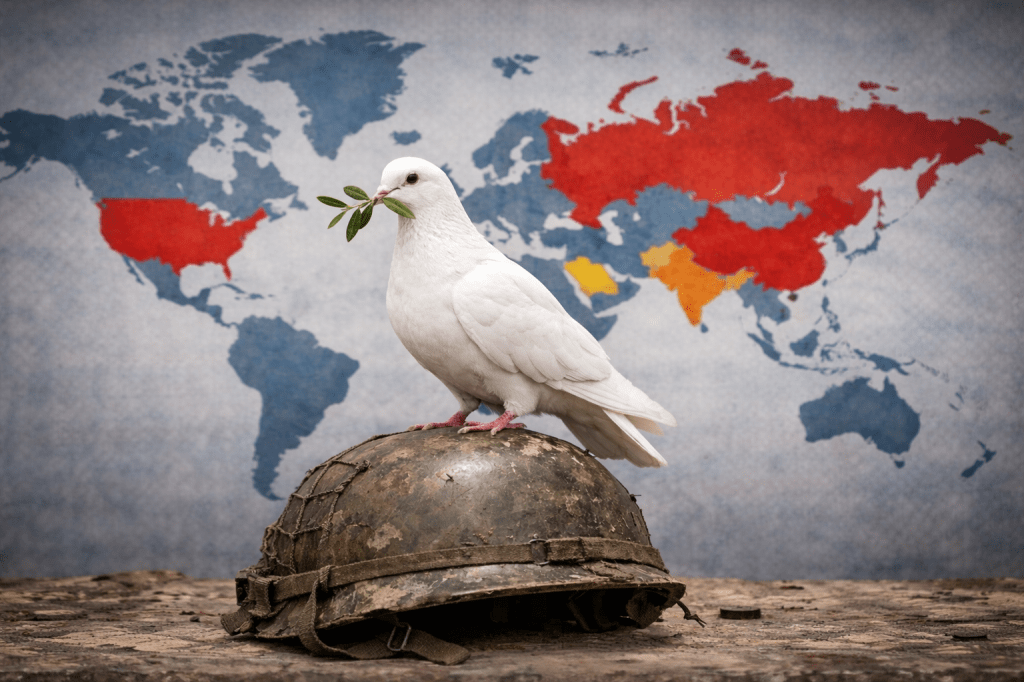
    While Europe struggled, 2025 saw deeper strategic coordination among Russia, China, and India. Though not a formal alliance, their growing cooperation in energy, trade, military exercises, and diplomatic positioning signals an accelerating shift away from a Western-dominated global order.

    This emerging bloc increasingly emphasizes sovereignty over values, stability over liberty, and power over principle. The Bible foretells a time when large coalitions of nations pursue their own strategic interests, often in opposition to one another, contributing to global instability rather than peace (Daniel 11; Revelation 16:12).

    America’s Transactional Turn

    Another notable development in 2025 was the continued evolution of American global leadership. The United States increasingly framed its foreign policy in transactional terms—security guarantees, trade access, and diplomatic support tied more directly to economic or strategic return.

    While this approach may appear pragmatic, it marks a departure from earlier eras when American influence was at least rhetorically linked to democratic ideals, moral leadership, and—however imperfectly—Christian ethical foundations. Scripture warns that when nations abandon righteousness as a guiding principle, their stability erodes from within (Proverbs 14:34).

    This shift also contributed to uncertainty among allies and emboldened rivals, further destabilizing the international system.

    Rising Unrest Within Nations

    Beyond wars and alliances, 2025 was marked by growing internal unrest across many countries. Economic inequality, mistrust of institutions, identity conflicts, and political polarization fueled protests, strikes, and sporadic violence. Governments increasingly struggled to maintain order without resorting to heavier surveillance or coercive measures.

    The Bible foretells such conditions: societies strained by fear, anger, and disillusionment, where people are “lovers of themselves” and distrustful of authority (2 Timothy 3:1–5). These pressures weaken nations from the inside, making them more vulnerable to external shocks and internal collapse.

    The Only Lasting Solution

    Taken together, the events of 2025 reinforce a vital biblical truth: humanity cannot secure lasting peace on its own. Military power, economic integration, and diplomatic maneuvering may delay conflict—but they cannot eliminate it. The worsening of world conditions should not surprise Christians; Christ Himself said these trends would intensify as the end of the age approaches (Matthew 24:8).

    Rather than yielding to fear or political despair, God’s people are called to a different response—to watch, to pray, and to look forward with hope. We are exhorted to pray earnestly for the coming of God’s Kingdom, the only government capable of bringing true justice, peace, and security to all nations (Matthew 6:10; Isaiah 9:6–7).

    As 2025 reminds us yet again, the solution to the world’s problems will not arise from shifting alliances or stronger armies—but from the return of Jesus Christ and the establishment of God’s righteous rule over the whole earth.
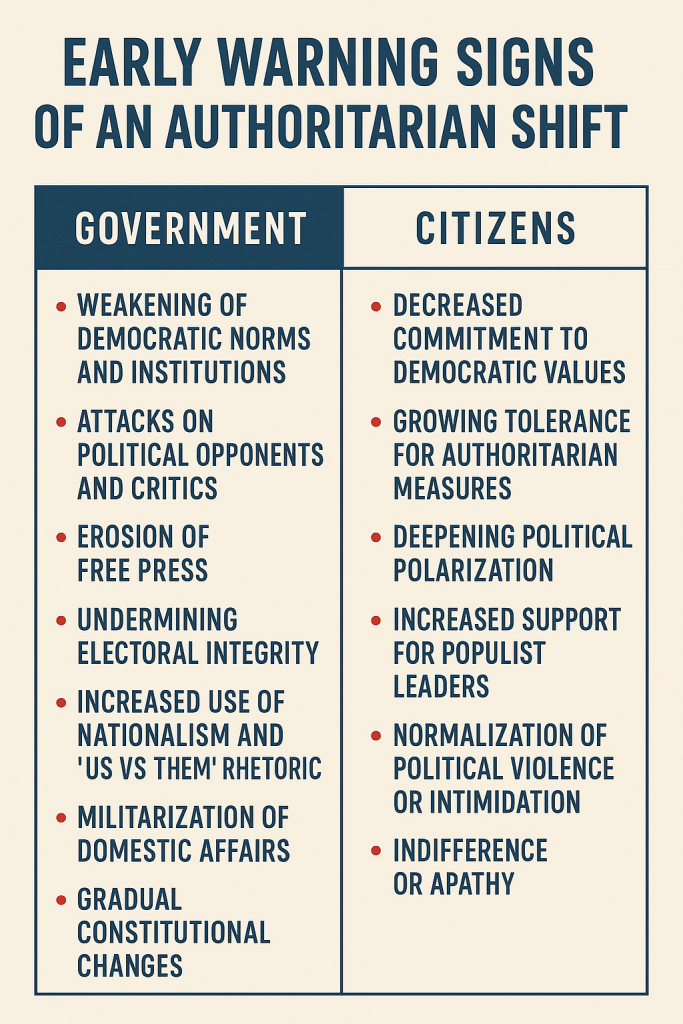
  • Early Signs of Authoritarianism: What the Government and Its Citizens Reveal

    Early Signs of Authoritarianism: What the Government and Its Citizens Reveal

    Across the world, democratic institutions are showing signs of wear. Many nations—both young democracies and long-established ones—are slowly drifting toward authoritarianism or are becoming more tolerant of leaders with apparently authoritarian approaches to governance. What’s more troubling is that this drift doesn’t always start with violent coups or military takeovers. Often, it begins with subtle shifts—first in government behavior, then in the attitudes of its citizens.

    From Democracy to Autocracy: Government-Level Warning Signs

    According to studies from Freedom House, Varieties of Democracy (V-Dem), and political scientists like Steven Levitsky and Daniel Ziblatt (How Democracies Die), the early symptoms of democratic decline include:

    • Weakening of institutions: Leaders bypass courts, weaken legislatures, and centralize power.
    • Attacks on the press and opposition: Independent journalism is labeled “fake news”; critics are treated as enemies.
    • Undermining electoral integrity: Rules are bent, votes suppressed, or results questioned.
    • Inflammatory nationalism: Leaders stir up “us versus them” rhetoric to divide society.
    • Militarization of politics: Police and military are used to suppress protests or intimidate dissent.
    • Incremental constitutional changes: Term limits are eliminated, and checks and balances eroded.

    These patterns have played out in countries like Hungary, Turkey, and Russia, where democratic structures were gradually hollowed out from within—often with the legal system as a tool of control.

    The Other Side of the Coin: What Citizens Reveal

    Yet governments don’t act in a vacuum. Citizens themselves show signs of enabling authoritarianism. Research by Yascha Mounk, Pippa Norris, and surveys like the World Values Survey reveal the following trends:

    • Declining commitment to democratic norms: Fewer people, especially the youth, view democracy as essential.
    • Support for strongman rule: Citizens begin to favor “strong leaders” who can “get things done,” even at the cost of democracy.
    • Deep polarization: Society divides into tribes where compromise is seen as betrayal.
    • Indifference and apathy: Many withdraw from civic duties, feeling their voices no longer matter.
    • Tolerating violence and censorship: Some justify political violence or suppression of dissent if it favors their side.

    In short: when enough people care more about power, comfort, or ideology than fairness, truth, or accountability, democracy withers.

    A Spiritual Dimension

    God intended for humanity to live free, joyful, and safe—not under the thumb of cruel or corrupt rulers. Scripture shows that He warned nations and removed kings when they became oppressive. But He also allowed tyrants to rise when His people disobeyed.

    “I gave you a king in My anger, and took him away in My wrath.” — Hosea 13:11

    When people turn from justice, ignore the cries of the poor, and tolerate corruption or abuse, God may allow unjust rulers as a form of correction. Authoritarianism, in that sense, is not just a political shift—it can be a spiritual consequence.

    But that’s not the end of the story.

    Beyond Corrupt Human Rule

    The Bible points us to a future beyond corrupt human rule. When Christ returns, He will establish a perfect government where justice, love, and truth prevail:

     “For the Lord is our Judge, the Lord is our Lawgiver, the Lord is our King; He will save us.” — Isaiah 33:22

    Under Christ’s rule:

    • All leaders will be spiritually and morally perfected (Revelation 5:10).
    • Laws will be just and applied with gentle strength (Isaiah 11:4).
    • Every citizen—rich or poor—will be cared for (Psalm 72:4).
    • There will be no need for propaganda, police states, or manipulation (Micah 4:3-4).

    This is the kind of leadership God intended from the beginning.

    Final Word

    If mankind continues to fail to change its ways—if ordinary citizens and national leaders don’t reject selfishness, if they refuse to care for the marginalized, if they ignore the signs—we may soon find much of the world (including the most powerful nations) ruled not by servants of the people, but by strongmen who rule only for themselves. And not just in countries with authoritarian legacies, but even in places we now regard as bastions of democracy. This includes the United States and the democracies of Asia and Europe.

  • The Passing of Pope Francis and the Path Ahead for the Catholic Church

    The Passing of Pope Francis and the Path Ahead for the Catholic Church

    On April 21, 2025, the world awoke to the news that Pope Francis, born Jorge Mario Bergoglio, had passed away at the age of 88. His death, though expected due to his recent health struggles, marks the end of a papacy that was as transformative as it was challenging.

    The Legacy of Pope Francis

    Pope Francis was the first Jesuit pope, the first from the Global South, and the first non-European to hold the papacy in over a millennium. Elected in 2013 following the resignation of Pope Benedict XVI, Francis quickly set a tone of humility and simplicity. He rejected the papal palace for modest quarters, emphasized service over status, and frequently reminded the Church to be “a field hospital for the wounded.”

    His Key Legacies:

    • A Church of the Poor: Francis sought to shift the Church’s focus toward social justice, economic inequality, and care for the marginalized.
    • Environmental Advocacy: His encyclical Laudato Si’ was a global call to action on climate change, rooted in both science and theology.
    • Synodality and Inclusion: He opened up global synods to deeper listening and greater participation, especially from laypeople and women.
    • Bridging East and West: Francis made significant efforts to reach out to the Orthodox churches, Islamic leaders, and even the atheist world, portraying the papacy as a platform for dialogue, not division.

    Yet, his papacy was not without controversy.

    The Challenges He Faced

    Pope Francis inherited a Church rocked by scandal, polarization, and a shrinking influence in secularized societies.

    • Sexual Abuse Crisis: While he took steps to address abuse and enforce accountability, critics felt he moved too slowly and hesitated in confronting entrenched institutional culture.
    • Doctrinal Tensions: His pastoral leniency—especially on issues like communion for the divorced and remarried—sparked pushback from conservative cardinals.
    • Internal Resistance: Within the Curia, efforts to reform finances and structures were met with inertia or subtle sabotage. Yet he pressed on, famously warning Vatican insiders against “spiritual Alzheimer’s” and careerism.
    • Global Fragmentation: As global Catholicism grew more diverse—demographically and theologically—Francis emphasized unity without uniformity, a challenging task in an increasingly polarized world.

    Despite this, he remained a steady voice for over a decade.

    Who Will Follow? The Frontrunners—and the Unknowns

    With Pope Francis now laid to rest, the College of Cardinals will convene in the coming days to elect the next pope. While the process is steeped in prayer, tradition, and secrecy, analysts have identified several frontrunners.

    Cardinal Pietro Parolin of Italy is widely respected for his diplomatic acumen as the Vatican’s Secretary of State. He brings deep institutional experience and a calm, steady hand in global affairs. However, he is sometimes seen as too reserved or bureaucratic, lacking the charismatic presence many seek in a modern pope.

    Cardinal Luis Antonio Tagle from the Philippines is known for his warmth, eloquence, and global popularity. Often described as “the Asian Francis,” his pastoral approach and media-friendly presence make him a compelling figure. Still, his perceived closeness to Pope Francis and prior management challenges in Caritas Internationalis may lead some cardinals to hesitate.

    Cardinal Matteo Zuppi of Italy is a bridge-builder and advocate for peace, respected for his leadership in both ecclesial and political circles. His involvement in international peace efforts and emphasis on compassion position him as a continuity candidate. Yet, his progressive image might not sit well with more conservative electors.

    Cardinal Jean-Claude Hollerich of Luxembourg is a Jesuit with sharp intellect and a deep understanding of European affairs. As president of COMECE, he brings a sophisticated grasp of EU dynamics. However, his openness to revisiting Church teachings may alienate more traditional factions.

    Cardinal Peter Turkson of Ghana has long been a prophetic voice on social justice, environment, and global inequities. He commands global respect, particularly in the Global South. Nonetheless, his advanced age and some internal controversies during his Vatican tenure may dim his prospects.

    Cardinal Robert Sarah of Guinea is revered by traditionalists for his doctrinal clarity and liturgical conservatism. A fierce defender of persecuted Christians, he could anchor the Church in orthodoxy. Yet, his strong conservative stance may polarize the conclave.

    But history reminds us: the next pope is not always the frontrunner. In 2013, very few observers predicted the election of Jorge Bergoglio. And yet, it was he who emerged from the Sistine Chapel balcony as Pope Francis.

    Geopolitical Crossroads: The Next Pope’s New World

    The pope is not just the Bishop of Rome; he is a global religious statesman. The next pontiff will inherit a world in flux—and a Church that must navigate through rapidly shifting tides.

    1. Europe’s Fragile Unity

    With the U.S. becoming increasingly isolationist, Europe is left to face rising Russian aggression on its own. The next pope will need to be a voice for moral clarity and continental unity, encouraging Europe to reclaim not just political cooperation but a shared spiritual heritage.

    2. Sharia Law and Cultural Tensions

    Across parts of Europe, the growing Muslim population has led to calls for recognition of Sharia-based parallel legal systems. The new pope will have to navigate interreligious relations with both diplomatic grace and doctrinal firmness, defending the religious freedom of all while protecting Christian identity.

    3. Global Persecution of Christians

    From the Middle East to Africa and even parts of Asia, Christians are increasingly persecuted, discriminated against, and even martyred. The next pope will need to be an unflinching advocate for the persecuted Christians (Catholics, in particular), pressing global leaders to act while strengthening the Church’s support systems on the ground.

    4. The Rise of New Empires

    China’s economic dominance, Russia’s militarism, and a fragmented West point to the emergence of competing “blocs” of influence. The Catholic Church, uniquely global and transnational, will need to be a bridge-builder and a moral compass in a divided age.

    God Is Sovereign

    While cardinals may deliberate, campaign informally, and weigh personalities and programs, the ultimate decision lies beyond their human plans.

    “For there is no authority except from God, and those that exist have been instituted by God.” — Romans 13:1 (ESV)

    Throughout history, God has raised up kings, emperors, and yes—even popes—to accomplish His divine purpose. The next pope, whoever he is, will be stepping into a role far greater than himself.

  • A World Unraveling – The High Price of Tariffs and a Coming Global Reckoning

    A World Unraveling – The High Price of Tariffs and a Coming Global Reckoning

    When President Donald Trump announced sweeping tariffs against nearly all countries in April 2025—infamously dubbed “Liberation Day”—the move was framed as an act of economic sovereignty. Aimed at defending American workers, correcting trade imbalances, and punishing foreign nations accused of unfair practices, the 10% baseline tariff (and far higher rates for select nations) was meant to be a declaration of independence from a trade system that many believed disadvantaged the United States.

    But what began as an assertion of American self-interest is now reverberating across the globe, triggering economic tremors that few anticipated and many fear may permanently reshape the global order.

    The Intentions: Economic Nationalism Reborn

    Trump’s rationale was not new. Tariffs have historically been used to protect domestic industries, reduce reliance on foreign imports, and pressure trade partners to change their behavior. This round of tariffs was more sweeping than any the U.S. had imposed in over a century. The administration targeted over 180 countries, including allies, emerging economies, and even remote territories that barely trade with the U.S.—a precaution against tariff evasion through transshipment.

    The administration’s messaging was simple but aggressive: it’s time for America to stop being the world’s economic doormat and to rebuild its industrial might from within.

    The Reality: Economic Strain and Fragmentation

    However, history and current evidence tell a more sobering story. Tariffs are blunt instruments. While they may temporarily protect local industries, they often result in higher consumer prices, supply chain disruptions, and retaliatory measures. We’ve seen this before—during the Great Depression with the Smoot-Hawley Tariff Act and more recently during Trump’s first term trade war with China. In both cases, the long-term consequences were damaging.

    In 2025, it’s happening again—on a broader scale:

    • Stock markets have plunged, wiping out trillions in value.
    • Consumer prices are rising as import costs spike.
    • Supply chains are unraveling as companies scramble to redirect sourcing.
    • Global trade flows are shifting away from the U.S., as countries retaliate and seek new partners.

    The U.S. hoped to isolate abusive trading behaviors, but it is increasingly isolating itself.

    The Rise of Economic Blocs

    In response, the world is reorganizing into regional economic blocs. What America has stepped away from, others are now rushing to claim:

    • The European Union, increasingly united in trade and security, is moving to fill the void in global leadership.
    • China, through its Belt and Road Initiative and new trade alliances across Asia, is tightening its grip on emerging markets.
    • India, ASEAN nations, and Latin America are pursuing regional deals to shield themselves from U.S. unpredictability.
    • Africa, through the African Continental Free Trade Area (AfCFTA), is charting a course toward intra-regional trade independence.

    These blocs are forming not just out of economic logic—but out of necessity. The post–World War II era of U.S.-led globalization is ending. In its place, a fragmented, competitive, and increasingly adversarial global economy is emerging.

    The Geopolitical Risks: From Trade War to Real War

    This economic realignment carries with it grave geopolitical risks.

    As trade blocs become more inward-looking and rivalrous, the possibility of military conflict among major powers increases—especially as nuclear-armed states compete for influence, resources, and strategic positioning. The risk of conflict between the U.S. and China, or even among European powers and their neighbors, is no longer hypothetical—it is becoming increasingly likely in a world no longer bound by mutual economic interest.

    Furthermore, the economic instability triggered by tariff wars could prompt a dangerous political shift. History has shown us that during extremely difficult times, people can trade personal freedom for security. With inflation, job losses, and uncertainty mounting, charismatic strongmen often step into the void—offering order, prosperity, and national pride in exchange for civil liberties and democratic safeguards.

    A World on the Edge

    This is precisely the world that the Bible describes will exist just before the return of Jesus Christ.

    The book of Revelation speaks of a final global system—a powerful economic and military confederation—that dominates the world for a short time. This “beast” power promises security and prosperity, and the world, desperate for stability, embraces it. But this system, empowered by human pride and corrupted leadership, ultimately brings humanity to the brink of annihilation (Matthew 24:22).

    We are not there yet—but the signs are unmistakable.

    • The weakening of American influence, once a stabilizing force in the world, is accelerating.
    • The rise of rival blocs, each with its own rules and ambitions, is fracturing the global system.
    • The erosion of freedoms in favor of authoritarian efficiency is gaining traction.

    A Time to Watch and Prepare

    President Trump’s tariffs were intended to make America strong. But by pursuing economic disengagement in a globalized world, the U.S. may have instead triggered the unraveling of the very system that kept major conflicts in check.

    We do not place our hope in presidents, trade policies, or economic systems. We watch these events with a discerning eye—not in panic, but in understanding. The unraveling world system is not the end of the story. It is a prelude to Christ’s return, when the kingdoms of this world will become the kingdoms of our Lord and of His Christ (Revelation 11:15).

    While men pursue security through strength and prosperity through force, true peace will only come through the righteous rule of God’s coming Kingdom.

  • A Crisis of Confidence: America’s Waning Trust at Home and Abroad

    A Crisis of Confidence: America’s Waning Trust at Home and Abroad

    In recent months, the American public has witnessed a disturbing convergence: confidence in President Trump’s administration is slipping fast, and so too is the world’s faith in America’s leadership. What was once the most trusted economic and political power is now facing skepticism not only from its citizens but from traditional allies and partners across the globe. And while future elections may bring to office leaders with more polished diplomacy and less abrasive economic policies, the trajectory has already been set.

    America’s House Divided

    At home, President Trump’s sweeping tariffs, controversial government “efficiency” initiatives, and public messaging—often through his personal social media account—have triggered widespread concern. A recent wave of polling shows that a growing majority of Americans, particularly independent voters and moderates, now believe that his policies disproportionately benefit the ultra-wealthy at the expense of working families.

    Consumer sentiment has sharply declined. Inflation fears persist. Retirement portfolios have taken a hit due to market instability triggered by aggressive trade moves. Job insecurity looms as small businesses grapple with rising costs and an unpredictable regulatory climate.

    Even members of the President’s own party are uneasy. While Trump retains strong support from his core base, discontent is building among voters who feel increasingly alienated by policies that seem disconnected from their everyday struggles. The damage may not only cost Republican seats in the upcoming 2026 midterms—it could cast a long shadow over the political future of the party itself.

    Global Reverberations: The World Turns Away

    America’s trust problem doesn’t stop at its shores. Across Europe, Asia, and the Americas, traditional U.S. allies are quietly repositioning themselves. The trust that once undergirded decades of alliance-building is giving way to caution, skepticism, and contingency planning.

    • In Europe, nations like France and Germany are doubling down on strategic autonomy, investing in independent defense capabilities and economic blocs less reliant on Washington.
    • In Asia, countries such as Japan and South Korea are strengthening regional ties and trade networks, wary of American unpredictability.
    • In Canada and Mexico, recent U.S. trade barriers have fueled nationalist sentiment and accelerated diversification of export destinations.

    Even if American voters elect a more diplomatically-minded administration in the future, many foreign leaders will proceed with the assumption that U.S. foreign policy can shift dramatically every four years—because it already has, and likely will again.

    The world is preparing for a post-American order—one where America is just another actor in a multipolar stage, rather than the conductor of the global orchestra.

    The Long Tail of Miscalculation

    What does all this mean for ordinary Americans? It means that the consequences of current decisions will likely outlast the administration that made them.

    • Jobs: As trade relationships weaken, export-dependent industries could see layoffs and contraction.
    • Cost of Living: Higher tariffs mean higher prices for goods. Inflationary pressure could eat further into wages and savings.
    • Retirement: Market instability could continue to erode the value of retirement investments and long-term financial planning.
    • Entrepreneurship: The rising cost of doing business in an unstable trade environment will discourage innovation and risk-taking, especially among small- and medium-sized enterprises.

    This isn’t just about politics. It’s about livelihoods, futures, and the long-term credibility of the nation.

    A Spiritual Wake-Up Call

    But there is a deeper issue at play—one that cannot be solved by elections or economic adjustments. God is allowing the United States to reap what it has sown. A nation once known for upholding Judeo-Christian values is now visibly crumbling under the weight of self-interest, division, and moral confusion.

    Proverbs 14:34 (NKJV) says, “Righteousness exalts a nation, but sin is a reproach to any people.” America has forsaken sound Biblical principles in governance, economy, and culture. Now, it is beginning to experience the natural consequences: loss of respect, loss of trust, and closed doors of opportunity as global alliances take shape—without America at the table.

    Just as God warned ancient Israel through His prophets, the message for America is clear: “Return to Me.” The current economic and political upheaval is not merely the result of poor governance. It is a divine signal—a trumpet call to repentance, humility, and national course correction.

    The Decline of a Superpower

    As things stand now, the world is clearly transitioning into a post-American era. The signs are everywhere: reduced influence in multilateral forums, trade blocs forming without U.S. participation, allies hedging their bets, and voters at home feeling more uncertain about their future than ever before.

    This is not irreversible—but the window of opportunity is closing. The longer the nation delays its spiritual reckoning, the more severe the consequences may become.

    The future of America does not rest in new tariffs or clever policies. It rests in a return to truth, humility, and obedience to the God who once blessed it. Only then can the country begin to rebuild not just its economy—but its soul.

    (Note: The chart summarizing Pres. Trump’s net approval ratings were added to the post on April 26, 2025.)