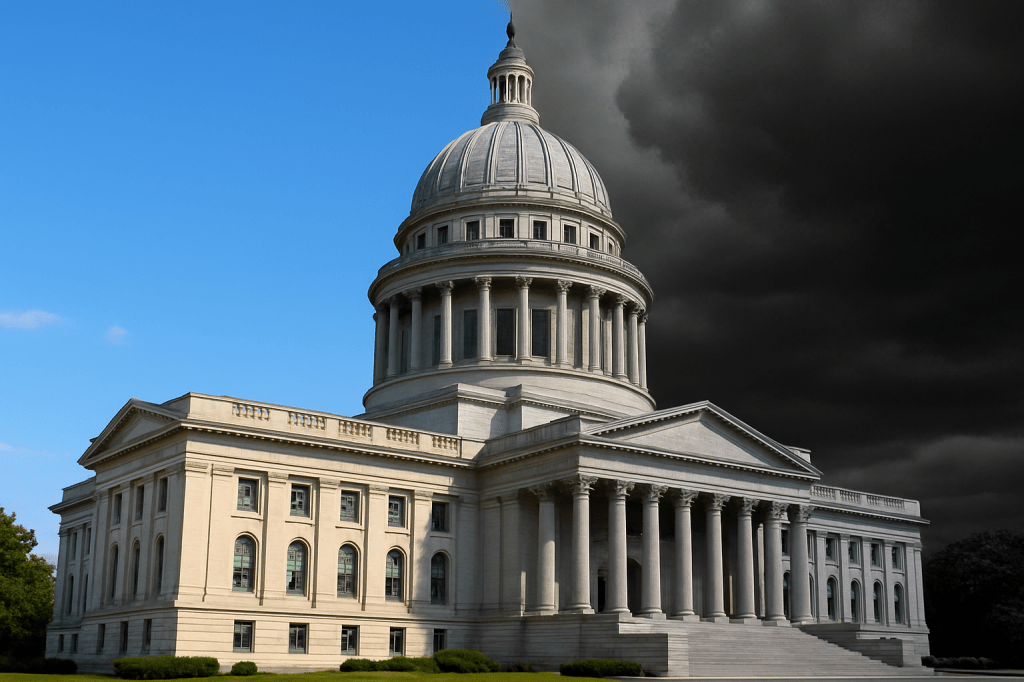
Across the world, democratic institutions are showing signs of wear. Many nations—both young democracies and long-established ones—are slowly drifting toward authoritarianism or are becoming more tolerant of leaders with apparently authoritarian approaches to governance. What’s more troubling is that this drift doesn’t always start with violent coups or military takeovers. Often, it begins with subtle shifts—first in government behavior, then in the attitudes of its citizens.
From Democracy to Autocracy: Government-Level Warning Signs
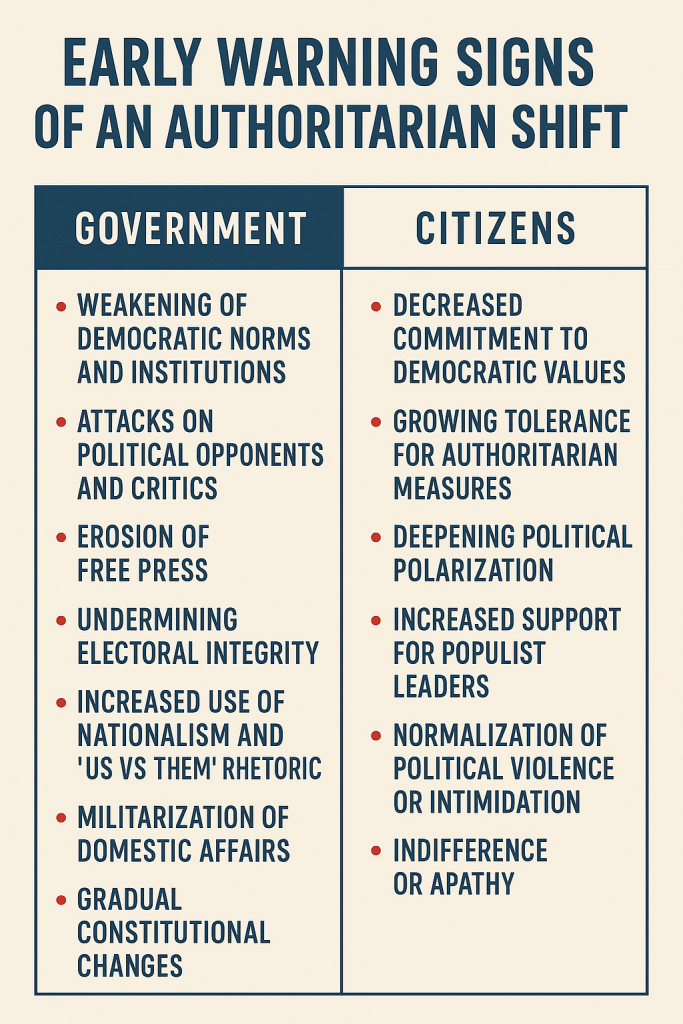
According to studies from Freedom House, Varieties of Democracy (V-Dem), and political scientists like Steven Levitsky and Daniel Ziblatt (How Democracies Die), the early symptoms of democratic decline include:
- Weakening of institutions: Leaders bypass courts, weaken legislatures, and centralize power.
- Attacks on the press and opposition: Independent journalism is labeled “fake news”; critics are treated as enemies.
- Undermining electoral integrity: Rules are bent, votes suppressed, or results questioned.
- Inflammatory nationalism: Leaders stir up “us versus them” rhetoric to divide society.
- Militarization of politics: Police and military are used to suppress protests or intimidate dissent.
- Incremental constitutional changes: Term limits are eliminated, and checks and balances eroded.
These patterns have played out in countries like Hungary, Turkey, and Russia, where democratic structures were gradually hollowed out from within—often with the legal system as a tool of control.
The Other Side of the Coin: What Citizens Reveal
Yet governments don’t act in a vacuum. Citizens themselves show signs of enabling authoritarianism. Research by Yascha Mounk, Pippa Norris, and surveys like the World Values Survey reveal the following trends:
- Declining commitment to democratic norms: Fewer people, especially the youth, view democracy as essential.
- Support for strongman rule: Citizens begin to favor “strong leaders” who can “get things done,” even at the cost of democracy.
- Deep polarization: Society divides into tribes where compromise is seen as betrayal.
- Indifference and apathy: Many withdraw from civic duties, feeling their voices no longer matter.
- Tolerating violence and censorship: Some justify political violence or suppression of dissent if it favors their side.
In short: when enough people care more about power, comfort, or ideology than fairness, truth, or accountability, democracy withers.
A Spiritual Dimension
God intended for humanity to live free, joyful, and safe—not under the thumb of cruel or corrupt rulers. Scripture shows that He warned nations and removed kings when they became oppressive. But He also allowed tyrants to rise when His people disobeyed.
“I gave you a king in My anger, and took him away in My wrath.” — Hosea 13:11
When people turn from justice, ignore the cries of the poor, and tolerate corruption or abuse, God may allow unjust rulers as a form of correction. Authoritarianism, in that sense, is not just a political shift—it can be a spiritual consequence.
But that’s not the end of the story.
Beyond Corrupt Human Rule
The Bible points us to a future beyond corrupt human rule. When Christ returns, He will establish a perfect government where justice, love, and truth prevail:
“For the Lord is our Judge, the Lord is our Lawgiver, the Lord is our King; He will save us.” — Isaiah 33:22
Under Christ’s rule:
- All leaders will be spiritually and morally perfected (Revelation 5:10).
- Laws will be just and applied with gentle strength (Isaiah 11:4).
- Every citizen—rich or poor—will be cared for (Psalm 72:4).
- There will be no need for propaganda, police states, or manipulation (Micah 4:3-4).
This is the kind of leadership God intended from the beginning.
Final Word
If mankind continues to fail to change its ways—if ordinary citizens and national leaders don’t reject selfishness, if they refuse to care for the marginalized, if they ignore the signs—we may soon find much of the world (including the most powerful nations) ruled not by servants of the people, but by strongmen who rule only for themselves. And not just in countries with authoritarian legacies, but even in places we now regard as bastions of democracy. This includes the United States and the democracies of Asia and Europe.