Tag: Bible prophecy

  • Early Signs of Authoritarianism: What the Government and Its Citizens Reveal

    Early Signs of Authoritarianism: What the Government and Its Citizens Reveal

    Across the world, democratic institutions are showing signs of wear. Many nations—both young democracies and long-established ones—are slowly drifting toward authoritarianism or are becoming more tolerant of leaders with apparently authoritarian approaches to governance. What’s more troubling is that this drift doesn’t always start with violent coups or military takeovers. Often, it begins with subtle shifts—first in government behavior, then in the attitudes of its citizens.

    From Democracy to Autocracy: Government-Level Warning Signs

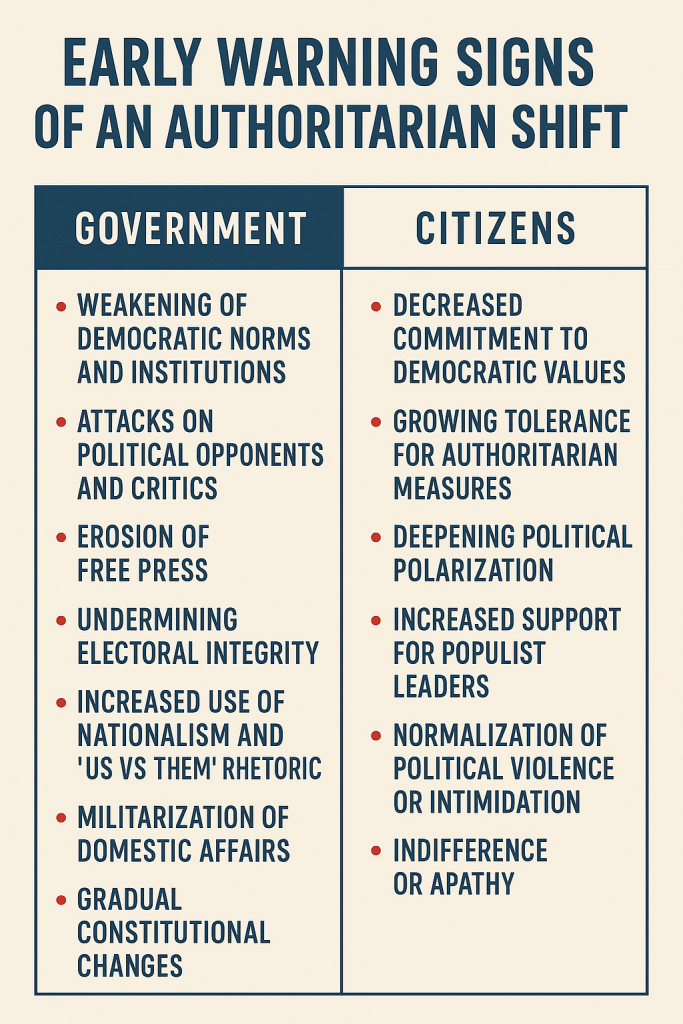
    According to studies from Freedom House, Varieties of Democracy (V-Dem), and political scientists like Steven Levitsky and Daniel Ziblatt (How Democracies Die), the early symptoms of democratic decline include:

    • Weakening of institutions: Leaders bypass courts, weaken legislatures, and centralize power.
    • Attacks on the press and opposition: Independent journalism is labeled “fake news”; critics are treated as enemies.
    • Undermining electoral integrity: Rules are bent, votes suppressed, or results questioned.
    • Inflammatory nationalism: Leaders stir up “us versus them” rhetoric to divide society.
    • Militarization of politics: Police and military are used to suppress protests or intimidate dissent.
    • Incremental constitutional changes: Term limits are eliminated, and checks and balances eroded.

    These patterns have played out in countries like Hungary, Turkey, and Russia, where democratic structures were gradually hollowed out from within—often with the legal system as a tool of control.
    The Other Side of the Coin: What Citizens Reveal

    Yet governments don’t act in a vacuum. Citizens themselves show signs of enabling authoritarianism. Research by Yascha Mounk, Pippa Norris, and surveys like the World Values Survey reveal the following trends:

    • Declining commitment to democratic norms: Fewer people, especially the youth, view democracy as essential.
    • Support for strongman rule: Citizens begin to favor “strong leaders” who can “get things done,” even at the cost of democracy.
    • Deep polarization: Society divides into tribes where compromise is seen as betrayal.
    • Indifference and apathy: Many withdraw from civic duties, feeling their voices no longer matter.
    • Tolerating violence and censorship: Some justify political violence or suppression of dissent if it favors their side.

    In short: when enough people care more about power, comfort, or ideology than fairness, truth, or accountability, democracy withers.

    A Spiritual Dimension

    God intended for humanity to live free, joyful, and safe—not under the thumb of cruel or corrupt rulers. Scripture shows that He warned nations and removed kings when they became oppressive. But He also allowed tyrants to rise when His people disobeyed.

    “I gave you a king in My anger, and took him away in My wrath.” — Hosea 13:11

    When people turn from justice, ignore the cries of the poor, and tolerate corruption or abuse, God may allow unjust rulers as a form of correction. Authoritarianism, in that sense, is not just a political shift—it can be a spiritual consequence.

    But that’s not the end of the story.

    Beyond Corrupt Human Rule

    The Bible points us to a future beyond corrupt human rule. When Christ returns, He will establish a perfect government where justice, love, and truth prevail:

     “For the Lord is our Judge, the Lord is our Lawgiver, the Lord is our King; He will save us.” — Isaiah 33:22

    Under Christ’s rule:

    • All leaders will be spiritually and morally perfected (Revelation 5:10).
    • Laws will be just and applied with gentle strength (Isaiah 11:4).
    • Every citizen—rich or poor—will be cared for (Psalm 72:4).
    • There will be no need for propaganda, police states, or manipulation (Micah 4:3-4).

    This is the kind of leadership God intended from the beginning.

    Final Word

    If mankind continues to fail to change its ways—if ordinary citizens and national leaders don’t reject selfishness, if they refuse to care for the marginalized, if they ignore the signs—we may soon find much of the world (including the most powerful nations) ruled not by servants of the people, but by strongmen who rule only for themselves. And not just in countries with authoritarian legacies, but even in places we now regard as bastions of democracy. This includes the United States and the democracies of Asia and Europe.

  • Vacuum of Power: Who Steps in If the U.S. Walks Away from Ukraine Peace Talks?

    Vacuum of Power: Who Steps in If the U.S. Walks Away from Ukraine Peace Talks?

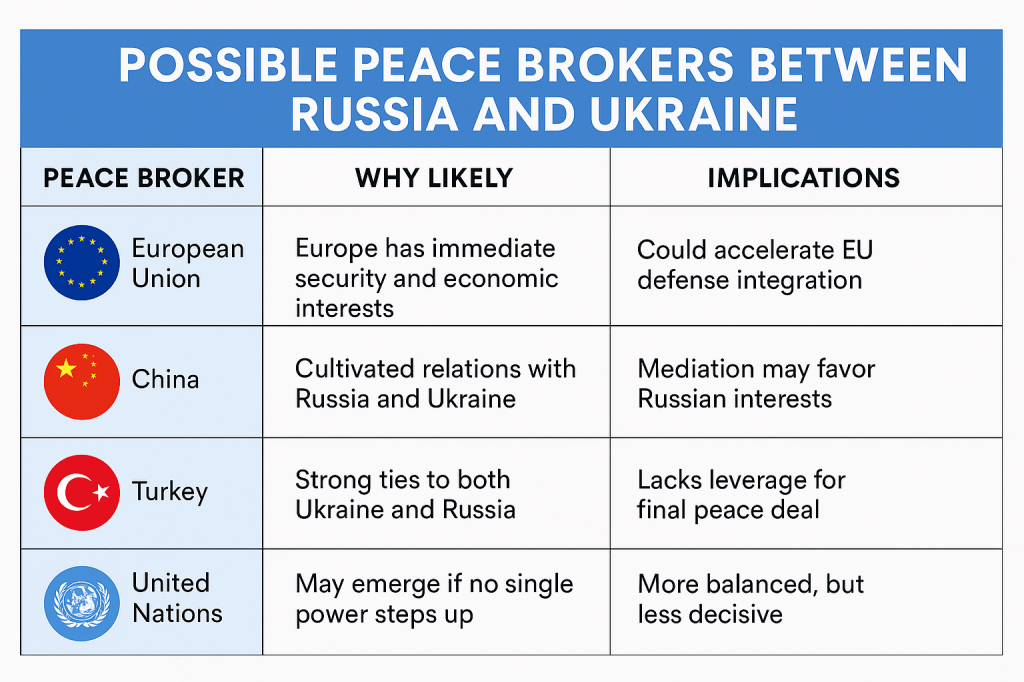
    As the Trump administration threatens to withdraw from peace negotiations between Russia and Ukraine, a dangerous vacuum is forming. If the U.S. steps back, others are ready to step in—and the one best poised to fill that role is the European Union.

    Europe, more than any other region, has direct security and economic stakes in the outcome of the war. Should the EU, led by nations like France and Germany, manage to broker peace where Washington falters, it would not only mark a diplomatic victory—it would solidify Europe’s emerging role as a global leader in world affairs.

    This shift is not just geopolitical—it aligns with Biblical prophecy. Scripture foresees a powerful union rising from the heart of Europe, more dominant than the United States, just before the return of Christ (Daniel 7:7-8; Revelation 17:12-13). The world may soon witness the rise of a superpower that reshapes global alliances—and prophecy warns that it will wield great influence, for better or worse.

    “The ten horns which you saw are ten kings… they receive authority for one hour as kings with the beast. These are of one mind, and they will give their power and authority to the beast.” – Revelation 17:12–13

    As the U.S. recedes from the center of global diplomacy, Europe’s moment may be dawning.

  • A Scientific Exodus: A Nation at Risk of Losing Its Edge

    A Scientific Exodus: A Nation at Risk of Losing Its Edge

    In a quiet but consequential shift, some of America’s best and brightest scientists are packing their bags—not because they’ve lost faith in science, but because they’ve lost faith in the system supporting it.

    From physicists and biomedical researchers to climate scientists and engineers, highly trained professionals are now being drawn away from the United States to countries that offer a more stable, respectful, and well-funded environment for their work. The exodus isn’t dramatic, but it is undeniable—and its effects could ripple across generations.

    Why Are Scientists Leaving?

    The ongoing movement of scientists away from the United States has accelerated under policies perceived as hostile to scientific inquiry. Among the key reasons:

    • Funding Cuts: Major research institutions like the National Institutes of Health (NIH), the National Science Foundation (NSF), and the Centers for Disease Control and Prevention (CDC) have seen budgets slashed or frozen. Research grants are becoming harder to secure, especially for long-term or basic research.
    • Political Interference: Decisions that used to be grounded in peer-reviewed science are now being overridden by political agendas. Several high-profile projects were stalled or canceled due to ideological disagreements, eroding the trust scientists place in public institutions.
    • Immigration Restrictions: Many international researchers—who make up a significant portion of the U.S. scientific community—are finding it harder to enter or remain in the country due to tightened visa policies and anti-immigrant rhetoric.
    • Lack of Academic Freedom: There is growing concern over efforts to suppress or discredit science that contradicts prevailing political narratives, especially in areas like climate change, reproductive health, and pandemic preparedness.

    Where Are They Going?

    Countries such as France, Germany, Canada, Australia, and even China have recognized the opportunity. These nations are actively recruiting disillusioned American scientists through dedicated talent-attraction programs:

    • France launched its “Choose France for Science” initiative, which recently received hundreds of applications for just a few dozen positions.
    • Australia’s Global Talent Visa Program has drawn in academics from U.S. institutions who now feel more respected and supported abroad.
    • Germany continues to be a haven for physicists and chemists, especially through institutions like the Max Planck Society.
    • China, despite geopolitical tensions, has successfully attracted ethnic Chinese scientists from U.S. universities to return and lead cutting-edge research in AI, quantum computing, and biotech.

    Areas of Expertise Being Lost

    The scientists leaving are not average academics—they represent the elite of the global research community. Many are:

    • Biomedical researchers in cancer therapy and immunology
    • Artificial intelligence and machine learning experts
    • Environmental and climate scientists
    • Physicists involved in particle research and quantum technologies
    • Engineers specializing in aerospace, robotics, and advanced manufacturing

    These aren’t just brain drains—they are bleeding-edge minds whose work directly affects national security, public health, and global competitiveness.

    Lessons from History: The WWII Parallel

    Ironically, a major reason the United States won World War II was because of the exact opposite trend: brilliant scientists migrated to America, fleeing persecution and ideological tyranny in their own countries.

    Jewish and anti-Nazi scientists from Germany and Austria—including Albert Einstein, Enrico Fermi, and Leo Szilard—brought with them unparalleled expertise. Their contributions were vital to America’s scientific rise, including the success of the Manhattan Project, which led to the development of the atomic bomb.

    America’s post-war technological dominance wasn’t just built on factories—it was built on brains that had found refuge in a country that respected their minds and valued their freedom.

    Now, the tables are turning.

    When God Withholds the Wise

    The Bible presents a sobering parallel. In Isaiah 3:1,3 (NIV), God warned Jerusalem and Judah of judgment:

     “See now, the Lord, the Lord Almighty, is about to take from Jerusalem and Judah both supply and support: all supplies of food and all supplies of water… the judge and the prophet, the diviner and the elder, the captain of fifty and the man of rank, the counselor, skilled craftsman and clever enchanter.”

    When a nation turns its back on God and His laws, He does not merely withhold rain or prosperity—He also removes its human capital: the wise, the skilled, the visionary. Without such leaders and thinkers, a society collapses from within, even if its military and economy still appear strong on the outside.

    What This Means for America

    The loss of scientific talent is not just a brain drain—it’s a judgment of capability. It hinders America’s ability to innovate, compete, and protect its own people. Technologies that could have cured diseases, predicted natural disasters, or strengthened national defense may now be developed under different flags.

    It is a warning, but also a wake-up call.

    Restoring scientific integrity is not just about increasing funding or adjusting immigration quotas. It’s about restoring the moral and spiritual foundation upon which wisdom and truth are welcomed. It’s about America humbling itself as a nation and recognizing that knowledge is a gift from God, not something to be manipulated for political convenience.

    As we watch the pillars of America’s global leadership quietly erode, one is reminded of Proverbs 29:18:

     “Where there is no revelation, the people cast off restraint; but blessed is the one who heeds wisdom’s instruction.”

    Will America once again become a refuge for wisdom and innovation—or will it become the very place from which wisdom flees?

  • The Asian Pivot: China’s Long-Term Strategy to Thrive Beyond the American System

    The Asian Pivot: China’s Long-Term Strategy to Thrive Beyond the American System

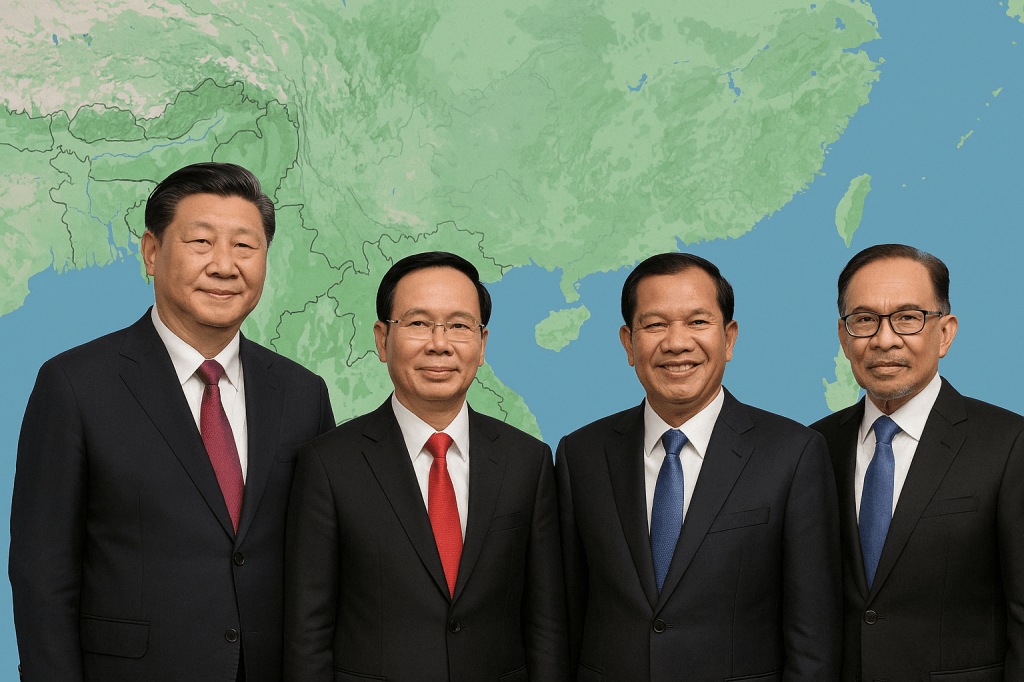
    As tensions between the United States and China continue to escalate—particularly in the realm of trade and technology—Beijing is quietly laying the groundwork for a long-term economic strategy that could reshape the power dynamics of Asia. At the center of this push is President Xi Jinping’s ongoing tour of Southeast Asia, visiting Vietnam, Malaysia, and Cambodia—a move that signals China’s growing focus on emerging Asian markets and a future less dependent on the U.S.-led global economy.

    Xi Jinping’s Southeast Asia Tour: A Strategic Reconnection

    This week, Xi Jinping undertakes his first overseas diplomatic trip of 2025, traveling to:

    • Vietnam (April 14–15) 
    • Malaysia (April 15–17) 
    • Cambodia (April 17–18)

    These visits are not merely ceremonial. They are a calculated move to strengthen China’s economic and political influence in its immediate neighborhood, particularly at a time when the United States is entangled in its own domestic political volatility and global alliances are being tested by tariff wars and foreign policy shifts.

    In Vietnam, Xi is engaging in high-level talks to promote infrastructure development and defense cooperation—areas that are traditionally seen as sensitive due to Vietnam’s balancing act between China and the West. In Malaysia, discussions center on bolstering trade and increasing Chinese investment in manufacturing and digital technology sectors. And in Cambodia, where China already enjoys significant influence, the visit is expected to deepen long-standing ties and further integrate the two economies.

    The Next Stops: Indonesia and Central Asia?

    Beyond this week’s tour, there are strong indicators that Indonesia may soon be on Xi’s diplomatic radar. A recent phone call between Xi and Indonesian President Prabowo Subianto reaffirmed both nations’ commitment to expanding their strategic partnership, particularly in light of the 75th anniversary of diplomatic ties.

    Likewise, Central Asia—including Kazakhstan, Kyrgyzstan, Tajikistan, Turkmenistan, and Uzbekistan—remains a critical focus area. China is set to host the next China–Central Asia Summit, following a successful inaugural meeting in Xi’an in 2023. These engagements are part of a broader effort to secure alternative supply chains, new energy corridors, and infrastructure links under the Belt and Road Initiative (BRI).

    The Bigger Picture: Preparing for a Post-American Trade Order

    While the immediate economic benefits of these engagements may not yet be dramatic, their geopolitical implications are far-reaching. China is methodically building a regional trade network that is resilient and increasingly self-sufficient. This will become critically important as the American economic system continues to display signs of instability, especially as economic policy in the US increasingly sways with every change in presidential administration.

    As the US imposes erratic tariffs, wavers on global commitments, and faces rising internal polarization, China is presenting itself to its neighbors as a stable, long-term economic partner—offering infrastructure, financing, and market access.

    A Prophetic Pattern: Toward a Unified Eastern Bloc

    What we are witnessing could be the early stages of economic and political unification across Asia, aligning China, Russia, and eventually other major Asian economies such as Japan and South Korea. Although Japan and South Korea remain closely aligned with the United States for now, the erosion of American credibility and consistency may eventually drive them to seek more reliable trade partnerships within the region.

    This shift is not only geopolitical—it also fits a prophetic pattern long observed in Bible prophecy. Scripture describes the rise of Eastern powers—”kings from the east” (Revelation 16:12)—who will play a pivotal role in end-time events. The Bible also indicates that the dominant economic force of the end times will not be the Anglo-American system but a revived European power bloc. As the United States and its allies fade in influence—whether by internal collapse or external exclusion—the stage is being set for an economically unified Asia, possibly in loose collaboration with or in tension against a dominant European superstructure.

    The World Is Rebalancing

    Xi Jinping’s current diplomatic maneuvers are not isolated events—they are the latest in a strategic chess game, one that aims to secure China’s leadership role in a post-American, multi-polar global economy. These new alliances and trade relations, especially with Asia’s emerging markets, serve as a foundation for resilience and independence in a world where U.S. leadership is no longer guaranteed.

    The world is rebalancing. For those watching closely—and for students of both geopolitics and prophecy—these developments underscore a profound truth: nations rise and fall according to a divine timetable, and the shifts we are seeing today may well be part of a larger unfolding narrative foretold long ago.

  • Watching World Events Through the Lens of Bible Prophecy

    As another year ends, we look back at significant trends and developments that have shaped our world. From political upheavals to technological breakthroughs, the past year has been a whirlwind of change. Yet, as students of Bible prophecy, we understand that these changes are not random. They fit within the broader framework of God’s plan for humanity and point us toward the culmination of history—the establishment of His Kingdom under Jesus Christ.

    Key Trends of the Past Year

    1. Escalating Global Tensions

    The past year saw heightened conflicts among nations. Territorial disputes, ideological divides, and economic rivalries continue to fuel tensions. For instance, the ongoing war between Russia and Ukraine has reshaped geopolitical alliances and created widespread economic and humanitarian crises.

    Meanwhile, the tension in the South China Sea, with China asserting its claims over disputed waters, has alarmed neighboring nations and drawn in global powers like the United States.

    In the Middle East, Israel remains embroiled in a conflict with proxy entities supported by Iran, such as Hezbollah and Hamas, exacerbating an already volatile region. Jesus prophesied, “You will hear of wars and rumors of wars. See that you are not troubled; for all these things must come to pass, but the end is not yet” (Matthew 24:6). Such events remind us that human efforts to achieve lasting peace are futile without God’s intervention.

    2. Natural Disasters and Environmental Challenges

    From devastating earthquakes to record-breaking storms, natural disasters have been on the rise.

    Specific examples include the catastrophic earthquakes in Turkey and Syria earlier this year, which claimed tens of thousands of lives, and Typhoon Mawar, which left widespread devastation in parts of the Pacific.

    Climate change remains a pressing issue, with prolonged droughts in East Africa contributing to severe food insecurity and massive flooding in Pakistan displacing millions. These events echo Christ’s warning about “famines, pestilences, and earthquakes in various places” (Matthew 24:7). They serve as a wake-up call for humanity to repent and turn to God.

    3. Advances in Technology and AI

    This year witnessed remarkable progress in artificial intelligence, biotechnology, and digital connectivity. While these advancements promise solutions to many of humanity’s problems, they also bring ethical dilemmas and the potential for misuse. The Bible warns about humanity’s increasing reliance on its own knowledge rather than seeking God’s wisdom (Genesis 11:4-6).

    4. Moral Decline and Social Fragmentation

    Societies worldwide continue to grapple with moral confusion and a loss of shared values. Issues such as gender identity, family breakdown, and rising crime dominate headlines. The Apostle Paul described the last days as being marked by “perilous times,” when people will be “lovers of themselves, lovers of money, boasters, proud, blasphemers” (2 Timothy 3:1-2).

    Developments to Watch in the Coming Year

    As we move into a new year, several developments warrant close attention:

    • Geopolitical Alignments: Watch for shifts in alliances and power dynamics, especially in the Middle East, Europe, and Asia.
    • Economic Instability: Global markets remain fragile, with inflation, debt, and energy concerns posing significant risks.
    • Social Movements: Keep an eye on grassroots movements that challenge established norms and authorities, as these often reflect deeper societal undercurrents.
    • Technological Integration: Monitor how technology continues to reshape economies, education, and even religious practices.

    How Should We Respond?

    1. Remain Spiritually Alert

    Jesus instructed His followers to “watch therefore, and pray always that you may be counted worthy to escape all these things that will come to pass” (Luke 21:36). Staying alert means not only being informed about world events but also examining our spiritual condition.

    2. Strengthen Our Faith

    As the world becomes increasingly uncertain, we must anchor ourselves in God’s Word. Regular prayer, Bible study, and fellowship with other believers are essential to maintaining a strong connection with God.

    3. Prepare for God’s Kingdom

    The Bible reminds us that this world is temporary. Our focus should be on seeking “first the kingdom of God and His righteousness” (Matthew 6:33). This involves living according to God’s laws and cultivating a character that reflects His values.

    A Call to Action

    The trends we’ve observed this year underscore the urgency of Christ’s return. As events unfold, let us not be overwhelmed by fear or uncertainty. Instead, let’s view them as milestones along the path to God’s Kingdom. By staying vigilant, faithful, and active in proclaiming the Gospel, we can prepare ourselves and others for the glorious future that awaits.