Tag: education

  • A Scientific Exodus: A Nation at Risk of Losing Its Edge

    A Scientific Exodus: A Nation at Risk of Losing Its Edge

    In a quiet but consequential shift, some of America’s best and brightest scientists are packing their bags—not because they’ve lost faith in science, but because they’ve lost faith in the system supporting it.

    From physicists and biomedical researchers to climate scientists and engineers, highly trained professionals are now being drawn away from the United States to countries that offer a more stable, respectful, and well-funded environment for their work. The exodus isn’t dramatic, but it is undeniable—and its effects could ripple across generations.

    Why Are Scientists Leaving?

    The ongoing movement of scientists away from the United States has accelerated under policies perceived as hostile to scientific inquiry. Among the key reasons:

    • Funding Cuts: Major research institutions like the National Institutes of Health (NIH), the National Science Foundation (NSF), and the Centers for Disease Control and Prevention (CDC) have seen budgets slashed or frozen. Research grants are becoming harder to secure, especially for long-term or basic research.
    • Political Interference: Decisions that used to be grounded in peer-reviewed science are now being overridden by political agendas. Several high-profile projects were stalled or canceled due to ideological disagreements, eroding the trust scientists place in public institutions.
    • Immigration Restrictions: Many international researchers—who make up a significant portion of the U.S. scientific community—are finding it harder to enter or remain in the country due to tightened visa policies and anti-immigrant rhetoric.
    • Lack of Academic Freedom: There is growing concern over efforts to suppress or discredit science that contradicts prevailing political narratives, especially in areas like climate change, reproductive health, and pandemic preparedness.

    Where Are They Going?

    Countries such as France, Germany, Canada, Australia, and even China have recognized the opportunity. These nations are actively recruiting disillusioned American scientists through dedicated talent-attraction programs:

    • France launched its “Choose France for Science” initiative, which recently received hundreds of applications for just a few dozen positions.
    • Australia’s Global Talent Visa Program has drawn in academics from U.S. institutions who now feel more respected and supported abroad.
    • Germany continues to be a haven for physicists and chemists, especially through institutions like the Max Planck Society.
    • China, despite geopolitical tensions, has successfully attracted ethnic Chinese scientists from U.S. universities to return and lead cutting-edge research in AI, quantum computing, and biotech.

    Areas of Expertise Being Lost

    The scientists leaving are not average academics—they represent the elite of the global research community. Many are:

    • Biomedical researchers in cancer therapy and immunology
    • Artificial intelligence and machine learning experts
    • Environmental and climate scientists
    • Physicists involved in particle research and quantum technologies
    • Engineers specializing in aerospace, robotics, and advanced manufacturing

    These aren’t just brain drains—they are bleeding-edge minds whose work directly affects national security, public health, and global competitiveness.

    Lessons from History: The WWII Parallel

    Ironically, a major reason the United States won World War II was because of the exact opposite trend: brilliant scientists migrated to America, fleeing persecution and ideological tyranny in their own countries.

    Jewish and anti-Nazi scientists from Germany and Austria—including Albert Einstein, Enrico Fermi, and Leo Szilard—brought with them unparalleled expertise. Their contributions were vital to America’s scientific rise, including the success of the Manhattan Project, which led to the development of the atomic bomb.

    America’s post-war technological dominance wasn’t just built on factories—it was built on brains that had found refuge in a country that respected their minds and valued their freedom.

    Now, the tables are turning.

    When God Withholds the Wise

    The Bible presents a sobering parallel. In Isaiah 3:1,3 (NIV), God warned Jerusalem and Judah of judgment:

     “See now, the Lord, the Lord Almighty, is about to take from Jerusalem and Judah both supply and support: all supplies of food and all supplies of water… the judge and the prophet, the diviner and the elder, the captain of fifty and the man of rank, the counselor, skilled craftsman and clever enchanter.”

    When a nation turns its back on God and His laws, He does not merely withhold rain or prosperity—He also removes its human capital: the wise, the skilled, the visionary. Without such leaders and thinkers, a society collapses from within, even if its military and economy still appear strong on the outside.

    What This Means for America

    The loss of scientific talent is not just a brain drain—it’s a judgment of capability. It hinders America’s ability to innovate, compete, and protect its own people. Technologies that could have cured diseases, predicted natural disasters, or strengthened national defense may now be developed under different flags.

    It is a warning, but also a wake-up call.

    Restoring scientific integrity is not just about increasing funding or adjusting immigration quotas. It’s about restoring the moral and spiritual foundation upon which wisdom and truth are welcomed. It’s about America humbling itself as a nation and recognizing that knowledge is a gift from God, not something to be manipulated for political convenience.

    As we watch the pillars of America’s global leadership quietly erode, one is reminded of Proverbs 29:18:

     “Where there is no revelation, the people cast off restraint; but blessed is the one who heeds wisdom’s instruction.”

    Will America once again become a refuge for wisdom and innovation—or will it become the very place from which wisdom flees?
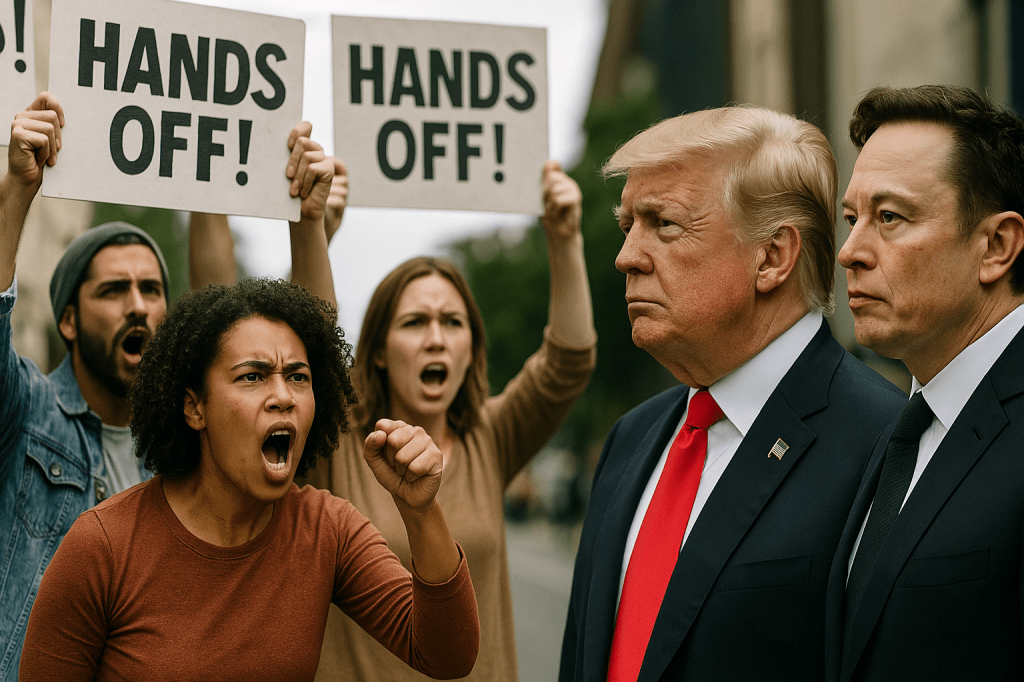
  • “Hands Off!” – A Nation Speaks, But Will Its Leaders Listen?

    “Hands Off!” – A Nation Speaks, But Will Its Leaders Listen?

    On April 5, 2025, the United States witnessed a moment of rare unity—not in the halls of Congress, but in the streets, sidewalks, and town squares of all 50 states. From liberal coastal cities to deep-red heartland towns, Americans took part in a powerful and coordinated show of dissent under one rallying cry: “Hands Off!”

    These protests, organized by a coalition of over 150 advocacy groups, were not merely about policy disagreements. They were a response to sweeping structural changes being implemented by President Donald Trump’s administration, particularly under the guidance of Elon Musk, who now leads the Department of Government Efficiency (DOGE).

    The movement represents more than a partisan outcry; it reflects growing concern—even in Republican-dominated states—about the preservation of democracy, the shrinking role of government in people’s lives, and the threats to public institutions many Americans have long depended on.

    The Protest Movement: What’s at Stake?

    The “Hands Off!” movement emerged in response to a radical reimagining of the U.S. government:

    • Massive layoffs across federal departments, affecting millions of workers and citizens who rely on those services.
    • Closure of entire agencies focused on public health, environmental regulation, and civil rights enforcement.
    • Deep cuts to education, healthcare, and welfare, which disproportionately impact low-income and rural communities.
    • Aggressive deportations targeting political activists and immigrant communities.
    • Privatization of public services and a concentration of decision-making power under unelected billionaires.

    These sweeping changes have prompted Americans of every background to speak out—including residents of deeply Republican states such as Texas, Alabama, South Carolina, Oklahoma, and Idaho. In towns where President Trump carried over 60% of the vote in previous elections, people are now marching side-by-side with protestors from traditionally liberal enclaves, driven by shared fears: job insecurity, declining access to education and healthcare, and a growing sense of disenfranchisement.

    Who Is Behind the Movement?

    While key organizers such as MoveOn.org, Indivisible, and the ACLU are often associated with progressive politics, the “Hands Off!” movement has drawn a diverse cross-section of Americans, including:

    • Veterans’ groups concerned about cuts to VA services
    • Educators and students alarmed by attacks on academic freedom and funding
    • Healthcare workers worried about rising patient loads and shrinking support
    • Faith-based communities raising moral objections to government overreach
    • Even conservative voters who supported Trump but now question the consequences of centralized power and widespread job loss

    This diversity is significant. It shows that the unrest is not limited to the usual coastal opposition. It’s spreading across the heartland—where voters now feel that the administration’s promises of “efficiency” are coming at the expense of livelihoods and local autonomy.

    The Trump-Musk Response: Dismissal and Intimidation

    Rather than acknowledge the protesters’ concerns, President Trump doubled down. From his Florida golf resort, he denounced the demonstrations as “illegal gatherings” and issued stark threats:

    • Cuts to federal education funding for institutions that allow or endorse protest activities.
    • Warnings of imprisonment, expulsion, or even deportation for protest participants.

    Elon Musk, meanwhile, brushed off the movement as being driven by “rival billionaires,” while pressing ahead with controversial DOGE reforms aimed at automating and outsourcing government functions.

    In essence, the administration has chosen to meet peaceful protest with ridicule, threats, and silence.

    What Could Force a Policy Shift?

    Despite their current stance, there are several potential forces that could push the administration to reconsider or pause its policies:

    • Internal Republican Pressure: If GOP lawmakers begin to feel electoral heat—especially in midterm races—they may demand a policy recalibration.
    • Economic Fallout: Investor panic, falling markets, or widespread job losses could lead to a strategic freeze to stabilize the economy.
    • Legal Challenges: Federal courts may block some actions as unconstitutional or procedurally flawed.
    • Elite Pushback: Business leaders, retired generals, or influential conservative voices could break ranks and speak out.
    • Strategic Political Calculation: Trump may temporarily halt or water down policies to improve public perception ahead of the 2026 elections.

    The Cost of an Unyielding Government

    If none of these forces succeed and the administration remains unbending, the consequences could be dire:

    • Widening political polarization and deepening national divisions
    • Prolonged unrest and social instability
    • A weakened global image of American democracy
    • Greater hardship for working-class Americans, including many in red states who are now realizing the local effects of national policy shifts

    A Biblical Warning for Our Time

    Scripture provides sobering examples of what happens when leaders harden their hearts and ignore the voice of the people.

    In 1 Kings 12, King Rehoboam ignored the elders’ advice and increased the burdens on his people. His arrogant declaration—“My father chastised you with whips, but I will chastise you with scorpions”—led to the division of Israel into two kingdoms. Rehoboam’s refusal to listen shattered national unity and ushered in prolonged conflict.

    Likewise, Pharaoh’s obstinate defiance in the face of God’s warnings through Moses (Exodus 7–12) brought devastation upon Egypt: economic collapse, natural disasters, and national mourning.

    In both cases, the leaders’ unwillingness to hear the cries of their people led to national ruin. The parallels to today’s moment are striking—and sobering.

    A Moment of Decision

    The “Hands Off!” rallies are not a purely partisan stunt or a passing trend. They are a nationwide alarm bell—ringing from both blue cities and red counties. Americans from all walks of life are demanding transparency, accountability, and a reversal of policies that threaten the social fabric.

    History and Scripture urge us to take such moments seriously. Leaders who rule by force and ignore the governed seldom end well. The people are speaking—not just in Washington or New York, but in Birmingham, Boise, and Amarillo.

    The question now is: will the administration listen?