Tag: end-time prophecy

  • After Khamenei: A Shifting Middle East — and a Merciful Pause

    After Khamenei: A Shifting Middle East — and a Merciful Pause

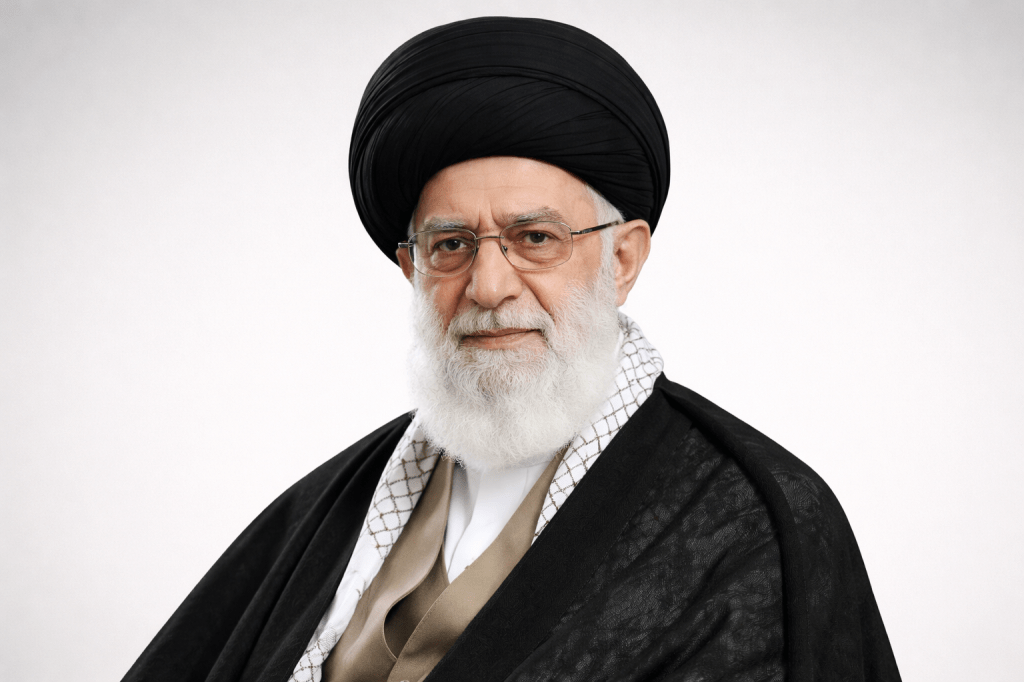
    The death of Ali Khamenei, Iran’s Supreme Leader for more than three decades, marks one of the most consequential turning points in the modern Middle East.

    For over 30 years, Khamenei stood at the center of Iran’s political, military and ideological system. Under his leadership, Iran projected influence far beyond its borders — not primarily through conventional armies, but through networks of allied movements and militias stretching from Lebanon to Yemen.

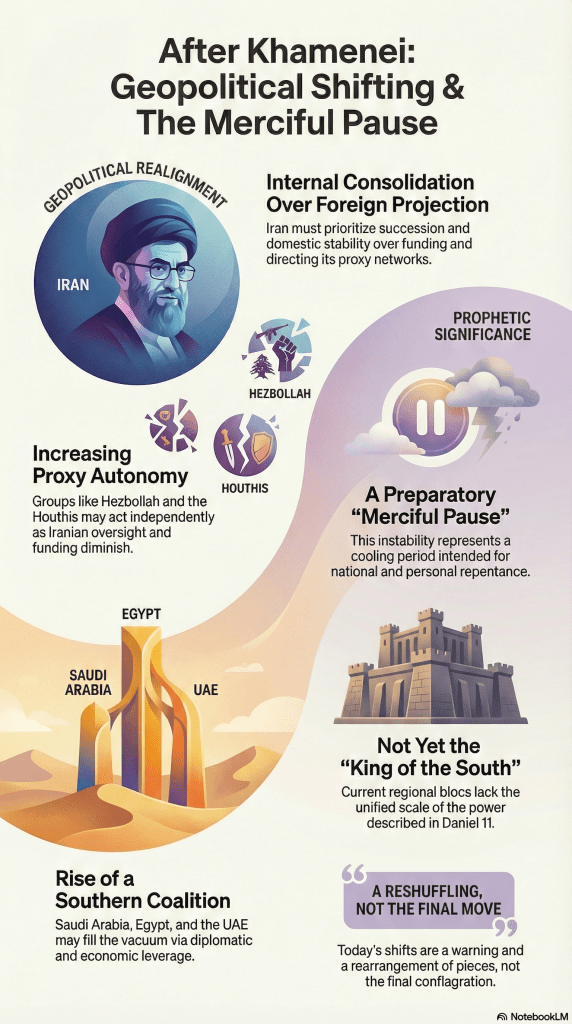
    Now, with the supreme office suddenly vacant, Iran faces an urgent priority: consolidate power at home before it can project power abroad.

    And that shift could reshape the entire region.

    Consolidation Before Projection

    Iran’s constitutional system provides mechanisms for succession, but mechanisms do not guarantee stability. The leadership must:

    • Prevent factional infighting
    • Assure the loyalty of the security establishment
    • Stabilize the economy under continuing sanctions
    • Demonstrate continuity to both citizens and regional allies

    In moments like this, governments historically turn inward. External adventures become secondary to internal consolidation.

    If Tehran’s new leadership must “fix its own backyard,” its ability to coordinate, fund and strategically direct its proxy network may weaken — at least temporarily.

    And when a patron weakens, its partners adjust.

    Proxies With Their Own Agendas

    Iran’s influence has long rested on relationships with groups such as Hezbollah, Hamas, elements within Iraq’s Popular Mobilization Forces, and the Houthis.

    These movements are aligned with Tehran — but they are not identical to it.

    Each has:

    • Local political ambitions
    • Domestic constituencies
    • Independent command structures
    • Survival instincts

    If Iran becomes less capable of sustained funding, weapons transfers or strategic oversight, these groups may act more autonomously. Some could even explore pragmatic accommodation with a rising regional power — especially if that power offers economic lifelines, political legitimacy or security guarantees.

    Loyalty in geopolitics is often proportional to usefulness.
    Who Could Seize the Moment?

    No single country is positioned to replace Iran outright. But a coalition could gradually dilute its influence.

    A likely axis would involve:

    • Saudi Arabia — financial muscle and leadership ambition
    • Egypt — demographic weight and institutional legitimacy
    • United Arab Emirates — strategic agility and economic reach
    • Possibly coordination with Israel on security matters

    Such cooperation would not mirror Iran’s militia-based model. Instead, it would compete through:

    • Investment and reconstruction
    • Diplomatic integration
    • Regional security frameworks
    • Energy and trade leverage

    If these states coordinate effectively, they could nudge Iran out of its dominant regional position, not by destroying it outright, but by reshaping the incentive structure around it.

    History shows that influence is rarely erased overnight. It erodes.

    But This Is Not Yet the “King of the South”

    For students of prophecy, the question naturally arises: Is this the emergence of the end-time “king of the south” described in Daniel 11?

    The Bible describes a southern power strong enough to “push” at a northern superpower — one modeled prophetically after the Holy Roman Empire (Daniel 11:40).

    Whatever bloc may eventually form in the Middle East, it has not yet reached that scale of consolidated power.

    The present shifts are significant — but they are preparatory, not final.

    No regional coalition today has the unified military, ideological cohesion, and strategic boldness described in prophecy as capable of directly challenging the coming European-centered power.

    That stage is still developing.

    A Merciful Interval

    There is another dimension often overlooked.

    When long-standing powers weaken, instability usually follows. Yet Scripture shows that God governs the rise and fall of nations (Daniel 2:21).

    If Iran’s regional reach diminishes now, it may represent something more than geopolitical recalibration.

    It may be a merciful pause.

    A pause before rival end-time powers fully mature.

    A pause before the final configuration described in prophecy brings humanity to the brink of self-destruction (Matthew 24:21–22).

    The Middle East has long been a furnace of rivalry. But what we may be witnessing is not yet the final conflagration — rather, a temporary cooling that gives space for repentance.

    God does not delight in chaos. He allows time.

    Time to reflect.

    Time to reconsider national and personal direction.

    Time to turn back to Him before the final sequence unfolds.

    Watching the Horizon

    Iran’s leadership now turns inward. Its proxies weigh their options. Regional states assess opportunity. Coalitions quietly form.

    But prophecy reminds us: today’s rearrangements are not the end of the story.

    The “king of the south” is yet to rise to full stature. The northern power it confronts is not yet fully revealed.

    What we see now may be a reshuffling of pieces on the board — not the final move.

    And in that reshuffling, we see both warning and mercy.

    We continue to watch.
  • The Bombs That Echoed Beyond the Bunker: How the U.S. Struck Iran and Redefined the Conflict

    The Bombs That Echoed Beyond the Bunker: How the U.S. Struck Iran and Redefined the Conflict

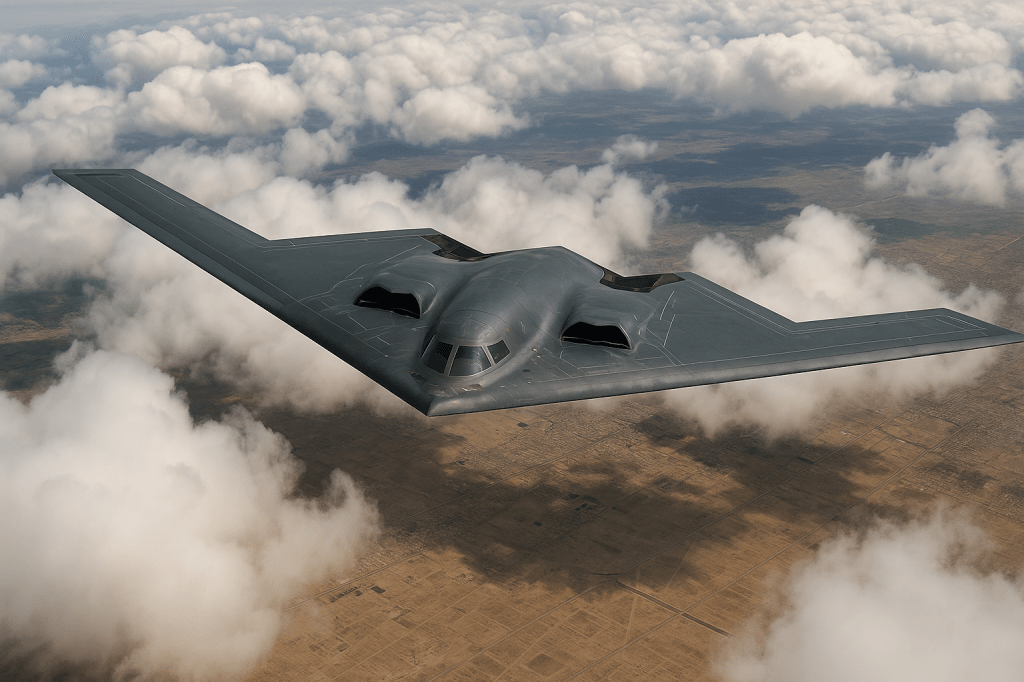
    The world watched with bated breath as U.S. stealth bombers pierced Iranian skies this week, dropping bunker-busting munitions over nuclear sites long suspected of harboring secret ambitions. The airstrikes, aimed primarily at Fordow and Natanz, were President Donald Trump’s dramatic move to insert the United States into the Israel–Iran conflict — a conflict that has steadily escalated over months of covert attacks, proxy skirmishes, and fiery rhetoric.

    This was no random act of war. The chain of events leading to the strikes was long in the making.

    Israel had already launched targeted bombings on Iran’s nuclear infrastructure after a series of provocations and growing concern that Iran was on the verge of achieving “breakout capability” — the technical means to rapidly assemble a nuclear weapon. Iran had enriched uranium beyond 60%, far exceeding the JCPOA limit of 3.67%, and had blocked international inspectors from verifying its claims of peaceful use. Following Iranian retaliatory missile strikes that hit civilian infrastructure in Israel — including a hospital — President Trump acted, stating that the U.S. “could not afford to remain on the sidelines any longer.”

    The U.S. strikes were powerful and symbolically significant. Reports suggest they inflicted damage on key components of Iran’s nuclear program, especially at deeply buried sites like Fordow. However, experts remain cautious: while the attacks likely delayed Iran’s nuclear timeline, they did not obliterate its capacity. Iran’s nuclear infrastructure, built for redundancy and deeply embedded in mountainous terrain, appears bruised but not broken.

    The Islamic Republic’s response has been telling. Rather than capitulate, Iran has shifted into a hardened posture. Supreme Leader Ayatollah Ali Khamenei has reportedly delegated broader military authority to the IRGC’s Supreme Council, signaling a move toward full war footing. At the same time, he has retreated from public view and fortified leadership succession mechanisms — a sign that the regime is preparing for further destabilization.

    And destabilization may well be inevitable. Iran’s economy, already reeling under decades of sanctions and recent damage to oil and gas platforms, faces a dangerous tipping point. Inflation is soaring, blackouts are widespread, and foreign reserves are shrinking. New sanctions by the U.S. Treasury—targeting oil networks and defense contractors—tighten the noose.

    Still, even in this moment of heightened tension, there are subtle signals of diplomatic possibilities. Behind closed doors, indirect talks between the U.S. and Iran, brokered by Oman and European intermediaries, have resumed. Iran has made clear that any negotiation will only proceed if Israel halts its military campaign. The U.S., for its part, has given the diplomacy track a two-week window before resuming further military action.

    What would a negotiated agreement mean for the Islamic regime?

    If Tehran is forced to accept limits on enrichment, allow full inspections, and scale back its regional proxy activities, the regime may secure short-term relief — such as eased sanctions, access to frozen assets, and a reopening of international trade. But this comes at a long-term cost: Iran’s ambition to become the uncontested leader of the Islamic world would be severely blunted.

    Interestingly, many Muslim-majority nations have responded to these developments with a tone of caution and neutrality. Egypt, Saudi Arabia, the UAE, and others have called for restraint and diplomacy rather than rallying to Iran’s defense. The Arab world, once deeply fractured along Sunni–Shia lines, seems unwilling to unite under Iran’s banner in a broader Islamic showdown. Their priority remains regional stability and economic continuity, not ideological warfare.

    This failure to galvanize Islamic solidarity is one of the more consequential outcomes of the conflict. Iran’s once-lofty goal of positioning itself as Islam’s vanguard power — and possibly even the long-awaited Mahdi state in some extremist views — now seems distant. Instead of leading, Iran now finds itself isolated, internally strained, and increasingly cornered.

    The Bible speaks prophetically of a time near the end when a power from the south — a “king of the South” — will rise to challenge a dominant power in the north (Daniel 11:40). Many biblical scholars believe this southern power will emerge from Arab nations south of the Promised Land such as Egypt or a coalition that includes Libya, not from Iran. What’s unfolding now may well be a realignment toward that eventual scenario. Iran’s decline makes room for another Islamic bloc to fill that prophetic role.

    The bombs dropped by the United States did more than strike concrete and steel — they shattered illusions. Iran’s nuclear program may recover in part, and its leadership may cling to power a while longer. But the regional and prophetic trajectory is shifting. If Iran does come to the negotiating table — as economic desperation and diplomatic isolation suggest it might — it will do so not as a rising empire but as a state trying to salvage its footing. And with that, the dream of Iran leading the Islamic world grows dimmer, clearing the stage for other prophetic actors to emerge.

  • The Lion Strikes: How Israel’s Offensive Against Iran Could Pave the Way for Another Power in the Middle East

    The Lion Strikes: How Israel’s Offensive Against Iran Could Pave the Way for Another Power in the Middle East

    In a dramatic development, Israel has launched a targeted and far-reaching strike on Iranian nuclear and military infrastructure. The operation—striking key facilities such as Natanz and Fordow, and eliminating several of Iran’s top nuclear scientists—delivers a significant blow to Tehran’s ambition to become a nuclear power.

    These attacks are not only crippling Iran’s scientific and military capabilities but are also signaling a shift in the Middle East’s balance of power. Israel, perceiving a nuclear-armed Iran as an existential threat, has acted decisively to delay or dismantle what it views as an imminent danger. In doing so, Israel has likely bought itself time—perhaps even years—of relative security from a nuclear threat originating from Iran.

    However, these events may have a broader prophetic consequence. As Iran’s ability to wield the ultimate weapon of mass destruction gets postponed, and its ability to project power wanes as Israel brings the war into its doorstep, it could open the door for a new Islamic power to rise—not rooted in Elam (ancient Iran), but in the Arab world. Iran, whose ancient name in the Bible is Elam (Genesis 10:22; Jeremiah 49:34–39), may find its dominance eclipsed by a coalition of Arab nations, leading to the emergence of a different kind of power bloc in the Middle East.

    According to Daniel 11, a “king of the South” will arise south of Israel in the end time—a national or regional power bloc that will challenge the “king of the North”, a revived Roman Empire based in Europe. When this king of the South attacks, the king of the North will launch a swift and devastating counterattack (Daniel 11:40).

    The biblical details in Daniel 11:42–43 tell us more:

    “He shall stretch out his hand against the countries, and the land of Egypt shall not escape. He shall have power over the treasures of gold and silver, and over all the precious things of Egypt; also the Libyans and Ethiopians shall follow at his heels.”

    This strongly indicates that Egypt, Libya, and possibly other Arab nations will comprise or support the king of the South. These are not Persian or Elamite nations, but nations from the Arab world—suggesting that by the time this prophecy is fulfilled, Iran will no longer be a dominant player in Middle Eastern affairs.

    This fits perfectly with Jeremiah 49, which foretells judgment upon Elam, stating that God would “break the bow of Elam” and scatter its people. Yet the prophecy does not end there. In verse 39, God declares:

    “But it shall come to pass in the latter days: I will bring back the captives of Elam,” says the Lord.

    Though Iran may be humbled in coming years, God will not forget its people. In the Millennial reign of Jesus Christ, the people of Elam—Iran—will be restored to their land and brought under God’s righteous government. They will no longer be instruments of aggression, but citizens of a world at peace.

    The current Israeli-Iranian conflict, therefore, may be far more than a military standoff—it may be a prophetic transition, marking the decline of Elam’s influence and preparing the stage for the final alignment of nations described in the Bible. As one Islamic power fades, another rises. But above all, the ultimate resolution lies not in human alliances or military might, but in the coming Kingdom of God, where all nations—including Iran—will be restored under the leadership of Jesus Christ.