Tag: European security

  • Leadership, War, and the Hand of God: What Ukraine and Russia Are Teaching Europe

    Leadership, War, and the Hand of God: What Ukraine and Russia Are Teaching Europe

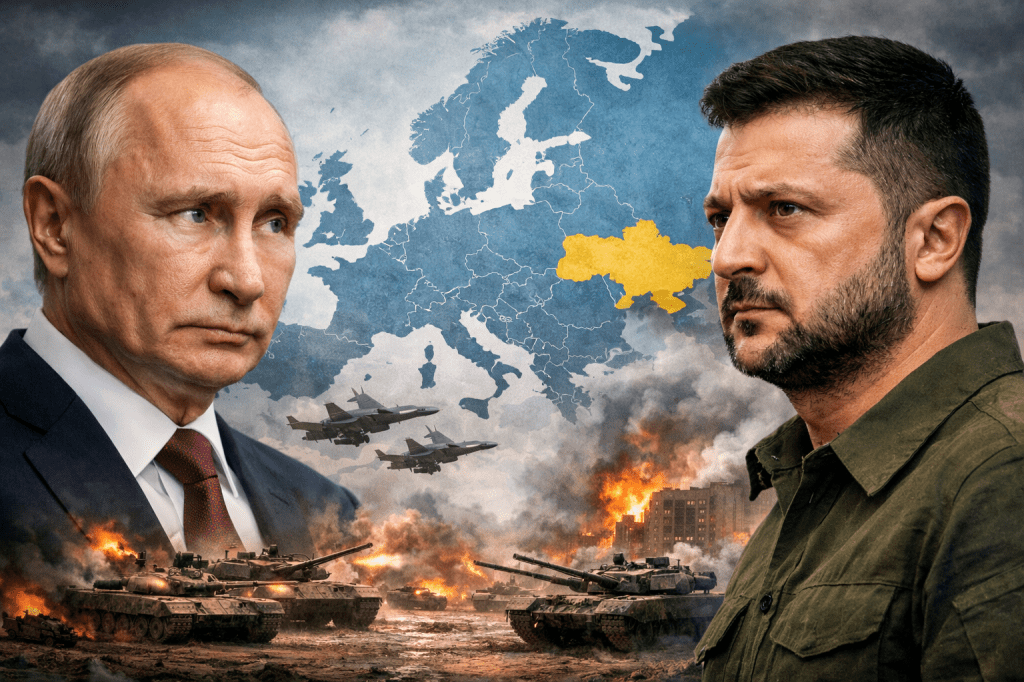
    History rarely turns on a single battle. More often, it turns on leadership—how power is exercised, how truth is handled, and how people are motivated when the cost becomes unbearable. The ongoing war between Russia and Ukraine is a vivid example. While weapons, manpower, and alliances matter greatly, the leadership styles of the two presidents involved are shaping the direction of this conflict in ways that may reach far beyond Eastern Europe.

    This is not merely a geopolitical struggle. It is a reminder that God rules in the affairs of men (Daniel 4:17), raising up leaders—wise or foolish, strong or weak—to accomplish His purposes.

    Two leaders, two radically different approaches

    On one side stands Vladimir Putin, a leader who governs through centralization, control, and fear. Power flows upward. Information flows downward—filtered, curated, and often softened to avoid displeasing the top. Loyalty is prized more than candor. This style has served Putin well in consolidating political power over decades.

    On the other side is Volodymyr Zelensky, whose leadership has evolved dramatically under fire. His approach is more distributed. He relies heavily on professional military advice, encourages honest feedback, and communicates openly with both his people and Ukraine’s allies. His authority rests less on fear and more on legitimacy and shared purpose.

    These differences do not determine who will “win” the war—but they strongly influence how the war unfolds.

    Leadership shapes direction, not destiny

    Wars are not decided by leadership style alone. Geography, industrial capacity, alliances, and sheer numbers still matter. Russia has greater manpower and resources, and it remains possible—even likely—that it will emerge from this war with some territorial gains.

    Yet leadership influences critical factors that accumulate over time:

    • Learning speed: Systems that punish bad news adapt slowly. Systems that tolerate honesty adjust faster.
    • Morale and endurance: Fear can compel obedience, but meaning sustains sacrifice.
    • Alliance management: Transparency builds trust; opacity erodes it.

    Ukraine’s resilience—its refusal to collapse under pressure—has surprised much of the world. That resilience is not accidental. It flows from a leadership style that rewards initiative, accepts responsibility, and shares risk with the population.

    Russia, by contrast, has relied on coercion and narrative control. That approach can sustain effort—but it struggles to correct mistakes quickly. Over long wars, such rigidity becomes costly.

    God’s hand over national leadership

    Scripture reminds us that God both appoints and removes leaders:

    “He changes times and seasons; He removes kings and raises up kings” (Daniel 2:21).

    This applies not only to righteous rulers, but also to flawed and even oppressive ones. God used Pharaoh, Nebuchadnezzar, Cyrus, and others—each very different in character—to accomplish His will.

    The contrast between Putin and Zelensky should not be viewed merely as democracy versus authoritarianism, or good versus evil in simplistic terms. Rather, it is another reminder that God allows leadership styles to expose national strengths and weaknesses, often preparing the stage for larger events yet to come.

    Ukraine’s influence on Europe’s future

    Regardless of how the war ends territorially, Ukraine has already changed Europe.

    Its steadfastness has:

    • Ended decades of European complacency
    • Reawakened military preparedness
    • Hardened attitudes toward coercion and appeasement

    Europe is moving—slowly but unmistakably—toward a more unified and force-ready posture. This matters prophetically.

    Bible prophecy indicates that a powerful leader will arise in Europe, one who will dominate the world scene for a short but intense period (Daniel 11; Revelation 13). This leader will not be timid. He will act decisively, militarily, and without the restraint that has characterized post–World War II Europe.

    Ukraine’s resistance may well shape the environment that produces such a leader—one forged in a Europe that has learned, painfully, that peace cannot rest on wishful thinking alone.

    A sobering prophetic possibility

    It is striking that biblical prophecy suggests a future European power that will not fear confrontation with Russia, even to the point of invasion when it serves his purposes (Daniel 11:44). While Scripture does not give all details, it does show that geopolitical power shifts dramatically at the end of this age.

    The current war does not fulfill these prophecies outright—but it conditions minds and institutions. It teaches Europe to think in terms of force, resolve, and preemptive action. Leadership styles matter here. Ukraine’s example reinforces the idea that survival favors decisiveness, unity, and readiness to act.

    Trajectory

    Leadership does not decide wars by itself—but it sets their trajectory. Putin’s style has produced endurance through control. Zelensky’s has produced resilience through shared purpose. Both are being used—knowingly or unknowingly—within God’s greater plan.

    For students of prophecy, this war is not just about borders. It is about preparation—of nations, leaders, and peoples—for events that Scripture tells us are coming.

    As Christ Himself warned, “See that you are not troubled; for all these things must come to pass” (Matthew 24:6).

    The task of God’s people is not fear, but understanding—and faith in the One who truly governs the nations.

  • Probing the Shield: Russia’s Airspace Tests and Europe’s Future Army

    Probing the Shield: Russia’s Airspace Tests and Europe’s Future Army

    Every few weeks, headlines surface of Russian fighter jets or drones slipping—sometimes boldly, sometimes stealthily—into NATO airspace. Recently, Estonia, Poland, and other allies have sounded the alarm as Russian aircraft flew without transponders, ignored intercept signals, or even sent swarms of drones across borders.

    To the casual observer, these events seem reckless. Why would Russia risk provoking NATO, the most powerful military alliance in the world? But there is strategy here. Moscow is probing. Each incursion is a test—an attempt to measure NATO’s reflexes, to spot weaknesses, and to learn how far it can go without triggering a serious response.

    And yet, in a twist of irony, these provocations may be preparing NATO for the very conflict Russia hopes to avoid. Every incursion forces allied radars to track, interceptors to scramble, and commanders to review their rules of engagement. Every incident adds data, sharpens coordination, and strengthens air defenses along NATO’s eastern flank. Russia may think it is playing offense, but in reality it is helping its adversaries rehearse for war.

    NATO Today, Europe Tomorrow

    But what of NATO’s future? The alliance has held since 1949, yet cracks are visible. American leadership has become uncertain, swaying between strong commitments and hints of withdrawal. If the United States wavers long enough, NATO as we know it may one day fade.

    That does not mean Europe will remain undefended. On the contrary, the pressures of Russian aggression and American inconsistency may drive European states to consolidate their own defense into a new structure—a European army. Such a force would not begin from scratch. It would inherit the muscle memory that NATO’s training and Russia’s provocations are providing right now.

    A Power Foretold

    The Bible itself points to the rise of such a force. In the book of Revelation, the Apostle John describes a European-centered power that will astonish the world with its military might: “Who is like the beast? Who is able to make war with him?” (Revelation 13:4).

    That prophecy speaks of a union, political and military, arising in Europe in the end times—an army that no earthly coalition could match. It is sobering to realize that today’s “tests” by Russia may be laying the groundwork for that very power. The lessons Europe learns under NATO’s umbrella will be reapplied in a future alliance, one described in Scripture as both formidable and unmatched.

    Rehearsals

    So the next time Russian jets slip into Baltic skies or drones drift over Poland, remember: these are not isolated provocations. They are rehearsals. Moscow is probing for weakness, but in doing so it is forcing Europe to harden its shield. And in the long arc of history, that shield may outlast NATO itself—emerging as something far stronger, and prophetically destined, on the world stage.

  • A Glimmer of Hope: Trump, Zelensky, and the Long Road to Peace

    A Glimmer of Hope: Trump, Zelensky, and the Long Road to Peace

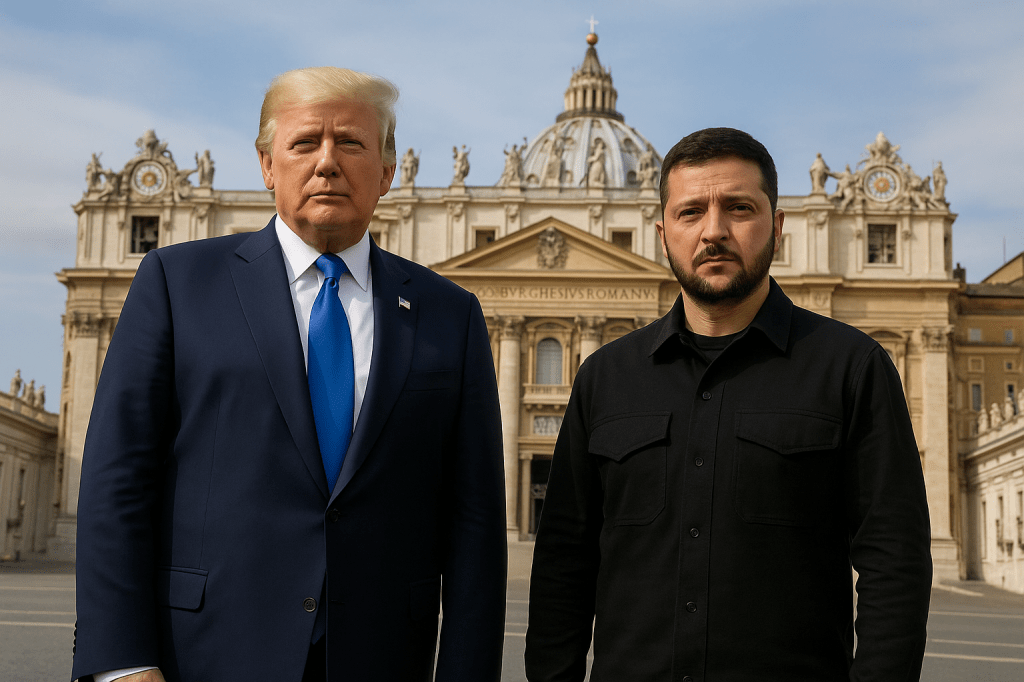
    At the sidelines of the funeral of Pope Francis, held at the Vatican — a setting deeply symbolic of hope, reconciliation, and peace — a private and significant meeting took place between Ukrainian President Volodymyr Zelensky and U.S. President Donald Trump. Although their conversation lasted only around fifteen minutes, it produced key developments that, if sustained, suggest a possible shift in tone regarding the ongoing Russia-Ukraine conflict. This meeting, in its timing and tone, could have lasting implications for Ukraine, Europe, and global peace efforts.

    Key Outcomes of the Meeting

    The Zelensky–Trump meeting achieved several notable outcomes that signal at least a partial change from previous U.S. positions:

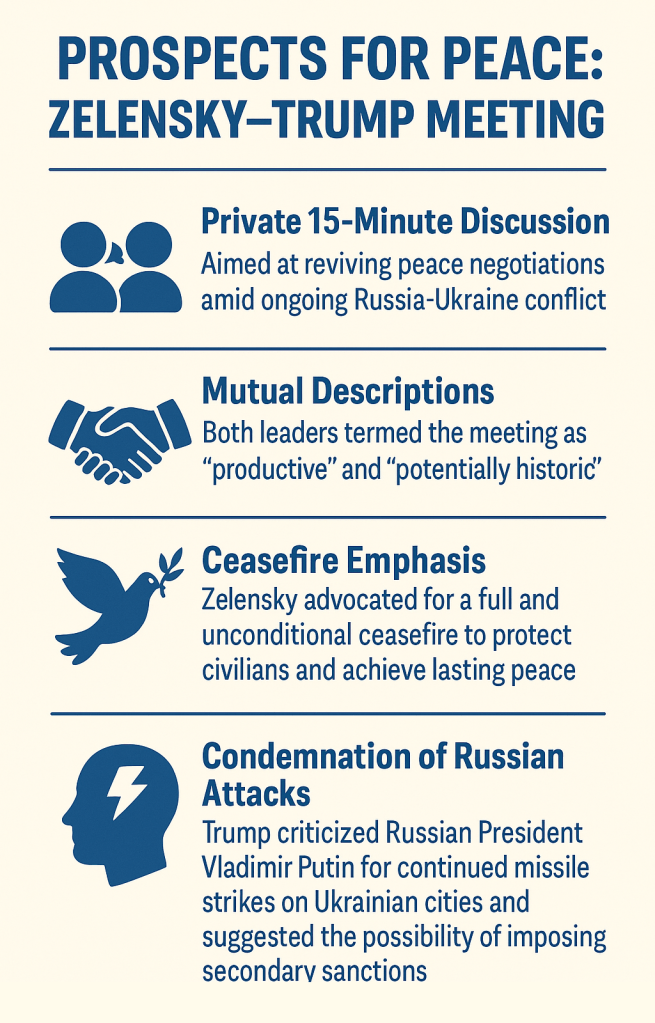
    • Private 15-Minute Discussion – The two leaders engaged in a brief but focused conversation aimed at reviving the stalled peace negotiations between Ukraine and Russia. Though details remain limited, both sides characterized the exchange as serious and constructive.
    • Mutual Praise of the Meeting – Afterward, both Trump and Zelensky described their discussion as “productive” and “potentially historic.” This mutual appreciation suggested a desire — at least rhetorically — to move beyond posturing and work toward real diplomatic progress.
    • Emphasis on the Need for a Ceasefire – President Zelensky strongly advocated for a full and unconditional ceasefire to protect Ukrainian civilians and prevent further devastation. Trump, echoing a similar concern, called for immediate steps to reduce violence on the ground, marking a notable rhetorical shift from earlier periods when he emphasized quick deals even at Ukraine’s potential expense.
    • Public Condemnation of Russia’s Attacks – For the first time in a significant international setting, Trump openly criticized Russia’s continued missile strikes on Ukrainian cities. He even hinted at the possibility of imposing secondary sanctions on Russia if hostilities escalated — a firmer line than he had taken during his previous administration.

    These outcomes suggest that while Trump’s overall strategy may not have fully changed, his tone and priorities appear to have evolved — at least in how he publicly frames the conflict.

    Factors That Likely Changed President Trump’s Tone

    Several important forces likely contributed to this adjustment in Trump’s rhetoric and stance:

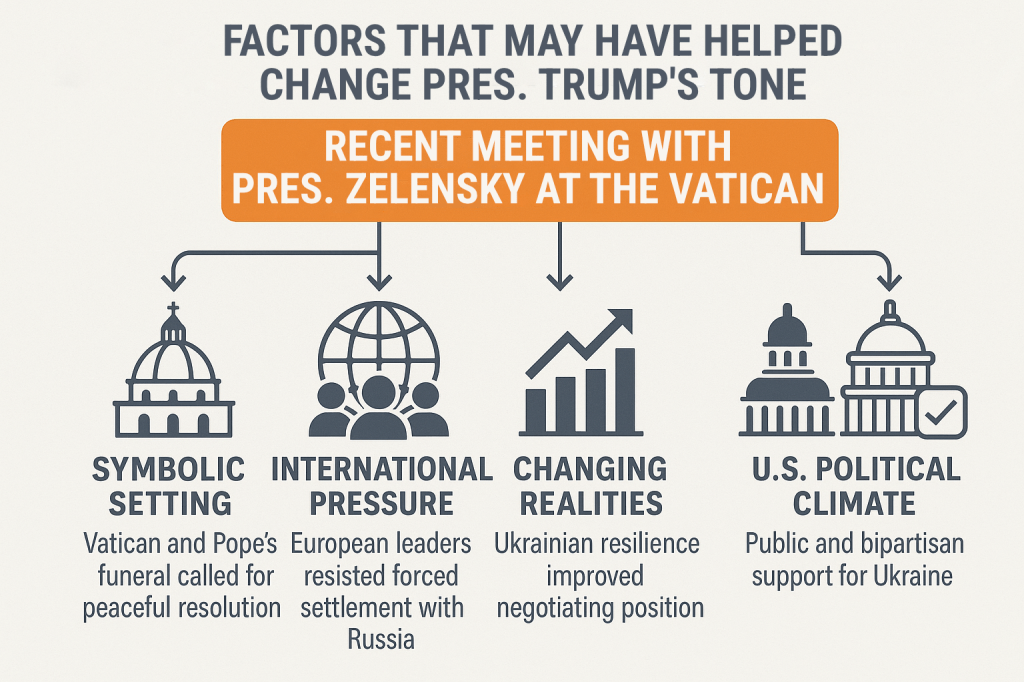
    • The Symbolic Setting of the Vatican – Meeting during Pope Francis’ funeral inevitably shaped the atmosphere. In a setting dedicated to peace, compassion, and global unity, it would have appeared callous and politically risky for Trump to project a transactional or overly hardline image.
    • International Diplomatic Pressure – Major European powers such as France, Germany, and the United Kingdom had already signaled strong opposition to any peace deal that legitimized Russia’s territorial gains. Trump’s administration would risk significant diplomatic isolation if it pushed for an unjust settlement.
    • Ukraine’s Battlefield Resilience – Ukraine’s ability to hold its ground against Russian aggression impressed even skeptical observers. Zelensky’s ability to represent a nation that refuses to surrender easily likely demanded a more respectful and serious response from Trump.
    • Growing Bipartisan U.S. Support for Ukraine – Both Democratic and Republican lawmakers have increasingly voiced support for Ukraine’s territorial integrity. With elections looming in 2026, Trump cannot afford to alienate a significant portion of the American electorate who sympathize with Ukraine’s struggle.
    • Trump’s Need to Reinforce a Statesmanlike Image – As he looks toward solidifying his legacy and future leadership reputation, Trump understands the value of being seen as a “peacemaker.” This meeting provided an opportunity to bolster that image on a global stage.

    Taken together, these factors likely combined to encourage Trump to moderate his tone and speak more seriously about a diplomatic path forward.

    Personal Values That Helped Soften Trump’s Tone

    Trump’s change in tone wasn’t merely a result of external pressures. Some of his core personal values may also have played a role:

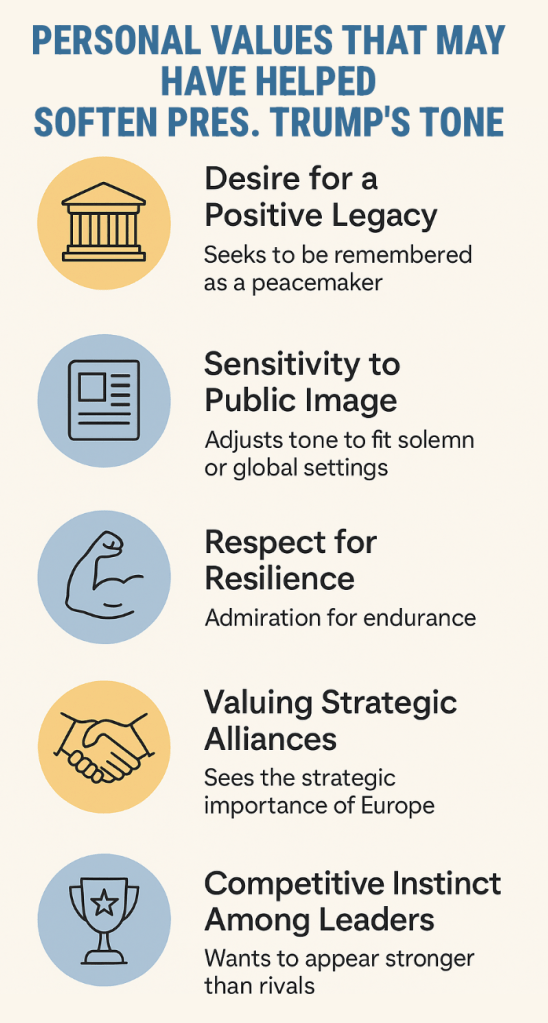
    • Desire for a Legacy of Peace – Trump is deeply concerned about how history will remember him. Securing peace between Ukraine and Russia could be a monumental achievement that cements his place among world leaders who brokered significant peace deals.
    • Sensitivity to Public Image – Trump’s acute awareness of how he is portrayed in the media likely made him realize that appearing compassionate, especially at the Vatican, would play well both internationally and domestically.
    • Respect for Strength and Resilience – Trump’s admiration for strength — whether in individuals, businesses, or nations — likely drew a measure of respect for Ukraine’s unwavering resistance against a much larger military power.
    • Transactional View of Alliances – Trump sees international relationships through the lens of mutual benefit. He understands that maintaining strong European alliances is crucial for America’s broader strategic interests.
    • Competitive Instinct Against World Leaders – Trump views global politics as a contest among strong personalities. His evolving criticism of Putin may not only reflect strategic calculation but also a desire to appear tougher and more effective than the Russian leader.

    These personal values — particularly the desire for a positive legacy and respect for strength — could later motivate Trump to adjust even further on the more contentious areas of the peace negotiations.

    Remaining Areas of Difference

    Despite the softened tone, serious divergences remain between the U.S. and Ukraine’s vision of peace:

    • Recognition of Crimea as Russian Territory – Reports indicate that Trump is still inclined to propose recognizing Russia’s annexation of Crimea — a move Ukraine and nearly all of Europe categorically reject. For Ukraine, such recognition would legitimize illegal aggression and set a dangerous precedent.
    • Permanent Exclusion of Ukraine from NATO Membership – Trump has also suggested that Ukraine should be permanently barred from NATO as part of any settlement. This would leave Ukraine vulnerable to future Russian attacks and could embolden other aggressors worldwide.

    If these areas are not resolved, any peace agreement would be fragile at best — and future conflicts almost inevitable.

    What Could Change Trump’s Mind

    Several dynamics could influence Trump to reconsider these positions:

    • Continued Ukrainian Military Gains – If Ukraine demonstrates continued success on the battlefield, the political cost of asking them to surrender land will become much higher.
    • Strong Legislative and Public Pressure in the U.S. – If Congress ties military aid and diplomatic support to maintaining Ukraine’s sovereignty — and if public opinion stays firmly with Ukraine — Trump will find it harder to push controversial concessions.
    • European Unity and Toughness – A united European stance could make any plan involving territorial compromise diplomatically and economically costly for the U.S.
    • Legacy Motivations – Trump’s desire to be remembered as a historic peacemaker could drive him to accept more principled, lasting solutions, rather than quick political victories.

    Thus, personal ambition for a noble legacy could actually help steer Trump toward better, fairer peace terms.

    How Putin Might React

    Russian President Vladimir Putin is unlikely to ignore these developments:

    • Potential Escalation – If Putin senses that the U.S. position is hardening, he may attempt to escalate militarily to force a settlement while he still holds significant ground.
    • Undermining Trump’s Credibility – Russia’s information networks might try to discredit Trump if they believe he is drifting too far from their strategic goals.
    • Increased Diplomatic Pressure on Ukraine – Expect Moscow to step up efforts to intimidate Ukraine into accepting unfavorable terms before U.S. policy hardens further.

    In short, Russia is likely to respond aggressively, viewing a tougher Trump as a threat to their long-term objectives.

    The Bigger Picture

    Even if a ceasefire is achieved, true and lasting peace will not come merely through negotiations. 

    What is needed is a profound change in the hearts and values of leaders and nations:

    • Leaders must focus on justice and dignity over power and conquest.
    • Nations must seek cooperation and fairness instead of exploitation and fear.
    • Alliances must be built not just on interest, but on principles of mutual respect.

    The Bible points us to a future beyond the broken leadership of today. 

    When Christ returns, He will establish a government where “nation shall not lift up sword against nation, neither shall they learn war anymore” (Micah 4:3).

    Under His perfect reign, there will be no more aggressors and no more victims. 

    Bigger nations will no longer oppress smaller ones. Great powers will no longer fear or threaten one another. True, lasting peace will fill the earth — a peace built on justice, love, and eternal strength.

    Cautious Optimism

    The Vatican meeting between Trump and Zelensky offers a rare moment of cautious optimism. 

    But real peace will require more than changed strategies — it will require changed values. 

    Until the Kingdom of God is established on earth, peace among nations will remain fragile. But every step toward justice, compassion, and respect today is a small glimpse of the greater peace that is yet to come.