Tag: Global economy

  • BRICS in Rio: A Rising Bloc’s Bid to Reshape the World Order

    BRICS in Rio: A Rising Bloc’s Bid to Reshape the World Order

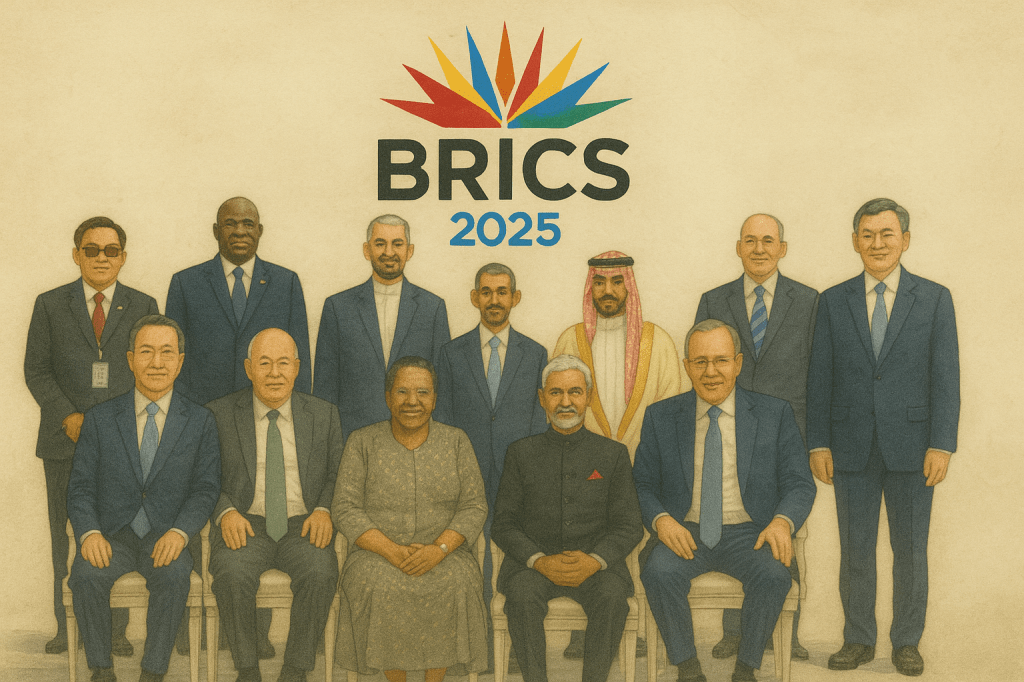
    As the leaders of an expanded BRICS convene in Rio de Janeiro this July 6-7 for the 17th BRICS Summit, the world watches closely. What began in 2009 as an informal coalition of emerging economies is now growing into a geopolitical force, aiming to challenge the dominance of Western institutions like the G7, the IMF, and SWIFT.

    With major issues on the table—including currency de-dollarization, cross-border payment systems, and development finance—the BRICS bloc appears more ambitious than ever.

    The BRICS—originally Brazil, Russia, India, and China—held their first summit in 2009. South Africa joined the following year, completing the initial five-member alliance. Over time, BRICS built real institutional capacity, establishing the New Development Bank (NDB) and Contingent Reserve Arrangement (CRA) to promote development and economic resilience among its members.

    A major expansion took place in 2023, when Egypt, Ethiopia, Iran, and the United Arab Emirates were granted full membership. Indonesia joined in early 2025, bringing the group to eleven. With ongoing interest from countries like Vietnam, Bangladesh, and Argentina, BRICS is quickly turning from a bloc into a movement.

    BRICS’ accomplishments over the last 16 years include:

    • Financial Infrastructure: The NDB has funded more than $30 billion in development projects, while the CRA provides a $100 billion reserve pool to guard against financial crises.
    • Alternative Payment Systems: With growing distrust of Western-dominated platforms like SWIFT, BRICS members have begun developing BRICS Pay, a decentralized payment messaging system allowing trade in local currencies.
    • Strategic Partnerships: Dozens of working groups and institutions now foster cooperation on energy, health, digital governance, and more—advancing what some have called a new “Global South consensus.”

    Despite progress, the Rio 2025 summit reveals fault lines:

    • Leadership Absences: Neither Xi Jinping nor Vladimir Putin is attending in person. Putin faces travel limitations due to international sanctions, and Xi reportedly cited scheduling conflicts. Their absence reflects the bloc’s internal tensions.
    • Ideological Divide: While nations like Iran and Russia advocate a confrontational stance toward the West, others like India, Brazil, and Indonesia prefer a more balanced approach. This divergence hampers consensus on issues like UN reform, Ukraine, and Gaza.
    • Competing Interests: India’s growing ties with Western powers contrast with China’s ambitions, and Brazil, the host nation, has tried to focus this year’s agenda on neutral topics like climate finance, AI governance, and healthcare.

    With 11 member nations representing over 40% of global GDP (PPP) and more than half the world’s population, BRICS is no longer a marginal force. It’s now a serious contender in shaping global governance.

    Key differences with the G7 include:

    • Development Focus: While G7 prioritizes legacy institutions like the IMF and World Bank, BRICS centers its efforts on flexible South-South cooperation.
    • Financial Sovereignty: Tools like BRICS Pay and the NDB enable countries to bypass traditional Western financial systems.
    • Multipolar Vision: BRICS advocates for a more equitable world order, with power shared among emerging and developing nations—not monopolized by the West.

    After Russia’s invasion of Ukraine in 2022, Western sanctions cut off many Russian banks from the SWIFT network. In response, Russia turned to:

    • SPFS: Its own financial messaging system.
    • Bilateral Trade Deals: Using rubles, yuan, and other local currencies with BRICS members.
    • BRICS Pay: A system still in early rollout but with growing support. China, Brazil, and Iran have all agreed to increase usage in 2025.

    Though not yet a global replacement for SWIFT, BRICS Pay offers a real alternative for countries under sanctions—laying the groundwork for a parallel financial system.

    If BRICS can overcome its divisions, the economic integration of Russia, India, and China could mark the emergence of a powerful Eastern economic bloc. With joint development banks, currency swaps, and shared digital platforms, this bloc would rival any Western alliance economically and geopolitically.

    Such a scenario aligns with what many Bible students interpret as an end-time prophecy: an Eastern power—“kings from the East”—rising to challenge a revived Roman Empire (see Revelation 16:12).

    The BRICS summit in Rio showcases both promise and peril. Its expansion, financial innovation, and strategic agenda give it the tools to build a new world order. But internal rivalries, absent leaders, and divergent visions threaten to stall momentum.

    Still, if BRICS succeeds, it won’t just change economics. It could reshape the balance of global power—perhaps even fulfilling ancient biblical prophecies about a world divided between East and West in the final days before Christ’s return.

  • The “Freeloader” Fallacy and the Unraveling of the World America Built

    The “Freeloader” Fallacy and the Unraveling of the World America Built

    In recent years, voices from within the United States—most prominently in the current administration of President Donald Trump—have labeled America’s European allies as “freeloaders.” This sentiment, recently reinforced by leaked chats from senior U.S. defense officials, suggests that the U.S. is unfairly burdened by its role as the world’s security guarantor, while allies reap the benefits without paying their fair share.

    But this view, while emotionally resonant in a time of rising nationalism and budget pressures, fails to recognize a deeper historical truth: the so-called “freeloading” arrangement was designed by the United States itself after World War II.

    America’s Strategic Design After World War II

    When the dust of WWII settled, the United States stood as the dominant power in a shattered world. Europe lay in ruins. Germany, the nation that had ignited two world wars, was disarmed and divided. The Soviet Union, though an ally during the war, quickly emerged as a global ideological and military threat, expanding its grip over Eastern Europe and seeking to export communism globally.

    To prevent a third world war—and to contain the spread of Soviet communism—the U.S. devised a grand strategy. It would serve as a global security umbrella, deploying its vast military and nuclear power to deter aggression in both Europe and Asia.

    But this security guarantee came with conditions.

    Why the U.S. Took on the Burden

    In Europe, the U.S. created NATO in 1949, a collective defense alliance that essentially declared: “If the Soviets invade, America will respond.” This meant stationing tens of thousands of troops in Germany and elsewhere—not to dominate Europe, but to protect it, while also ensuring that Germany would never again re-arm on its own and potentially start another global war.

    The U.S. didn’t stop in Europe. In Asia, the United States went even further: it wrote Japan’s post-war constitution, explicitly forbidding it from maintaining offensive military forces. In exchange, the U.S. promised to defend Japan from any external threats. This kept the peace in the Pacific and ensured that Japan, once an imperial power, would remain a pacifist state under American protection.

    Aside from maintaining military presence in various points around the globe, this also meant that the U.S. Navy would patrol the world’s oceans and major trade routes, ensuring they remained open and secure for international commerce. This naval presence guaranteed that goods, products, energy supplies, and even people could travel safely across seas and continents, under the protection of a rules-based order that the U.S. enforced. In effect, the United States became the maritime guardian of global trade, allowing the modern economy to flourish.

    The Global Bargain

    What did America get in return?

    Quite a lot.

    These countries, under the U.S. defense umbrella, pledged to:

    • Side with the United States in the ideological and military contest of the Cold War. 
    • Maintain for the most part (or at least at the surface) democratic forms of governance, compatible with American values and institutions. 
    • Participate in a global economic system centered on free trade, the U.S. dollar, and open access to American markets, capital, and technology. 

    This arrangement created decades of global stability, fueled unprecedented economic growth, and cemented America’s leadership role in the world. Allies didn’t have to spend massive portions of their GDP on defense, because America did it for them—intentionally, and as a strategic choice.

    But this system also worked immensely in America’s favor:

    • It helped defeat the former Soviet Union.
    • It generated vast wealth for the United States.
    • It gave America access to the natural resources, talent, savings, and investments of allied nations.
    • It kept the U.S. economy resilient, allowing it to absorb shocks during oil crises, recessions, and financial collapses because the global economy was effectively built around it.

    This wasn’t just charity. It was a mutually beneficial arrangement that secured the U.S. economy and reinforced its global dominance across finance, technology, and military affairs.

    The Trump Doctrine and the Unraveling Order

    Enter the 21st century, and with it, growing discontent. Successive U.S. administrations urged allies to increase defense spending, but President Trump went further—publicly ridiculing NATO partners, questioning America’s commitment to mutual defense, and suggesting that the U.S. might not come to their aid.

    The recent leaks of U.S. defense officials calling allies “freeloaders” is not new rhetoric—it is the continuation of a growing American retrenchment from the very system it built. This shift is not just about burden-sharing; it’s about dismantling a world order that was held together by American security guarantees and economic leadership.

    And the consequences are enormous.

    As America pulls back:

    • Germany is rearming—a move unthinkable just a decade ago.
    • Japan is building new missile capabilities, breaking with its pacifist tradition.
    • France and others are openly discussing European “strategic autonomy,” no longer counting on U.S. support.

    The global system is fragmenting. Old alliances are fraying, and new coalitions may rise—not because of shared values, but based on shared interests, geography, or ethnicity. The future could very well be a world of competing blocs, exclusive clubs, and permanent insecurity.

    A Nation in Decline—By God’s Hand

    It is tempting to see all this purely through the lens of geopolitics. But for those who understand biblical prophecy, something deeper is taking place.

    America’s decline is not merely the result of policy decisions or shifting public opinion—it is a judgment from God.

    “My people are destroyed for lack of knowledge. Because you have rejected knowledge, I also will reject you… I will change their glory into shame.”  (Hosea 4:6–7)

    God blessed America with power, influence, and prosperity—but as the nation increasingly turns from Him, He is taking away its leadership role, allowing other powers to rise in its place. Whether those nations will be friendly or adversarial remains to be seen—but they will not uphold the same values or provide the same guarantees.

    What we are witnessing is not just the collapse of a U.S.-led global system. We are witnessing a divine reshaping of the world order, as foretold in Scripture.