Tag: global trade

  • Tariffs Rolled Back: China Sees an Opening, America Risks More Than It Thinks

    Tariffs Rolled Back: China Sees an Opening, America Risks More Than It Thinks

    After months of aggressive tariffs targeting Chinese goods, the U.S. has reversed course—partially rolling back some of the very tariffs it once defended as “necessary pain.” The reason? Mounting economic pressure, international backlash, and rising consumer costs at home.

    Yet this isn’t just about tariffs. It’s about how nations perceive strength, foresight, and credibility.

    China’s Calculated Calm

    Beijing, unsurprisingly, has not celebrated loudly. Instead, it’s using this rollback to present itself—especially to Asia-Pacific nations—as a reliable, stable, and forward-looking economic partner.

    China’s quiet confidence suggests it’s playing a long game: 

    • Let America appear reactive and short-sighted 
    • Fill the vacuum left by U.S. instability 
    • Build loyalty among countries hurt by U.S. tariffs 

    Allies Are Watching—and Worrying

    To many U.S. allies, this isn’t just a course correction—it’s another example of incoherent policy-making. First came the shock tariffs. Now comes the quiet reversal. The message? 

    “America acts first, thinks later.”

    As alliances strain, countries like Japan, South Korea, Vietnam, and even the EU are increasingly looking to China—not the U.S.—for consistency.

    What the Bible Says About Leadership and Judgment

    Isaiah 3:4 is strikingly relevant here:  “I will make mere youths their officials; children will rule over them.”

    God sometimes allows national leaders to act impulsively and without wisdom as a wake-up call for His people. It’s a warning to turn back to God’s principles of justice, truth, and humility.

    Where This Is Headed

    If America continues down this path of erratic policymaking, it risks more than economic losses. It risks becoming a symbol of declining global leadership, fractured alliances, and moral confusion. Meanwhile, China continues to craft its narrative as the stabilizer in a chaotic world order.

  • A World Unraveling – The High Price of Tariffs and a Coming Global Reckoning

    A World Unraveling – The High Price of Tariffs and a Coming Global Reckoning

    When President Donald Trump announced sweeping tariffs against nearly all countries in April 2025—infamously dubbed “Liberation Day”—the move was framed as an act of economic sovereignty. Aimed at defending American workers, correcting trade imbalances, and punishing foreign nations accused of unfair practices, the 10% baseline tariff (and far higher rates for select nations) was meant to be a declaration of independence from a trade system that many believed disadvantaged the United States.

    But what began as an assertion of American self-interest is now reverberating across the globe, triggering economic tremors that few anticipated and many fear may permanently reshape the global order.

    The Intentions: Economic Nationalism Reborn

    Trump’s rationale was not new. Tariffs have historically been used to protect domestic industries, reduce reliance on foreign imports, and pressure trade partners to change their behavior. This round of tariffs was more sweeping than any the U.S. had imposed in over a century. The administration targeted over 180 countries, including allies, emerging economies, and even remote territories that barely trade with the U.S.—a precaution against tariff evasion through transshipment.

    The administration’s messaging was simple but aggressive: it’s time for America to stop being the world’s economic doormat and to rebuild its industrial might from within.

    The Reality: Economic Strain and Fragmentation

    However, history and current evidence tell a more sobering story. Tariffs are blunt instruments. While they may temporarily protect local industries, they often result in higher consumer prices, supply chain disruptions, and retaliatory measures. We’ve seen this before—during the Great Depression with the Smoot-Hawley Tariff Act and more recently during Trump’s first term trade war with China. In both cases, the long-term consequences were damaging.

    In 2025, it’s happening again—on a broader scale:

    • Stock markets have plunged, wiping out trillions in value.
    • Consumer prices are rising as import costs spike.
    • Supply chains are unraveling as companies scramble to redirect sourcing.
    • Global trade flows are shifting away from the U.S., as countries retaliate and seek new partners.

    The U.S. hoped to isolate abusive trading behaviors, but it is increasingly isolating itself.

    The Rise of Economic Blocs

    In response, the world is reorganizing into regional economic blocs. What America has stepped away from, others are now rushing to claim:

    • The European Union, increasingly united in trade and security, is moving to fill the void in global leadership.
    • China, through its Belt and Road Initiative and new trade alliances across Asia, is tightening its grip on emerging markets.
    • India, ASEAN nations, and Latin America are pursuing regional deals to shield themselves from U.S. unpredictability.
    • Africa, through the African Continental Free Trade Area (AfCFTA), is charting a course toward intra-regional trade independence.

    These blocs are forming not just out of economic logic—but out of necessity. The post–World War II era of U.S.-led globalization is ending. In its place, a fragmented, competitive, and increasingly adversarial global economy is emerging.

    The Geopolitical Risks: From Trade War to Real War

    This economic realignment carries with it grave geopolitical risks.

    As trade blocs become more inward-looking and rivalrous, the possibility of military conflict among major powers increases—especially as nuclear-armed states compete for influence, resources, and strategic positioning. The risk of conflict between the U.S. and China, or even among European powers and their neighbors, is no longer hypothetical—it is becoming increasingly likely in a world no longer bound by mutual economic interest.

    Furthermore, the economic instability triggered by tariff wars could prompt a dangerous political shift. History has shown us that during extremely difficult times, people can trade personal freedom for security. With inflation, job losses, and uncertainty mounting, charismatic strongmen often step into the void—offering order, prosperity, and national pride in exchange for civil liberties and democratic safeguards.

    A World on the Edge

    This is precisely the world that the Bible describes will exist just before the return of Jesus Christ.

    The book of Revelation speaks of a final global system—a powerful economic and military confederation—that dominates the world for a short time. This “beast” power promises security and prosperity, and the world, desperate for stability, embraces it. But this system, empowered by human pride and corrupted leadership, ultimately brings humanity to the brink of annihilation (Matthew 24:22).

    We are not there yet—but the signs are unmistakable.

    • The weakening of American influence, once a stabilizing force in the world, is accelerating.
    • The rise of rival blocs, each with its own rules and ambitions, is fracturing the global system.
    • The erosion of freedoms in favor of authoritarian efficiency is gaining traction.

    A Time to Watch and Prepare

    President Trump’s tariffs were intended to make America strong. But by pursuing economic disengagement in a globalized world, the U.S. may have instead triggered the unraveling of the very system that kept major conflicts in check.

    We do not place our hope in presidents, trade policies, or economic systems. We watch these events with a discerning eye—not in panic, but in understanding. The unraveling world system is not the end of the story. It is a prelude to Christ’s return, when the kingdoms of this world will become the kingdoms of our Lord and of His Christ (Revelation 11:15).

    While men pursue security through strength and prosperity through force, true peace will only come through the righteous rule of God’s coming Kingdom.

  • Can the U.S. Become a Manufacturing Hub Again?

    Can the U.S. Become a Manufacturing Hub Again?

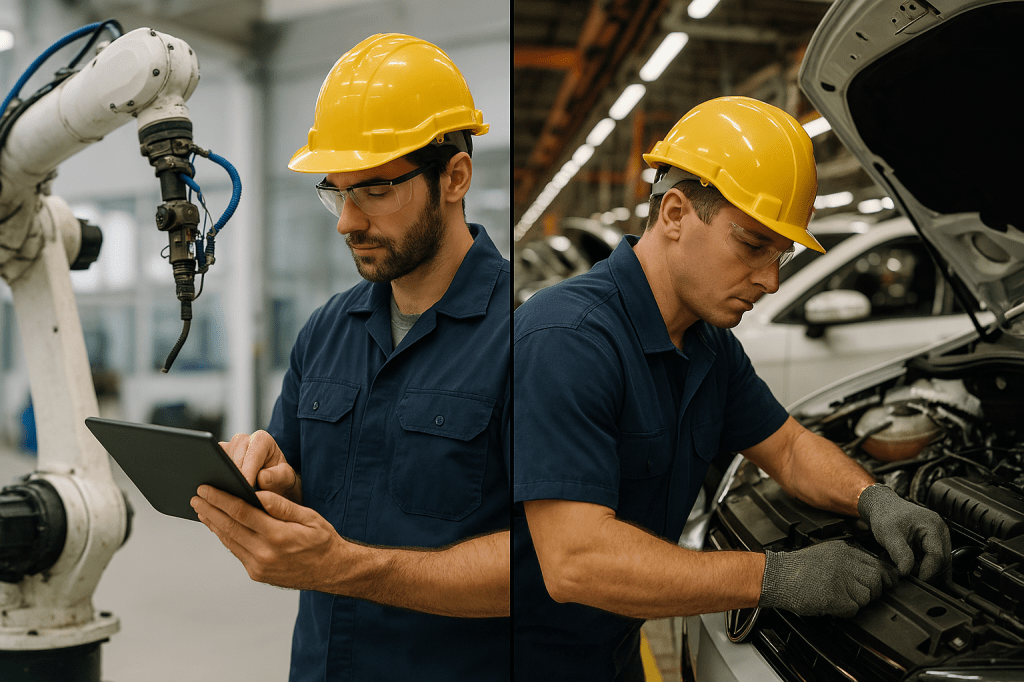
    One of the core objectives behind recent U.S. tariff policies, particularly toward countries like China, is the desire to bring manufacturing back to American soil. Political leaders often frame this goal as reclaiming economic self-sufficiency, protecting jobs, and revitalizing struggling communities. But is this objective truly attainable in today’s global economy? Or has the U.S. economy evolved in such a way that its comparative advantage now lies elsewhere?

    To answer that, we must consider both economic realities and timeless biblical principles that offer valuable insights for any nation seeking prosperity and sustainability.

    The Economic Landscape

    The United States has, over the past several decades, shifted from an industrial economy to one heavily focused on services. Sectors like finance, software development, healthcare, education, and intellectual property have become its global strongholds. This transition didn’t happen by accident—it reflects the U.S.’s natural strengths in innovation, capital markets, and high-skill labor.

    As of March 2025, the U.S. manufacturing sector employed approximately 12.76 million people, a figure that has remained relatively stable over the past year. In contrast, the services sector has continued to dominate the U.S. economy, contributing significantly to GDP growth.

    Tariffs are intended to protect and encourage domestic manufacturing by making foreign goods more expensive. In theory, this should give U.S. companies the space to grow. However, high labor costs, a weakened industrial base, and global supply chain integration pose real challenges. Rebuilding large-scale manufacturing in the U.S. is not impossible, but it will take time, investment, and strategic focus—especially in high-tech or critical industries like semiconductors, defense, and clean energy.

    What Would Be a Realistic Strategy?

    Rather than aiming to become the world’s factory floor again, the U.S. may find greater success focusing on advanced manufacturing and strategic reshoring:

    • Encourage innovation in robotics, AI, and clean energy.
    • Protect national interests by reshoring production of essential goods like pharmaceuticals and microchips.
    • Invest in workforce development and industrial infrastructure.

    This strategy not only leverages America’s existing strengths but also prepares it for the future rather than returning to the past.

    Biblical Principles That Apply

    While economics sets the stage, biblical wisdom provides enduring principles to guide national policy:

    1. Wise Stewardship

    “Be diligent to know the state of your flocks…” (Proverbs 27:23–24)

    Nations, like individuals, must manage their resources wisely. The U.S. must not squander its strengths in services and technology but instead strengthen its vulnerabilities responsibly.

    2. Count the Cost

    “For which of you, intending to build a tower, does not sit down first and count the cost…?” (Luke 14:28)

    Reviving manufacturing requires more than good intentions. It demands sober evaluation, investment, and long-term planning.

    3. Value of Labor

    “The wages of the laborers… which you kept back by fraud, cry out…” (James 5:4)

    Labor must be respected and rewarded fairly. America’s higher wage standards reflect a moral commitment to worker dignity, which should not be undermined for the sake of cheaper goods.

    4. Global Interdependence

    “The eye cannot say to the hand, ‘I have no need of you.’” (1 Corinthians 12:21)

    Although the apostle Paul was primarily talking here about the interrelationship among the various members of the church, the principle applies to the global economy as well. While national resilience is important, total isolation isn’t biblical. Interdependence, when managed justly, is part of God’s design.

    5. Just Weights and Measures

    “Dishonest scales are an abomination…” (Proverbs 11:1)

    Trade policies should be fair, transparent, and just—not manipulative or self-serving.

    6. Preparing for the Future

    “Go to the ant… she prepares her food in the summer…” (Proverbs 6:6–8)

    It is wise to prepare for future economic realities. Investing in high-tech industries, education, and sustainable production aligns with this principle.

    A Balanced Approach

    The U.S. may never return to being the global hub for mass manufacturing, but it doesn’t need to. Its strength lies in services, technology, and high-value production. Tariffs can play a role in protecting national interests, but they should be part of a larger, future-oriented economic strategy.

    Ultimately, scripture reminds us that wise stewardship, fair dealings, and thoughtful planning are essential to national strength. In a world of shifting economic tides, these biblical principles remain an unshakable foundation.