Tag: history

  • Early Signs of Authoritarianism: What the Government and Its Citizens Reveal

    Early Signs of Authoritarianism: What the Government and Its Citizens Reveal

    Across the world, democratic institutions are showing signs of wear. Many nations—both young democracies and long-established ones—are slowly drifting toward authoritarianism or are becoming more tolerant of leaders with apparently authoritarian approaches to governance. What’s more troubling is that this drift doesn’t always start with violent coups or military takeovers. Often, it begins with subtle shifts—first in government behavior, then in the attitudes of its citizens.

    From Democracy to Autocracy: Government-Level Warning Signs

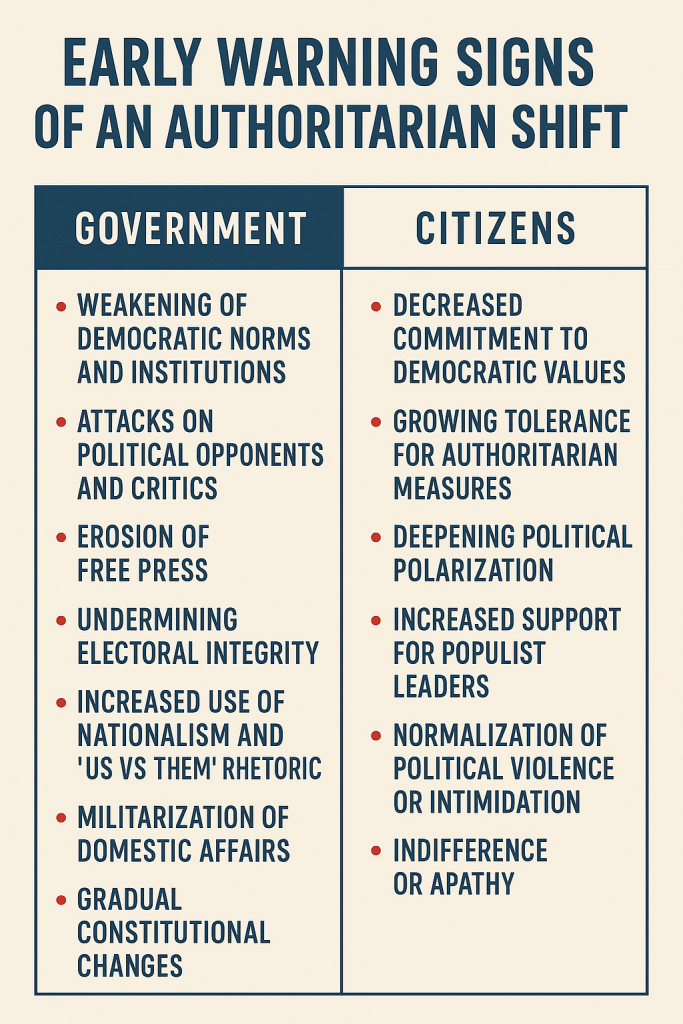
    According to studies from Freedom House, Varieties of Democracy (V-Dem), and political scientists like Steven Levitsky and Daniel Ziblatt (How Democracies Die), the early symptoms of democratic decline include:

    • Weakening of institutions: Leaders bypass courts, weaken legislatures, and centralize power.
    • Attacks on the press and opposition: Independent journalism is labeled “fake news”; critics are treated as enemies.
    • Undermining electoral integrity: Rules are bent, votes suppressed, or results questioned.
    • Inflammatory nationalism: Leaders stir up “us versus them” rhetoric to divide society.
    • Militarization of politics: Police and military are used to suppress protests or intimidate dissent.
    • Incremental constitutional changes: Term limits are eliminated, and checks and balances eroded.

    These patterns have played out in countries like Hungary, Turkey, and Russia, where democratic structures were gradually hollowed out from within—often with the legal system as a tool of control.
    The Other Side of the Coin: What Citizens Reveal

    Yet governments don’t act in a vacuum. Citizens themselves show signs of enabling authoritarianism. Research by Yascha Mounk, Pippa Norris, and surveys like the World Values Survey reveal the following trends:

    • Declining commitment to democratic norms: Fewer people, especially the youth, view democracy as essential.
    • Support for strongman rule: Citizens begin to favor “strong leaders” who can “get things done,” even at the cost of democracy.
    • Deep polarization: Society divides into tribes where compromise is seen as betrayal.
    • Indifference and apathy: Many withdraw from civic duties, feeling their voices no longer matter.
    • Tolerating violence and censorship: Some justify political violence or suppression of dissent if it favors their side.

    In short: when enough people care more about power, comfort, or ideology than fairness, truth, or accountability, democracy withers.

    A Spiritual Dimension

    God intended for humanity to live free, joyful, and safe—not under the thumb of cruel or corrupt rulers. Scripture shows that He warned nations and removed kings when they became oppressive. But He also allowed tyrants to rise when His people disobeyed.

    “I gave you a king in My anger, and took him away in My wrath.” — Hosea 13:11

    When people turn from justice, ignore the cries of the poor, and tolerate corruption or abuse, God may allow unjust rulers as a form of correction. Authoritarianism, in that sense, is not just a political shift—it can be a spiritual consequence.

    But that’s not the end of the story.

    Beyond Corrupt Human Rule

    The Bible points us to a future beyond corrupt human rule. When Christ returns, He will establish a perfect government where justice, love, and truth prevail:

     “For the Lord is our Judge, the Lord is our Lawgiver, the Lord is our King; He will save us.” — Isaiah 33:22

    Under Christ’s rule:

    • All leaders will be spiritually and morally perfected (Revelation 5:10).
    • Laws will be just and applied with gentle strength (Isaiah 11:4).
    • Every citizen—rich or poor—will be cared for (Psalm 72:4).
    • There will be no need for propaganda, police states, or manipulation (Micah 4:3-4).

    This is the kind of leadership God intended from the beginning.

    Final Word

    If mankind continues to fail to change its ways—if ordinary citizens and national leaders don’t reject selfishness, if they refuse to care for the marginalized, if they ignore the signs—we may soon find much of the world (including the most powerful nations) ruled not by servants of the people, but by strongmen who rule only for themselves. And not just in countries with authoritarian legacies, but even in places we now regard as bastions of democracy. This includes the United States and the democracies of Asia and Europe.


  • A Scientific Exodus: A Nation at Risk of Losing Its Edge

    A Scientific Exodus: A Nation at Risk of Losing Its Edge

    In a quiet but consequential shift, some of America’s best and brightest scientists are packing their bags—not because they’ve lost faith in science, but because they’ve lost faith in the system supporting it.

    From physicists and biomedical researchers to climate scientists and engineers, highly trained professionals are now being drawn away from the United States to countries that offer a more stable, respectful, and well-funded environment for their work. The exodus isn’t dramatic, but it is undeniable—and its effects could ripple across generations.

    Why Are Scientists Leaving?

    The ongoing movement of scientists away from the United States has accelerated under policies perceived as hostile to scientific inquiry. Among the key reasons:

    • Funding Cuts: Major research institutions like the National Institutes of Health (NIH), the National Science Foundation (NSF), and the Centers for Disease Control and Prevention (CDC) have seen budgets slashed or frozen. Research grants are becoming harder to secure, especially for long-term or basic research.
    • Political Interference: Decisions that used to be grounded in peer-reviewed science are now being overridden by political agendas. Several high-profile projects were stalled or canceled due to ideological disagreements, eroding the trust scientists place in public institutions.
    • Immigration Restrictions: Many international researchers—who make up a significant portion of the U.S. scientific community—are finding it harder to enter or remain in the country due to tightened visa policies and anti-immigrant rhetoric.
    • Lack of Academic Freedom: There is growing concern over efforts to suppress or discredit science that contradicts prevailing political narratives, especially in areas like climate change, reproductive health, and pandemic preparedness.

    Where Are They Going?

    Countries such as France, Germany, Canada, Australia, and even China have recognized the opportunity. These nations are actively recruiting disillusioned American scientists through dedicated talent-attraction programs:

    • France launched its “Choose France for Science” initiative, which recently received hundreds of applications for just a few dozen positions.
    • Australia’s Global Talent Visa Program has drawn in academics from U.S. institutions who now feel more respected and supported abroad.
    • Germany continues to be a haven for physicists and chemists, especially through institutions like the Max Planck Society.
    • China, despite geopolitical tensions, has successfully attracted ethnic Chinese scientists from U.S. universities to return and lead cutting-edge research in AI, quantum computing, and biotech.

    Areas of Expertise Being Lost

    The scientists leaving are not average academics—they represent the elite of the global research community. Many are:

    • Biomedical researchers in cancer therapy and immunology
    • Artificial intelligence and machine learning experts
    • Environmental and climate scientists
    • Physicists involved in particle research and quantum technologies
    • Engineers specializing in aerospace, robotics, and advanced manufacturing

    These aren’t just brain drains—they are bleeding-edge minds whose work directly affects national security, public health, and global competitiveness.

    Lessons from History: The WWII Parallel

    Ironically, a major reason the United States won World War II was because of the exact opposite trend: brilliant scientists migrated to America, fleeing persecution and ideological tyranny in their own countries.

    Jewish and anti-Nazi scientists from Germany and Austria—including Albert Einstein, Enrico Fermi, and Leo Szilard—brought with them unparalleled expertise. Their contributions were vital to America’s scientific rise, including the success of the Manhattan Project, which led to the development of the atomic bomb.

    America’s post-war technological dominance wasn’t just built on factories—it was built on brains that had found refuge in a country that respected their minds and valued their freedom.

    Now, the tables are turning.

    When God Withholds the Wise

    The Bible presents a sobering parallel. In Isaiah 3:1,3 (NIV), God warned Jerusalem and Judah of judgment:

     “See now, the Lord, the Lord Almighty, is about to take from Jerusalem and Judah both supply and support: all supplies of food and all supplies of water… the judge and the prophet, the diviner and the elder, the captain of fifty and the man of rank, the counselor, skilled craftsman and clever enchanter.”

    When a nation turns its back on God and His laws, He does not merely withhold rain or prosperity—He also removes its human capital: the wise, the skilled, the visionary. Without such leaders and thinkers, a society collapses from within, even if its military and economy still appear strong on the outside.

    What This Means for America

    The loss of scientific talent is not just a brain drain—it’s a judgment of capability. It hinders America’s ability to innovate, compete, and protect its own people. Technologies that could have cured diseases, predicted natural disasters, or strengthened national defense may now be developed under different flags.

    It is a warning, but also a wake-up call.

    Restoring scientific integrity is not just about increasing funding or adjusting immigration quotas. It’s about restoring the moral and spiritual foundation upon which wisdom and truth are welcomed. It’s about America humbling itself as a nation and recognizing that knowledge is a gift from God, not something to be manipulated for political convenience.

    As we watch the pillars of America’s global leadership quietly erode, one is reminded of Proverbs 29:18:

     “Where there is no revelation, the people cast off restraint; but blessed is the one who heeds wisdom’s instruction.”

    Will America once again become a refuge for wisdom and innovation—or will it become the very place from which wisdom flees?

  • Tariffs and the Coming Global Crunch: What the Bible Says About the Storm Ahead

    Tariffs and the Coming Global Crunch: What the Bible Says About the Storm Ahead

    As the Trump administration pushes forward with an aggressive and persistent tariff regime—aimed especially at China and other trading partners—economists around the world are beginning to sound the alarm. What started as a trade negotiation tool is fast becoming a global economic earthquake, shaking supply chains, disturbing markets, and threatening millions of livelihoods. And if these tariffs continue or escalate through the rest of this administration, the economic outlook becomes increasingly grim.

    The Gathering Clouds of Recession

    Leading financial institutions like JPMorgan, Goldman Sachs, and the International Monetary Fund now warn of a heightened risk of a U.S. and global recession. When the world’s largest economy tightens its grip on global trade through punitive tariffs, ripple effects are inevitable. Export-heavy economies such as Germany, Japan, and South Korea are already feeling the squeeze. Developing nations reliant on trade, remittances, or raw material exports may face even more serious consequences.

    Experts agree that this downturn is largely artificial—not caused by natural market cycles, pandemics, or wars—but by deliberate government policy. In other words, this is a man-made crisis. And if the current policies persist, global growth could stall, pushing millions back into poverty.

    Poverty, Hunger, and Malnutrition: A Humanitarian Time Bomb

    A prolonged economic slowdown will hit the most vulnerable populations the hardest. Here’s what’s likely to happen:

    • Poverty rates will rise, especially in countries with weak social protection systems. As exports decline and local industries falter, millions could lose their jobs or be forced into underemployment.
    • Food prices may soar, particularly in nations that import a large share of their staples. Inflation will reduce purchasing power, leading to food insecurity even in middle-income households.
    • Malnutrition will increase, not because calories are unavailable, but because nutrient-rich food becomes unaffordable. The poorest families often replace meats, vegetables, and fruits with rice, bread, or instant noodles—foods that fill but don’t nourish.
    • Social unrest may erupt, especially in densely populated urban centers where inequality is most visible. We’ve seen this before—economic shocks have triggered uprisings, political collapses, and even wars.

    A New World Order: Re-Aligning Without America

    One likely outcome of a prolonged trade war is the realignment of global economic alliances. Countries may increasingly seek to bypass the U.S. by:

    • Strengthening regional trade pacts such as RCEP in Asia or Mercosur in South America
    • Deepening partnerships between China, the EU, and Africa
    • Conducting trade in currencies other than the U.S. dollar, weakening America’s financial dominance

    This economic decoupling may reduce global cooperation and increase geopolitical tension, making the world less stable and more prone to conflict.

    How Can Countries Respond?

    Some governments are already exploring mitigation measures, such as:

    • Boosting domestic food production and energy self-sufficiency
    • Expanding social safety nets, including cash transfer programs and food subsidies
    • Pursuing currency swaps and trade deals with alternative partners
    • Investing in local manufacturing and infrastructure to stimulate internal demand

    These are practical steps—but they will only go so far.

    A Biblical Perspective: Man’s Way vs. God’s Way

    The Bible long ago foretold these patterns of crisis. The prophet Jeremiah declared, “O Lord, I know the way of man is not in himself; it is not in man who walks to direct his own steps” (Jeremiah 10:23). This isn’t just a poetic statement—it’s a profound truth about the failure of human governance apart from God.

    As long as mankind continues to rule itself without God’s laws, the world will continue to experience bad decisions, ineffective leadership, and policies that lead to suffering. The Bible warns that in the last days, economic hardship, hunger, and widespread poverty will increase:

    “And I heard a voice in the midst of the four living creatures saying, ‘A quart of wheat for a denarius, and three quarts of barley for a denarius…’” (Revelation 6:6)

    This prophetic symbol describes a time when food becomes scarce and expensive—precisely the kind of situation a global recession could bring about.

    But God allows these events not out of cruelty—but as a wake-up call. Mankind must come to realize that we cannot govern ourselves without divine guidance. The increasing crises—economic, environmental, moral—are leading humanity to the brink, pushing us to realize how inept we are at governing ourselves.

    Coping with Crisis: God’s Way

    For us ordinary people facing these challenges, there are a few things we can do. Here are some ways we can respond—in line with God’s commandments:

    1. Live simply and wisely – Get out of or avoid debt, budget carefully, and distinguish between wants and needs (Proverbs 22:7; 21:20).
    2. Help others – God commands us to look after the poor and those in need. Share what you have, especially during times of hardship (Isaiah 58:7-10).
    3. Store a little for the future – Like Joseph did in Egypt, wise preparation can lessen the blow of lean years (Genesis 41).
    4. Seek God’s Kingdom – Focus on spiritual growth and trust in God’s provision (Matthew 6:33).
    5. Stay hopeful – Even as the world faces decline, God promises a coming Kingdom where justice, abundance, and peace will reign (Isaiah 2:4; Revelation 21:4).

    A Spiritual Issue

    The worsening global economic outlook is not just a financial issue—it is a spiritual issue, reflecting the failure of mankind’s systems and the consequences of rejecting God’s guidance. We are called not only to understand the times but to act with wisdom, compassion, and faith. A better world is coming—but until then, we must endure, prepare, and obey.

  • The “Freeloader” Fallacy and the Unraveling of the World America Built

    The “Freeloader” Fallacy and the Unraveling of the World America Built

    In recent years, voices from within the United States—most prominently in the current administration of President Donald Trump—have labeled America’s European allies as “freeloaders.” This sentiment, recently reinforced by leaked chats from senior U.S. defense officials, suggests that the U.S. is unfairly burdened by its role as the world’s security guarantor, while allies reap the benefits without paying their fair share.

    But this view, while emotionally resonant in a time of rising nationalism and budget pressures, fails to recognize a deeper historical truth: the so-called “freeloading” arrangement was designed by the United States itself after World War II.

    America’s Strategic Design After World War II

    When the dust of WWII settled, the United States stood as the dominant power in a shattered world. Europe lay in ruins. Germany, the nation that had ignited two world wars, was disarmed and divided. The Soviet Union, though an ally during the war, quickly emerged as a global ideological and military threat, expanding its grip over Eastern Europe and seeking to export communism globally.

    To prevent a third world war—and to contain the spread of Soviet communism—the U.S. devised a grand strategy. It would serve as a global security umbrella, deploying its vast military and nuclear power to deter aggression in both Europe and Asia.

    But this security guarantee came with conditions.

    Why the U.S. Took on the Burden

    In Europe, the U.S. created NATO in 1949, a collective defense alliance that essentially declared: “If the Soviets invade, America will respond.” This meant stationing tens of thousands of troops in Germany and elsewhere—not to dominate Europe, but to protect it, while also ensuring that Germany would never again re-arm on its own and potentially start another global war.

    The U.S. didn’t stop in Europe. In Asia, the United States went even further: it wrote Japan’s post-war constitution, explicitly forbidding it from maintaining offensive military forces. In exchange, the U.S. promised to defend Japan from any external threats. This kept the peace in the Pacific and ensured that Japan, once an imperial power, would remain a pacifist state under American protection.

    Aside from maintaining military presence in various points around the globe, this also meant that the U.S. Navy would patrol the world’s oceans and major trade routes, ensuring they remained open and secure for international commerce. This naval presence guaranteed that goods, products, energy supplies, and even people could travel safely across seas and continents, under the protection of a rules-based order that the U.S. enforced. In effect, the United States became the maritime guardian of global trade, allowing the modern economy to flourish.

    The Global Bargain

    What did America get in return?

    Quite a lot.

    These countries, under the U.S. defense umbrella, pledged to:

    • Side with the United States in the ideological and military contest of the Cold War. 
    • Maintain for the most part (or at least at the surface) democratic forms of governance, compatible with American values and institutions. 
    • Participate in a global economic system centered on free trade, the U.S. dollar, and open access to American markets, capital, and technology. 

    This arrangement created decades of global stability, fueled unprecedented economic growth, and cemented America’s leadership role in the world. Allies didn’t have to spend massive portions of their GDP on defense, because America did it for them—intentionally, and as a strategic choice.

    But this system also worked immensely in America’s favor:

    • It helped defeat the former Soviet Union.
    • It generated vast wealth for the United States.
    • It gave America access to the natural resources, talent, savings, and investments of allied nations.
    • It kept the U.S. economy resilient, allowing it to absorb shocks during oil crises, recessions, and financial collapses because the global economy was effectively built around it.

    This wasn’t just charity. It was a mutually beneficial arrangement that secured the U.S. economy and reinforced its global dominance across finance, technology, and military affairs.

    The Trump Doctrine and the Unraveling Order

    Enter the 21st century, and with it, growing discontent. Successive U.S. administrations urged allies to increase defense spending, but President Trump went further—publicly ridiculing NATO partners, questioning America’s commitment to mutual defense, and suggesting that the U.S. might not come to their aid.

    The recent leaks of U.S. defense officials calling allies “freeloaders” is not new rhetoric—it is the continuation of a growing American retrenchment from the very system it built. This shift is not just about burden-sharing; it’s about dismantling a world order that was held together by American security guarantees and economic leadership.

    And the consequences are enormous.

    As America pulls back:

    • Germany is rearming—a move unthinkable just a decade ago.
    • Japan is building new missile capabilities, breaking with its pacifist tradition.
    • France and others are openly discussing European “strategic autonomy,” no longer counting on U.S. support.

    The global system is fragmenting. Old alliances are fraying, and new coalitions may rise—not because of shared values, but based on shared interests, geography, or ethnicity. The future could very well be a world of competing blocs, exclusive clubs, and permanent insecurity.

    A Nation in Decline—By God’s Hand

    It is tempting to see all this purely through the lens of geopolitics. But for those who understand biblical prophecy, something deeper is taking place.

    America’s decline is not merely the result of policy decisions or shifting public opinion—it is a judgment from God.

    “My people are destroyed for lack of knowledge. Because you have rejected knowledge, I also will reject you… I will change their glory into shame.”  (Hosea 4:6–7)

    God blessed America with power, influence, and prosperity—but as the nation increasingly turns from Him, He is taking away its leadership role, allowing other powers to rise in its place. Whether those nations will be friendly or adversarial remains to be seen—but they will not uphold the same values or provide the same guarantees.

    What we are witnessing is not just the collapse of a U.S.-led global system. We are witnessing a divine reshaping of the world order, as foretold in Scripture.

  • When a Signal Becomes a Siren: How a Digital Blunder Revealed a Geopolitical Rift

    When a Signal Becomes a Siren: How a Digital Blunder Revealed a Geopolitical Rift

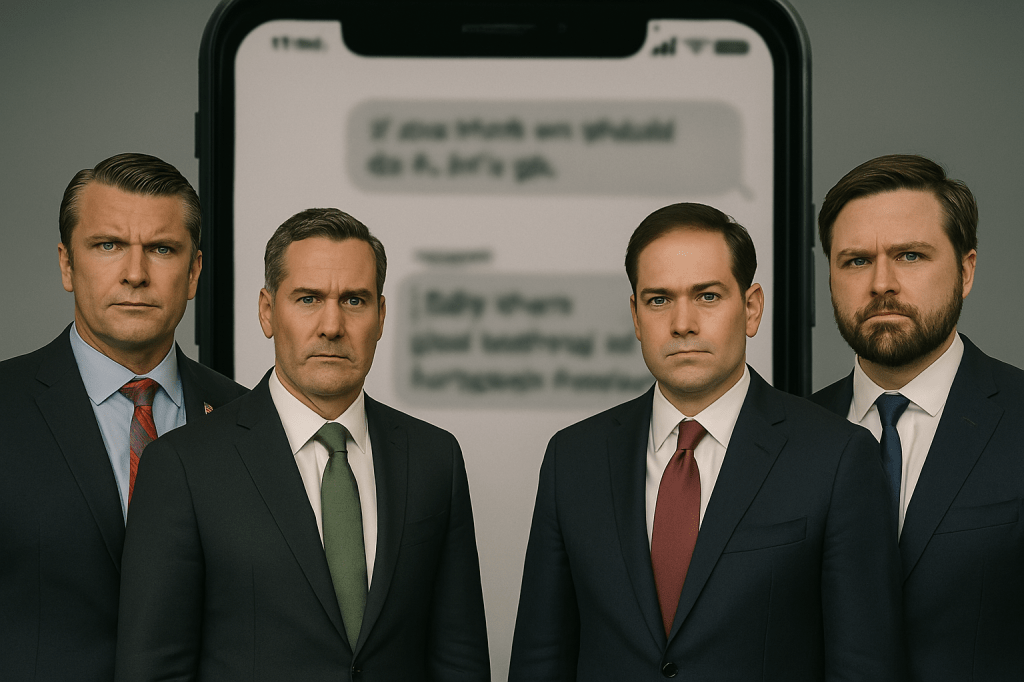
    In a moment that would be almost comedic if it weren’t so alarming, a senior U.S. official recently added The Atlantic editor-in-chief Jeffrey Goldberg to a Signal group chat intended only for top-level military and government leaders. Inside this chat, senior members of the Trump administration—including Defense Secretary Pete Hegseth, National Security Adviser Mike Waltz, Secretary of State Marco Rubio, and Vice President JD Vance—were discussing a potential military strike against Houthi rebels in Yemen. The conversation contained what most observers would consider sensitive, if not outright classified, operational information: target locations, aircraft to be deployed, weapons systems, and timelines.

    Goldberg, stunned to find himself in the virtual war room, watched silently. The officials, apparently oblivious to his presence, continued discussing military actions with astonishing candor. Later, Goldberg went public with screenshots and a narrative of the incident, sparking outrage—not just in Washington, but across Europe and the broader international community.

    This was not just a breach of digital security. It was a breach of trust. And its fallout may mark yet another turning point in the slow erosion of America’s leadership among its democratic allies.

    Europe’s Growing Frustration

    Perhaps more damaging than the operational details were the opinions shared within the chat. Vice President JD Vance was quoted saying: “If you think we should do it, let’s go. I just hate bailing Europe out again.” To which Defense Secretary Hegseth replied: “I fully share your loathing of European freeloading. It’s PATHETIC.”

    European diplomats were stunned. While allied nations often have disagreements behind closed doors, these words—blunt, dismissive, and now public—cut deep. One EU diplomat told Politico that this leak confirmed their worst fears: that these officials were not merely posturing in public, but genuinely disdainful of their European counterparts. The comment reinforced the view that the U.S., under current leadership, no longer sees NATO and other alliances as relationships of mutual respect, but as burdens it reluctantly carries.

    Former British Defense Secretary Grant Shapps and other European leaders were quick to point out that UK aircraft were directly involved in supporting U.S. operations in the region. The characterization of Europe as passive and parasitic was not only wrong—it was insulting.

    The Cracks in the Alliance Are Widening

    This diplomatic fiasco didn’t happen in a vacuum. It comes on the heels of years of shifting American foreign policy—retreats from multilateralism, trade skirmishes, and a growing isolationist sentiment among U.S. voters and officials. Allies have already begun to question whether the U.S. can still be counted on in a crisis. Now, they are wondering whether they should even try.

    The European Union has long debated the need for “strategic autonomy”—building its own defense capacities independent of the U.S. This event may give that idea a new urgency.

    The Tail and Not the Head

    From a biblical standpoint, what we are witnessing is not just a political realignment. It is a spiritual reckoning.

    In Deuteronomy 28, God outlines the blessings for obedience and the curses for disobedience directed to the descendants of Israel. Among the warnings, He said:

    “The LORD will make you the head and not the tail… if you heed the commandments of the LORD your God” (Deuteronomy 28:13).

    But if Israel disobeyed, the reverse would happen:

    “The alien who is among you shall rise higher and higher above you, and you shall come down lower and lower. He shall be the head, and you shall be the tail” (Deuteronomy 28:43–44).

    America, modern descendant of the biblical tribe of Manasseh (a son of Joseph and a branch of the house of Israel), was once clearly the “head” of the nations—a global leader, a force for order, a beacon of democratic values. But it has increasingly turned its back on God’s commandments. It celebrates what God calls sin, exalts pride over repentance, and puts national interest before divine instruction.

    This latest diplomatic debacle is a reflection of that spiritual decline. A nation that cannot keep its communications secure, that mocks its allies behind their backs, and that fails to act with humility and integrity, is not fit to lead. It is becoming the tail.

    A Warning and a Wake-Up Call

    The Signal group chat leak is more than a tech blunder or diplomatic embarrassment. It is a sign of unraveling leadership—moral, strategic, and spiritual. America’s allies are losing faith. Its adversaries are watching closely. And its citizens are left wondering how the world’s most powerful nation could stumble so carelessly.

    But Scripture shows us the way back:

    “Return to Me, and I will return to you,” says the LORD of hosts (Malachi 3:7).

    America—and indeed all modern descendants of Israel—need to humble itself, and to restore the values that once made it great.

    Until then, the head will continue to become the tail.