Tag: history

  • Is America Losing Its Role as Democracy’s Champion?

    Is America Losing Its Role as Democracy’s Champion?

    For much of the past century, the United States has stood as the “leader of the free world”, championing democracy, human rights, and freedom for oppressed peoples. From its role in defeating fascism in World War II to its Cold War stand against communism, America positioned itself as the global defender of liberty. Through institutions like Voice of America (VOA) and Radio Free Europe/Radio Liberty (RFE/RL), it broadcast the values of democracy to nations suffering under authoritarian rule.

    But that era may now be ending. The recent defunding and dismantling of U.S.-funded media organizations, the withdrawal from international alliances, and America’s inward turn under the Trump administration signal a dramatic shift. The United States is no longer the unwavering beacon of freedom it once was. And perhaps, this decline is not merely political—but something that is coming from God.

    A Nation Turning Inward: The End of Global Leadership?

    A couple of recent decisions by the U.S. government reflect a profound change in direction:

    • The Shutdown of Voice of America and Radio Free Europe/Radio Liberty – These organizations, which once brought truth to people in authoritarian regimes, are now silent due to government defunding. Without them, America no longer counters the propaganda of China, Russia, and Iran, allowing these regimes to expand their influence unchecked.
    • Retreat from Global Institutions – The Trump administration has distanced America from international organizations such as the United Nations Human Rights Council and the World Health Organization, abandoning its role in shaping global policy.

    Many are asking: Is the United States still the champion of democracy, or is it becoming another empire in decline?

    God’s Judgment on America? The Biblical Perspective

    Throughout history, God has used oppressive governments or governments that make bad choices as a form of punishment to wake up His people from spiritual complacency. When ancient Israel and Judah turned away from God—embracing corruption, injustice, and idolatry—He allowed them to have weak or oppressive leaders which eventually led them to fall into captivity under the Assyrians and Babylonians.

    Could it be that America is following the same path?

    • The removal of America’s global influence may be God’s way of humbling a nation that has turned its back on Him.
    • The rise of authoritarian regimes across the world may be a wake-up call for God’s people to realize that America’s perceived power is nothing if not from God.

    America, like ancient Israel, has been blessed beyond measure—yet it has corrupted those blessings with moral decay, materialism, and rebellion against God’s laws. The consequences are now unfolding before our eyes.

    The Rise of a New Global Leader

    As America retreats, its enemies are scrambling to fill-up the leadership vacuum it is leaving.  Ultimately, another world power is being prepared to take its place—a power that will not defend democracy or individual freedom, but will instead dominate the world through authoritarian rule.

    • China’s expanding influence in Africa, Latin America, and the South Pacific is growing unchecked.
    • Russia’s aggressive expansion in Ukraine and beyond is being met with weak resistance.
    • The European Union, long divided, may soon unite under a strong leader who will reshape the world order.

    The world is being repositioned for a new era—an era foretold in Bible prophecy, where a global empire will rise and ultimately bring about the downfall of the United States and its influence.

    Daniel 2 and Revelation 17 speak of a final world power that will dominate in the last days. This power is coming into place now. And when it fully emerges, it will not tolerate America’s dominance.

    A Time to Seek God

    This is not a time for bitter political rivalries or misguided nationalism. This is a time to seek God.

    America is being removed from its position of global leadership, just as past empires were before it. God is allowing this so that His people will wake up and turn to Him before it is too late. Let those who have ears to hear, heed the warning.
  • Eastern Europe’s Protests: A Pivot Toward the EU and Away from Russian Influence

    Eastern Europe’s Protests: A Pivot Toward the EU and Away from Russian Influence

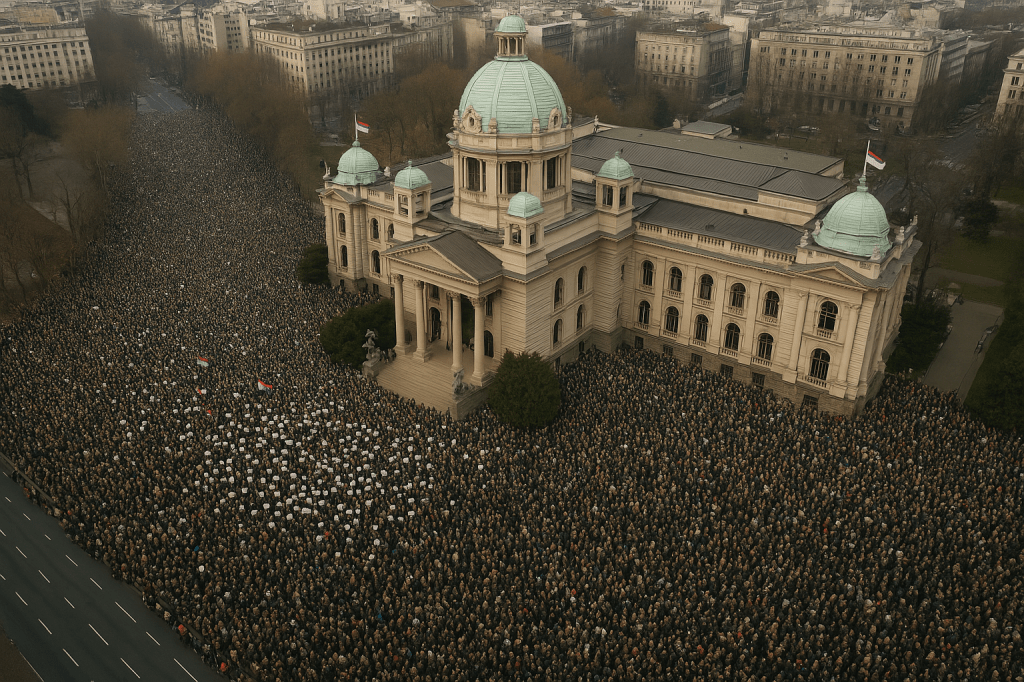
    The streets of Bratislava, Belgrade, Budapest, and Bucharest are alive with the voices of tens of thousands demanding a shift in their nations’ political trajectories. Across Slovakia, Serbia, Hungary, and Romania, citizens are rejecting the pro-Russian policies of their governments and calling for a stronger alignment with the European Union. This movement—growing in intensity—highlights a reality that runs counter to Vladimir Putin’s ambitions: rather than regaining dominance over Eastern Europe, Russia’s invasion of Ukraine has accelerated the ideological and political realignment of these nations toward Western Europe.

    The Backfiring of Putin’s Strategy

    When Russia launched its full-scale invasion of Ukraine in 2022, Putin envisioned a swift conquest that would solidify Russia’s sphere of influence and deter former Soviet and Warsaw Pact nations from deepening their ties with the EU and NATO. However, the opposite has occurred. Ukraine, once balancing between East and West, is now firmly committed to European integration. Finland and Sweden have abandoned neutrality and joined NATO, while Poland and the Baltic states have ramped up their defenses against potential Russian aggression.

    Now, the aftershocks of Russia’s aggression are manifesting in countries that were not initially on the frontlines. The recent protests in Slovakia erupted over Prime Minister Robert Fico’s overtures to Moscow. In Serbia, young demonstrators are rallying against government corruption and Russia’s influence over President Aleksandar Vučić. Romania has seen protests amid political maneuvering linked to Russian interference in its elections. Hungary, under Viktor Orbán, remains the Kremlin’s closest EU ally, yet anti-government demonstrations indicate a growing discontent with Budapest’s pro-Russian policies. These movements suggest a broader continental shift, as nations that once sat on the geopolitical fence are now tilting decisively toward Brussels and away from Moscow.

    The Historical Parallels: The Two Legs of Europe

    Interestingly, these very nations were once part of or influenced by either the Holy Roman Empire or the Byzantine Empire—two great pillars of European civilization that emerged from the division of the old Roman Empire. Slovakia and Hungary were historically connected to the Holy Roman Empire, while Serbia and Romania had ties to the Byzantine Empire.

    This historical context is striking. Europe today appears to be reconfiguring itself in ways reminiscent of its old self that is divided between the Holy Roman Empire in the west, and the Byzantine Empire in the east. These two regions have also long been shaped by the spiritual morals of the Catholic Church and Orthodox Christianity—two branches of the same faith that split centuries ago. This shared Christian heritage continues to influence their cultural and political identities, even as they navigate contemporary geopolitical shifts.

    Setting the Stage for Prophetic Fulfillment

    While these protests may not immediately result in Slovakia, Serbia, Hungary, or Romania officially pivoting toward the EU, they appear to be setting the trajectory toward a greater geopolitical realignment—one that aligns with biblical prophecy. Scripture foretells the re-emergence of a powerful entity rooted in the traditions of the Roman Empire. The Book of Daniel describes a final kingdom that will arise in the last days:

    “And the fourth kingdom shall be as strong as iron, inasmuch as iron breaks in pieces and shatters everything; and like iron that crushes, that kingdom will break in pieces and crush all the others. Whereas you saw the feet and toes, partly of potter’s clay and partly of iron, the kingdom shall be divided; yet the strength of the iron shall be in it, just as you saw the iron mixed with ceramic clay” (Daniel 2:40-41, NKJV).

    This divided kingdom, depicted in Nebuchadnezzar’s vision, symbolizes the final phase of the Roman system—comprising strong and weak elements, yet unified in a form of revived imperial authority. The protests across Eastern Europe, calling for closer ties to the EU, indicate that these nations are being pulled toward what could eventually form the prophesied final configuration of the Roman Empire.

    A Europe in Transition

    Russia’s war in Ukraine was intended to reassert Moscow’s dominance, but instead, it is accelerating Europe’s realignment along historical lines. The protests in Eastern Europe are not merely political events; they are part of a broader transformation that echoes the division of the old Roman world. Whether today’s movements will result in immediate policy shifts remains uncertain, but the trajectory is clear: countries in Eastern Europe that used to be part of, under the influence of, or had a close relationship with the old Roman Empire are moving away from Russian influence and gravitating toward a European-centered future.

    For those who understand biblical prophecy, these events provide yet another piece of the puzzle. The geopolitical restructuring we are witnessing today may well be part of the unfolding of God’s plan, leading to the re-emergence of the Roman system that will play a pivotal role in the end times.

  • America’s Reliability Crisis: NATO and Global Security Shifts

    America’s Reliability Crisis: NATO and Global Security Shifts

    For decades, the United States has been the linchpin of global security, the backbone of NATO, the chief protector of the Pacific, and the ultimate deterrent against authoritarian expansionism. However, recent developments suggest that America’s role as the world’s guardian is eroding—an erosion driven not just by political decisions, but perhaps by a deeper spiritual message that the nation must heed.

    A Pattern of Unreliability in U.S. Commitments

    The Trump administration’s handling of intelligence sharing with Ukraine has sent shockwaves through allied nations. The sudden suspension of intelligence support to Ukraine, followed by its conditional resumption, has raised concerns about America’s commitment to its allies. While Ukraine’s struggle against Russian aggression continues, the erratic nature of U.S. policy has left NATO nations questioning whether they could face a similar fate.

    European nations, sensing the volatility of U.S. policy, are now exploring alternative security arrangements. The European Union is considering expanding its military intelligence capabilities and reducing its reliance on U.S. intelligence. Countries such as France and Germany are leading discussions on an independent European military force—an idea that was once dismissed as politically infeasible but is now gaining momentum.

    In the Pacific, America’s key allies—South Korea, Taiwan, and the Philippines—are also recalibrating their defense strategies. South Korea is bolstering regional partnerships, particularly with Japan, in anticipation of a less reliable American presence. Taiwan is actively seeking multilateral security cooperation beyond the U.S., participating in joint military exercises with the Philippines and Japan. Meanwhile, the Philippines is modernizing its military and diversifying its defense partnerships, engaging countries like Australia and Canada in military agreements.

    The Breakdown of America’s Global Leadership

    This growing shift away from American reliance signals the waning of U.S. global leadership. Allies who once placed unwavering trust in Washington now see the need to hedge their bets. For decades, the U.S. thrived on the strength of its alliances, but as these alliances weaken, so too does America’s influence in global affairs.

    Historically, great empires did not fall solely due to external threats but because of internal decay. America’s reluctance or inability to maintain stable commitments to its allies mirrors the decline of past world powers. The erosion of trust in U.S. leadership is not just a political problem—it is symptomatic of deeper issues plaguing the nation.

    A Spiritual Message to America

    From a biblical perspective, national greatness is not simply a product of military strength or economic prowess—it is tied to moral and spiritual standing. The United States has long claimed to be a nation under God, but its increasing political instability, social divisions, and unreliable leadership may be signs that it is drifting further from divine favor.

    The Bible warns that nations that forget God will face decline. The book of Proverbs states,

    “Righteousness exalts a nation, but sin is a reproach to any people” (Proverbs 14:34).

    When a nation abandons righteousness, its foundations begin to crumble, and its power wanes.

    Could it be that God is allowing America’s global dominance to wane as a wake-up call? The moral compass of the nation has shifted dramatically, embracing ideologies and practices that directly contradict biblical values. At the same time, political turmoil and international distrust are rising. The weakening of U.S. leadership should not just be seen as a strategic challenge but also as a spiritual warning.

    The Path to Restoration

    If America wishes to maintain its standing as a world power, it must look beyond military alliances and strategic policies. The key to lasting strength is not just in political or economic reforms but in a national return to godly principles.

    Leaders must recognize that power without righteousness is fleeting. The nation must prioritize integrity, justice, and moral leadership if it hopes to remain a stabilizing force in the world. This requires not only changes in governance but also a revival of spiritual commitment among its people.

    America’s allies are preparing for a world where the U.S. is no longer the primary protector. If this trend continues, the United States will find itself increasingly isolated, no longer at the helm of world affairs. This should be a sobering reality for American leaders, but also an opportunity—a moment to turn back to God, to seek His guidance, and to reestablish itself as a force for good in the world.