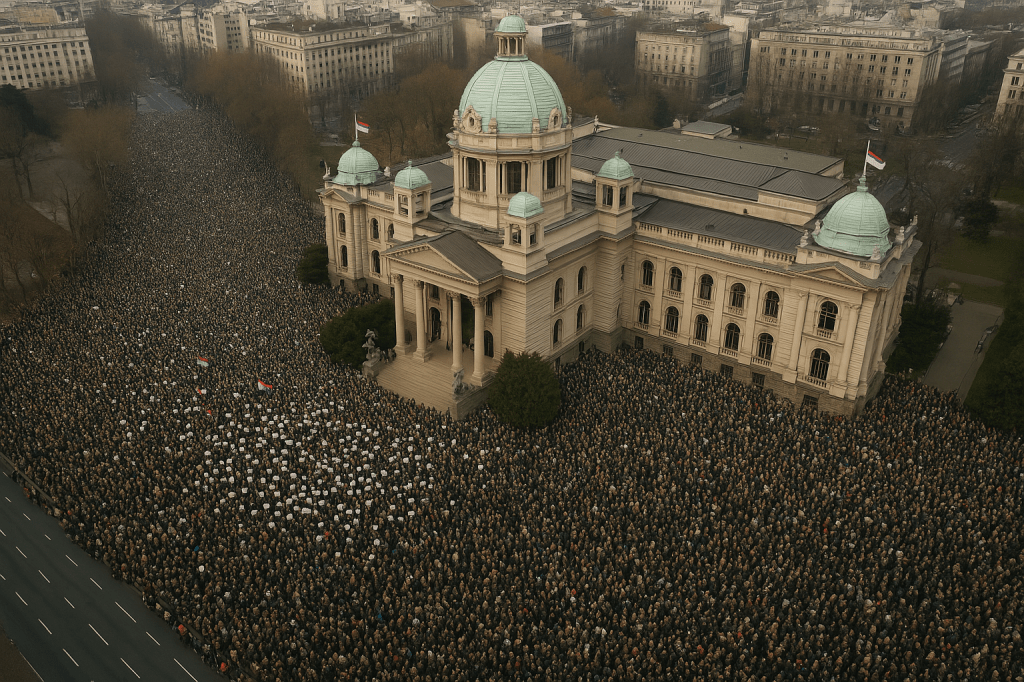
The streets of Bratislava, Belgrade, Budapest, and Bucharest are alive with the voices of tens of thousands demanding a shift in their nations’ political trajectories. Across Slovakia, Serbia, Hungary, and Romania, citizens are rejecting the pro-Russian policies of their governments and calling for a stronger alignment with the European Union. This movement—growing in intensity—highlights a reality that runs counter to Vladimir Putin’s ambitions: rather than regaining dominance over Eastern Europe, Russia’s invasion of Ukraine has accelerated the ideological and political realignment of these nations toward Western Europe.
The Backfiring of Putin’s Strategy
When Russia launched its full-scale invasion of Ukraine in 2022, Putin envisioned a swift conquest that would solidify Russia’s sphere of influence and deter former Soviet and Warsaw Pact nations from deepening their ties with the EU and NATO. However, the opposite has occurred. Ukraine, once balancing between East and West, is now firmly committed to European integration. Finland and Sweden have abandoned neutrality and joined NATO, while Poland and the Baltic states have ramped up their defenses against potential Russian aggression.
Now, the aftershocks of Russia’s aggression are manifesting in countries that were not initially on the frontlines. The recent protests in Slovakia erupted over Prime Minister Robert Fico’s overtures to Moscow. In Serbia, young demonstrators are rallying against government corruption and Russia’s influence over President Aleksandar Vučić. Romania has seen protests amid political maneuvering linked to Russian interference in its elections. Hungary, under Viktor Orbán, remains the Kremlin’s closest EU ally, yet anti-government demonstrations indicate a growing discontent with Budapest’s pro-Russian policies. These movements suggest a broader continental shift, as nations that once sat on the geopolitical fence are now tilting decisively toward Brussels and away from Moscow.
The Historical Parallels: The Two Legs of Europe
Interestingly, these very nations were once part of or influenced by either the Holy Roman Empire or the Byzantine Empire—two great pillars of European civilization that emerged from the division of the old Roman Empire. Slovakia and Hungary were historically connected to the Holy Roman Empire, while Serbia and Romania had ties to the Byzantine Empire.
This historical context is striking. Europe today appears to be reconfiguring itself in ways reminiscent of its old self that is divided between the Holy Roman Empire in the west, and the Byzantine Empire in the east. These two regions have also long been shaped by the spiritual morals of the Catholic Church and Orthodox Christianity—two branches of the same faith that split centuries ago. This shared Christian heritage continues to influence their cultural and political identities, even as they navigate contemporary geopolitical shifts.
Setting the Stage for Prophetic Fulfillment
While these protests may not immediately result in Slovakia, Serbia, Hungary, or Romania officially pivoting toward the EU, they appear to be setting the trajectory toward a greater geopolitical realignment—one that aligns with biblical prophecy. Scripture foretells the re-emergence of a powerful entity rooted in the traditions of the Roman Empire. The Book of Daniel describes a final kingdom that will arise in the last days:
“And the fourth kingdom shall be as strong as iron, inasmuch as iron breaks in pieces and shatters everything; and like iron that crushes, that kingdom will break in pieces and crush all the others. Whereas you saw the feet and toes, partly of potter’s clay and partly of iron, the kingdom shall be divided; yet the strength of the iron shall be in it, just as you saw the iron mixed with ceramic clay” (Daniel 2:40-41, NKJV).
This divided kingdom, depicted in Nebuchadnezzar’s vision, symbolizes the final phase of the Roman system—comprising strong and weak elements, yet unified in a form of revived imperial authority. The protests across Eastern Europe, calling for closer ties to the EU, indicate that these nations are being pulled toward what could eventually form the prophesied final configuration of the Roman Empire.
A Europe in Transition
Russia’s war in Ukraine was intended to reassert Moscow’s dominance, but instead, it is accelerating Europe’s realignment along historical lines. The protests in Eastern Europe are not merely political events; they are part of a broader transformation that echoes the division of the old Roman world. Whether today’s movements will result in immediate policy shifts remains uncertain, but the trajectory is clear: countries in Eastern Europe that used to be part of, under the influence of, or had a close relationship with the old Roman Empire are moving away from Russian influence and gravitating toward a European-centered future.
For those who understand biblical prophecy, these events provide yet another piece of the puzzle. The geopolitical restructuring we are witnessing today may well be part of the unfolding of God’s plan, leading to the re-emergence of the Roman system that will play a pivotal role in the end times.
