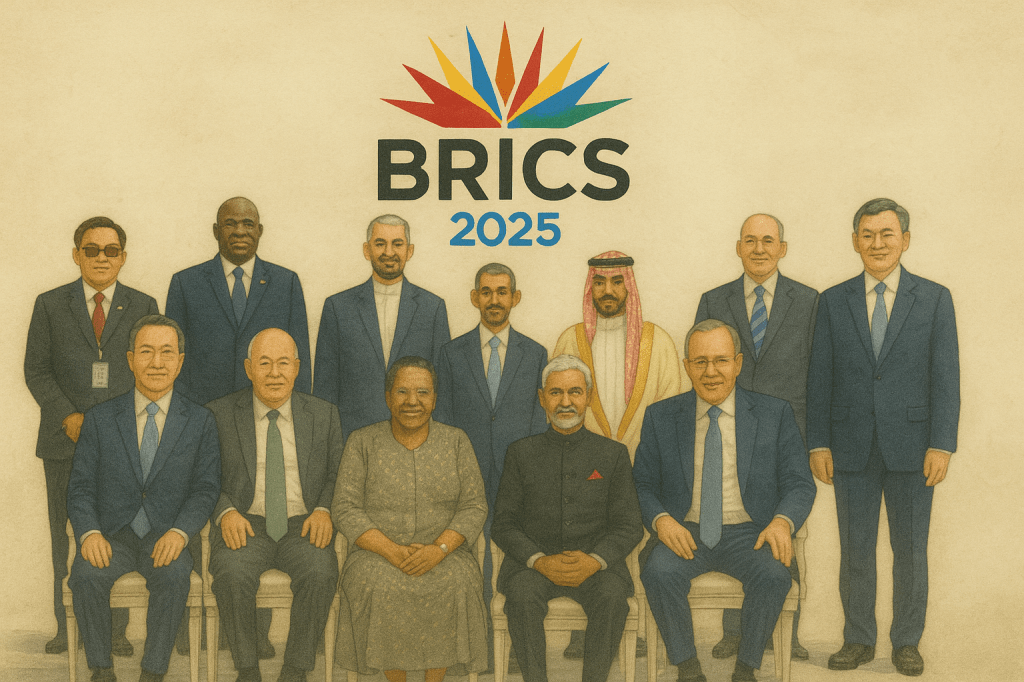
As the leaders of an expanded BRICS convene in Rio de Janeiro this July 6-7 for the 17th BRICS Summit, the world watches closely. What began in 2009 as an informal coalition of emerging economies is now growing into a geopolitical force, aiming to challenge the dominance of Western institutions like the G7, the IMF, and SWIFT.
With major issues on the table—including currency de-dollarization, cross-border payment systems, and development finance—the BRICS bloc appears more ambitious than ever.
The BRICS—originally Brazil, Russia, India, and China—held their first summit in 2009. South Africa joined the following year, completing the initial five-member alliance. Over time, BRICS built real institutional capacity, establishing the New Development Bank (NDB) and Contingent Reserve Arrangement (CRA) to promote development and economic resilience among its members.
A major expansion took place in 2023, when Egypt, Ethiopia, Iran, and the United Arab Emirates were granted full membership. Indonesia joined in early 2025, bringing the group to eleven. With ongoing interest from countries like Vietnam, Bangladesh, and Argentina, BRICS is quickly turning from a bloc into a movement.
BRICS’ accomplishments over the last 16 years include:
- Financial Infrastructure: The NDB has funded more than $30 billion in development projects, while the CRA provides a $100 billion reserve pool to guard against financial crises.
- Alternative Payment Systems: With growing distrust of Western-dominated platforms like SWIFT, BRICS members have begun developing BRICS Pay, a decentralized payment messaging system allowing trade in local currencies.
- Strategic Partnerships: Dozens of working groups and institutions now foster cooperation on energy, health, digital governance, and more—advancing what some have called a new “Global South consensus.”
Despite progress, the Rio 2025 summit reveals fault lines:
- Leadership Absences: Neither Xi Jinping nor Vladimir Putin is attending in person. Putin faces travel limitations due to international sanctions, and Xi reportedly cited scheduling conflicts. Their absence reflects the bloc’s internal tensions.
- Ideological Divide: While nations like Iran and Russia advocate a confrontational stance toward the West, others like India, Brazil, and Indonesia prefer a more balanced approach. This divergence hampers consensus on issues like UN reform, Ukraine, and Gaza.
- Competing Interests: India’s growing ties with Western powers contrast with China’s ambitions, and Brazil, the host nation, has tried to focus this year’s agenda on neutral topics like climate finance, AI governance, and healthcare.
With 11 member nations representing over 40% of global GDP (PPP) and more than half the world’s population, BRICS is no longer a marginal force. It’s now a serious contender in shaping global governance.
Key differences with the G7 include:
- Development Focus: While G7 prioritizes legacy institutions like the IMF and World Bank, BRICS centers its efforts on flexible South-South cooperation.
- Financial Sovereignty: Tools like BRICS Pay and the NDB enable countries to bypass traditional Western financial systems.
- Multipolar Vision: BRICS advocates for a more equitable world order, with power shared among emerging and developing nations—not monopolized by the West.
After Russia’s invasion of Ukraine in 2022, Western sanctions cut off many Russian banks from the SWIFT network. In response, Russia turned to:
- SPFS: Its own financial messaging system.
- Bilateral Trade Deals: Using rubles, yuan, and other local currencies with BRICS members.
- BRICS Pay: A system still in early rollout but with growing support. China, Brazil, and Iran have all agreed to increase usage in 2025.
Though not yet a global replacement for SWIFT, BRICS Pay offers a real alternative for countries under sanctions—laying the groundwork for a parallel financial system.
If BRICS can overcome its divisions, the economic integration of Russia, India, and China could mark the emergence of a powerful Eastern economic bloc. With joint development banks, currency swaps, and shared digital platforms, this bloc would rival any Western alliance economically and geopolitically.
Such a scenario aligns with what many Bible students interpret as an end-time prophecy: an Eastern power—“kings from the East”—rising to challenge a revived Roman Empire (see Revelation 16:12).
The BRICS summit in Rio showcases both promise and peril. Its expansion, financial innovation, and strategic agenda give it the tools to build a new world order. But internal rivalries, absent leaders, and divergent visions threaten to stall momentum.
Still, if BRICS succeeds, it won’t just change economics. It could reshape the balance of global power—perhaps even fulfilling ancient biblical prophecies about a world divided between East and West in the final days before Christ’s return.
