Tag: Israel

  • After Khamenei: A Shifting Middle East — and a Merciful Pause

    After Khamenei: A Shifting Middle East — and a Merciful Pause

    The death of Ali Khamenei, Iran’s Supreme Leader for more than three decades, marks one of the most consequential turning points in the modern Middle East.

    For over 30 years, Khamenei stood at the center of Iran’s political, military and ideological system. Under his leadership, Iran projected influence far beyond its borders — not primarily through conventional armies, but through networks of allied movements and militias stretching from Lebanon to Yemen.

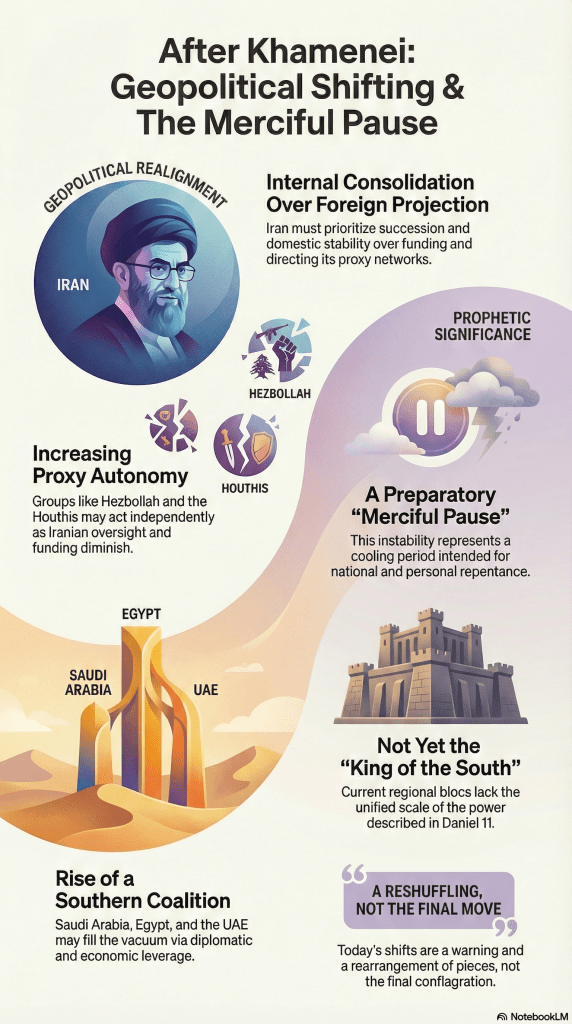
    Now, with the supreme office suddenly vacant, Iran faces an urgent priority: consolidate power at home before it can project power abroad.

    And that shift could reshape the entire region.

    Consolidation Before Projection

    Iran’s constitutional system provides mechanisms for succession, but mechanisms do not guarantee stability. The leadership must:

    • Prevent factional infighting
    • Assure the loyalty of the security establishment
    • Stabilize the economy under continuing sanctions
    • Demonstrate continuity to both citizens and regional allies

    In moments like this, governments historically turn inward. External adventures become secondary to internal consolidation.

    If Tehran’s new leadership must “fix its own backyard,” its ability to coordinate, fund and strategically direct its proxy network may weaken — at least temporarily.

    And when a patron weakens, its partners adjust.

    Proxies With Their Own Agendas

    Iran’s influence has long rested on relationships with groups such as Hezbollah, Hamas, elements within Iraq’s Popular Mobilization Forces, and the Houthis.

    These movements are aligned with Tehran — but they are not identical to it.

    Each has:

    • Local political ambitions
    • Domestic constituencies
    • Independent command structures
    • Survival instincts

    If Iran becomes less capable of sustained funding, weapons transfers or strategic oversight, these groups may act more autonomously. Some could even explore pragmatic accommodation with a rising regional power — especially if that power offers economic lifelines, political legitimacy or security guarantees.

    Loyalty in geopolitics is often proportional to usefulness.
    Who Could Seize the Moment?

    No single country is positioned to replace Iran outright. But a coalition could gradually dilute its influence.

    A likely axis would involve:

    • Saudi Arabia — financial muscle and leadership ambition
    • Egypt — demographic weight and institutional legitimacy
    • United Arab Emirates — strategic agility and economic reach
    • Possibly coordination with Israel on security matters

    Such cooperation would not mirror Iran’s militia-based model. Instead, it would compete through:

    • Investment and reconstruction
    • Diplomatic integration
    • Regional security frameworks
    • Energy and trade leverage

    If these states coordinate effectively, they could nudge Iran out of its dominant regional position, not by destroying it outright, but by reshaping the incentive structure around it.

    History shows that influence is rarely erased overnight. It erodes.

    But This Is Not Yet the “King of the South”

    For students of prophecy, the question naturally arises: Is this the emergence of the end-time “king of the south” described in Daniel 11?

    The Bible describes a southern power strong enough to “push” at a northern superpower — one modeled prophetically after the Holy Roman Empire (Daniel 11:40).

    Whatever bloc may eventually form in the Middle East, it has not yet reached that scale of consolidated power.

    The present shifts are significant — but they are preparatory, not final.

    No regional coalition today has the unified military, ideological cohesion, and strategic boldness described in prophecy as capable of directly challenging the coming European-centered power.

    That stage is still developing.

    A Merciful Interval

    There is another dimension often overlooked.

    When long-standing powers weaken, instability usually follows. Yet Scripture shows that God governs the rise and fall of nations (Daniel 2:21).

    If Iran’s regional reach diminishes now, it may represent something more than geopolitical recalibration.

    It may be a merciful pause.

    A pause before rival end-time powers fully mature.

    A pause before the final configuration described in prophecy brings humanity to the brink of self-destruction (Matthew 24:21–22).

    The Middle East has long been a furnace of rivalry. But what we may be witnessing is not yet the final conflagration — rather, a temporary cooling that gives space for repentance.

    God does not delight in chaos. He allows time.

    Time to reflect.

    Time to reconsider national and personal direction.

    Time to turn back to Him before the final sequence unfolds.

    Watching the Horizon

    Iran’s leadership now turns inward. Its proxies weigh their options. Regional states assess opportunity. Coalitions quietly form.

    But prophecy reminds us: today’s rearrangements are not the end of the story.

    The “king of the south” is yet to rise to full stature. The northern power it confronts is not yet fully revealed.

    What we see now may be a reshuffling of pieces on the board — not the final move.

    And in that reshuffling, we see both warning and mercy.

    We continue to watch.

  • The Lion Strikes: How Israel’s Offensive Against Iran Could Pave the Way for Another Power in the Middle East

    The Lion Strikes: How Israel’s Offensive Against Iran Could Pave the Way for Another Power in the Middle East

    In a dramatic development, Israel has launched a targeted and far-reaching strike on Iranian nuclear and military infrastructure. The operation—striking key facilities such as Natanz and Fordow, and eliminating several of Iran’s top nuclear scientists—delivers a significant blow to Tehran’s ambition to become a nuclear power.

    These attacks are not only crippling Iran’s scientific and military capabilities but are also signaling a shift in the Middle East’s balance of power. Israel, perceiving a nuclear-armed Iran as an existential threat, has acted decisively to delay or dismantle what it views as an imminent danger. In doing so, Israel has likely bought itself time—perhaps even years—of relative security from a nuclear threat originating from Iran.

    However, these events may have a broader prophetic consequence. As Iran’s ability to wield the ultimate weapon of mass destruction gets postponed, and its ability to project power wanes as Israel brings the war into its doorstep, it could open the door for a new Islamic power to rise—not rooted in Elam (ancient Iran), but in the Arab world. Iran, whose ancient name in the Bible is Elam (Genesis 10:22; Jeremiah 49:34–39), may find its dominance eclipsed by a coalition of Arab nations, leading to the emergence of a different kind of power bloc in the Middle East.

    According to Daniel 11, a “king of the South” will arise south of Israel in the end time—a national or regional power bloc that will challenge the “king of the North”, a revived Roman Empire based in Europe. When this king of the South attacks, the king of the North will launch a swift and devastating counterattack (Daniel 11:40).

    The biblical details in Daniel 11:42–43 tell us more:

    “He shall stretch out his hand against the countries, and the land of Egypt shall not escape. He shall have power over the treasures of gold and silver, and over all the precious things of Egypt; also the Libyans and Ethiopians shall follow at his heels.”

    This strongly indicates that Egypt, Libya, and possibly other Arab nations will comprise or support the king of the South. These are not Persian or Elamite nations, but nations from the Arab world—suggesting that by the time this prophecy is fulfilled, Iran will no longer be a dominant player in Middle Eastern affairs.

    This fits perfectly with Jeremiah 49, which foretells judgment upon Elam, stating that God would “break the bow of Elam” and scatter its people. Yet the prophecy does not end there. In verse 39, God declares:

    “But it shall come to pass in the latter days: I will bring back the captives of Elam,” says the Lord.

    Though Iran may be humbled in coming years, God will not forget its people. In the Millennial reign of Jesus Christ, the people of Elam—Iran—will be restored to their land and brought under God’s righteous government. They will no longer be instruments of aggression, but citizens of a world at peace.

    The current Israeli-Iranian conflict, therefore, may be far more than a military standoff—it may be a prophetic transition, marking the decline of Elam’s influence and preparing the stage for the final alignment of nations described in the Bible. As one Islamic power fades, another rises. But above all, the ultimate resolution lies not in human alliances or military might, but in the coming Kingdom of God, where all nations—including Iran—will be restored under the leadership of Jesus Christ.

  • Trump’s Proposal for a U.S. Takeover of Gaza: A Bold Move or a Risky Gamble?

    Trump’s Proposal for a U.S. Takeover of Gaza: A Bold Move or a Risky Gamble?

    President Donald Trump has never been one to shy away from bold, unconventional proposals. His latest idea—suggesting that the United States take control of Gaza—has sparked intense debate across the international community. Framing it as a part of his broader vision for Middle East peace, Trump envisions transforming the war-torn region into a prosperous economic hub. However, the reactions from U.S. allies, Middle Eastern nations, and global organizations indicate that this proposal faces significant hurdles. Even if a modified version of the plan emerges, history has shown that true and lasting peace in the Middle East will not be achieved by human efforts but only by the return of Jesus Christ.

    The Motivation Behind the Proposal

    Trump’s rationale for proposing a U.S. takeover of Gaza seems to be rooted in both security and economic ambitions. He argues that a stable and economically vibrant Gaza would reduce regional tensions, eliminate Hamas’ control, and provide a pathway for long-term peace. He has even described the vision of a transformed Gaza as the “Riviera of the Middle East,” suggesting that with the right investments, the region could become a thriving center of commerce and tourism.

    The plan also aligns with Trump’s broader Middle East strategy of using economic incentives to drive political stability. His previous policies, including the Abraham Accords, relied on economic cooperation between Israel and Arab states as a stepping stone toward peace. By taking direct control of Gaza, Trump likely hopes to fast-track reconstruction efforts and create an environment where extremist groups can no longer operate.

    Reactions from America’s Allies and the Middle East

    Despite Trump’s ambitions, his proposal has been met with swift opposition from U.S. allies and key players in the Middle East.

    • Middle Eastern Nations: Countries like Egypt, Jordan, and Saudi Arabia have firmly rejected the idea of relocating Palestinians as part of the plan, calling it a violation of Palestinian sovereignty. These nations, which have historically played a role in mediating between Israel and the Palestinians, are wary of any initiative that could lead to long-term instability.
    • International Community: The United Nations and European Union have also raised concerns, warning that any forced relocation of Palestinians could constitute ethnic cleansing. Additionally, there are fears that a U.S. military presence in Gaza would escalate tensions with Iran and its proxies, including Hezbollah.
    • American Political Landscape: Even within the U.S., the idea of assuming direct control over Gaza is deeply controversial. Many lawmakers, including both Democrats and some Republicans, argue that such a move could entangle the U.S. in another prolonged conflict with no clear exit strategy.

    A Modified Version of the Proposal?

    Given the fierce opposition, it is possible that Trump will push for a modified version of his proposal rather than a direct U.S. takeover. Some potential adjustments might include:

    1. An International Coalition for Gaza’s Reconstruction – Instead of direct U.S. control, Trump could propose a coalition of nations, including Arab states and European allies, to oversee Gaza’s rebuilding process.
    2. Temporary UN-Led Administration – A transitional governing body under UN oversight could administer Gaza while infrastructure and economic development take place.
    3. Economic Investment Zones – Trump could shift the narrative from a political takeover to an economic revitalization plan, similar to his previous “Peace to Prosperity” initiative.
    4. Security Cooperation Without Full Control – The U.S. might establish security zones in partnership with Israel and moderate Palestinian factions to ensure that Hamas and other militant groups do not re-emerge.

    While these modifications may make the plan more feasible, deep-rooted conflicts in the region make any man-made solution inherently unstable.

    The Only True and Lasting Peace

    The Middle East has long been the focus of peace initiatives, negotiations, and diplomatic deals, yet true and lasting peace remains elusive. Whether through the Camp David Accords, the Oslo Accords, or the Abraham Accords, every effort to resolve the conflict has eventually encountered significant obstacles. Even if Trump or any other leader were to implement a successful political or economic framework, it would still be subject to the volatility of human nature and geopolitical struggles.

    The Bible makes it clear that true peace will only come when Jesus Christ returns to establish His Kingdom. Isaiah 9:6-7 speaks of Christ as the “Prince of Peace,” whose government will bring justice and righteousness that will never end. Zechariah 14 describes how Christ will return to Jerusalem and establish a reign of peace that will finally unify the nations.

    While leaders like Trump may have grand visions for peace in the Middle East, history has shown that human efforts are limited. The only perfect and permanent solution will come when Christ returns to rule from Jerusalem, bringing true justice, prosperity, and reconciliation to all people.

    President Trump’s proposal to take over Gaza is yet another ambitious attempt to reshape the Middle East, but it faces significant opposition and practical challenges. Even if a modified version emerges, history suggests that human solutions will always fall short of bringing lasting peace to this troubled region. The ultimate resolution to the Middle East conflict—and indeed, to all conflicts—will come when Jesus Christ establishes His righteous government. Until then, world leaders will continue to try and fail, proving once again that true peace is something only God can bring.