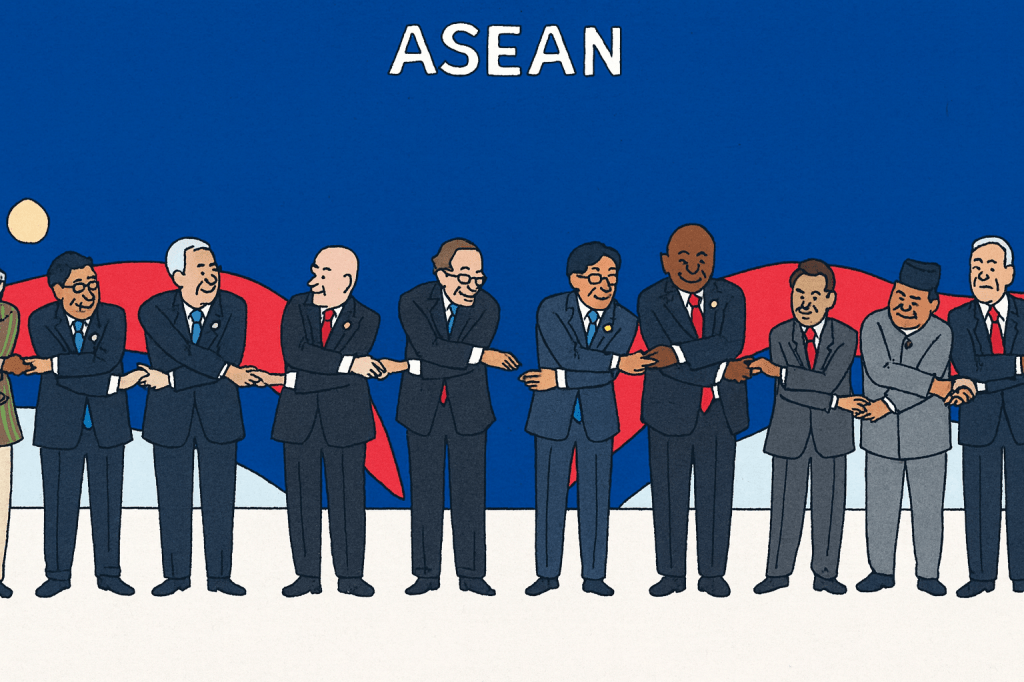
At this week’s 47th ASEAN Summit in Kuala Lumpur, Southeast Asian leaders made history by admitting Timor-Leste as the bloc’s 11th member. The event was hailed as proof of ASEAN’s expanding influence and its ongoing pursuit of peace and cooperation in a turbulent world. A cease-fire between Thailand and Cambodia and new trade deals with the United States further underlined ASEAN’s role as a stabilizing hub of dialogue and development.
But beneath the celebrations lies a sober reality: ASEAN’s peace rests on a diplomatic balancing act, not on collective security. While the association’s economic agenda has propelled Southeast Asia into one of the world’s most dynamic regions, its inward-looking approach to defense leaves it vulnerable in an era of resurgent great-power rivalry.
A Peaceful but Fragile Community
Since its founding in 1967, ASEAN’s strength has been its ability to prevent conflict among its members. The so-called “ASEAN Way”—non-interference, consensus, and quiet diplomacy—has kept the region largely free of war for over half a century.
Yet ASEAN was never designed to repel outside threats. It has no mutual-defense clause, no unified military command, and no mechanism to counter external coercion. When it comes to the South China Sea, for instance, the bloc prefers cautious negotiation over confrontation—even as China builds up its presence and influence in the area.
This makes ASEAN, for all its internal stability, strategically exposed. Economically dependent on trade with both East and West, it must walk a fine line between competing powers. Should a powerful Asian coalition ever emerge—one that could project force across the region—ASEAN might find itself drawn into the orbit of that greater power rather than standing apart from it.
The Prophetic Horizon
Students of Bible prophecy find these developments worth watching. In the book of Revelation, the apostle John saw the rise of “the kings from the east,” whose forces would number “two hundred million” (Revelation 9:16; 16:12). Many have long understood this to refer to a great eastern bloc—perhaps involving China, Russia, and other Asian powers—that will play a decisive role in end-time events.
If such a coalition were to take shape, the nations of Southeast Asia—peace-oriented, economically tied to the East, and lacking collective defense—could easily fall under its sway. The process may not come through invasion, but through alignment, dependency, and integration within a broader eastern framework.
A Lesson in Where Security Truly Lies
Scripture reminds us that “He changes the times and the seasons; He removes kings and raises up kings” (Daniel 2:21). Nations rise and fall according to God’s purpose, moving the world toward the fulfillment of His plan.
ASEAN’s diplomacy, admirable in its pursuit of harmony, shows humanity’s longing for peace—but peace built solely on negotiation and trade remains fragile. Lasting security, the Bible teaches, comes not from neutrality or economic interdependence but from righteous leadership under God’s law:
“The work of righteousness will be peace, and the effect of righteousness, quietness and assurance forever.” — Isaiah 32:17 (NKJV)
As Southeast Asia grows in prominence, its people and leaders would do well to remember that true peace will not come from east or west, but from the soon-coming Prince of Peace who will establish justice among all nations.
