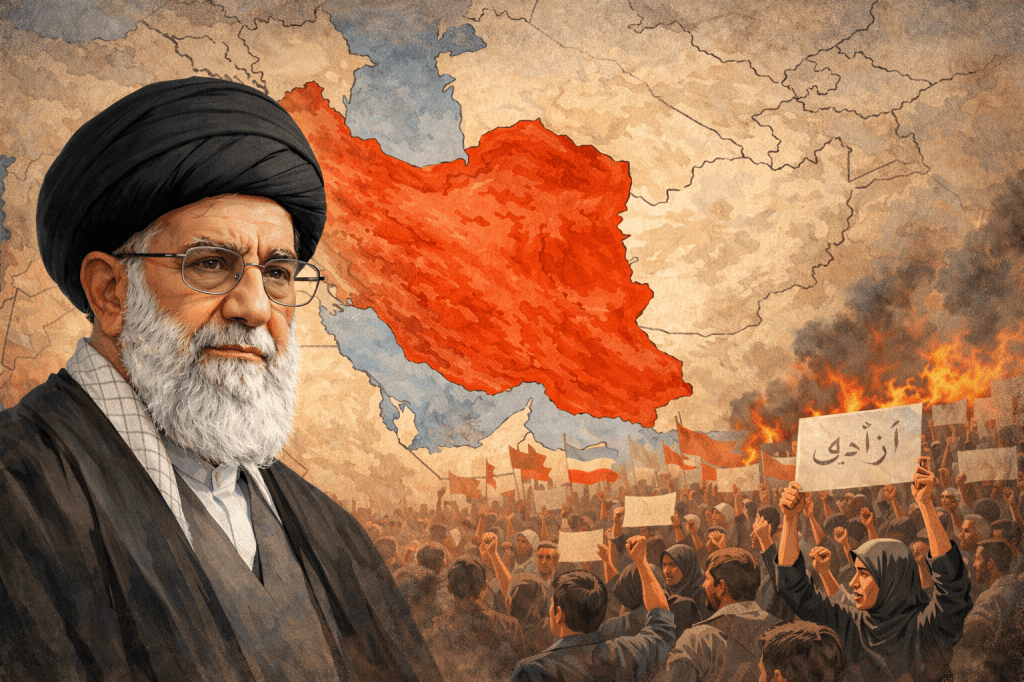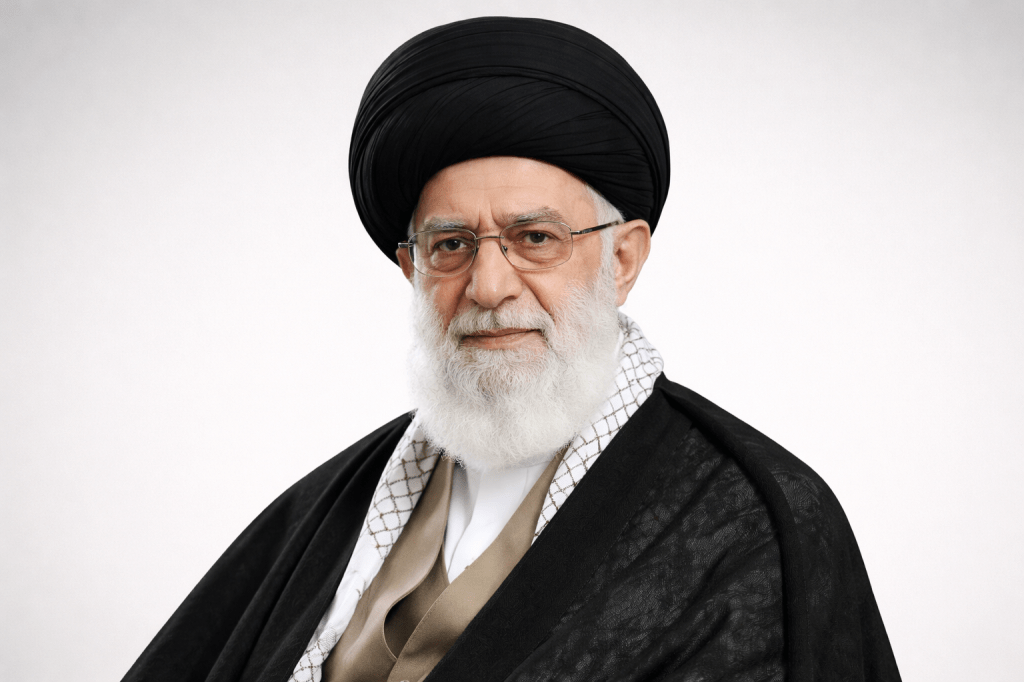
The death of Ali Khamenei, Iran’s Supreme Leader for more than three decades, marks one of the most consequential turning points in the modern Middle East.
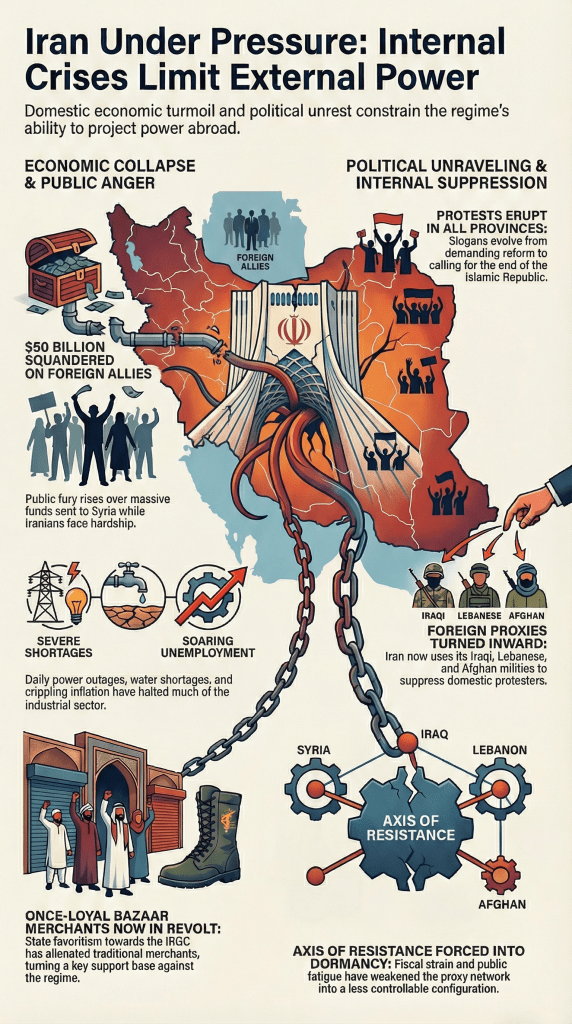
For over 30 years, Khamenei stood at the center of Iran’s political, military and ideological system. Under his leadership, Iran projected influence far beyond its borders — not primarily through conventional armies, but through networks of allied movements and militias stretching from Lebanon to Yemen.
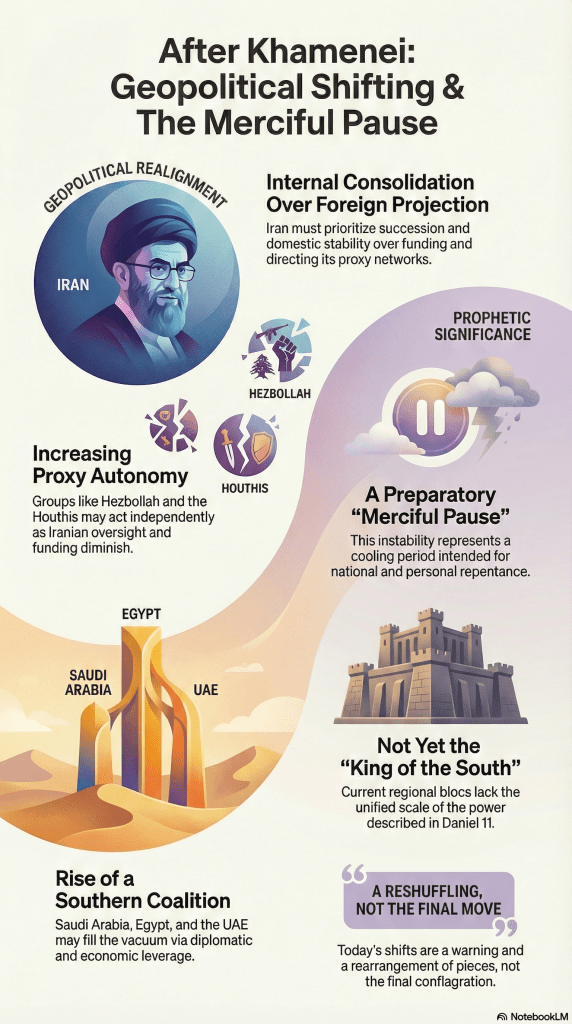
Now, with the supreme office suddenly vacant, Iran faces an urgent priority: consolidate power at home before it can project power abroad.
And that shift could reshape the entire region.
Consolidation Before Projection
Iran’s constitutional system provides mechanisms for succession, but mechanisms do not guarantee stability. The leadership must:
- Prevent factional infighting
- Assure the loyalty of the security establishment
- Stabilize the economy under continuing sanctions
- Demonstrate continuity to both citizens and regional allies
In moments like this, governments historically turn inward. External adventures become secondary to internal consolidation.
If Tehran’s new leadership must “fix its own backyard,” its ability to coordinate, fund and strategically direct its proxy network may weaken — at least temporarily.
And when a patron weakens, its partners adjust.
Proxies With Their Own Agendas
Iran’s influence has long rested on relationships with groups such as Hezbollah, Hamas, elements within Iraq’s Popular Mobilization Forces, and the Houthis.
These movements are aligned with Tehran — but they are not identical to it.
Each has:
- Local political ambitions
- Domestic constituencies
- Independent command structures
- Survival instincts
If Iran becomes less capable of sustained funding, weapons transfers or strategic oversight, these groups may act more autonomously. Some could even explore pragmatic accommodation with a rising regional power — especially if that power offers economic lifelines, political legitimacy or security guarantees.
Loyalty in geopolitics is often proportional to usefulness.
Who Could Seize the Moment?
No single country is positioned to replace Iran outright. But a coalition could gradually dilute its influence.
A likely axis would involve:
- Saudi Arabia — financial muscle and leadership ambition
- Egypt — demographic weight and institutional legitimacy
- United Arab Emirates — strategic agility and economic reach
- Possibly coordination with Israel on security matters
Such cooperation would not mirror Iran’s militia-based model. Instead, it would compete through:
- Investment and reconstruction
- Diplomatic integration
- Regional security frameworks
- Energy and trade leverage
If these states coordinate effectively, they could nudge Iran out of its dominant regional position, not by destroying it outright, but by reshaping the incentive structure around it.
History shows that influence is rarely erased overnight. It erodes.
But This Is Not Yet the “King of the South”
For students of prophecy, the question naturally arises: Is this the emergence of the end-time “king of the south” described in Daniel 11?
The Bible describes a southern power strong enough to “push” at a northern superpower — one modeled prophetically after the Holy Roman Empire (Daniel 11:40).
Whatever bloc may eventually form in the Middle East, it has not yet reached that scale of consolidated power.
The present shifts are significant — but they are preparatory, not final.
No regional coalition today has the unified military, ideological cohesion, and strategic boldness described in prophecy as capable of directly challenging the coming European-centered power.
That stage is still developing.
A Merciful Interval
There is another dimension often overlooked.
When long-standing powers weaken, instability usually follows. Yet Scripture shows that God governs the rise and fall of nations (Daniel 2:21).
If Iran’s regional reach diminishes now, it may represent something more than geopolitical recalibration.
It may be a merciful pause.
A pause before rival end-time powers fully mature.
A pause before the final configuration described in prophecy brings humanity to the brink of self-destruction (Matthew 24:21–22).
The Middle East has long been a furnace of rivalry. But what we may be witnessing is not yet the final conflagration — rather, a temporary cooling that gives space for repentance.
God does not delight in chaos. He allows time.
Time to reflect.
Time to reconsider national and personal direction.
Time to turn back to Him before the final sequence unfolds.
Watching the Horizon
Iran’s leadership now turns inward. Its proxies weigh their options. Regional states assess opportunity. Coalitions quietly form.
But prophecy reminds us: today’s rearrangements are not the end of the story.
The “king of the south” is yet to rise to full stature. The northern power it confronts is not yet fully revealed.
What we see now may be a reshuffling of pieces on the board — not the final move.
And in that reshuffling, we see both warning and mercy.
We continue to watch.