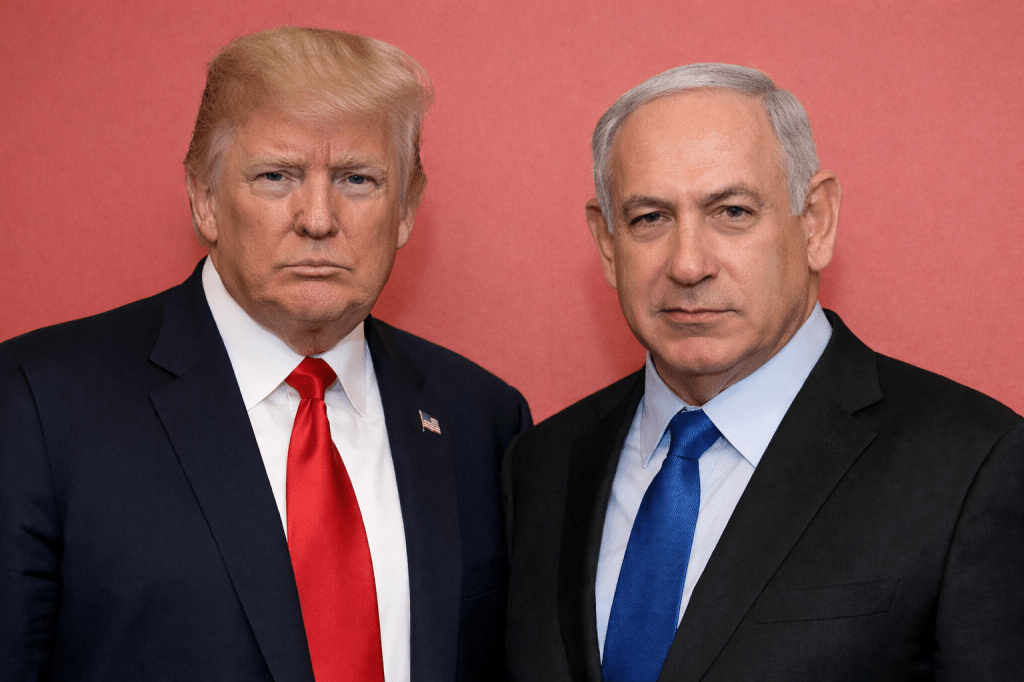
The present military strikes by the United States and Israel against Iran mark one of the most serious escalations in the Middle East in recent years. While immediate headlines focus on missile exchanges, air defenses, and retaliatory threats, the longer-term implications may prove even more significant.
Beyond the battlefield damage, these strikes are likely to further weaken Iran’s ability to directly project power across the region. And in doing so, they may begin to reshape the balance of influence in ways that are prophetically noteworthy.
Iran’s Diminishing Reach
For decades, Iran has extended its influence not primarily through conventional armies crossing borders, but through indirect power — training, funding, and arming proxy groups throughout Lebanon, Syria, Iraq, Yemen, and Gaza. This strategy allowed Tehran to exert regional leverage without inviting full-scale war.
However, sustained military pressure changes that equation.
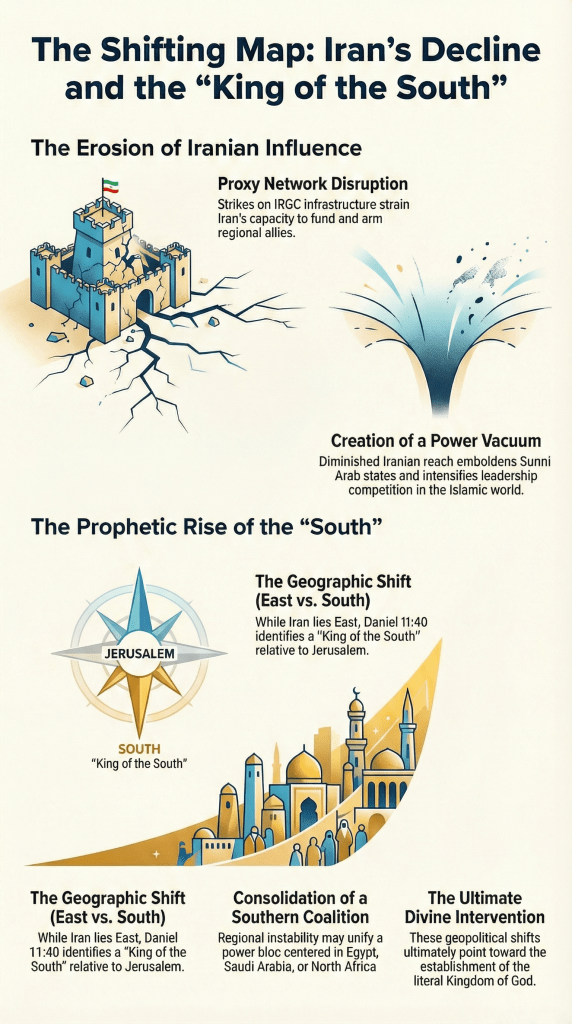
Strikes that target military infrastructure, command networks, weapons production, and elements tied to the Islamic Revolutionary Guard Corps inevitably strain Iran’s logistical capacity. Even if the Iranian government remains in power, its ability to fund, arm, and coordinate its regional allies may be reduced. Economic strain from sanctions combined with military losses compounds this effect.
In short, whether the current campaign is brief or prolonged, it is likely to further weaken Iran’s direct and indirect power projection.
And when a dominant regional player weakens, a vacuum can form.
A Possible Power Vacuum in the Islamic World
Iran is a Persian, Shiite-majority nation and has never represented the entire Islamic world. In fact, much of the Sunni Arab world has historically viewed Iranian expansion with suspicion.
If Iran’s influence diminishes significantly, several possibilities emerge:
- Sunni Arab states may feel less constrained and more emboldened.
- Regional alliances among Arab nations could deepen.
- Leadership competition within the Islamic world could intensify.
- A stronger southern regional bloc could begin to consolidate.
Geographically speaking, Iran lies east of Israel. But the Bible speaks of a power south of Jerusalem rising at the time of the end.
This distinction is important.
The Prophetic Dimension: The “King of the South”
The book of Daniel provides remarkable insight into geopolitical developments surrounding the Holy Land. Historically, Daniel 11 describes conflicts between northern and southern powers relative to Jerusalem.
In its end-time setting, Daniel 11:40 (NKJV) states:
“At the time of the end the king of the South shall attack him; and the king of the North shall come against him like a whirlwind…”
The geographic reference point throughout the chapter is Jerusalem.
In earlier historical fulfillments, the “king of the South” referred to rulers based in Egypt. Many prophetic interpretations have long understood that a future southern power — located south of Jerusalem — will again rise and play a major role shortly before the return of Jesus Christ.
Iran does not fit that geographic description. It lies to the east.
But if Iran’s regional weight declines, could this open the door for another southern coalition — perhaps centered in Egypt, Saudi Arabia, or a broader North African-Arab alignment — to rise in prominence?
It is not difficult to envision such a development under conditions of crisis. History shows that instability often accelerates consolidation. War, economic distress, or perceived external threats can unify previously fragmented nations.
Right now, the Islamic world is divided along ethnic, political, and sectarian lines. But circumstances can change rapidly.
Watching Without Speculating
We must be careful not to jump to premature conclusions. Prophetic fulfillment often occurs through sudden realignments rather than gradual shifts. No present nation or leader should be hastily labeled as a final fulfillment.
Yet we also should not ignore directional trends.
If Iran weakens significantly, and if another regional power south of Jerusalem begins to consolidate influence — especially in opposition to a northern power — that would align remarkably with the biblical pattern described in Daniel.
The Bible does not give these prophecies to satisfy curiosity, but to provide perspective and warning.
The Greater Lesson
While geopolitical analysis is important, prophecy ultimately points beyond political maneuvering to something far greater: the coming literal rule of Jesus Christ over this earth.
Daniel’s prophecies culminate not in endless war, but in divine intervention.
The same book that describes the clash of kings also foretells the establishment of God’s Kingdom:
“And in the days of these kings the God of heaven will set up a kingdom which shall never be destroyed…” (Daniel 2:44, NKJV)
Events in the Middle East should not merely provoke strategic interest — they should stir spiritual reflection.
The volatility of nations underscores the certainty of God’s word.
Power rises. Power falls. Alliances shift. But the prophetic outline remains intact.
A Call to Watch — and to Return
Christ instructed His followers to “watch” world events. Not in fear, but in awareness. Not in speculation, but in faith.
The Middle East remains the central stage of biblical prophecy. As developments unfold — including the weakening of established powers and the potential emergence of new ones — we should observe carefully.
More importantly, we should examine ourselves.
The approaching fulfillment of prophecy is not simply about geopolitics; it is about repentance, readiness, and renewal. God’s exhortation has not changed. He calls individuals and nations alike to return to Him.
The rise and fall of regional powers ultimately point to the only lasting government — the Kingdom of God under the rule of Jesus Christ.
As the world grows more unstable, that hope grows nearer.
