As the war in Ukraine grinds on, U.S. President Donald Trump has unveiled a controversial peace proposal aimed at ending the conflict. His plan includes recognition of Russia’s annexation of Crimea, acceptance of Russian control over other occupied Ukrainian territories, a permanent block on Ukraine joining NATO, and the lifting of Western sanctions on Russia. The goal, Trump argues, is to “stop the killing” and restore stability.
But peace at this price is proving unacceptable—not just to Ukraine, but to much of Europe.
Why Ukraine Won’t Accept It
Ukrainian President Volodymyr Zelensky has remained firm: Crimea and the occupied territories are sovereign Ukrainian land. To accept this deal would violate Ukraine’s constitution, dishonor the memory of its fallen defenders, and reward aggression. As Zelensky bluntly put it, “This is our territory, the territory of the people of Ukraine.” No peace can be built on a foundation of surrender and injustice.
Why Europe Is Alarmed
European leaders are also rejecting the Trump plan. To them, it’s not peace—it’s appeasement. Recognizing territorial conquest sets a dangerous precedent in a continent scarred by war. EU officials warn that such a deal could “kill EU unity,” weaken NATO, and embolden future acts of aggression. By sidelining European voices and values, the proposal risks fracturing the Western alliance.
A World Without Shared Values
Trump’s plan, if implemented, will not produce peace. It will shift global dynamics. Europe is already moving toward greater strategic autonomy—asserting itself more forcefully in defense and diplomacy. The U.S., meanwhile, is at risk of forfeiting its global leadership—not due to a lack of military power, but from a growing disconnect with the moral compass of its democratic allies.
The Bible reminds us, “Can two walk together unless they are agreed?” (Amos 3:3). True peace, like true partnership, requires shared values—not just shared interests. Trump’s peace deal fails that test. And the world is watching.
After months of aggressive tariffs targeting Chinese goods, the U.S. has reversed course—partially rolling back some of the very tariffs it once defended as “necessary pain.” The reason? Mounting economic pressure, international backlash, and rising consumer costs at home.
Yet this isn’t just about tariffs. It’s about how nations perceive strength, foresight, and credibility.
China’s Calculated Calm
Beijing, unsurprisingly, has not celebrated loudly. Instead, it’s using this rollback to present itself—especially to Asia-Pacific nations—as a reliable, stable, and forward-looking economic partner.
China’s quiet confidence suggests it’s playing a long game:
Let America appear reactive and short-sighted
Fill the vacuum left by U.S. instability
Build loyalty among countries hurt by U.S. tariffs
Allies Are Watching—and Worrying
To many U.S. allies, this isn’t just a course correction—it’s another example of incoherent policy-making. First came the shock tariffs. Now comes the quiet reversal. The message?
“America acts first, thinks later.”
As alliances strain, countries like Japan, South Korea, Vietnam, and even the EU are increasingly looking to China—not the U.S.—for consistency.
What the Bible Says About Leadership and Judgment
Isaiah 3:4 is strikingly relevant here: “I will make mere youths their officials; children will rule over them.”
God sometimes allows national leaders to act impulsively and without wisdom as a wake-up call for His people. It’s a warning to turn back to God’s principles of justice, truth, and humility.
Where This Is Headed
If America continues down this path of erratic policymaking, it risks more than economic losses. It risks becoming a symbol of declining global leadership, fractured alliances, and moral confusion. Meanwhile, China continues to craft its narrative as the stabilizer in a chaotic world order.
The war in Ukraine is reshaping global alliances, military capabilities, and geopolitical expectations—but perhaps nowhere more profoundly than in Europe. While the United States continues to play an important role in Ukraine’s defense, its support under the Trump administration has become more measured, transactional, and at times uncertain. Into this vacuum has stepped a more assertive, rapidly maturing European military framework—one that is not just reacting to Russia, but preparing to stand on its own.
From Steadfast Ally to Strategic Partner: The U.S. Shifts Gear
Since 2022, the United States has supplied Ukraine with a formidable array of weapons, intelligence, and training. Systems like the HIMARS rocket launchers—short for High Mobility Artillery Rocket System, a highly mobile and precise long-range rocket artillery platform—Patriot missile defense batteries, Javelin anti-tank missiles, and real-time satellite surveillance have been game-changers on the battlefield. But since 2024, U.S. support has become increasingly conditional and strategically leveraged, with aid packages paused or tied to diplomatic objectives—such as ceasefire compliance or debt repayment proposals.
This has caused anxiety in Kyiv and among NATO allies, highlighting the risks of over-reliance on a single, politically dynamic superpower. In response, Europe has not just filled the gap—it has transformed the challenge into an opportunity.
Europe’s Arsenal Awakens: Compatible Yet Competitive
European nations are rolling out a new generation of weapons systems—interoperable with NATO standards, but increasingly independent of U.S. designs.
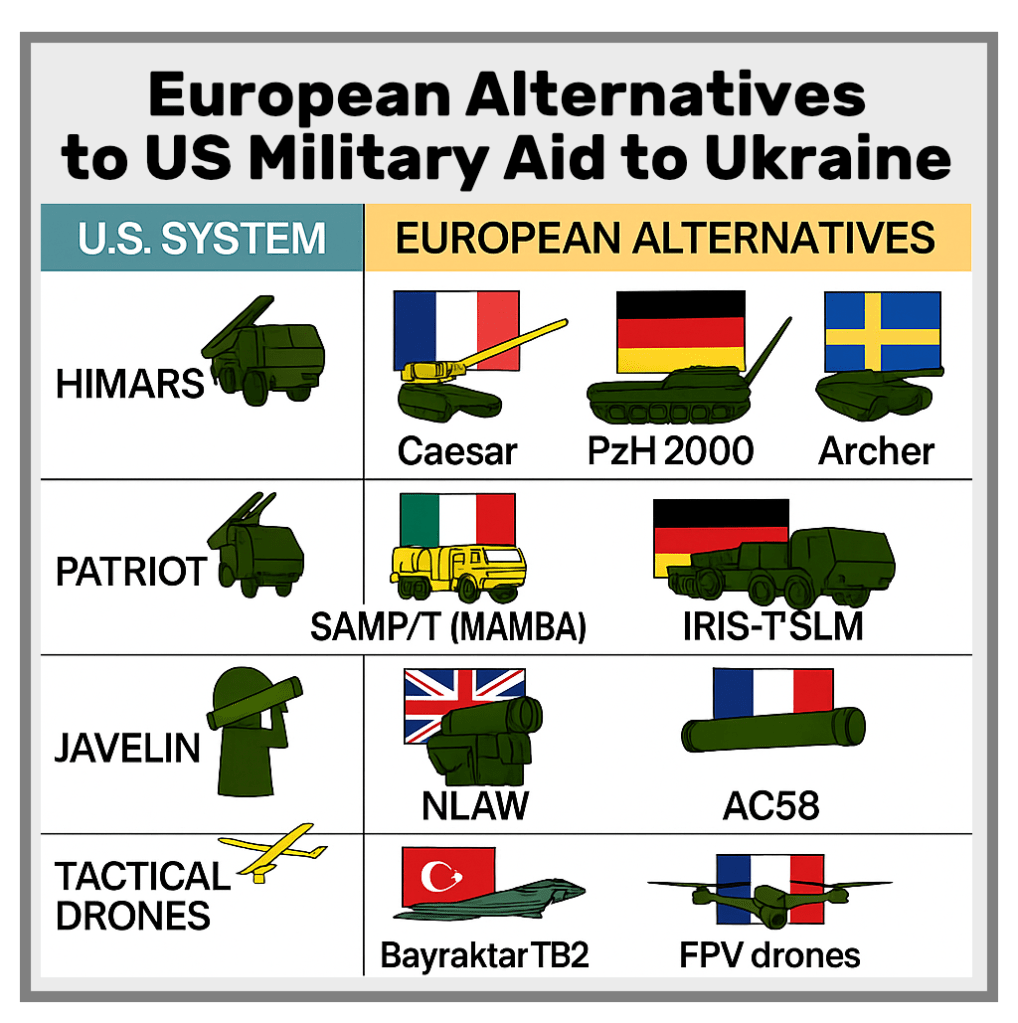
In the field of long-range precision artillery and rockets, Europe is deploying systems like the German PzH 2000, the French Caesar, the Swedish Archer, and a European variant of the Multiple Launch Rocket System (MLRS). These alternatives offer firepower and accuracy that rival the U.S. HIMARS, with rapid deployment capabilities and growing battlefield efficiency.
In air defense, the European SAMP/T (Mamba)—short for Sol-Air Moyenne Portée/Terrestre, a medium-range surface-to-air missile system developed by France and Italy—Germany’s IRIS-T SLM—InfraRed Imaging System Tail/Surface Launched Medium-range, a cutting-edge ground-based air defense system—and the UK’s Sky Sabre are all emerging as powerful complements—and in some cases, future replacements—for the U.S. Patriot systems. These European systems are improving in range, reliability, and interoperability, proving effective in live combat scenarios.
Anti-tank warfare is another area of parity. The British NLAW—short for Next generation Light Anti-tank Weapon, a shoulder-fired, disposable missile system designed for use by infantry against armored vehicles—and French Eryx are proving to be cost-effective, easily deployed, and tactically agile alternatives to the U.S. Javelin. Though Javelin still leads in range and target-lock capabilities, European systems are preferred in close-quarter operations.
On the drone front, while the U.S. dominates with Switchblade and Phoenix Ghost drones, Europe—along with Türkiye—is catching up. The Bayraktar TB2—a medium-altitude, long-endurance unmanned combat aerial vehicle (UCAV) developed by Türkiye for reconnaissance and precision strikes—supplemented by rapid innovation in FPV (first-person view) drones—small, manually piloted drones equipped with cameras and often used as loitering munitions—along with loitering drone tech from Poland and Ukraine, shows Europe’s ability to adapt and mass-produce effective UAV solutions.
Europe is also developing its own surveillance and battlefield coordination systems. France’s CERES—short for Capacité de Renseignement Électromagnétique Spatiale, a constellation of French military satellites for electronic intelligence—and the EU Satellite Centre are improving regional intelligence capabilities, although still not at par with U.S. global intelligence networks. Meanwhile, European C4I (Command, Control, Communications, Computers, and Intelligence) systems are being refined for NATO compatibility and AI-assisted command structures.
These tools are not just theoretical—they are being live-tested on Ukrainian soil, under the harshest real-world conditions. Field results are feeding directly into Europe’s growing defense research, industrial production, and doctrine refinement.
Learning the Russian Way of War: A Crash Course in Deterrence
Beyond hardware, European forces are gaining unprecedented insight into Russian military doctrine and operational behavior:
Strengths: Effective use of artillery saturation, trench warfare, and electronic warfare (EW); increasing drone adaptability.
European observers and trainers embedded with Ukrainian units have seen these dynamics up close, allowing them to adapt faster than in any traditional training scenario. In effect, the war has become a real-time strategic classroom.
And this learning is being added on top of decades of exposure to U.S. military technology, tactics, and interoperability standards. The result is a fusion: a uniquely European doctrine that integrates NATO compatibility with localized resilience, battlefield adaptability, and self-reliance.
A New European Military Order Emerges
Europe is no longer merely a supporting actor in NATO—it is becoming a strategic force in its own right. This is evident in:
The €800 billion “ReArm Europe” initiative, pooling defense investment across the continent.
The Coalition of the Willing, a group of 30+ nations ready to back Ukraine with military and peacekeeping forces, regardless of Washington’s direction.
The EU Strategic Compass and PESCO (Permanent Structured Cooperation, a framework for EU member states to collaborate more closely on defense projects and initiatives) provide the backbone for long-term continental defense planning., providing the backbone for long-term continental defense planning.
More significantly, these steps represent a strategic pivot: from transatlantic dependence to continental autonomy, with the potential to stand alone—not just against Russia, but any global threat.
Europe as a Global Power
From a biblical and prophetic standpoint, this development is particularly striking. The Bible speaks of a final world power rising out of Europe, described in the book of Daniel and the Revelation as a “beast” system of immense influence—politically, economically, and militarily.
In that light, the consolidation of Europe’s military might—sparked by Russia’s war, accelerated by U.S. disengagement, and refined by real-world learning—takes on profound significance. What we are witnessing may well be the emergence of the military dimension of that prophesied power.
A military that was once fractured, slow, and dependent is now becoming agile, well-informed, technically sophisticated, and integrated—not only in doctrine and equipment but in strategic vision.
The Furnace That Forges
As U.S. assistance to Ukraine becomes more measured and transactional, Europe has not only risen to meet the challenge—it is turning the war in Ukraine into the forge of a new military identity. What began as a stopgap has become a transformation.
Europe is no longer just learning from the U.S.—it is learning from the enemy, innovating from within, and evolving into a deterrent force that could, one day, rival any military on Earth.
The fire of war is forging Europe’s future—and with it, the world’s direction.
In a quiet but consequential shift, some of America’s best and brightest scientists are packing their bags—not because they’ve lost faith in science, but because they’ve lost faith in the system supporting it.
From physicists and biomedical researchers to climate scientists and engineers, highly trained professionals are now being drawn away from the United States to countries that offer a more stable, respectful, and well-funded environment for their work. The exodus isn’t dramatic, but it is undeniable—and its effects could ripple across generations.
Why Are Scientists Leaving?
The ongoing movement of scientists away from the United States has accelerated under policies perceived as hostile to scientific inquiry. Among the key reasons:
Funding Cuts: Major research institutions like the National Institutes of Health (NIH), the National Science Foundation (NSF), and the Centers for Disease Control and Prevention (CDC) have seen budgets slashed or frozen. Research grants are becoming harder to secure, especially for long-term or basic research.
Political Interference: Decisions that used to be grounded in peer-reviewed science are now being overridden by political agendas. Several high-profile projects were stalled or canceled due to ideological disagreements, eroding the trust scientists place in public institutions.
Immigration Restrictions: Many international researchers—who make up a significant portion of the U.S. scientific community—are finding it harder to enter or remain in the country due to tightened visa policies and anti-immigrant rhetoric.
Lack of Academic Freedom: There is growing concern over efforts to suppress or discredit science that contradicts prevailing political narratives, especially in areas like climate change, reproductive health, and pandemic preparedness.
Where Are They Going?
Countries such as France, Germany, Canada, Australia, and even China have recognized the opportunity. These nations are actively recruiting disillusioned American scientists through dedicated talent-attraction programs:
France launched its “Choose France for Science” initiative, which recently received hundreds of applications for just a few dozen positions.
Australia’s Global Talent Visa Program has drawn in academics from U.S. institutions who now feel more respected and supported abroad.
Germany continues to be a haven for physicists and chemists, especially through institutions like the Max Planck Society.
China, despite geopolitical tensions, has successfully attracted ethnic Chinese scientists from U.S. universities to return and lead cutting-edge research in AI, quantum computing, and biotech.
Areas of Expertise Being Lost
The scientists leaving are not average academics—they represent the elite of the global research community. Many are:
Biomedical researchers in cancer therapy and immunology
Artificial intelligence and machine learning experts
Environmental and climate scientists
Physicists involved in particle research and quantum technologies
Engineers specializing in aerospace, robotics, and advanced manufacturing
These aren’t just brain drains—they are bleeding-edge minds whose work directly affects national security, public health, and global competitiveness.
Lessons from History: The WWII Parallel
Ironically, a major reason the United States won World War II was because of the exact opposite trend: brilliant scientists migrated to America, fleeing persecution and ideological tyranny in their own countries.
Jewish and anti-Nazi scientists from Germany and Austria—including Albert Einstein, Enrico Fermi, and Leo Szilard—brought with them unparalleled expertise. Their contributions were vital to America’s scientific rise, including the success of the Manhattan Project, which led to the development of the atomic bomb.
America’s post-war technological dominance wasn’t just built on factories—it was built on brains that had found refuge in a country that respected their minds and valued their freedom.
Now, the tables are turning.
When God Withholds the Wise
The Bible presents a sobering parallel. In Isaiah 3:1,3 (NIV), God warned Jerusalem and Judah of judgment:
“See now, the Lord, the Lord Almighty, is about to take from Jerusalem and Judah both supply and support: all supplies of food and all supplies of water… the judge and the prophet, the diviner and the elder, the captain of fifty and the man of rank, the counselor, skilled craftsman and clever enchanter.”
When a nation turns its back on God and His laws, He does not merely withhold rain or prosperity—He also removes its human capital: the wise, the skilled, the visionary. Without such leaders and thinkers, a society collapses from within, even if its military and economy still appear strong on the outside.
What This Means for America
The loss of scientific talent is not just a brain drain—it’s a judgment of capability. It hinders America’s ability to innovate, compete, and protect its own people. Technologies that could have cured diseases, predicted natural disasters, or strengthened national defense may now be developed under different flags.
It is a warning, but also a wake-up call.
Restoring scientific integrity is not just about increasing funding or adjusting immigration quotas. It’s about restoring the moral and spiritual foundation upon which wisdom and truth are welcomed. It’s about America humbling itself as a nation and recognizing that knowledge is a gift from God, not something to be manipulated for political convenience.
As we watch the pillars of America’s global leadership quietly erode, one is reminded of Proverbs 29:18:
“Where there is no revelation, the people cast off restraint; but blessed is the one who heeds wisdom’s instruction.”
Will America once again become a refuge for wisdom and innovation—or will it become the very place from which wisdom flees?
In recent months, the American public has witnessed a disturbing convergence: confidence in President Trump’s administration is slipping fast, and so too is the world’s faith in America’s leadership. What was once the most trusted economic and political power is now facing skepticism not only from its citizens but from traditional allies and partners across the globe. And while future elections may bring to office leaders with more polished diplomacy and less abrasive economic policies, the trajectory has already been set.
America’s House Divided
At home, President Trump’s sweeping tariffs, controversial government “efficiency” initiatives, and public messaging—often through his personal social media account—have triggered widespread concern. A recent wave of polling shows that a growing majority of Americans, particularly independent voters and moderates, now believe that his policies disproportionately benefit the ultra-wealthy at the expense of working families.
Consumer sentiment has sharply declined. Inflation fears persist. Retirement portfolios have taken a hit due to market instability triggered by aggressive trade moves. Job insecurity looms as small businesses grapple with rising costs and an unpredictable regulatory climate.
Even members of the President’s own party are uneasy. While Trump retains strong support from his core base, discontent is building among voters who feel increasingly alienated by policies that seem disconnected from their everyday struggles. The damage may not only cost Republican seats in the upcoming 2026 midterms—it could cast a long shadow over the political future of the party itself.
Global Reverberations: The World Turns Away
America’s trust problem doesn’t stop at its shores. Across Europe, Asia, and the Americas, traditional U.S. allies are quietly repositioning themselves. The trust that once undergirded decades of alliance-building is giving way to caution, skepticism, and contingency planning.
In Europe, nations like France and Germany are doubling down on strategic autonomy, investing in independent defense capabilities and economic blocs less reliant on Washington.
In Asia, countries such as Japan and South Korea are strengthening regional ties and trade networks, wary of American unpredictability.
In Canada and Mexico, recent U.S. trade barriers have fueled nationalist sentiment and accelerated diversification of export destinations.
Even if American voters elect a more diplomatically-minded administration in the future, many foreign leaders will proceed with the assumption that U.S. foreign policy can shift dramatically every four years—because it already has, and likely will again.
The world is preparing for a post-American order—one where America is just another actor in a multipolar stage, rather than the conductor of the global orchestra.
The Long Tail of Miscalculation
What does all this mean for ordinary Americans? It means that the consequences of current decisions will likely outlast the administration that made them.
Jobs: As trade relationships weaken, export-dependent industries could see layoffs and contraction.
Cost of Living: Higher tariffs mean higher prices for goods. Inflationary pressure could eat further into wages and savings.
Retirement: Market instability could continue to erode the value of retirement investments and long-term financial planning.
Entrepreneurship: The rising cost of doing business in an unstable trade environment will discourage innovation and risk-taking, especially among small- and medium-sized enterprises.
This isn’t just about politics. It’s about livelihoods, futures, and the long-term credibility of the nation.
A Spiritual Wake-Up Call
But there is a deeper issue at play—one that cannot be solved by elections or economic adjustments. God is allowing the United States to reap what it has sown.A nation once known for upholding Judeo-Christian values is now visibly crumbling under the weight of self-interest, division, and moral confusion.
Proverbs 14:34 (NKJV) says, “Righteousness exalts a nation, but sin is a reproach to any people.” America has forsaken sound Biblical principles in governance, economy, and culture. Now, it is beginning to experience the natural consequences: loss of respect, loss of trust, and closed doors of opportunity as global alliances take shape—without America at the table.
Just as God warned ancient Israel through His prophets, the message for America is clear: “Return to Me.” The current economic and political upheaval is not merely the result of poor governance. It is a divine signal—a trumpet call to repentance, humility, and national course correction.
The Decline of a Superpower
As things stand now, the world is clearly transitioning into a post-American era. The signs are everywhere: reduced influence in multilateral forums, trade blocs forming without U.S. participation, allies hedging their bets, and voters at home feeling more uncertain about their future than ever before.
This is not irreversible—but the window of opportunity is closing. The longer the nation delays its spiritual reckoning, the more severe the consequences may become.
The future of America does not rest in new tariffs or clever policies. It rests in a return to truth, humility, and obedience to the God who once blessed it. Only then can the country begin to rebuild not just its economy—but its soul.
(Note: The chart summarizing Pres. Trump’s net approval ratings were added to the post on April 26, 2025.)