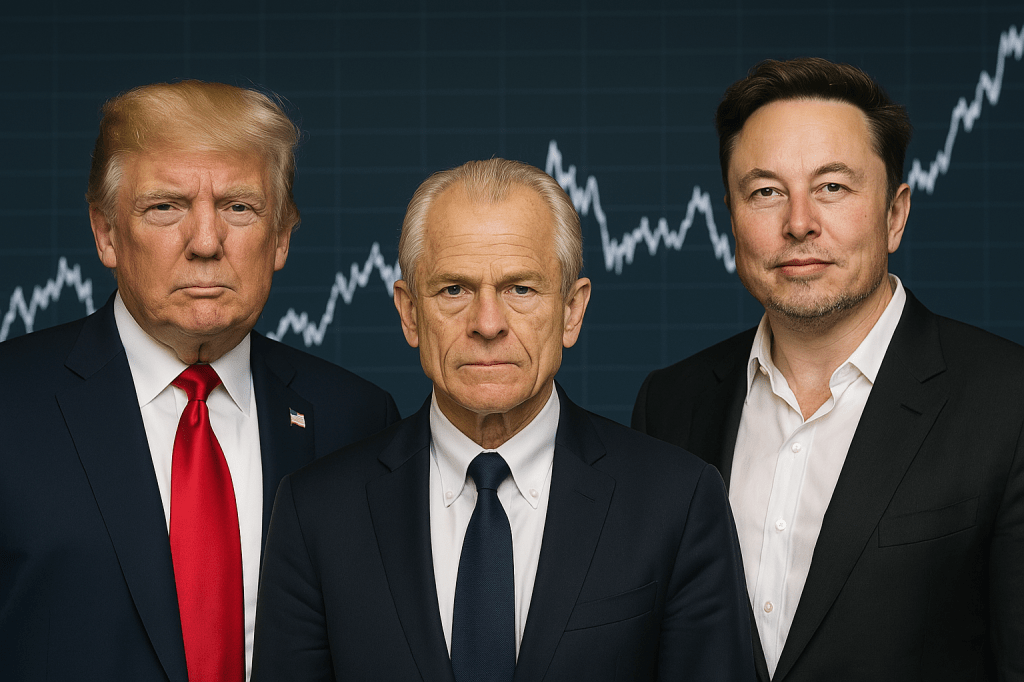
The global markets held their breath—and then exhaled—when President Donald Trump announced a sudden 90-day pause on the sweeping tariffs he had imposed on virtually all U.S. trading partners. Except for China, whose tariffs were raised sharply to 125%, most nations received a temporary reprieve from what many feared would become a full-scale global trade war.
But this “pause” has analysts and world leaders wondering: is this merely a temporary detour, or the beginning of a quiet retreat?
Why the Sudden Shift?
The official narrative from the Trump administration is that this is a “strategic pause”—a window of time to negotiate bespoke trade arrangements with allies and economic partners. Treasury Secretary Scott Bessent noted that the 90-day halt gives space for talks with countries like Japan, Vietnam, and the European Union.
Yet beneath this diplomatic language lies a more complex—and revealing—story.
Internal Dissent
While some cabinet members like Commerce Secretary Howard Lutnick and trade advisor Peter Navarro pushed aggressively for the tariffs, others sounded the alarm. Treasury Secretary Bessent and National Economic Council Director Kevin Hassett reportedly warned of the dangers of a unilateral tariff policy, urging a more measured and consultative approach.
Their concerns proved prescient.
Elon Musk’s Warning
One of the loudest voices from the private sector was Elon Musk, who called for a zero-tariff environment between Europe and North America and warned that blanket tariffs would disrupt Tesla’s global supply chain. Musk’s businesses depend on internationally sourced components, and the tariffs would significantly raise production costs.
Predictably, Navarro dismissed Musk’s position as self-serving. But the economic fallout soon made it clear that Musk and others raising red flags were not speaking out of self-interest alone—they were highlighting systemic risks to American consumers, workers, and the broader economy.
Economic Turbulence and Market Recoil
The markets responded with a wild swing of emotion.
At first, optimism over the tariff pause sent the S&P 500 up 9.5% in a single day—one of the largest one-day rallies in its history. But the euphoria didn’t last. Investors quickly realized that no one knows what happens on Day 91. Will the tariffs resume in full force? Will exceptions be granted selectively? The lack of clarity caused a sharp sell-off the next day, with the Dow losing over 2,000 points.
Businesses across the country remain in limbo. Some are delaying hiring and investments. Others are considering shifting supply chains abroad—ironically, the opposite of the tariffs’ intended effect.
Why Call It a “Pause” Instead of a Reversal?
Calling it a “pause” allows the President to preserve political face. It offers flexibility: he can later say he gave America’s partners a chance to negotiate—and if they didn’t, he had no choice but to proceed.
This language also keeps pressure on foreign governments while maintaining domestic leverage. But make no mistake: if the tariffs are reinstated, the economic whiplash could be far worse the second time around. The credibility of U.S. trade policy is already in question. A re-escalation could deepen inflation, strain key industries, and damage America’s standing in global markets.
A Lesson in Leadership: The Value of Many Counselors
Could this turmoil have been avoided? Almost certainly yes.
Had the administration listened early on—not only to internal critics but also to voices like Elon Musk’s—much of this volatility might have been spared. The issue wasn’t merely policy—it was isolation in decision-making, surrounded by yes-men and ideological hardliners.
The Bible has long taught the wisdom of diverse counsel:
“Where there is no counsel, the people fall;
But in the multitude of counselors there is safety.”
(Proverbs 11:14)
“Without counsel, plans go awry,
But in the multitude of counselors they are established.”
(Proverbs 15:22)
Scripture reveals that even great leaders falter when they ignore wise advice. King Rehoboam rejected the seasoned advice of elders in favor of arrogant young men, splitting the kingdom of Israel (1 Kings 12). Moses thrived by heeding Jethro’s advice to delegate (Exodus 18).
The principle is clear: humility and wise counsel go hand in hand. National leaders who isolate themselves in echo chambers risk decisions harmful to their reputation and their people.
Adjusting the Course
President Trump’s tariff pause may signal rethinking—or merely a tactical maneuver. Its lessons should not be missed. Listening only to affirming voices leads to blind spots. Strong leadership isn’t about always being right, but about being wise enough to adjust course when consequences become clear.
The Bible’s wisdom remains timeless. If only more leaders today took it to heart.
