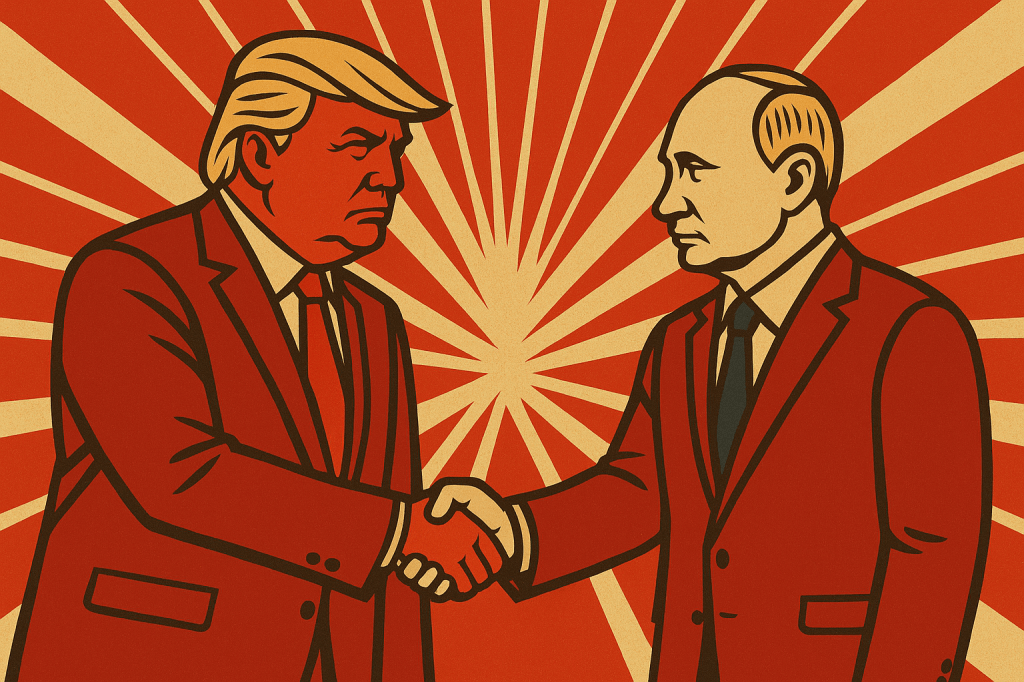
In recent years, the world has watched a quiet but profound shift taking place across Eurasia. Once separated by ideology, suspicion, and historic rivalries, Russia, China, and India are now moving into deeper military, economic, and strategic alignment. What once appeared as limited cooperation is rapidly taking the shape of something far more consequential—the early framework of a powerful Eastern military and economic bloc that is reshaping global security.
Just this week, China and Russia conducted joint anti-missile defense drills on Russian territory—a highly sensitive area of military cooperation. Anti-missile systems are not ordinary battlefield tools; they are designed for strategic nuclear survival. These exercises reveal that Moscow and Beijing are not merely partners of convenience—they are preparing together for high-end warfare against advanced military powers.
At the same time, Russian President Vladimir Putin made a major state visit to India, where he and Prime Minister Narendra Modi agreed to expand cooperation in defense, energy, trade, and high technology. Russia reaffirmed its commitment to supply India with uninterrupted oil and gas, deepen military equipment transfers, and accelerate joint weapons development. These agreements further solidify Russia as India’s primary long-term strategic partner, even as pressure mounts from Western nations.
Together, these two developments—strategic missile defense coordination between China and Russia and Russia’s expanding economic-military commitments with India—signal the tightening of an enormous Eastern alignment. Russia now sits at the center of two massive Asian powers, binding them through energy, weapons, diplomacy, and shared opposition to Western dominance.
This alignment is no longer theoretical. It now influences:
- Global energy markets
- Arms production and weapons supply
- Trade corridors across Eurasia
- Cyber and space warfare capabilities
- Diplomatic voting blocs in international institutions
And most sobering of all—it aligns precisely with a military configuration foretold in Bible prophecy thousands of years ago.
A Prophetic Eastern Power Foretold
The book of Revelation describes a time just before the return of Jesus Christ when an enormous military force will rise from the East:
“Then the sixth angel sounded: And I heard a voice… saying… ‘Release the four angels who are bound at the great river Euphrates.’ … And the number of the army of the horsemen was two hundred million; I heard the number of them.” (Revelation 9:13, 16)
This army unleashes a catastrophic war that results in the death of one-third of all humanity:
“By these three plagues a third of mankind was killed—by the fire and the smoke and the brimstone which came out of their mouths.” (Revelation 9:18)
For centuries, critics dismissed this as symbolic or impossible. No nation in all of history could field such numbers. But today, China alone possesses the industrial and manpower base necessary for mass-mobilization on an unprecedented scale. Add to that India’s population, Russia’s nuclear arsenal and missile systems, and the combined military technology of these powers—and suddenly a 200-million-man force is no longer unthinkable.
What we are witnessing today is likely the early geopolitical scaffolding of that very army.
A Western Invasion Triggers the Eastern Response
Revelation reveals that this massive Eastern force does not strike first. It is a retaliatory power, responding to earlier devastation launched from the West:
“They were given power… to torment men five months… The shapes of the locusts were like horses prepared for battle… and their sound was like chariots with many horses running into battle.” (Revelation 9:5–9)
This describes a technologically overwhelming assault—symbolized by aircraft-like weapons—coming from a revived imperial power historically associated with Rome. This suggests that a future Western-centered empire will unleash devastating attacks that destabilize the world, triggering the colossal Eastern retaliation described later in Revelation 9.
Thus, the coming world war is not random. It unfolds in distinct prophetic phases—first Western domination, then Eastern vengeance.
Not Just Geopolitics—But Divine Judgment
These wars are not merely the product of nationalism, economics, or ideology. They are allowed by God as a final intervention in human self-destruction.
After the devastation of Revelation 9, Scripture declares:
“But the rest of mankind, who were not killed by these plagues, did not repent of the works of their hands…” (Revelation 9:20)
God permits these horrors for one overriding reason: to shock humanity out of its rebellion and back toward Him. The world has rejected God’s law, exalted violence, celebrated immorality, and mocked repentance. In mercy, God allows the consequences of human defiance to play out—so that at last, people may see that human rule without God leads only to death.
Yet even then, His goal is still salvation, not annihilation.
Why God Delays—Even Now
Long before these judgments arrive, God extends mercy:
“Or do you despise the riches of His goodness, forbearance, and longsuffering, not knowing that the goodness of God leads you to repentance?” (Romans 2:4)
God’s patience is not permission to continue in sin—it is an open door to repentance. Every year that passes without World War III is not a sign that prophecy is false. It is proof that God is still giving humanity time to change.
But the deepening military drills, missile defenses, energy alliances, and war-ready economic blocs forming today show that the world is racing toward the very conditions the Bible warned would come.
What This Means for Us Now
The alignment of Russia, China, and India delivers a personal message to every thinking observer:
- The world is not drifting aimlessly
- Global power is shifting exactly as prophecy declared
- Military alliances will not bring peace
- Economic blocs will not stop global catastrophe
- Only the return of Jesus Christ and the establishment of God’s Kingdom will finally end war
The coming wars will be terrible beyond modern imagination. Yet they will also clear the way for the only true solution to human conflict—God’s righteous rule over all nations.