The upcoming NATO summit in The Hague this June 24 and 25—meant to showcase unity and resolve—may end up doing the opposite: exposing divisions, achieving little, and revealing a troubling shift. The alliance that once served as the anchor of Western defense now faces an identity crisis, largely influenced by the changing role of the United States under President Donald Trump.
A President at Odds with the Alliance
President Trump comes to the NATO summit not as a stabilizing leader but as a disruptor. His position on the Russian invasion of Ukraine sharply differs from that of most European leaders. While many in Europe see Russia’s 2022 attack on Ukraine as unprovoked aggression, Trump has suggested that Ukraine “provoked” Russia—downplaying Moscow’s responsibility and treating both sides as equally culpable.
This stance is deeply unsettling to countries like Poland, the Baltic states, and Romania. For them, NATO is more than diplomacy—it’s a protective shield. But under Trump’s view, that shield seems uncertain.
Trump’s view of Vladimir Putin also contrasts sharply with NATO consensus. While European leaders regard Putin as a serious, long-term threat to European stability, Trump has described him in favorable terms—even amid allegations of war crimes. This isn’t just a difference in tone—it reflects a fundamentally different understanding of global threats.
From Shared Values to Shared Costs
At its core, Trump treats NATO less like a community of shared democratic values and more like a financial arrangement. His message has been blunt: pay more or risk losing protection. Although calls for higher European defense spending aren’t new, Trump frames the issue as a fee-for-service model—diminishing the alliance’s foundational spirit of mutual defense.
This year’s summit is expected to focus heavily on Trump’s demand that allies commit 5% of GDP to defense. Some countries like Poland and the UK may support the idea, but many others find it politically and economically unfeasible, even coercive.
Even more concerning is what won’t be addressed: there will likely be no new pledges to Ukraine or a clear plan to deal with Russia’s ongoing threats. That silence speaks volumes.
A Shifting Balance of Power
The summit may produce few policy breakthroughs, but it will make one reality painfully clear: the United States no longer leads NATO as it once did. Without U.S. leadership grounded in shared values, the alliance becomes more fragmented—less a united front, and more a group of nations with diverging priorities.
Faced with this void, Europe is beginning to respond.
Europe Steps Forward
As the summit unfolds, European leaders are moving to create a more independent defense structure. France is taking the lead, with Germany showing increased support. Their goal: prepare for a future where Europe must defend itself—even without, or against, U.S. approval.
Key elements of this shift include France’s nuclear arsenal, the EU’s Common Security and Defence Policy (CSDP), and joint defense projects through initiatives like PESCO. Once seen as symbolic, these are now gaining strategic importance.
Eastern Europe is also adapting. Countries like Poland are ramping up defense spending and modernizing their forces. Nordic nations are working more closely together through regional groups like NORDEFCO and the Joint Expeditionary Force.
A Prophetic Parallel
This changing defense landscape may have more than political implications—it could carry prophetic weight. The Bible foretells a final resurrection of the Roman Empire, emerging from Europe shortly before the return of Jesus Christ. Scripture describes this end-time empire as a powerful beast—ruthless, dominant, and seemingly unstoppable: “Who is like the beast? Who is able to make war with him?” (Revelation 13:4).
The weakening of NATO and the decline of U.S. leadership are not just political shifts—they are part of a larger prophetic pattern. A new European-centered power is rising, one that may dominate the global stage with strength and unity, even without—or in defiance of—American leadership.
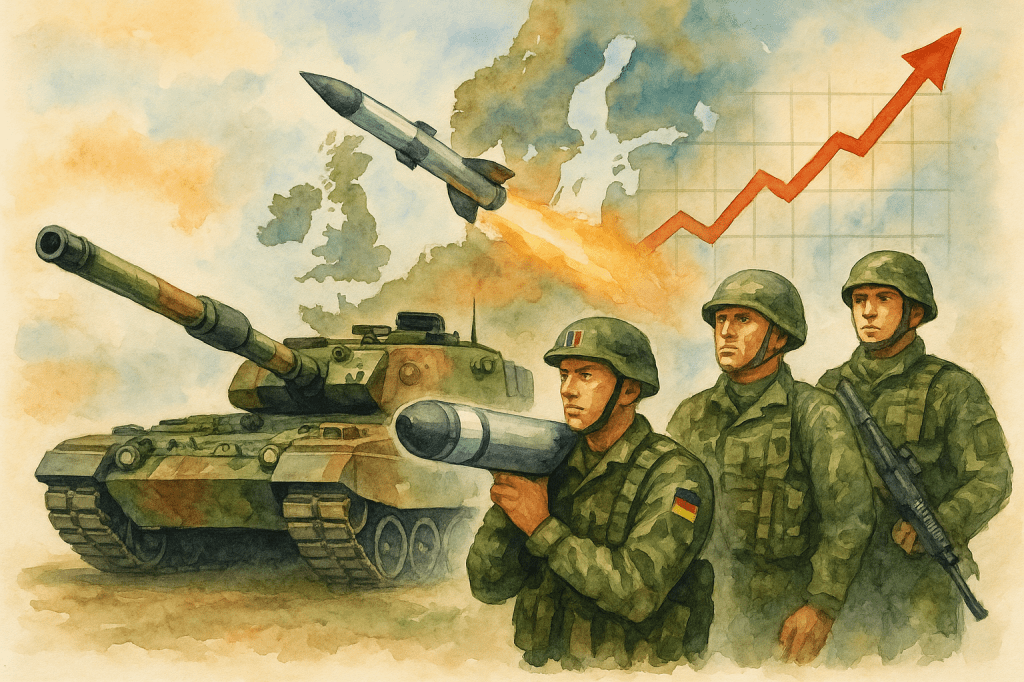
In recent years, a quiet revolution has been unfolding across the European continent. Long known for its reliance on diplomacy, economic influence, and NATO protection, Europe is now undergoing one of the most dramatic rearmament campaigns in its modern history. From Germany and Poland to Sweden and Denmark, defense budgets are surging, production lines are being reactivated, and leaders are speaking with new urgency about “war readiness.”
Germany has pledged to raise defense spending to 3.5% of GDP, launching a massive modernization campaign including expanded tank and artillery production, as well as investments in cyber and missile defense.
Poland is going further, earmarking 4.7% of GDP—now the highest in NATO—for new weapon systems, base upgrades, and troop increases. Meanwhile, Sweden is expanding its armed forces, reintroducing conscription, and ramping up spending to reach 2.6% of GDP by 2028.
Denmark plans to hit 3% of GDP by 2026, citing Russian aggression and emerging threats as key motivations. The Baltic states—Estonia, Latvia, and Lithuania—are each committing over 3% of GDP and building territorial defense units with citizen-soldier models.
France is investing in new-generation aircraft and drones, while Italy is streamlining its military-industrial base to boost efficiency.
Although theUK is not part of the EU, it is also undertaking significant measures to enhance its military readiness. The UK’s Strategic Defence Review outlines plans to increase defense spending to 2.5% of GDP by 2027, with a longer-term goal of reaching 3%. Key initiatives include the construction of up to 12 SSN-AUKUS nuclear-powered submarines, a £15 billion investment in the Astraea nuclear warhead program, and the procurement of 7,000 long-range missiles.
Additionally, the UK is establishing six new munitions factories to ensure an “always-on” weapons pipeline. On the technological front, the UK is investing in the Global Combat Air Programme (GCAP) to develop a sixth-generation stealth fighter in collaboration with Japan and Italy.
Efforts are also underway to expand the British Army to 76,000 personnel, create a new home guard, and enhance cyber and electromagnetic capabilities through the establishment of a CyberEM Command.
Europe as a whole is also pushing technological advancement. The EU’s European Defence Fund is channeling billions into joint R&D for AI, autonomous systems, and space-based surveillance. NATO-aligned nations are jointly developing standardized platforms for faster, interoperable deployment. Recruitment campaigns have been reinvigorated, with new enlistment incentives, reserve force expansions, and revitalized officer academies across the continent.
All these efforts point toward a continent no longer satisfied with symbolic defense gestures, but one preparing, materially and mentally, for the very real possibility of conventional and hybrid war.
A Changing World Order
Several major forces are converging to drive this military resurgence:
Russian Aggression: The ongoing conflict in Ukraine has shattered decades-old illusions of peace on the continent. With Russia investing heavily in its military-industrial complex, European nations now see the need to prepare for high-intensity warfare.
Uncertainty Over U.S. Support: The return of Donald Trump to the White House and his continuing “America First” posture have deepened concerns about long-term American commitment to Europe’s defense. This is prompting nations to take ownership of their own security.
Emerging Global Threats: Rising instability in parts of the Middle East, terrorism, cyberattacks, and the proliferation of drones and artificial intelligence in warfare have added new layers of complexity to Europe’s security landscape.
Internal Political Shifts: Public sentiment is shifting, especially in frontline states like Poland and the Baltic nations. Defense is no longer seen as a luxury but a necessity. Even traditionally pacifist countries like Germany and Sweden are rewriting their security doctrines.
Challenges Along the Way
Despite this new momentum, Europe’s defense transformation faces serious limitations:
Fragmented Military Systems: Europe maintains over a dozen different tank models, more than 30 types of naval vessels, and dozens of aircraft types, each with its own logistics chain, spare parts system, and training regimen. This lack of standardization results in operational inefficiencies, higher maintenance costs, and serious interoperability challenges in joint missions. Similarly, air forces operate multiple jet fighters that are incompatible in terms of armament and electronic systems. During exercises, these disparities often complicate coordination, from communications to battlefield support. The absence of a central procurement body further aggravates the issue, leading to overlapping orders and missed opportunities for bulk purchasing. Unless these fractured systems are consolidated, Europe’s ability to act quickly and cohesively in a large-scale conflict remains compromised.
Slow Production Capacity: Unlike Russia, which has moved to a war economy footing, Europe’s peacetime industries are not yet able to produce ammunition, vehicles, and systems at the speed and scale needed for major conflict.
Diverging National Priorities: What threatens Estonia may not concern Italy. Differing threat perceptions and strategic cultures across Europe hinder the formation of a unified response strategy. This divergence has also resulted in varying levels of support for Ukraine’s defense against Russia’s invasion. While frontline states like Poland, the Baltic nations, and the Nordic countries have provided robust military aid and training, others such as Hungary have been more reserved, citing internal political considerations or skepticism about provoking further escalation. These inconsistencies underscore the lack of a cohesive continental approach to security threats—even when a major war is unfolding at Europe’s doorstep.
Budgetary Constraints: While some nations, like Poland and Germany, are pouring billions into defense, others still struggle with fiscal limits or public resistance to increased military spending.
A Vision for Unity: The Case for a Common European Government
To truly overcome these limitations, a more radical solution is being quietly considered in think tanks and political circles: a common European government with a unified defense authority.
Such a government would:
Centralize decision-making on military strategy.
Standardize equipment, training, and procurement across nations.
Operate a single European military force under one command.
Speak with one voice in global affairs, strengthening Europe’s role on the world stage.
This is not mere idealism. The seeds have already been planted in initiatives like PESCO (Permanent Structured Cooperation), the European Defence Fund, and the “ReArm Europe” plan, which proposes up to €800 billion in defense investments through 2030.
However, real obstacles remain:
National sovereignty concerns.
Resistance from nations wary of losing control over their own armed forces.
The legal and political complexities of treaty reform.
Uncertainty about how such a force would relate to NATO.
What Could Accelerate This Path?
History shows that crises often accelerate integration. A large-scale terrorist attack on European soil, or a coordinated threat from a rogue state or coalition in the Middle East for example, could galvanize public support for stronger, centralized defense structures. In moments of deep fear or shock, nations tend to set aside long-standing differences in favor of unified action.
Should such an event occur, Europe’s path to full military unification could move from decades to just a few years, or even a few months. A single European military superpower would then emerge, capable of acting swiftly, decisively, and globally.
What Lies Ahead
Bible prophecy speaks of a coming end-time superpower—a revived Roman Empire—that will rise in Europe, just before the return of Jesus Christ. It will be politically and militarily dominant, led by strongmen and underpinned by ten nations or groups of nations acting in unity (Revelation 17:12–14).
What we are seeing today may well be the early stages of that development. The unprecedented rise in defense budgets, the move toward centralization, and the willingness to take military matters into Europe’s own hands—all suggest that the groundwork is being laid.
A Call for Vigilance
For Christians, these developments are not cause for fear, but for spiritual vigilance and heartfelt prayer.
We are reminded of Christ’s words: “Blessed are the peacemakers, for they shall be called sons of God” (Matthew 5:9, NKJV). As nations prepare for war, the Bible encourages us to pray all the more fervently for peace—peace in Europe, peace in the Middle East, and peace in our own communities.
The Bible also encourages to pray for wisdom among leaders, that they may exercise restraint even as they prepare for conflict.
And above all, Christ encourages us to pray for the coming of God’s kingdom, which will break the cycle of war once and for all. God’s Kingdom will not rely on tanks or missiles, but will be ruled by justice, equity, and righteousness (Isaiah 2:4; Micah 4:3).
Europe Rising
Europe is rising—militarily, politically, and prophetically. Whether through slow integration or rapid unification triggered by crisis, the continent is laying the foundation for a future superpower that may dominate the world stage.