Tag: Ukraine war

  • Europe’s Shift in Arms Procurement: A Subtle Sign of Change

    Europe’s Shift in Arms Procurement: A Subtle Sign of Change

    For decades, the defense relationship between the United States and Europe has been clear-cut: Europe bought American weapons, and Washington remained the uncontested leader of the Western alliance. That picture, however, is beginning to change.

    The recent decision by Denmark to bypass the American Patriot missile system in favor of the European-made SAMP/T (New Generation) air defense system is the most visible example of this shift. Denmark also intends to rely on European suppliers for its medium-range air defense, considering systems like Germany’s IRIS-T, Norway’s NASAMS, and France’s VL MICA. Officials in Copenhagen cited delivery speed, affordability, and industrial benefits as reasons—but the symbolism is clear: Europe is increasingly willing to equip itself without defaulting to U.S. systems.

    And Denmark is not alone.

    • Germany is leading the European Sky Shield Initiative, which is pooling resources to expand the IRIS-T system across Europe.
    • The Baltic States—Latvia, Lithuania, and Estonia—are purchasing IRIS-T units in joint arrangements with Germany.
    • Slovenia has also joined the Sky Shield program, relying on European suppliers rather than U.S. ones.
    • Poland, while still buying U.S. Patriots, is investing heavily in the British-designed CAMM missile family, weaving European systems into its layered defense structure.
    • On the ground, Czechia and Slovakia have turned to Swedish CV90 infantry fighting vehicles, and EU funds are pushing production of European artillery ammunition.
    • Ukraine, while still dependent on U.S. armaments, is now producing a significant portion of the weapons it uses in its war against Russia. These include locally manufactured drones, artillery shells, and even missile systems. At the same time, Ukraine has received European-made weapons such as German Leopard tanks, French Caesar howitzers, and British Storm Shadow missiles, showing both its own production and Europe’s growing role in its defense.

    None of this means Europe has abandoned the U.S. As of now, the United States still supplies the majority of Europe’s imported arms—especially in critical areas like fighter jets (the F-35 dominates sales) and strategic enablers. Yet, alongside those U.S. weapons, European nations are increasingly equipping themselves with homegrown systems that are largely interoperable with American platforms. It is not a clean break, but a diversification—a subtle hedge.

    Why This Shift?

    Several factors explain the trend:

    1. Delivery and cost pressures: U.S. systems are often more expensive and slower to deliver than European alternatives.
    2. Strategic autonomy: Europe wants the ability to defend itself without total reliance on American decision-making.
    3. Industrial policy: Supporting European defense industries preserves jobs, technology, and sovereignty.
    4. Political uncertainty: U.S. policy swings—especially under different administrations—make allies wary of putting all their eggs in one basket.

    A Spiritual Dimension

    Behind the headlines, however, lies a deeper story. The Bible tells us that God raises up nations and brings them down (Daniel 2:21). America long stood as the leader of the free world, providing the shield under which much of Europe prospered. But that leadership is eroding.

    The quiet but real shift in Europe’s arms procurement is a symptom of this change. By relying more on each other, Europeans are learning to do without America. This is not merely economics or politics—it is part of God’s judgment on the United States. Scripture warns that when a nation turns away from Him, He will “break the pride of your power” (Leviticus 26:19). America’s military dominance has been a key expression of that power. Now we see signs of it slipping away.

    A Marker of Something Larger

    The choice of Denmark may seem like a technical procurement matter, but it is a marker of something larger. Europe is slowly but steadily becoming more self-reliant in arms production. The United States still supplies much—but the monopoly is gone, and the trend is growing.

    In the months and years ahead, watch Europe’s defense market closely. What appears as procurement diversification is also a signal of shifting leadership in the Western world. As America declines, God is setting the stage for other powers to rise—just as the Bible foretells.

  • The Alaska Summit: Is a ‘Reverse Nixon’ Strategy Realistic?

    The Alaska Summit: Is a ‘Reverse Nixon’ Strategy Realistic?

    The highly anticipated Trump–Putin summit in Alaska has now concluded, and its outcome was largely as expected. There was no breakthrough peace deal, no dramatic ceasefire in Ukraine, and certainly no resolution of the war that has scarred Europe for over three years. Instead, as we anticipated, what emerged was a meeting heavy on appearances but light on substance—one that gave Russia space to make demands and allowed President Trump to present the encounter as a step toward peace.

    Yet one surprising narrative surfaced in post-summit commentary: that Russia could somehow be drawn into serving as a counterweight to China. At first glance, this might sound like a clever geopolitical gambit. In reality, if it is really part of Trump’s planned outcome, it is little more than wishful thinking.

    The “Reverse Nixon” Strategy—Revisited

    Some analysts have framed the Trump administration’s approach as a kind of “reverse Nixon.” Just as President Richard Nixon reached out to China in the 1970s to isolate the Soviet Union, so too might Trump try to cultivate Russia to isolate China. Post-summit analysis suggested that Alaska revealed “Washington’s intent to weaken the Sino-Russian partnership, positioning Russia as a potential counterbalance to China” (“Trump–Putin Summit in Alaska: Geopolitical Implications and Strategic Narratives”, Special Eurasia).

    However, it is important to stress that none of the major news outlets covering the Alaska summit—Reuters, AP, The Guardian, The Washington Post, or Wall Street Journal—quoted any U.S. official explicitly declaring this as policy. The focus of official statements remained firmly on Ukraine, ceasefire diplomacy, and territorial questions.

    This means that the “counterweight to China” idea, while attractive to some in Washington and appealing to commentators, remains speculative at best.

    Why Russia Will Not Truly Counter China

    Several factors make the notion of Russia acting as a stable American ally deeply unrealistic:

    1. Deep Cooperation with China (and North Korea):

    China has provided Russia with essential economic lifelines and diplomatic support throughout its war in Ukraine. North Korea has supplied artillery and munitions to Russia, underpinning its battlefield operations. These actions go beyond mere solidarity—they demonstrate an active and ongoing alliance. Moscow is unlikely to betray the countries that enable its war effort.

    2. Entrenched Distrust of the West:

    Under Putin, Russia has shaped its identity in opposition to the West. NATO and the United States are framed as existential threats to sovereignty. A genuine pivot toward Washington would undermine that domestic narrative and threaten regime legitimacy.

    3. Power Imbalance and Strategic Leverage:

    Moscow’s flirtation with Washington is not about alignment—it’s about leverage. Russia is signaling to Beijing that it has alternatives. But with its economy and industrial capacity still dwarfed by China’s, true independence remains elusive.

    4. Historical Precedents of Broken Hopes:

    Past attempts to reset ties with Russia—from the Bush-era friendliness to Obama’s “reset”—ended with disappointment. Today’s overtures are likely to follow that same pattern: brief engagement, followed by a return to opposition.

    The Risks

    This optimistic narrative—that the U.S. and Russia can form a strategic counterbalance to China—is, in reality, not achievable, especially for the long-term. At best, Russia will play along just enough to extract concessions while maintaining its vital ties with Beijing (and Pyongyang). At worst, this illusion will misguide U.S. policy, encouraging miscalculations and weakening alliances.

    The Prophetic Trajectory: Kings of the East

    Biblical prophecy casts a longer, more enduring shadow over these events. Revelation 9:13-16 speaks of armies east of the farthest boundaries of the Roman Empire about to invade it just before the return of Christ. This implies not division among eastern powers, but convergence—especially against the West.

    The idea that Russia is drifting away from China is a surface-level maneuver. Beneath this lies a deeper movement toward alignment, consistent with the prophetic vision of eastern powers uniting. Their eventual hostility will not be directed inward, but outward—against the West.

    Not Realistic

    The Alaska summit unfolded largely as we and some other observers predicted—no peace, continued Russian leverage, and cautious Western response. Yet the notion of Russia becoming a U.S. counterweight to China is not a realistic long-term outcome. Russia’s alliances run too deep, its distrust of the West too entrenched, and the prophetic currents too clear.

    Ultimately, Russia is not turning away from China; it is seeking respect from a powerful partner. And, as Scripture indicates, when the time is right, the eastern powers will move together—not toward peace with the West, but toward confrontation.

  • Forged in Fire: How Europe Is Building Its Own Military Might Through Ukraine

    Forged in Fire: How Europe Is Building Its Own Military Might Through Ukraine

    The war in Ukraine is reshaping global alliances, military capabilities, and geopolitical expectations—but perhaps nowhere more profoundly than in Europe. While the United States continues to play an important role in Ukraine’s defense, its support under the Trump administration has become more measured, transactional, and at times uncertain. Into this vacuum has stepped a more assertive, rapidly maturing European military framework—one that is not just reacting to Russia, but preparing to stand on its own.

    From Steadfast Ally to Strategic Partner: The U.S. Shifts Gear

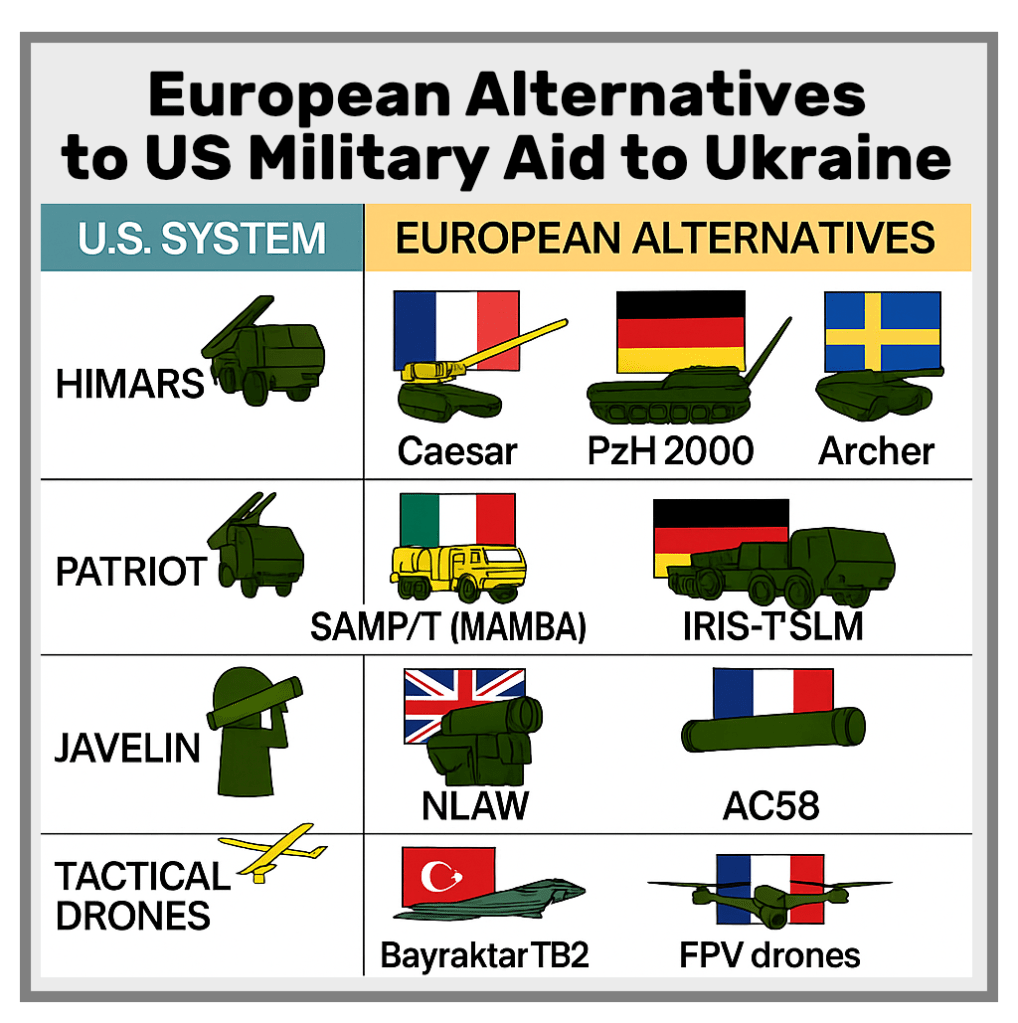
    Since 2022, the United States has supplied Ukraine with a formidable array of weapons, intelligence, and training. Systems like the HIMARS rocket launchers—short for High Mobility Artillery Rocket System, a highly mobile and precise long-range rocket artillery platform—Patriot missile defense batteries, Javelin anti-tank missiles, and real-time satellite surveillance have been game-changers on the battlefield. But since 2024, U.S. support has become increasingly conditional and strategically leveraged, with aid packages paused or tied to diplomatic objectives—such as ceasefire compliance or debt repayment proposals.

    This has caused anxiety in Kyiv and among NATO allies, highlighting the risks of over-reliance on a single, politically dynamic superpower. In response, Europe has not just filled the gap—it has transformed the challenge into an opportunity.

    Europe’s Arsenal Awakens: Compatible Yet Competitive

    European nations are rolling out a new generation of weapons systems—interoperable with NATO standards, but increasingly independent of U.S. designs.

    In the field of long-range precision artillery and rockets, Europe is deploying systems like the German PzH 2000, the French Caesar, the Swedish Archer, and a European variant of the Multiple Launch Rocket System (MLRS). These alternatives offer firepower and accuracy that rival the U.S. HIMARS, with rapid deployment capabilities and growing battlefield efficiency.

    In air defense, the European SAMP/T (Mamba)—short for Sol-Air Moyenne Portée/Terrestre, a medium-range surface-to-air missile system developed by France and Italy—Germany’s IRIS-T SLM—InfraRed Imaging System Tail/Surface Launched Medium-range, a cutting-edge ground-based air defense system—and the UK’s Sky Sabre are all emerging as powerful complements—and in some cases, future replacements—for the U.S. Patriot systems. These European systems are improving in range, reliability, and interoperability, proving effective in live combat scenarios.

    Anti-tank warfare is another area of parity. The British NLAW—short for Next generation Light Anti-tank Weapon, a shoulder-fired, disposable missile system designed for use by infantry against armored vehicles—and French Eryx are proving to be cost-effective, easily deployed, and tactically agile alternatives to the U.S. Javelin. Though Javelin still leads in range and target-lock capabilities, European systems are preferred in close-quarter operations.

    On the drone front, while the U.S. dominates with Switchblade and Phoenix Ghost drones, Europe—along with Türkiye—is catching up. The Bayraktar TB2—a medium-altitude, long-endurance unmanned combat aerial vehicle (UCAV) developed by Türkiye for reconnaissance and precision strikes—supplemented by rapid innovation in FPV (first-person view) drones—small, manually piloted drones equipped with cameras and often used as loitering munitions—along with loitering drone tech from Poland and Ukraine, shows Europe’s ability to adapt and mass-produce effective UAV solutions.

    Europe is also developing its own surveillance and battlefield coordination systems. France’s CERES—short for Capacité de Renseignement Électromagnétique Spatiale, a constellation of French military satellites for electronic intelligence—and the EU Satellite Centre are improving regional intelligence capabilities, although still not at par with U.S. global intelligence networks. Meanwhile, European C4I (Command, Control, Communications, Computers, and Intelligence) systems are being refined for NATO compatibility and AI-assisted command structures.

    These tools are not just theoretical—they are being live-tested on Ukrainian soil, under the harshest real-world conditions. Field results are feeding directly into Europe’s growing defense research, industrial production, and doctrine refinement.

    Learning the Russian Way of War: A Crash Course in Deterrence

    Beyond hardware, European forces are gaining unprecedented insight into Russian military doctrine and operational behavior:

    • Strengths: Effective use of artillery saturation, trench warfare, and electronic warfare (EW); increasing drone adaptability.
    • Weaknesses: Rigid command structure, poor logistics, morale problems, and ineffective air-ground coordination.

    European observers and trainers embedded with Ukrainian units have seen these dynamics up close, allowing them to adapt faster than in any traditional training scenario. In effect, the war has become a real-time strategic classroom.

    And this learning is being added on top of decades of exposure to U.S. military technology, tactics, and interoperability standards. The result is a fusion: a uniquely European doctrine that integrates NATO compatibility with localized resilience, battlefield adaptability, and self-reliance.

    A New European Military Order Emerges

    Europe is no longer merely a supporting actor in NATO—it is becoming a strategic force in its own right. This is evident in:

    • The €800 billion “ReArm Europe” initiative, pooling defense investment across the continent.
    • The Coalition of the Willing, a group of 30+ nations ready to back Ukraine with military and peacekeeping forces, regardless of Washington’s direction.
    • The EU Strategic Compass and PESCO (Permanent Structured Cooperation, a framework for EU member states to collaborate more closely on defense projects and initiatives) provide the backbone for long-term continental defense planning., providing the backbone for long-term continental defense planning.

    More significantly, these steps represent a strategic pivot: from transatlantic dependence to continental autonomy, with the potential to stand alone—not just against Russia, but any global threat.

    Europe as a Global Power

    From a biblical and prophetic standpoint, this development is particularly striking. The Bible speaks of a final world power rising out of Europe, described in the book of Daniel and the Revelation as a “beast” system of immense influence—politically, economically, and militarily.

    In that light, the consolidation of Europe’s military might—sparked by Russia’s war, accelerated by U.S. disengagement, and refined by real-world learning—takes on profound significance. What we are witnessing may well be the emergence of the military dimension of that prophesied power.

    A military that was once fractured, slow, and dependent is now becoming agile, well-informed, technically sophisticated, and integrated—not only in doctrine and equipment but in strategic vision.

    The Furnace That Forges

    As U.S. assistance to Ukraine becomes more measured and transactional, Europe has not only risen to meet the challenge—it is turning the war in Ukraine into the forge of a new military identity. What began as a stopgap has become a transformation.

    Europe is no longer just learning from the U.S.—it is learning from the enemy, innovating from within, and evolving into a deterrent force that could, one day, rival any military on Earth.

    The fire of war is forging Europe’s future—and with it, the world’s direction.