Tag: US Foreign Policy

  • America’s Foreign Policy Shift: Short-Term Gain, Long-Term Strain

    America’s Foreign Policy Shift: Short-Term Gain, Long-Term Strain

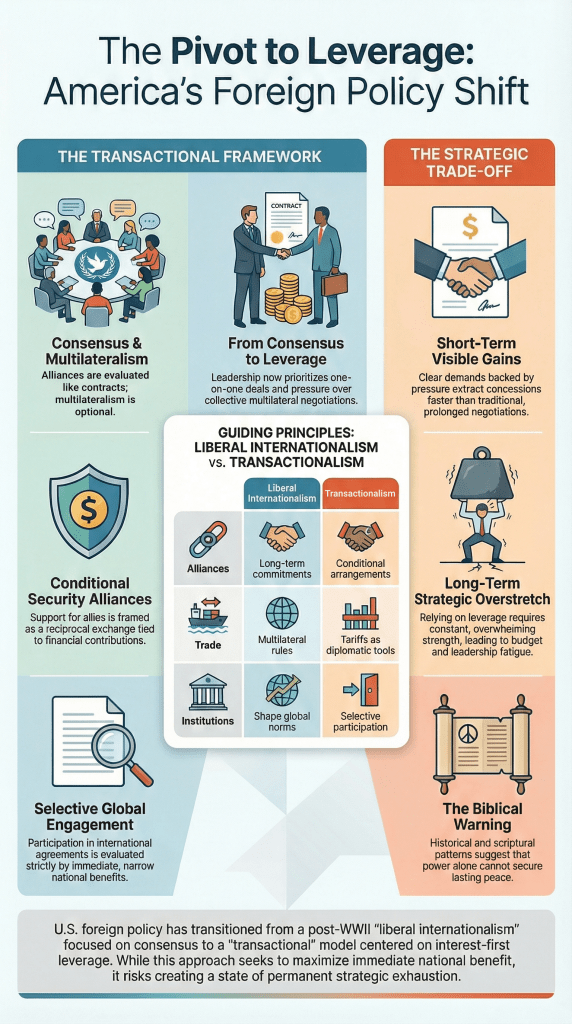
    Over the past several years, a noticeable shift has taken place in the foreign policy of the United States under the Trump administration. This shift marks a departure from the post–World War II framework that guided American engagement with the world for decades—a framework often described as “liberal internationalism”.

    Understanding this change is important not only geopolitically, but also morally and biblically.

    From Consensus to Transaction

    For much of the postwar era, American foreign policy emphasized consensus-building. Alliances were treated as long-term commitments, multilateral institutions were used to shape global norms, and leadership was exercised by persuading others that American interests broadly aligned with international stability.

    The Trump administration has taken a different approach—one that is more transactional, unilateral, and interest-first. Several concrete examples illustrate this shift:

    Alliances as conditional arrangements

    Security commitments, particularly within long-standing alliances, are increasingly tied to burden-sharing and financial contribution. Support is framed less as a shared obligation and more as a reciprocal exchange.

    Tariffs and trade as diplomatic tools

    Economic pressure—especially tariffs—is used directly to compel behavior, sometimes even against allies, rather than relying primarily on multilateral trade rules or coordinated economic frameworks.

    Selective engagement with international institutions

    Participation in global agreements and organizations is evaluated narrowly through immediate national benefit. When institutions are seen as constraining U.S. freedom of action, withdrawal or disengagement is treated as a legitimate option.

    Bilateral pressure over multilateral coordination

    Diplomacy increasingly favors one-on-one deals where American leverage is maximized, rather than collective negotiation where compromise and shared restraint are required.

    Taken together, these actions represent a move away from leadership through consensus and toward leadership through leverage.
    Short-Term Advantages

    In the short term, this approach can produce visible gains.

    Clear demands backed by pressure can extract concessions more quickly than prolonged negotiation. Allies and adversaries alike face fewer ambiguities about U.S. expectations. At the same time, the approach appears to promise fewer foreign entanglements, freeing resources for domestic priorities such as economic stability, infrastructure, and internal security.

    To many observers, this looks like a restoration of national strength and focus.

    The Long-Term Risks

    Yet this posture carries serious long-term risks.

    A transactional foreign policy only works if strength is constant—politically, economically, and militarily. When cooperation depends less on shared norms and more on pressure, any sign of weakness invites challenge. Rivals probe, allies hedge, and crises multiply.

    Ironically, rather than reducing commitments, this approach often forces the United States into a permanent state of strategic alert. Multiple regions require attention at once. Military readiness must be maintained everywhere. Diplomatic energy becomes reactive rather than preventative.

    What appears to save resources in the short term can, over time, sap national power. Constant war-footing strains budgets, exhausts leadership, and fuels domestic fatigue. History suggests that great powers are not undone by a single defeat, but by prolonged overstretch and internal division.

    A Biblical Warning Worth Remembering

    Scripture shows that this pattern is not new.

    God warned ancient Israel that continued rebellion would not result in isolated problems, but in pressure from many directions at once:

    “They shall besiege you at all your gates until your high and fortified walls… come down.” (Deuteronomy 28:52, NKJV)

    Later, the result was summarized simply:

    “The LORD sold them into the hand of their enemies all around.” (Judges 2:14, NKJV)

    When Israel turned away from God, He did not need to create new enemies. He withdrew protection—and pressures converged naturally. There was no single front to manage, no isolated crisis to contain.

    The Enduring Lesson

    The lesson for modern nations is not that military strength is unimportant, but that power alone cannot secure lasting peace. A nation that relies primarily on leverage must always maintain overwhelming strength—and history shows that such a condition cannot be sustained indefinitely.

    Foreign policy reflects deeper moral and spiritual realities. When a nation seeks security without righteousness and order without obedience, it often finds itself surrounded by problems rather than relieved of them.

    The warning God gave to ancient Israel still applies today: Strength may delay consequences but only repentance and wisdom can prevent them.
  • The Alaska Summit: Is a ‘Reverse Nixon’ Strategy Realistic?

    The Alaska Summit: Is a ‘Reverse Nixon’ Strategy Realistic?

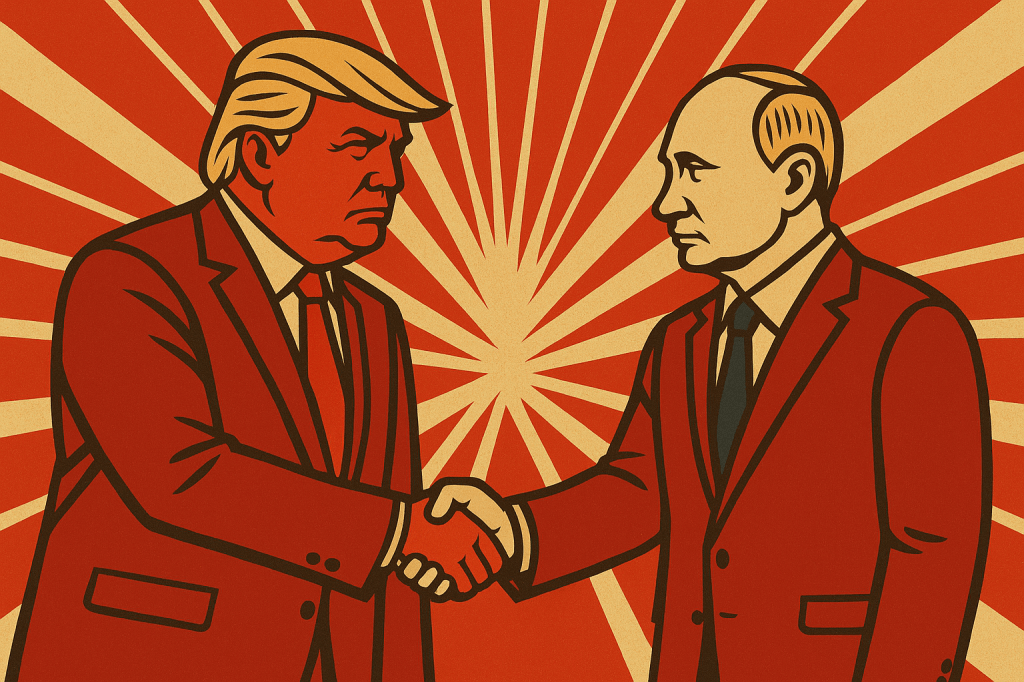
    The highly anticipated Trump–Putin summit in Alaska has now concluded, and its outcome was largely as expected. There was no breakthrough peace deal, no dramatic ceasefire in Ukraine, and certainly no resolution of the war that has scarred Europe for over three years. Instead, as we anticipated, what emerged was a meeting heavy on appearances but light on substance—one that gave Russia space to make demands and allowed President Trump to present the encounter as a step toward peace.

    Yet one surprising narrative surfaced in post-summit commentary: that Russia could somehow be drawn into serving as a counterweight to China. At first glance, this might sound like a clever geopolitical gambit. In reality, if it is really part of Trump’s planned outcome, it is little more than wishful thinking.

    The “Reverse Nixon” Strategy—Revisited

    Some analysts have framed the Trump administration’s approach as a kind of “reverse Nixon.” Just as President Richard Nixon reached out to China in the 1970s to isolate the Soviet Union, so too might Trump try to cultivate Russia to isolate China. Post-summit analysis suggested that Alaska revealed “Washington’s intent to weaken the Sino-Russian partnership, positioning Russia as a potential counterbalance to China” (“Trump–Putin Summit in Alaska: Geopolitical Implications and Strategic Narratives”, Special Eurasia).

    However, it is important to stress that none of the major news outlets covering the Alaska summit—Reuters, AP, The Guardian, The Washington Post, or Wall Street Journal—quoted any U.S. official explicitly declaring this as policy. The focus of official statements remained firmly on Ukraine, ceasefire diplomacy, and territorial questions.

    This means that the “counterweight to China” idea, while attractive to some in Washington and appealing to commentators, remains speculative at best.

    Why Russia Will Not Truly Counter China

    Several factors make the notion of Russia acting as a stable American ally deeply unrealistic:

    1. Deep Cooperation with China (and North Korea):

    China has provided Russia with essential economic lifelines and diplomatic support throughout its war in Ukraine. North Korea has supplied artillery and munitions to Russia, underpinning its battlefield operations. These actions go beyond mere solidarity—they demonstrate an active and ongoing alliance. Moscow is unlikely to betray the countries that enable its war effort.

    2. Entrenched Distrust of the West:

    Under Putin, Russia has shaped its identity in opposition to the West. NATO and the United States are framed as existential threats to sovereignty. A genuine pivot toward Washington would undermine that domestic narrative and threaten regime legitimacy.

    3. Power Imbalance and Strategic Leverage:

    Moscow’s flirtation with Washington is not about alignment—it’s about leverage. Russia is signaling to Beijing that it has alternatives. But with its economy and industrial capacity still dwarfed by China’s, true independence remains elusive.

    4. Historical Precedents of Broken Hopes:

    Past attempts to reset ties with Russia—from the Bush-era friendliness to Obama’s “reset”—ended with disappointment. Today’s overtures are likely to follow that same pattern: brief engagement, followed by a return to opposition.

    The Risks

    This optimistic narrative—that the U.S. and Russia can form a strategic counterbalance to China—is, in reality, not achievable, especially for the long-term. At best, Russia will play along just enough to extract concessions while maintaining its vital ties with Beijing (and Pyongyang). At worst, this illusion will misguide U.S. policy, encouraging miscalculations and weakening alliances.

    The Prophetic Trajectory: Kings of the East

    Biblical prophecy casts a longer, more enduring shadow over these events. Revelation 9:13-16 speaks of armies east of the farthest boundaries of the Roman Empire about to invade it just before the return of Christ. This implies not division among eastern powers, but convergence—especially against the West.

    The idea that Russia is drifting away from China is a surface-level maneuver. Beneath this lies a deeper movement toward alignment, consistent with the prophetic vision of eastern powers uniting. Their eventual hostility will not be directed inward, but outward—against the West.

    Not Realistic

    The Alaska summit unfolded largely as we and some other observers predicted—no peace, continued Russian leverage, and cautious Western response. Yet the notion of Russia becoming a U.S. counterweight to China is not a realistic long-term outcome. Russia’s alliances run too deep, its distrust of the West too entrenched, and the prophetic currents too clear.

    Ultimately, Russia is not turning away from China; it is seeking respect from a powerful partner. And, as Scripture indicates, when the time is right, the eastern powers will move together—not toward peace with the West, but toward confrontation.

  • A Summit Without a Center: How the 2025 NATO Meeting May Signal the End of U.S. Leadership in Europe

    A Summit Without a Center: How the 2025 NATO Meeting May Signal the End of U.S. Leadership in Europe

    The upcoming NATO summit in The Hague this June 24 and 25—meant to showcase unity and resolve—may end up doing the opposite: exposing divisions, achieving little, and revealing a troubling shift. The alliance that once served as the anchor of Western defense now faces an identity crisis, largely influenced by the changing role of the United States under President Donald Trump.

    A President at Odds with the Alliance

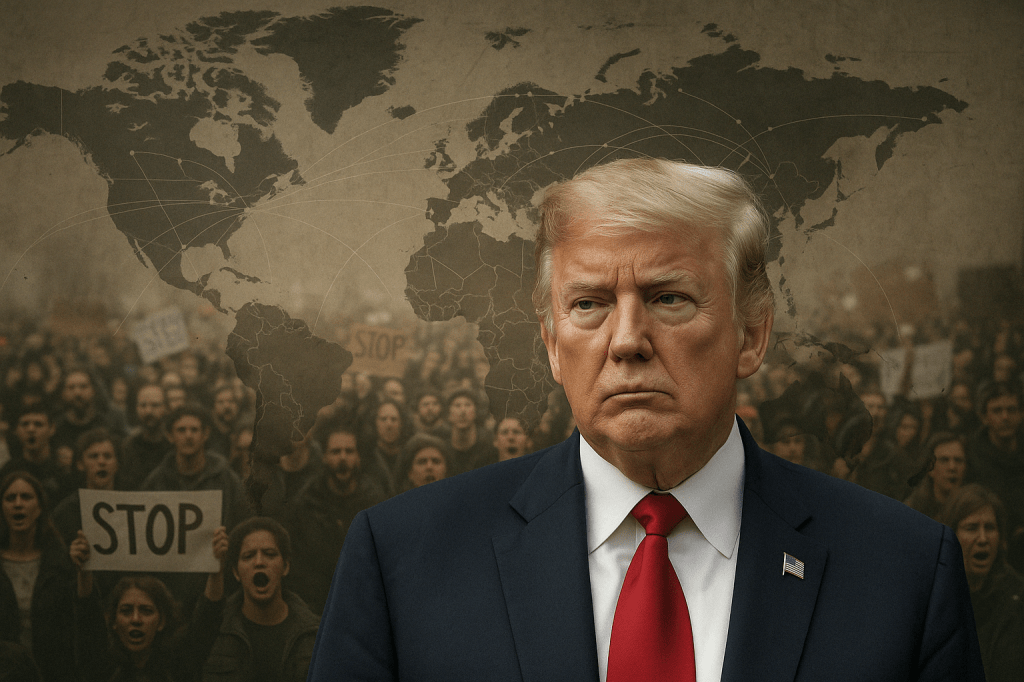
    President Trump comes to the NATO summit not as a stabilizing leader but as a disruptor. His position on the Russian invasion of Ukraine sharply differs from that of most European leaders. While many in Europe see Russia’s 2022 attack on Ukraine as unprovoked aggression, Trump has suggested that Ukraine “provoked” Russia—downplaying Moscow’s responsibility and treating both sides as equally culpable.

    This stance is deeply unsettling to countries like Poland, the Baltic states, and Romania. For them, NATO is more than diplomacy—it’s a protective shield. But under Trump’s view, that shield seems uncertain.

    Trump’s view of Vladimir Putin also contrasts sharply with NATO consensus. While European leaders regard Putin as a serious, long-term threat to European stability, Trump has described him in favorable terms—even amid allegations of war crimes. This isn’t just a difference in tone—it reflects a fundamentally different understanding of global threats.

    From Shared Values to Shared Costs

    At its core, Trump treats NATO less like a community of shared democratic values and more like a financial arrangement. His message has been blunt: pay more or risk losing protection. Although calls for higher European defense spending aren’t new, Trump frames the issue as a fee-for-service model—diminishing the alliance’s foundational spirit of mutual defense.

    This year’s summit is expected to focus heavily on Trump’s demand that allies commit 5% of GDP to defense. Some countries like Poland and the UK may support the idea, but many others find it politically and economically unfeasible, even coercive.

    Even more concerning is what won’t be addressed: there will likely be no new pledges to Ukraine or a clear plan to deal with Russia’s ongoing threats. That silence speaks volumes.

    A Shifting Balance of Power

    The summit may produce few policy breakthroughs, but it will make one reality painfully clear: the United States no longer leads NATO as it once did. Without U.S. leadership grounded in shared values, the alliance becomes more fragmented—less a united front, and more a group of nations with diverging priorities.

    Faced with this void, Europe is beginning to respond.

    Europe Steps Forward

    As the summit unfolds, European leaders are moving to create a more independent defense structure. France is taking the lead, with Germany showing increased support. Their goal: prepare for a future where Europe must defend itself—even without, or against, U.S. approval.

    Key elements of this shift include France’s nuclear arsenal, the EU’s Common Security and Defence Policy (CSDP), and joint defense projects through initiatives like PESCO. Once seen as symbolic, these are now gaining strategic importance.

    Eastern Europe is also adapting. Countries like Poland are ramping up defense spending and modernizing their forces. Nordic nations are working more closely together through regional groups like NORDEFCO and the Joint Expeditionary Force.

    A Prophetic Parallel

    This changing defense landscape may have more than political implications—it could carry prophetic weight. The Bible foretells a final resurrection of the Roman Empire, emerging from Europe shortly before the return of Jesus Christ. Scripture describes this end-time empire as a powerful beast—ruthless, dominant, and seemingly unstoppable: “Who is like the beast? Who is able to make war with him?” (Revelation 13:4).

    The weakening of NATO and the decline of U.S. leadership are not just political shifts—they are part of a larger prophetic pattern. A new European-centered power is rising, one that may dominate the global stage with strength and unity, even without—or in defiance of—American leadership.

  • Forged in Fire: How Europe Is Building Its Own Military Might Through Ukraine

    Forged in Fire: How Europe Is Building Its Own Military Might Through Ukraine

    The war in Ukraine is reshaping global alliances, military capabilities, and geopolitical expectations—but perhaps nowhere more profoundly than in Europe. While the United States continues to play an important role in Ukraine’s defense, its support under the Trump administration has become more measured, transactional, and at times uncertain. Into this vacuum has stepped a more assertive, rapidly maturing European military framework—one that is not just reacting to Russia, but preparing to stand on its own.

    From Steadfast Ally to Strategic Partner: The U.S. Shifts Gear

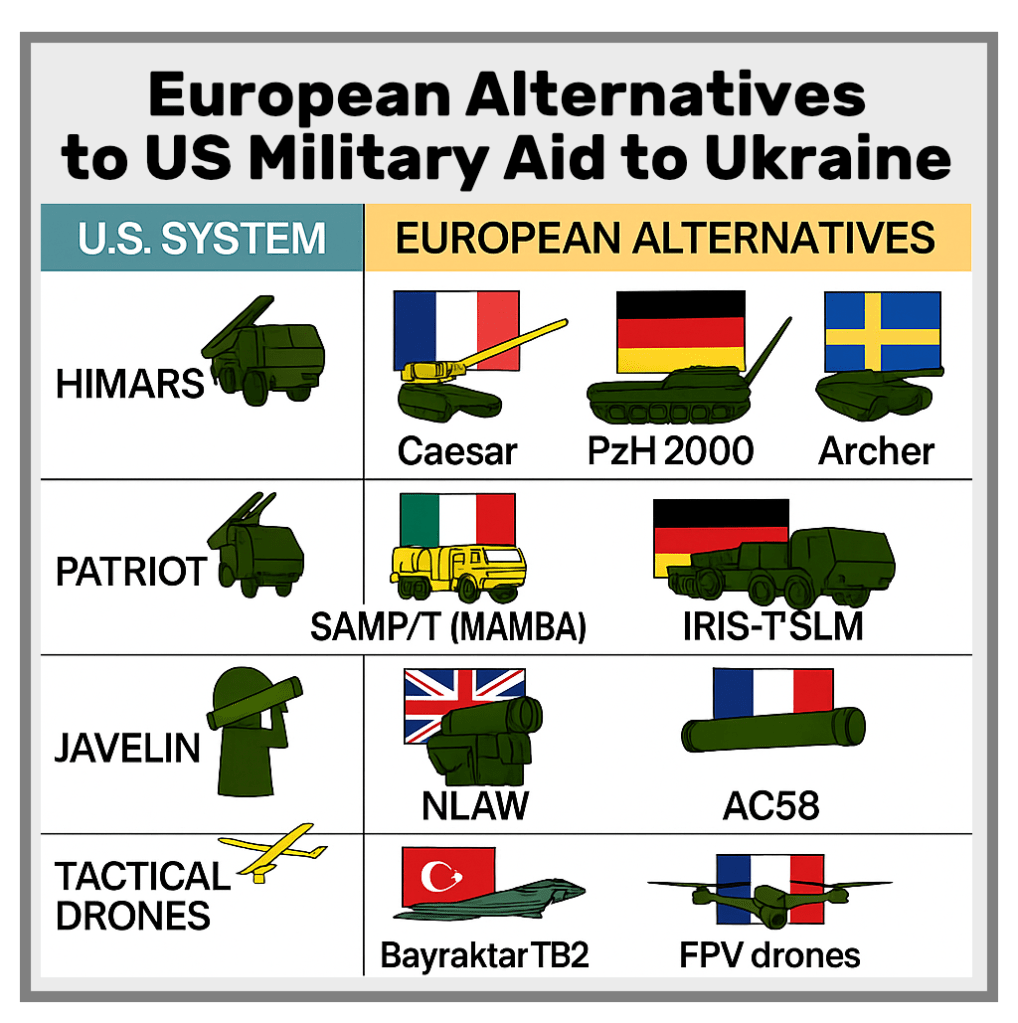
    Since 2022, the United States has supplied Ukraine with a formidable array of weapons, intelligence, and training. Systems like the HIMARS rocket launchers—short for High Mobility Artillery Rocket System, a highly mobile and precise long-range rocket artillery platform—Patriot missile defense batteries, Javelin anti-tank missiles, and real-time satellite surveillance have been game-changers on the battlefield. But since 2024, U.S. support has become increasingly conditional and strategically leveraged, with aid packages paused or tied to diplomatic objectives—such as ceasefire compliance or debt repayment proposals.

    This has caused anxiety in Kyiv and among NATO allies, highlighting the risks of over-reliance on a single, politically dynamic superpower. In response, Europe has not just filled the gap—it has transformed the challenge into an opportunity.

    Europe’s Arsenal Awakens: Compatible Yet Competitive

    European nations are rolling out a new generation of weapons systems—interoperable with NATO standards, but increasingly independent of U.S. designs.

    In the field of long-range precision artillery and rockets, Europe is deploying systems like the German PzH 2000, the French Caesar, the Swedish Archer, and a European variant of the Multiple Launch Rocket System (MLRS). These alternatives offer firepower and accuracy that rival the U.S. HIMARS, with rapid deployment capabilities and growing battlefield efficiency.

    In air defense, the European SAMP/T (Mamba)—short for Sol-Air Moyenne Portée/Terrestre, a medium-range surface-to-air missile system developed by France and Italy—Germany’s IRIS-T SLM—InfraRed Imaging System Tail/Surface Launched Medium-range, a cutting-edge ground-based air defense system—and the UK’s Sky Sabre are all emerging as powerful complements—and in some cases, future replacements—for the U.S. Patriot systems. These European systems are improving in range, reliability, and interoperability, proving effective in live combat scenarios.

    Anti-tank warfare is another area of parity. The British NLAW—short for Next generation Light Anti-tank Weapon, a shoulder-fired, disposable missile system designed for use by infantry against armored vehicles—and French Eryx are proving to be cost-effective, easily deployed, and tactically agile alternatives to the U.S. Javelin. Though Javelin still leads in range and target-lock capabilities, European systems are preferred in close-quarter operations.

    On the drone front, while the U.S. dominates with Switchblade and Phoenix Ghost drones, Europe—along with Türkiye—is catching up. The Bayraktar TB2—a medium-altitude, long-endurance unmanned combat aerial vehicle (UCAV) developed by Türkiye for reconnaissance and precision strikes—supplemented by rapid innovation in FPV (first-person view) drones—small, manually piloted drones equipped with cameras and often used as loitering munitions—along with loitering drone tech from Poland and Ukraine, shows Europe’s ability to adapt and mass-produce effective UAV solutions.

    Europe is also developing its own surveillance and battlefield coordination systems. France’s CERES—short for Capacité de Renseignement Électromagnétique Spatiale, a constellation of French military satellites for electronic intelligence—and the EU Satellite Centre are improving regional intelligence capabilities, although still not at par with U.S. global intelligence networks. Meanwhile, European C4I (Command, Control, Communications, Computers, and Intelligence) systems are being refined for NATO compatibility and AI-assisted command structures.

    These tools are not just theoretical—they are being live-tested on Ukrainian soil, under the harshest real-world conditions. Field results are feeding directly into Europe’s growing defense research, industrial production, and doctrine refinement.

    Learning the Russian Way of War: A Crash Course in Deterrence

    Beyond hardware, European forces are gaining unprecedented insight into Russian military doctrine and operational behavior:

    • Strengths: Effective use of artillery saturation, trench warfare, and electronic warfare (EW); increasing drone adaptability.
    • Weaknesses: Rigid command structure, poor logistics, morale problems, and ineffective air-ground coordination.

    European observers and trainers embedded with Ukrainian units have seen these dynamics up close, allowing them to adapt faster than in any traditional training scenario. In effect, the war has become a real-time strategic classroom.

    And this learning is being added on top of decades of exposure to U.S. military technology, tactics, and interoperability standards. The result is a fusion: a uniquely European doctrine that integrates NATO compatibility with localized resilience, battlefield adaptability, and self-reliance.

    A New European Military Order Emerges

    Europe is no longer merely a supporting actor in NATO—it is becoming a strategic force in its own right. This is evident in:

    • The €800 billion “ReArm Europe” initiative, pooling defense investment across the continent.
    • The Coalition of the Willing, a group of 30+ nations ready to back Ukraine with military and peacekeeping forces, regardless of Washington’s direction.
    • The EU Strategic Compass and PESCO (Permanent Structured Cooperation, a framework for EU member states to collaborate more closely on defense projects and initiatives) provide the backbone for long-term continental defense planning., providing the backbone for long-term continental defense planning.

    More significantly, these steps represent a strategic pivot: from transatlantic dependence to continental autonomy, with the potential to stand alone—not just against Russia, but any global threat.

    Europe as a Global Power

    From a biblical and prophetic standpoint, this development is particularly striking. The Bible speaks of a final world power rising out of Europe, described in the book of Daniel and the Revelation as a “beast” system of immense influence—politically, economically, and militarily.

    In that light, the consolidation of Europe’s military might—sparked by Russia’s war, accelerated by U.S. disengagement, and refined by real-world learning—takes on profound significance. What we are witnessing may well be the emergence of the military dimension of that prophesied power.

    A military that was once fractured, slow, and dependent is now becoming agile, well-informed, technically sophisticated, and integrated—not only in doctrine and equipment but in strategic vision.

    The Furnace That Forges

    As U.S. assistance to Ukraine becomes more measured and transactional, Europe has not only risen to meet the challenge—it is turning the war in Ukraine into the forge of a new military identity. What began as a stopgap has become a transformation.

    Europe is no longer just learning from the U.S.—it is learning from the enemy, innovating from within, and evolving into a deterrent force that could, one day, rival any military on Earth.

    The fire of war is forging Europe’s future—and with it, the world’s direction.

  • A Crisis of Confidence: America’s Waning Trust at Home and Abroad

    A Crisis of Confidence: America’s Waning Trust at Home and Abroad

    In recent months, the American public has witnessed a disturbing convergence: confidence in President Trump’s administration is slipping fast, and so too is the world’s faith in America’s leadership. What was once the most trusted economic and political power is now facing skepticism not only from its citizens but from traditional allies and partners across the globe. And while future elections may bring to office leaders with more polished diplomacy and less abrasive economic policies, the trajectory has already been set.

    America’s House Divided

    At home, President Trump’s sweeping tariffs, controversial government “efficiency” initiatives, and public messaging—often through his personal social media account—have triggered widespread concern. A recent wave of polling shows that a growing majority of Americans, particularly independent voters and moderates, now believe that his policies disproportionately benefit the ultra-wealthy at the expense of working families.

    Consumer sentiment has sharply declined. Inflation fears persist. Retirement portfolios have taken a hit due to market instability triggered by aggressive trade moves. Job insecurity looms as small businesses grapple with rising costs and an unpredictable regulatory climate.

    Even members of the President’s own party are uneasy. While Trump retains strong support from his core base, discontent is building among voters who feel increasingly alienated by policies that seem disconnected from their everyday struggles. The damage may not only cost Republican seats in the upcoming 2026 midterms—it could cast a long shadow over the political future of the party itself.

    Global Reverberations: The World Turns Away

    America’s trust problem doesn’t stop at its shores. Across Europe, Asia, and the Americas, traditional U.S. allies are quietly repositioning themselves. The trust that once undergirded decades of alliance-building is giving way to caution, skepticism, and contingency planning.

    • In Europe, nations like France and Germany are doubling down on strategic autonomy, investing in independent defense capabilities and economic blocs less reliant on Washington.
    • In Asia, countries such as Japan and South Korea are strengthening regional ties and trade networks, wary of American unpredictability.
    • In Canada and Mexico, recent U.S. trade barriers have fueled nationalist sentiment and accelerated diversification of export destinations.

    Even if American voters elect a more diplomatically-minded administration in the future, many foreign leaders will proceed with the assumption that U.S. foreign policy can shift dramatically every four years—because it already has, and likely will again.

    The world is preparing for a post-American order—one where America is just another actor in a multipolar stage, rather than the conductor of the global orchestra.

    The Long Tail of Miscalculation

    What does all this mean for ordinary Americans? It means that the consequences of current decisions will likely outlast the administration that made them.

    • Jobs: As trade relationships weaken, export-dependent industries could see layoffs and contraction.
    • Cost of Living: Higher tariffs mean higher prices for goods. Inflationary pressure could eat further into wages and savings.
    • Retirement: Market instability could continue to erode the value of retirement investments and long-term financial planning.
    • Entrepreneurship: The rising cost of doing business in an unstable trade environment will discourage innovation and risk-taking, especially among small- and medium-sized enterprises.

    This isn’t just about politics. It’s about livelihoods, futures, and the long-term credibility of the nation.

    A Spiritual Wake-Up Call

    But there is a deeper issue at play—one that cannot be solved by elections or economic adjustments. God is allowing the United States to reap what it has sown. A nation once known for upholding Judeo-Christian values is now visibly crumbling under the weight of self-interest, division, and moral confusion.

    Proverbs 14:34 (NKJV) says, “Righteousness exalts a nation, but sin is a reproach to any people.” America has forsaken sound Biblical principles in governance, economy, and culture. Now, it is beginning to experience the natural consequences: loss of respect, loss of trust, and closed doors of opportunity as global alliances take shape—without America at the table.

    Just as God warned ancient Israel through His prophets, the message for America is clear: “Return to Me.” The current economic and political upheaval is not merely the result of poor governance. It is a divine signal—a trumpet call to repentance, humility, and national course correction.

    The Decline of a Superpower

    As things stand now, the world is clearly transitioning into a post-American era. The signs are everywhere: reduced influence in multilateral forums, trade blocs forming without U.S. participation, allies hedging their bets, and voters at home feeling more uncertain about their future than ever before.

    This is not irreversible—but the window of opportunity is closing. The longer the nation delays its spiritual reckoning, the more severe the consequences may become.

    The future of America does not rest in new tariffs or clever policies. It rests in a return to truth, humility, and obedience to the God who once blessed it. Only then can the country begin to rebuild not just its economy—but its soul.

    (Note: The chart summarizing Pres. Trump’s net approval ratings were added to the post on April 26, 2025.)