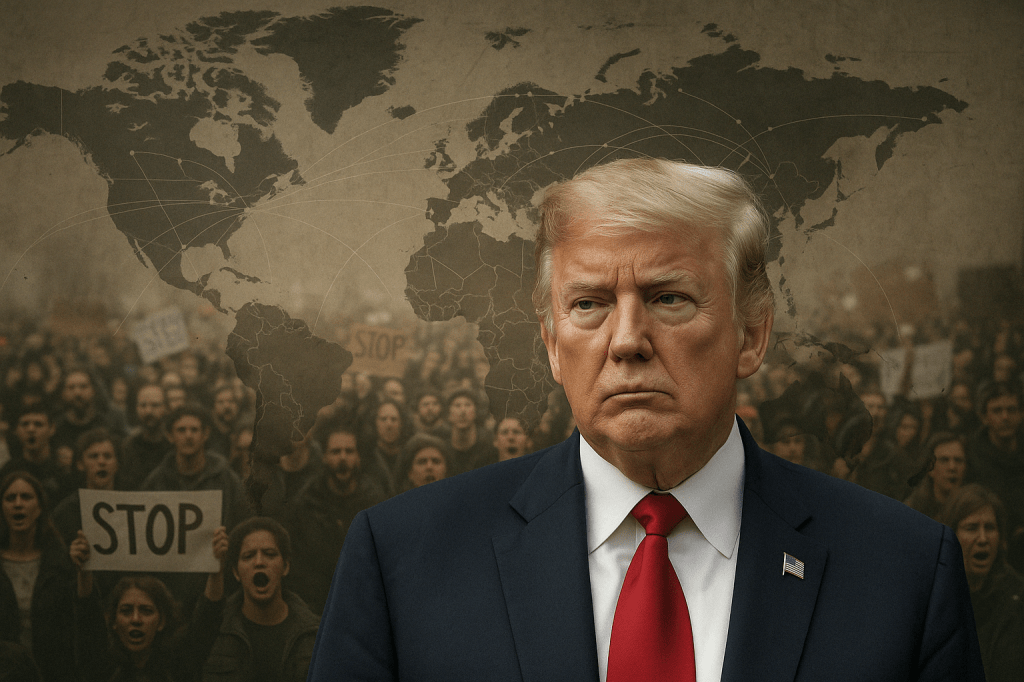
In recent months, the American public has witnessed a disturbing convergence: confidence in President Trump’s administration is slipping fast, and so too is the world’s faith in America’s leadership. What was once the most trusted economic and political power is now facing skepticism not only from its citizens but from traditional allies and partners across the globe. And while future elections may bring to office leaders with more polished diplomacy and less abrasive economic policies, the trajectory has already been set.
America’s House Divided
At home, President Trump’s sweeping tariffs, controversial government “efficiency” initiatives, and public messaging—often through his personal social media account—have triggered widespread concern. A recent wave of polling shows that a growing majority of Americans, particularly independent voters and moderates, now believe that his policies disproportionately benefit the ultra-wealthy at the expense of working families.
Consumer sentiment has sharply declined. Inflation fears persist. Retirement portfolios have taken a hit due to market instability triggered by aggressive trade moves. Job insecurity looms as small businesses grapple with rising costs and an unpredictable regulatory climate.
Even members of the President’s own party are uneasy. While Trump retains strong support from his core base, discontent is building among voters who feel increasingly alienated by policies that seem disconnected from their everyday struggles. The damage may not only cost Republican seats in the upcoming 2026 midterms—it could cast a long shadow over the political future of the party itself.

Global Reverberations: The World Turns Away
America’s trust problem doesn’t stop at its shores. Across Europe, Asia, and the Americas, traditional U.S. allies are quietly repositioning themselves. The trust that once undergirded decades of alliance-building is giving way to caution, skepticism, and contingency planning.
- In Europe, nations like France and Germany are doubling down on strategic autonomy, investing in independent defense capabilities and economic blocs less reliant on Washington.
- In Asia, countries such as Japan and South Korea are strengthening regional ties and trade networks, wary of American unpredictability.
- In Canada and Mexico, recent U.S. trade barriers have fueled nationalist sentiment and accelerated diversification of export destinations.
Even if American voters elect a more diplomatically-minded administration in the future, many foreign leaders will proceed with the assumption that U.S. foreign policy can shift dramatically every four years—because it already has, and likely will again.
The world is preparing for a post-American order—one where America is just another actor in a multipolar stage, rather than the conductor of the global orchestra.
The Long Tail of Miscalculation
What does all this mean for ordinary Americans? It means that the consequences of current decisions will likely outlast the administration that made them.
- Jobs: As trade relationships weaken, export-dependent industries could see layoffs and contraction.
- Cost of Living: Higher tariffs mean higher prices for goods. Inflationary pressure could eat further into wages and savings.
- Retirement: Market instability could continue to erode the value of retirement investments and long-term financial planning.
- Entrepreneurship: The rising cost of doing business in an unstable trade environment will discourage innovation and risk-taking, especially among small- and medium-sized enterprises.
This isn’t just about politics. It’s about livelihoods, futures, and the long-term credibility of the nation.
A Spiritual Wake-Up Call
But there is a deeper issue at play—one that cannot be solved by elections or economic adjustments. God is allowing the United States to reap what it has sown. A nation once known for upholding Judeo-Christian values is now visibly crumbling under the weight of self-interest, division, and moral confusion.
Proverbs 14:34 (NKJV) says, “Righteousness exalts a nation, but sin is a reproach to any people.” America has forsaken sound Biblical principles in governance, economy, and culture. Now, it is beginning to experience the natural consequences: loss of respect, loss of trust, and closed doors of opportunity as global alliances take shape—without America at the table.
Just as God warned ancient Israel through His prophets, the message for America is clear: “Return to Me.” The current economic and political upheaval is not merely the result of poor governance. It is a divine signal—a trumpet call to repentance, humility, and national course correction.
The Decline of a Superpower
As things stand now, the world is clearly transitioning into a post-American era. The signs are everywhere: reduced influence in multilateral forums, trade blocs forming without U.S. participation, allies hedging their bets, and voters at home feeling more uncertain about their future than ever before.
This is not irreversible—but the window of opportunity is closing. The longer the nation delays its spiritual reckoning, the more severe the consequences may become.
The future of America does not rest in new tariffs or clever policies. It rests in a return to truth, humility, and obedience to the God who once blessed it. Only then can the country begin to rebuild not just its economy—but its soul.
(Note: The chart summarizing Pres. Trump’s net approval ratings were added to the post on April 26, 2025.)
