Tag: war

  • A Glimmer of Hope: Trump, Zelensky, and the Long Road to Peace

    A Glimmer of Hope: Trump, Zelensky, and the Long Road to Peace

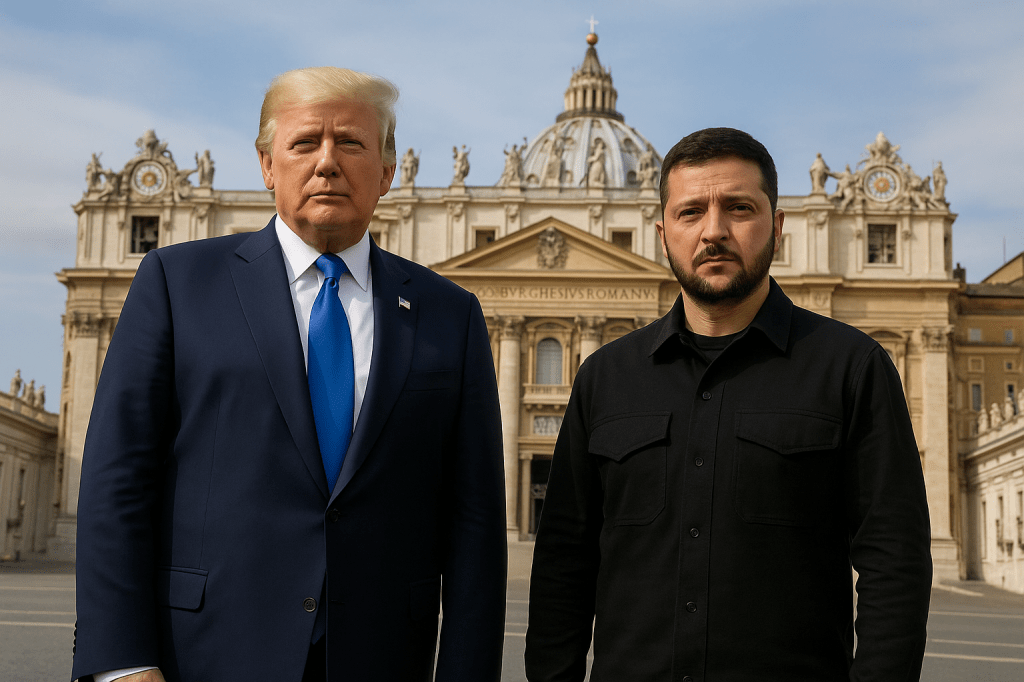
    At the sidelines of the funeral of Pope Francis, held at the Vatican — a setting deeply symbolic of hope, reconciliation, and peace — a private and significant meeting took place between Ukrainian President Volodymyr Zelensky and U.S. President Donald Trump. Although their conversation lasted only around fifteen minutes, it produced key developments that, if sustained, suggest a possible shift in tone regarding the ongoing Russia-Ukraine conflict. This meeting, in its timing and tone, could have lasting implications for Ukraine, Europe, and global peace efforts.

    Key Outcomes of the Meeting

    The Zelensky–Trump meeting achieved several notable outcomes that signal at least a partial change from previous U.S. positions:

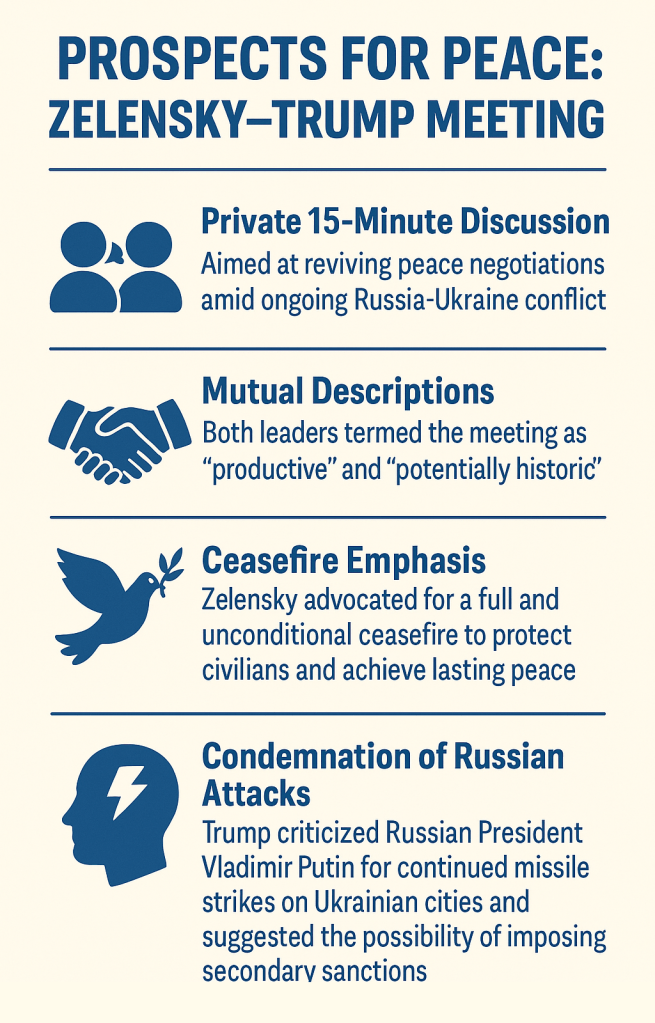
    • Private 15-Minute Discussion – The two leaders engaged in a brief but focused conversation aimed at reviving the stalled peace negotiations between Ukraine and Russia. Though details remain limited, both sides characterized the exchange as serious and constructive.
    • Mutual Praise of the Meeting – Afterward, both Trump and Zelensky described their discussion as “productive” and “potentially historic.” This mutual appreciation suggested a desire — at least rhetorically — to move beyond posturing and work toward real diplomatic progress.
    • Emphasis on the Need for a Ceasefire – President Zelensky strongly advocated for a full and unconditional ceasefire to protect Ukrainian civilians and prevent further devastation. Trump, echoing a similar concern, called for immediate steps to reduce violence on the ground, marking a notable rhetorical shift from earlier periods when he emphasized quick deals even at Ukraine’s potential expense.
    • Public Condemnation of Russia’s Attacks – For the first time in a significant international setting, Trump openly criticized Russia’s continued missile strikes on Ukrainian cities. He even hinted at the possibility of imposing secondary sanctions on Russia if hostilities escalated — a firmer line than he had taken during his previous administration.

    These outcomes suggest that while Trump’s overall strategy may not have fully changed, his tone and priorities appear to have evolved — at least in how he publicly frames the conflict.
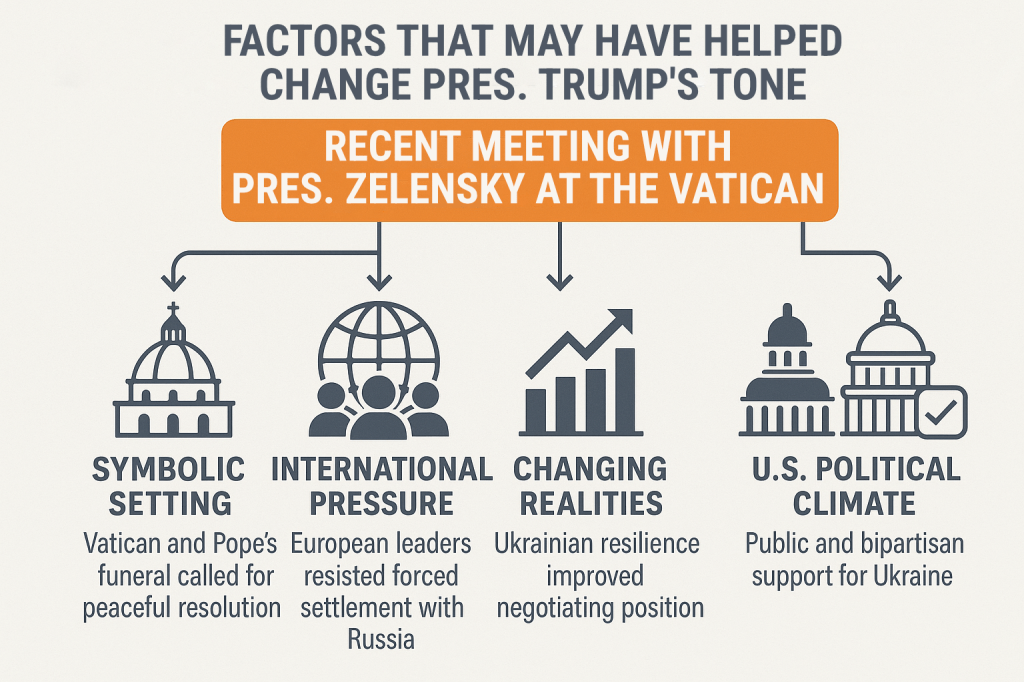
    Factors That Likely Changed President Trump’s Tone

    Several important forces likely contributed to this adjustment in Trump’s rhetoric and stance:

    • The Symbolic Setting of the Vatican – Meeting during Pope Francis’ funeral inevitably shaped the atmosphere. In a setting dedicated to peace, compassion, and global unity, it would have appeared callous and politically risky for Trump to project a transactional or overly hardline image.
    • International Diplomatic Pressure – Major European powers such as France, Germany, and the United Kingdom had already signaled strong opposition to any peace deal that legitimized Russia’s territorial gains. Trump’s administration would risk significant diplomatic isolation if it pushed for an unjust settlement.
    • Ukraine’s Battlefield Resilience – Ukraine’s ability to hold its ground against Russian aggression impressed even skeptical observers. Zelensky’s ability to represent a nation that refuses to surrender easily likely demanded a more respectful and serious response from Trump.
    • Growing Bipartisan U.S. Support for Ukraine – Both Democratic and Republican lawmakers have increasingly voiced support for Ukraine’s territorial integrity. With elections looming in 2026, Trump cannot afford to alienate a significant portion of the American electorate who sympathize with Ukraine’s struggle.
    • Trump’s Need to Reinforce a Statesmanlike Image – As he looks toward solidifying his legacy and future leadership reputation, Trump understands the value of being seen as a “peacemaker.” This meeting provided an opportunity to bolster that image on a global stage.

    Taken together, these factors likely combined to encourage Trump to moderate his tone and speak more seriously about a diplomatic path forward.
    Personal Values That Helped Soften Trump’s Tone

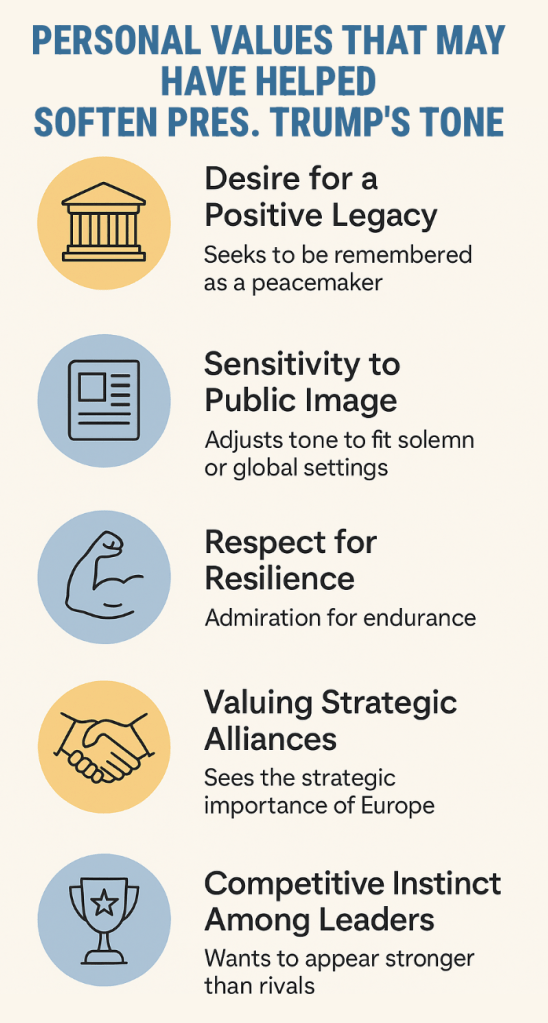
    Trump’s change in tone wasn’t merely a result of external pressures. Some of his core personal values may also have played a role:

    • Desire for a Legacy of Peace – Trump is deeply concerned about how history will remember him. Securing peace between Ukraine and Russia could be a monumental achievement that cements his place among world leaders who brokered significant peace deals.
    • Sensitivity to Public Image – Trump’s acute awareness of how he is portrayed in the media likely made him realize that appearing compassionate, especially at the Vatican, would play well both internationally and domestically.
    • Respect for Strength and Resilience – Trump’s admiration for strength — whether in individuals, businesses, or nations — likely drew a measure of respect for Ukraine’s unwavering resistance against a much larger military power.
    • Transactional View of Alliances – Trump sees international relationships through the lens of mutual benefit. He understands that maintaining strong European alliances is crucial for America’s broader strategic interests.
    • Competitive Instinct Against World Leaders – Trump views global politics as a contest among strong personalities. His evolving criticism of Putin may not only reflect strategic calculation but also a desire to appear tougher and more effective than the Russian leader.

    These personal values — particularly the desire for a positive legacy and respect for strength — could later motivate Trump to adjust even further on the more contentious areas of the peace negotiations.
    Remaining Areas of Difference

    Despite the softened tone, serious divergences remain between the U.S. and Ukraine’s vision of peace:

    • Recognition of Crimea as Russian Territory – Reports indicate that Trump is still inclined to propose recognizing Russia’s annexation of Crimea — a move Ukraine and nearly all of Europe categorically reject. For Ukraine, such recognition would legitimize illegal aggression and set a dangerous precedent.
    • Permanent Exclusion of Ukraine from NATO Membership – Trump has also suggested that Ukraine should be permanently barred from NATO as part of any settlement. This would leave Ukraine vulnerable to future Russian attacks and could embolden other aggressors worldwide.

    If these areas are not resolved, any peace agreement would be fragile at best — and future conflicts almost inevitable.

    What Could Change Trump’s Mind

    Several dynamics could influence Trump to reconsider these positions:

    • Continued Ukrainian Military Gains – If Ukraine demonstrates continued success on the battlefield, the political cost of asking them to surrender land will become much higher.
    • Strong Legislative and Public Pressure in the U.S. – If Congress ties military aid and diplomatic support to maintaining Ukraine’s sovereignty — and if public opinion stays firmly with Ukraine — Trump will find it harder to push controversial concessions.
    • European Unity and Toughness – A united European stance could make any plan involving territorial compromise diplomatically and economically costly for the U.S.
    • Legacy Motivations – Trump’s desire to be remembered as a historic peacemaker could drive him to accept more principled, lasting solutions, rather than quick political victories.

    Thus, personal ambition for a noble legacy could actually help steer Trump toward better, fairer peace terms.

    How Putin Might React

    Russian President Vladimir Putin is unlikely to ignore these developments:

    • Potential Escalation – If Putin senses that the U.S. position is hardening, he may attempt to escalate militarily to force a settlement while he still holds significant ground.
    • Undermining Trump’s Credibility – Russia’s information networks might try to discredit Trump if they believe he is drifting too far from their strategic goals.
    • Increased Diplomatic Pressure on Ukraine – Expect Moscow to step up efforts to intimidate Ukraine into accepting unfavorable terms before U.S. policy hardens further.

    In short, Russia is likely to respond aggressively, viewing a tougher Trump as a threat to their long-term objectives.

    The Bigger Picture

    Even if a ceasefire is achieved, true and lasting peace will not come merely through negotiations. 

    What is needed is a profound change in the hearts and values of leaders and nations:

    • Leaders must focus on justice and dignity over power and conquest.
    • Nations must seek cooperation and fairness instead of exploitation and fear.
    • Alliances must be built not just on interest, but on principles of mutual respect.

    The Bible points us to a future beyond the broken leadership of today. 

    When Christ returns, He will establish a government where “nation shall not lift up sword against nation, neither shall they learn war anymore” (Micah 4:3).

    Under His perfect reign, there will be no more aggressors and no more victims. 

    Bigger nations will no longer oppress smaller ones. Great powers will no longer fear or threaten one another. True, lasting peace will fill the earth — a peace built on justice, love, and eternal strength.

    Cautious Optimism

    The Vatican meeting between Trump and Zelensky offers a rare moment of cautious optimism. 

    But real peace will require more than changed strategies — it will require changed values. 

    Until the Kingdom of God is established on earth, peace among nations will remain fragile. But every step toward justice, compassion, and respect today is a small glimpse of the greater peace that is yet to come.

  • Trump’s Peace Proposal for Ukraine: A Deal Doomed by Diverging Values

    Trump’s Peace Proposal for Ukraine: A Deal Doomed by Diverging Values

    As the war in Ukraine grinds on, U.S. President Donald Trump has unveiled a controversial peace proposal aimed at ending the conflict. His plan includes recognition of Russia’s annexation of Crimea, acceptance of Russian control over other occupied Ukrainian territories, a permanent block on Ukraine joining NATO, and the lifting of Western sanctions on Russia. The goal, Trump argues, is to “stop the killing” and restore stability.

    But peace at this price is proving unacceptable—not just to Ukraine, but to much of Europe.

    Why Ukraine Won’t Accept It

    Ukrainian President Volodymyr Zelensky has remained firm: Crimea and the occupied territories are sovereign Ukrainian land. To accept this deal would violate Ukraine’s constitution, dishonor the memory of its fallen defenders, and reward aggression. As Zelensky bluntly put it, “This is our territory, the territory of the people of Ukraine.” No peace can be built on a foundation of surrender and injustice.

    Why Europe Is Alarmed

    European leaders are also rejecting the Trump plan. To them, it’s not peace—it’s appeasement. Recognizing territorial conquest sets a dangerous precedent in a continent scarred by war. EU officials warn that such a deal could “kill EU unity,” weaken NATO, and embolden future acts of aggression. By sidelining European voices and values, the proposal risks fracturing the Western alliance.

    A World Without Shared Values

    Trump’s plan, if implemented, will not produce peace. It will shift global dynamics. Europe is already moving toward greater strategic autonomy—asserting itself more forcefully in defense and diplomacy. The U.S., meanwhile, is at risk of forfeiting its global leadership—not due to a lack of military power, but from a growing disconnect with the moral compass of its democratic allies.

    The Bible reminds us, “Can two walk together unless they are agreed?” (Amos 3:3). True peace, like true partnership, requires shared values—not just shared interests. Trump’s peace deal fails that test. And the world is watching.

  • Forged in Fire: How Europe Is Building Its Own Military Might Through Ukraine

    Forged in Fire: How Europe Is Building Its Own Military Might Through Ukraine

    The war in Ukraine is reshaping global alliances, military capabilities, and geopolitical expectations—but perhaps nowhere more profoundly than in Europe. While the United States continues to play an important role in Ukraine’s defense, its support under the Trump administration has become more measured, transactional, and at times uncertain. Into this vacuum has stepped a more assertive, rapidly maturing European military framework—one that is not just reacting to Russia, but preparing to stand on its own.

    From Steadfast Ally to Strategic Partner: The U.S. Shifts Gear

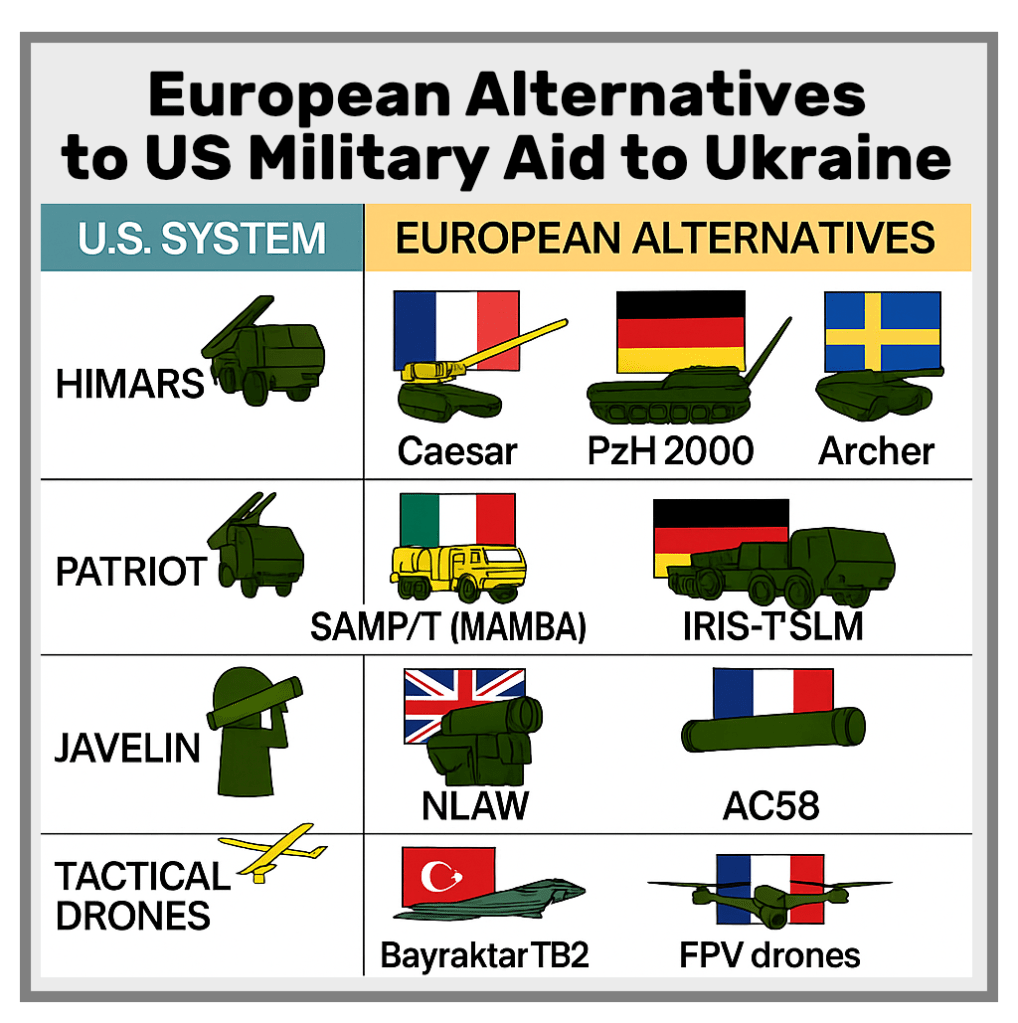
    Since 2022, the United States has supplied Ukraine with a formidable array of weapons, intelligence, and training. Systems like the HIMARS rocket launchers—short for High Mobility Artillery Rocket System, a highly mobile and precise long-range rocket artillery platform—Patriot missile defense batteries, Javelin anti-tank missiles, and real-time satellite surveillance have been game-changers on the battlefield. But since 2024, U.S. support has become increasingly conditional and strategically leveraged, with aid packages paused or tied to diplomatic objectives—such as ceasefire compliance or debt repayment proposals.

    This has caused anxiety in Kyiv and among NATO allies, highlighting the risks of over-reliance on a single, politically dynamic superpower. In response, Europe has not just filled the gap—it has transformed the challenge into an opportunity.

    Europe’s Arsenal Awakens: Compatible Yet Competitive

    European nations are rolling out a new generation of weapons systems—interoperable with NATO standards, but increasingly independent of U.S. designs.

    In the field of long-range precision artillery and rockets, Europe is deploying systems like the German PzH 2000, the French Caesar, the Swedish Archer, and a European variant of the Multiple Launch Rocket System (MLRS). These alternatives offer firepower and accuracy that rival the U.S. HIMARS, with rapid deployment capabilities and growing battlefield efficiency.

    In air defense, the European SAMP/T (Mamba)—short for Sol-Air Moyenne Portée/Terrestre, a medium-range surface-to-air missile system developed by France and Italy—Germany’s IRIS-T SLM—InfraRed Imaging System Tail/Surface Launched Medium-range, a cutting-edge ground-based air defense system—and the UK’s Sky Sabre are all emerging as powerful complements—and in some cases, future replacements—for the U.S. Patriot systems. These European systems are improving in range, reliability, and interoperability, proving effective in live combat scenarios.

    Anti-tank warfare is another area of parity. The British NLAW—short for Next generation Light Anti-tank Weapon, a shoulder-fired, disposable missile system designed for use by infantry against armored vehicles—and French Eryx are proving to be cost-effective, easily deployed, and tactically agile alternatives to the U.S. Javelin. Though Javelin still leads in range and target-lock capabilities, European systems are preferred in close-quarter operations.

    On the drone front, while the U.S. dominates with Switchblade and Phoenix Ghost drones, Europe—along with Türkiye—is catching up. The Bayraktar TB2—a medium-altitude, long-endurance unmanned combat aerial vehicle (UCAV) developed by Türkiye for reconnaissance and precision strikes—supplemented by rapid innovation in FPV (first-person view) drones—small, manually piloted drones equipped with cameras and often used as loitering munitions—along with loitering drone tech from Poland and Ukraine, shows Europe’s ability to adapt and mass-produce effective UAV solutions.

    Europe is also developing its own surveillance and battlefield coordination systems. France’s CERES—short for Capacité de Renseignement Électromagnétique Spatiale, a constellation of French military satellites for electronic intelligence—and the EU Satellite Centre are improving regional intelligence capabilities, although still not at par with U.S. global intelligence networks. Meanwhile, European C4I (Command, Control, Communications, Computers, and Intelligence) systems are being refined for NATO compatibility and AI-assisted command structures.

    These tools are not just theoretical—they are being live-tested on Ukrainian soil, under the harshest real-world conditions. Field results are feeding directly into Europe’s growing defense research, industrial production, and doctrine refinement.

    Learning the Russian Way of War: A Crash Course in Deterrence

    Beyond hardware, European forces are gaining unprecedented insight into Russian military doctrine and operational behavior:

    • Strengths: Effective use of artillery saturation, trench warfare, and electronic warfare (EW); increasing drone adaptability.
    • Weaknesses: Rigid command structure, poor logistics, morale problems, and ineffective air-ground coordination.

    European observers and trainers embedded with Ukrainian units have seen these dynamics up close, allowing them to adapt faster than in any traditional training scenario. In effect, the war has become a real-time strategic classroom.

    And this learning is being added on top of decades of exposure to U.S. military technology, tactics, and interoperability standards. The result is a fusion: a uniquely European doctrine that integrates NATO compatibility with localized resilience, battlefield adaptability, and self-reliance.

    A New European Military Order Emerges

    Europe is no longer merely a supporting actor in NATO—it is becoming a strategic force in its own right. This is evident in:

    • The €800 billion “ReArm Europe” initiative, pooling defense investment across the continent.
    • The Coalition of the Willing, a group of 30+ nations ready to back Ukraine with military and peacekeeping forces, regardless of Washington’s direction.
    • The EU Strategic Compass and PESCO (Permanent Structured Cooperation, a framework for EU member states to collaborate more closely on defense projects and initiatives) provide the backbone for long-term continental defense planning., providing the backbone for long-term continental defense planning.

    More significantly, these steps represent a strategic pivot: from transatlantic dependence to continental autonomy, with the potential to stand alone—not just against Russia, but any global threat.

    Europe as a Global Power

    From a biblical and prophetic standpoint, this development is particularly striking. The Bible speaks of a final world power rising out of Europe, described in the book of Daniel and the Revelation as a “beast” system of immense influence—politically, economically, and militarily.

    In that light, the consolidation of Europe’s military might—sparked by Russia’s war, accelerated by U.S. disengagement, and refined by real-world learning—takes on profound significance. What we are witnessing may well be the emergence of the military dimension of that prophesied power.

    A military that was once fractured, slow, and dependent is now becoming agile, well-informed, technically sophisticated, and integrated—not only in doctrine and equipment but in strategic vision.

    The Furnace That Forges

    As U.S. assistance to Ukraine becomes more measured and transactional, Europe has not only risen to meet the challenge—it is turning the war in Ukraine into the forge of a new military identity. What began as a stopgap has become a transformation.

    Europe is no longer just learning from the U.S.—it is learning from the enemy, innovating from within, and evolving into a deterrent force that could, one day, rival any military on Earth.

    The fire of war is forging Europe’s future—and with it, the world’s direction.

  • The “Freeloader” Fallacy and the Unraveling of the World America Built

    The “Freeloader” Fallacy and the Unraveling of the World America Built

    In recent years, voices from within the United States—most prominently in the current administration of President Donald Trump—have labeled America’s European allies as “freeloaders.” This sentiment, recently reinforced by leaked chats from senior U.S. defense officials, suggests that the U.S. is unfairly burdened by its role as the world’s security guarantor, while allies reap the benefits without paying their fair share.

    But this view, while emotionally resonant in a time of rising nationalism and budget pressures, fails to recognize a deeper historical truth: the so-called “freeloading” arrangement was designed by the United States itself after World War II.

    America’s Strategic Design After World War II

    When the dust of WWII settled, the United States stood as the dominant power in a shattered world. Europe lay in ruins. Germany, the nation that had ignited two world wars, was disarmed and divided. The Soviet Union, though an ally during the war, quickly emerged as a global ideological and military threat, expanding its grip over Eastern Europe and seeking to export communism globally.

    To prevent a third world war—and to contain the spread of Soviet communism—the U.S. devised a grand strategy. It would serve as a global security umbrella, deploying its vast military and nuclear power to deter aggression in both Europe and Asia.

    But this security guarantee came with conditions.

    Why the U.S. Took on the Burden

    In Europe, the U.S. created NATO in 1949, a collective defense alliance that essentially declared: “If the Soviets invade, America will respond.” This meant stationing tens of thousands of troops in Germany and elsewhere—not to dominate Europe, but to protect it, while also ensuring that Germany would never again re-arm on its own and potentially start another global war.

    The U.S. didn’t stop in Europe. In Asia, the United States went even further: it wrote Japan’s post-war constitution, explicitly forbidding it from maintaining offensive military forces. In exchange, the U.S. promised to defend Japan from any external threats. This kept the peace in the Pacific and ensured that Japan, once an imperial power, would remain a pacifist state under American protection.

    Aside from maintaining military presence in various points around the globe, this also meant that the U.S. Navy would patrol the world’s oceans and major trade routes, ensuring they remained open and secure for international commerce. This naval presence guaranteed that goods, products, energy supplies, and even people could travel safely across seas and continents, under the protection of a rules-based order that the U.S. enforced. In effect, the United States became the maritime guardian of global trade, allowing the modern economy to flourish.

    The Global Bargain

    What did America get in return?

    Quite a lot.

    These countries, under the U.S. defense umbrella, pledged to:

    • Side with the United States in the ideological and military contest of the Cold War. 
    • Maintain for the most part (or at least at the surface) democratic forms of governance, compatible with American values and institutions. 
    • Participate in a global economic system centered on free trade, the U.S. dollar, and open access to American markets, capital, and technology. 

    This arrangement created decades of global stability, fueled unprecedented economic growth, and cemented America’s leadership role in the world. Allies didn’t have to spend massive portions of their GDP on defense, because America did it for them—intentionally, and as a strategic choice.

    But this system also worked immensely in America’s favor:

    • It helped defeat the former Soviet Union.
    • It generated vast wealth for the United States.
    • It gave America access to the natural resources, talent, savings, and investments of allied nations.
    • It kept the U.S. economy resilient, allowing it to absorb shocks during oil crises, recessions, and financial collapses because the global economy was effectively built around it.

    This wasn’t just charity. It was a mutually beneficial arrangement that secured the U.S. economy and reinforced its global dominance across finance, technology, and military affairs.

    The Trump Doctrine and the Unraveling Order

    Enter the 21st century, and with it, growing discontent. Successive U.S. administrations urged allies to increase defense spending, but President Trump went further—publicly ridiculing NATO partners, questioning America’s commitment to mutual defense, and suggesting that the U.S. might not come to their aid.

    The recent leaks of U.S. defense officials calling allies “freeloaders” is not new rhetoric—it is the continuation of a growing American retrenchment from the very system it built. This shift is not just about burden-sharing; it’s about dismantling a world order that was held together by American security guarantees and economic leadership.

    And the consequences are enormous.

    As America pulls back:

    • Germany is rearming—a move unthinkable just a decade ago.
    • Japan is building new missile capabilities, breaking with its pacifist tradition.
    • France and others are openly discussing European “strategic autonomy,” no longer counting on U.S. support.

    The global system is fragmenting. Old alliances are fraying, and new coalitions may rise—not because of shared values, but based on shared interests, geography, or ethnicity. The future could very well be a world of competing blocs, exclusive clubs, and permanent insecurity.

    A Nation in Decline—By God’s Hand

    It is tempting to see all this purely through the lens of geopolitics. But for those who understand biblical prophecy, something deeper is taking place.

    America’s decline is not merely the result of policy decisions or shifting public opinion—it is a judgment from God.

    “My people are destroyed for lack of knowledge. Because you have rejected knowledge, I also will reject you… I will change their glory into shame.”  (Hosea 4:6–7)

    God blessed America with power, influence, and prosperity—but as the nation increasingly turns from Him, He is taking away its leadership role, allowing other powers to rise in its place. Whether those nations will be friendly or adversarial remains to be seen—but they will not uphold the same values or provide the same guarantees.

    What we are witnessing is not just the collapse of a U.S.-led global system. We are witnessing a divine reshaping of the world order, as foretold in Scripture.

  • The Illusion of Peace: What Trump’s Ceasefire Means for Ukraine

    The Illusion of Peace: What Trump’s Ceasefire Means for Ukraine

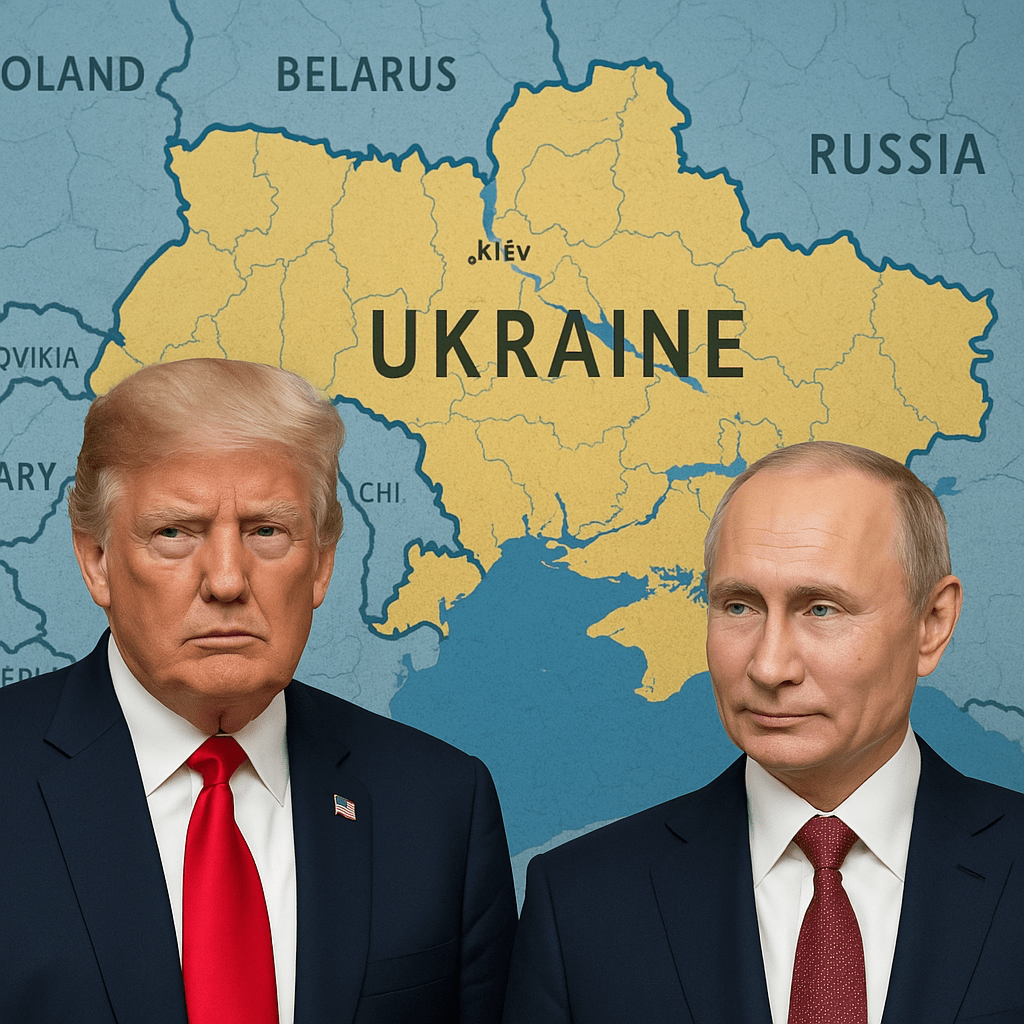
    The world watched closely as U.S. President Donald Trump and Russian President Vladimir Putin announced a series of agreements aimed at de-escalating the ongoing war in Ukraine. These agreements, however, appear to be stopgap measures rather than a genuine step toward lasting peace. While the immediate effect includes a 30-day halt to attacks on energy infrastructure and a prisoner exchange, there is little to suggest that these deals will prevent further bloodshed in the long run.

    A Ceasefire, But Not a Resolution

    Among the key points agreed upon in the Trump-Putin discussions were:

    • A 30-day ceasefire specifically focused on stopping strikes against Ukraine’s energy infrastructure.
    • A prisoner exchange, with both sides agreeing to release a set number of captives, including injured Ukrainian soldiers.
    • Technical discussions regarding a maritime ceasefire in the Black Sea and potential future negotiations to settle the broader conflict.

    Notably, Ukraine was not invited to participate in these negotiations. By excluding Ukraine from talks about its own future, Putin and Trump reinforced a troubling narrative: that Ukraine is merely a pawn in a larger ideological and geopolitical struggle between Russia and the West. This exclusion sends a dangerous message—that the future of sovereign nations can be determined by the world’s superpowers without their input or consent.

    A Temporary Reprieve Before the Next Assault?

    Russia has already demonstrated a pattern of using ceasefires to regroup and prepare for further military actions. The fact that Putin declined a broader ceasefire proposal suggests that his commitment to peace is, at best, conditional. History shows us that Russian military strategy often involves lulls in fighting to reorganize and strengthen its forces.

    For Ukraine, this means that while a brief respite from targeted infrastructure attacks may provide some relief, the fundamental threat remains unchanged. Without its direct involvement in the negotiations, Ukraine has no guarantee that the war will not intensify once this temporary agreement expires.

    Man’s Illusion of Peace

    As history has repeatedly shown, mankind is incapable of achieving real and lasting peace apart from God. The fragile agreements between Trump and Putin are a testament to this reality. The Bible warns us of this in Isaiah 59:8, which states,

    “The way of peace they do not know; there is no justice in their paths.”

    Time and again, leaders have sought to craft peace through negotiations, ceasefires, and treaties—only for those agreements to collapse under the weight of human ambition, deception, and self-interest.

    This pattern has played out throughout history:

    • The Treaty of Versailles ended World War I, only for World War II to erupt two decades later.
    • The Cold War ended with the collapse of the Soviet Union, yet conflicts between Russia and the West continue in various forms.
    • The Abraham Accords promised stability in the Middle East, yet war still persists between Israel and its adversaries.

    The so-called “peace” of this world is nothing more than a pause before the next war. Human history is a testament to the inability of man to secure true peace through diplomacy alone. The apostle Paul warned of this when he wrote in 1 Thessalonians 5:3,

    “For when they say, ‘Peace and safety!’ then sudden destruction comes upon them.”

    This verse perfectly describes the situation unfolding in Ukraine—leaders proclaiming peace while the storm clouds of war still loom on the horizon.

    The True Path to Lasting Peace

    The Bible makes it clear that genuine peace will only come with the return of Jesus Christ. Isaiah 2:4 tells us of a future time when Christ will establish true peace:

    “He shall judge between the nations, and shall rebuke many people; they shall beat their swords into plowshares, and their spears into pruning hooks; nation shall not lift up sword against nation, neither shall they learn war anymore.”

    This vision stands in stark contrast to the fleeting and fragile agreements of world leaders today. The peace of this world is temporary, riddled with compromises that fail to address the root causes of conflict. True peace will not come through human agreements but through the reign of Jesus Christ, who will establish righteousness, justice, and lasting harmony among nations.

    A World Awaiting True Peace

    The Trump-Putin agreements are yet another example of mankind’s inability to secure enduring peace. While they may provide temporary relief, they do not address the deeper issues fueling the conflict. As long as nations continue to rely on their own wisdom rather than seeking the guidance of God, wars and conflicts will persist.

    The world yearns for peace, but it will not find it through diplomatic maneuvering, fragile treaties, or political posturing. It will only come when the Prince of Peace establishes His Kingdom. Until then, mankind will continue to produce nothing more than temporary pauses before the next war.